2000 BMW 540I SEDAN lock
[x] Cancel search: lockPage 130 of 217
130n
Brake system Winter operationBrake fluid level
The warning lamp for the brake
hydraulic system comes on, or
the "CHECK BRAKE FLUID"
message appears in the Check
Control.
The brake fluid level is too low in the
reservoir (refer to page 152).
If the brake fluid level is too low and
brake pedal travel has become notice-
ably longer, there may be a defect in
one of the brake system's hydraulic
circuits.
Proceed to the nearest authorized
BMW center. Higher brake appli-
cation pressure may be necessary
under these conditions, and brake
pedal travel may be significantly longer.
Please remember to adapt your driving
style accordingly.<
The warning lamp comes on together
with the "CHECK BRAKE PADS" mes-
sage in the Check Control.
Brake pads
The warning lamp for the brake
pads comes on, or the "CHECK
BRAKE PADS" message ap-
pears in the Check Control:
The brake pads have reached their
minimum pad thickness. Proceed to the
nearest authorized BMW center as
soon as possible to have the pads
replaced.
For your own safety: Use only
brake pads that BMW has
approved for your specific vehicle
model. BMW cannot evaluate non-
approved brake pads to determine if
they are suited for use, and therefore
cannot ensure the operating safety of
the vehicle if they are installed.<
The onset of winter is often accompa-
nied by rapid changes in weather.
Adaptations in driving style should be
accompanied by preparations on the
vehicle itself to ensure that your vehicle
operation through the winter remains
safe and trouble-free.CoolantEnsure that the coolant mixture con-
tains the year-round ratio of 50: 50 of
water and antifreeze/corrosion protec-
tion. This mixture provides protection
against freezing down to approx. -347
(-376). Replace the coolant every four
years.LocksBMW door lock deicer can be used to
free the locks if they are frozen. This
deicer also contains lubricant.
After using deicer, treatment with BMW
lock barrel grease is recommended.
Page 131 of 217

131n
RepairsIndexOverview Controls Car care Technology Data
Winter operationRubber seals and components In order to prevent the weather-strip-
ping from freezing, apply BMW rubber
treatment or silicone spray to the seals
on the doors, hood and luggage com-
partment lid/tailgate.
A full range of car-care products is
available from your BMW center.< Snow chainsBMW snow chains
* can be mounted on
both summer and winter tires. Mount
them in pairs on the rear wheels only
and comply with the manufacturer's
safety precautions. Do not exceed a
maximum speed of 30 mph (50 km/h).
For maximum traction, we recommend
that you manually deactivate the
ASC+T/DSC
* when driving with snow
chains mounted. Refer to page 91.
Starting offWe recommend that you use the man-
ual control switch to deactivate ASC+T/
DSC
* when starting off in deep snow or
when rocking the car to free it (refer to
page 91).
Driving on low-traction road
surfacesUse smooth, gentle pressure to control
the accelerator pedal. Avoid excessive
engine speeds and shift to the next
higher gear at an early point. Adapt
your speed and driving style when ap-
proaching grades or slopes. Maintain
an adequate distance between yourself
and the car ahead.BrakesWinter road conditions substantially
reduce the amount of traction available
between the tires and the road surface.
The resulting increases in braking dis-
tance are considerable and should be
kept in mind at all times.
ABS is intended to prevent the wheels
from locking during brake applications,
thus helping to maintain vehicle stability
and steering response. If the ABS does not respond in a critical
braking situation and the wheels lock:
Reduce the pressure on the brake
pedal until the wheels just start to roll
again while still maintaining enough
force to continue braking.
Following that, increase pedal pressure
again. Reduce the pressure as the
wheels lock, then reapply pressure.
Repeat this procedure. This type of
staggered braking will reduce the brak-
ing distance, and the vehicle still re-
mains responsive to steering.
You can then attempt to steer around
hazards after you have reduced pres-
sure on the brake pedal.
Do not shift down on slick road
surfaces. Doing so could cause
the rear wheels to lose traction and
skid, which could result in the loss of
vehicle control.<
Depress the clutch during hard
braking on road surfaces which
provide only poor or uneven traction.<
Page 132 of 217

132n
Winter operation Power steering Level control system
*
Skid controlRelease the accelerator pedal and
depress the clutch pedal. Countersteer
carefully and attempt to regain control
of the vehicle.ParkingEngage 1st or reverse gear. If your car
is equipped with an automatic transmis-
sion, place the selector lever in "Park."
On vehicles with manual transmission,
also apply the parking brake when
parking on inclined surfaces. In order to
prevent the parking brake linings from
locking due to frost or corrosion, dry
them by gently applying the parking
brake as the vehicle is coming to a
stop. Make sure that following traffic is
not endangered.
The brake lamps do not come on
when the parking brake is
applied.<
If there is a change in steering behavior,
for instance greater steering effort or if
steering becomes lighter as speed
increases in vehicles equipped with
Servotronic
*:
Contact your BMW center immediately
for an inspection.
If the power steering fails,
increased effort will be required
to steer the vehicle.<
The warning lamp for the level
control system comes on, or the
message "LEVEL CONTROL
INACTIVE" appears in the Check Con-
trol: There is a malfunction in the level
control system.
Stop and inspect the vehicle. If it is
riding significantly lower in the rear than
in the front, or if it is sitting at an incline
(left rear compared to right rear),
consult the nearest authorized BMW
center. Drive with appropriate caution
in the meantime. The vehicle has
reduced ground clearance or driving
comfort is noticeably reduced.
Even if the attitude of the vehicle is
normal, you should consult the nearest
authorized BMW center if the warning
lamp indicates a system fault.
Page 143 of 217
143n
RepairsIndexOverview Controls Car care Technology Data
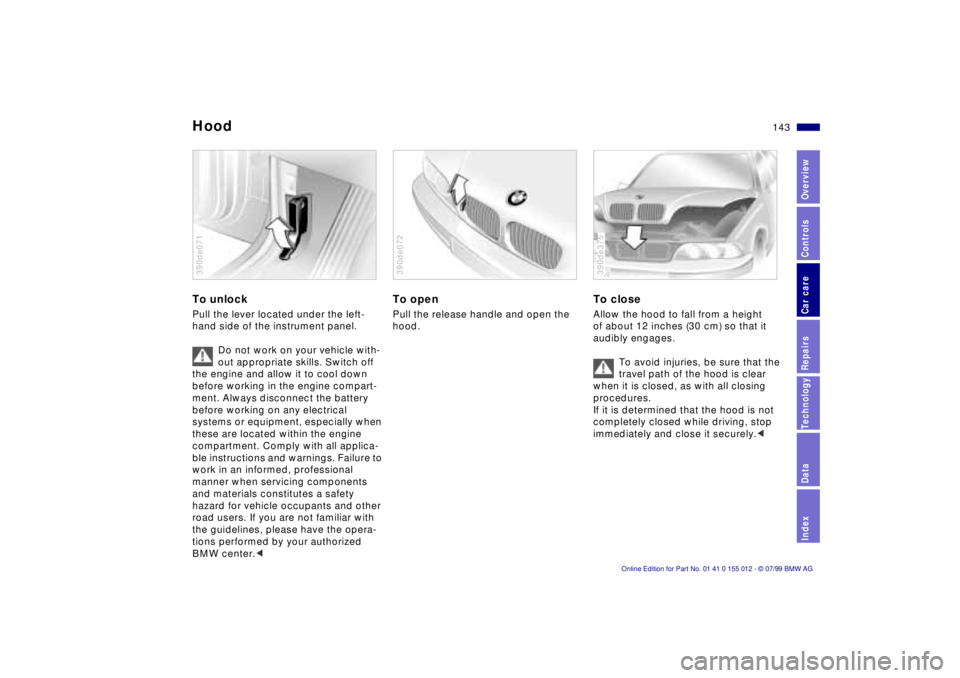
HoodTo unlockPull the lever located under the left-
hand side of the instrument panel.
Do not work on your vehicle with-
out appropriate skills. Switch off
the engine and allow it to cool down
before working in the engine compart-
ment. Always disconnect the battery
before working on any electrical
systems or equipment, especially when
these are located within the engine
compartment. Comply with all applica-
ble instructions and warnings. Failure to
work in an informed, professional
manner when servicing components
and materials constitutes a safety
hazard for vehicle occupants and other
road users. If you are not familiar with
the guidelines, please have the opera-
tions performed by your authorized
BMW center.<390de071
To openPull the release handle and open the
hood.390de072
To closeAllow the hood to fall from a height
of about 12 inches (30 cm) so that it
audibly engages.
To avoid injuries, be sure that the
travel path of the hood is clear
when it is closed, as with all closing
procedures.
If it is determined that the hood is not
completely closed while driving, stop
immediately and close it securely.< 390de375
Page 152 of 217
152n
Coolant Brake fluidAdding coolantWait until the engine cools before re-
moving the cap from the expansion
tank. The needle of the coolant gauge
in the instrument cluster must be lo-
cated in the blue zone; otherwise, there
is a danger of scalding.
1 Start by turning the cap counter-
clockwise. Pause to allow any
accumulated pressure to escape,
then open.
2 If the coolant is low, slowly add
coolant until the correct level is
reached Ð do not overfill.
The coolant is a mixture of water and
extended-duty antifreeze with corrosion
inhibitor. Always maintain the pre-
scribed all-season 50:50 mixture ratio
for year-round protection against inter-
nal corrosion. No other additives are re-
quired.
Replace the coolant every four years.If the indicator lamp for the
brake hydraulic system appears
or if the "CHECK BRAKE FLUID"
warning appears in the Check
Control: The brake fluid level is
too low in the reservoir.
The brake fluid reservoir is located
under the microfilter housing on the
driver's side of the car. Should you de-
termine that the brake fluid is low, refer
the problem to your BMW center, who
can trace and rectify any sources of
leakage when refilling the reservoir.
Your BMW center is familiar with the
specifications for approved brake fluids
(DOT 4).
Brake fluid loss results in extended
pedal travel. For this situation, refer to
the notes on page 130.
Brake fluid is hygroscopic, that is,
it absorbs moisture from the air
over time.
In order to ensure the safety and
reliability of the brake system, have the
brake fluid changed every two years by
an authorized BMW center. Refer also
to the Service and Warranty Information
Booklet (US models) or to the Warranty
and Service Guide Booklet (Canadian
models).
Brake fluid is toxic and damages the
vehicle's paint. You should always store
it in its original container and in a loca-
tion which is out of reach of children.
Do not spill the fluid and do not fill the
brake fluid reservoir beyond the "MAX"
mark. The brake fluid could ignite upon
contact with hot engine parts and cause
serious burns.<
Comply with the applicable
environmental laws regulating the
disposal of brake fluid.<
Page 173 of 217
173n
RepairsIndexOverview Controls Car care Technology Data
Changing tires
Safety measures in the event of a
flat tire or wheel change:
Stop the vehicle as far as possible from
passing traffic. Park on a firm, flat,
surface. Switch on the hazard flashers.
Turn the steering wheel to the straight-
ahead position, remove the key and
engage the steering lock. Shift into 1st
or reverse (selector lever in Park with
automatic transmission) and engage the
parking brake. All passengers should
be outside the car and well away from
your immediate working area (behind a
guardrail, for instance).
If a warning triangle or portable hazard
warning lamp is available, set it up on
the roadside at an appropriate distance
from the rear of the vehicle. Comply
with all safety guidelines and regula-
tions.
Change the wheel only on a level, firm
surface which is not slippery. Avoid
jacking the car on a soft or slippery sup-
port surface (snow, ice, loose gravel,
etc.), since it could slide sideways.
Position the jack on a firm support
surface.
Do not place wooden blocks or similar
objects under the jack. If this is done,
the jack might not be able to reach its
full support capacity because of the
limited height.
Do not lie under the vehicle or start the
engine when the vehicle is supported
by the jack Ð risk of fatal injury.<
What you will needIn order to avoid rattling noises later,
note the position of the tools when you
remove them and return them to their
original position when you are through
using them.
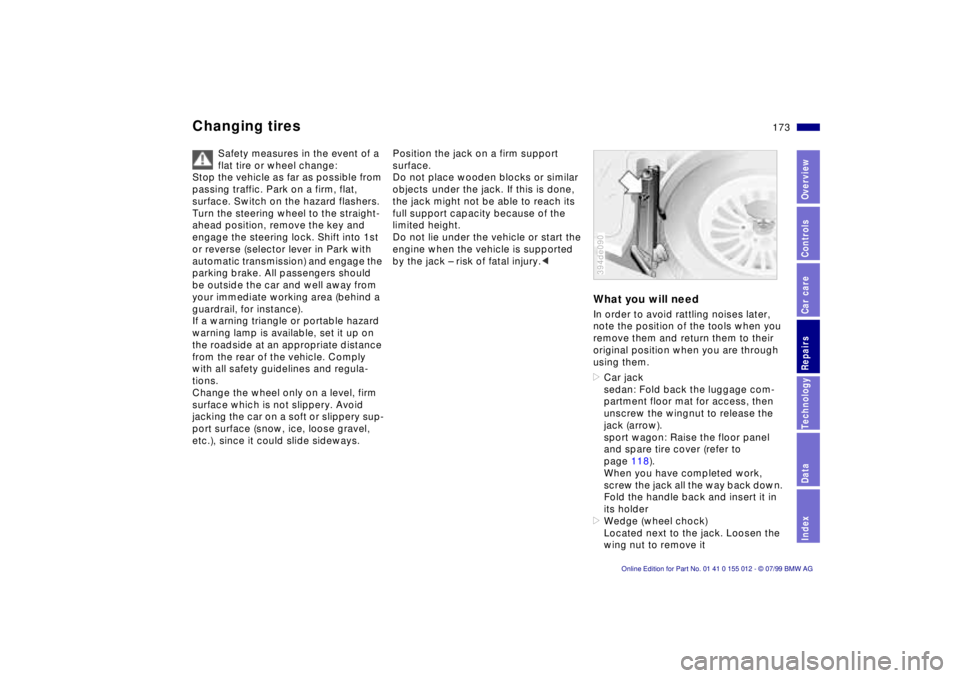
>Car jack
sedan: Fold back the luggage com-
partment floor mat for access, then
unscrew the wingnut to release the
jack (arrow).
sport wagon: Raise the floor panel
and spare tire cover (refer to
page 118).
When you have completed work,
screw the jack all the way back down.
Fold the handle back and insert it in
its holder
>Wedge (wheel chock)
Located next to the jack. Loosen the
wing nut to remove it394de090
Page 176 of 217
176n
Changing tires Battery
Size 255/40 R17 94 W
* tires on
the rear axle:
In the event of a puncture or other tire
failure, it may be necessary to mount
the spare tire of different size at the
rear. This tire is of full capacity in all
load and speed ranges. Nevertheless,
mount a tire of the correct size as soon
as possible.<
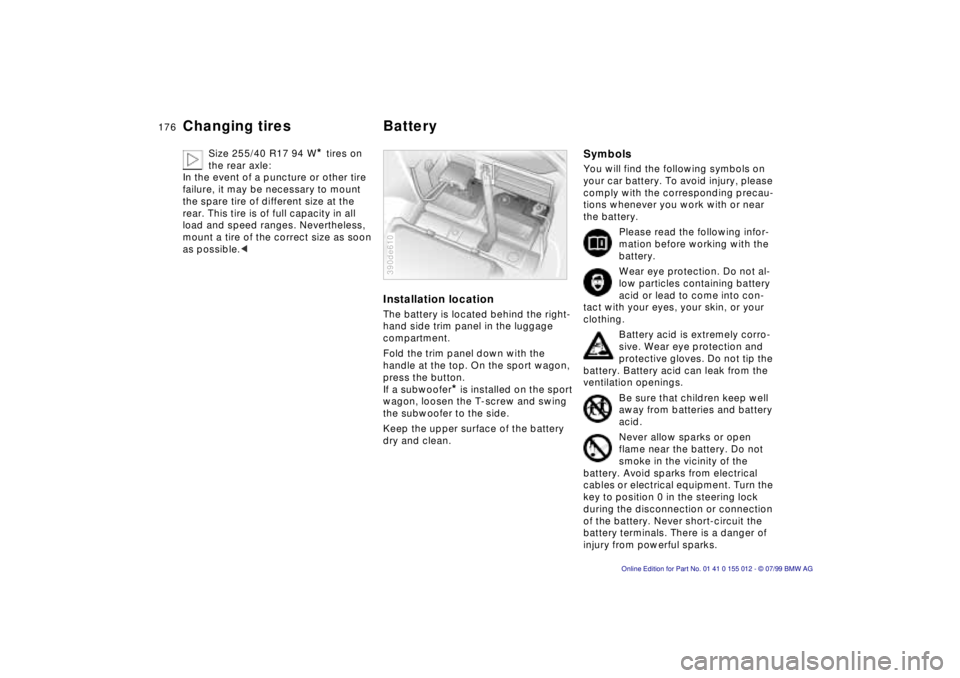
Installation locationThe battery is located behind the right-
hand side trim panel in the luggage
compartment.
Fold the trim panel down with the
handle at the top. On the sport wagon,
press the button.
If a subwoofer
* is installed on the sport
wagon, loosen the T-screw and swing
the subwoofer to the side.
Keep the upper surface of the battery
dry and clean.
390de610
SymbolsYou will find the following symbols on
your car battery. To avoid injury, please
comply with the corresponding precau-
tions whenever you work with or near
the battery.
Please read the following infor-
mation before working with the
battery.
Wear eye protection. Do not al-
low particles containing battery
acid or lead to come into con-
tact with your eyes, your skin, or your
clothing.
Battery acid is extremely corro-
sive. Wear eye protection and
protective gloves. Do not tip the
battery. Battery acid can leak from the
ventilation openings.
Be sure that children keep well
away from batteries and battery
acid.
Never allow sparks or open
flame near the battery. Do not
smoke in the vicinity of the
battery. Avoid sparks from electrical
cables or electrical equipment. Turn the
key to position 0 in the steering lock
during the disconnection or connection
of the battery. Never short-circuit the
battery terminals. There is a danger of
injury from powerful sparks.
Page 184 of 217
184n
Towing the vehicle
The towed vehicle should always
be the lighter of the two vehicles.
If this is not the case, it is no longer
possible to control vehicle response.<
Tow-startingIt is not possible to start the engine of
vehicles equipped with an automatic
transmission by towing or pushing.
For instructions on jump starting, refer
to page 182.
Never attempt to use your vehicle to
push another car, since damage to the
energy-absorbing bumpers could
result.
Towing a vehicle with automatic
transmission1 Place the selector lever in position N
2 Towing speed:
Max. 45 mph (70 km/h)
3 Towing distance:
Max. 95 miles (150 km)
4 Leave the ignition key at position 1 to
ensure that the brake lamps, turn sig-
nals, horn and windshield wipers re-
main operative, and to prevent the
steering lock detent from engaging.
5 Switch on the hazard-warning system
(observe country-specific regula-
tions).
Find some means of identifying the ve-
hicle in tow, for instance, place a sign
or warning triangle in the rear window.
Make sure that the ignition key
remains in position 1 even when
the electrical system has failed to pre-
vent the steering lock from engaging.
The steering and brakes are without
power assist when the engine is off.
This means that increased effort is
required for steering and braking.<
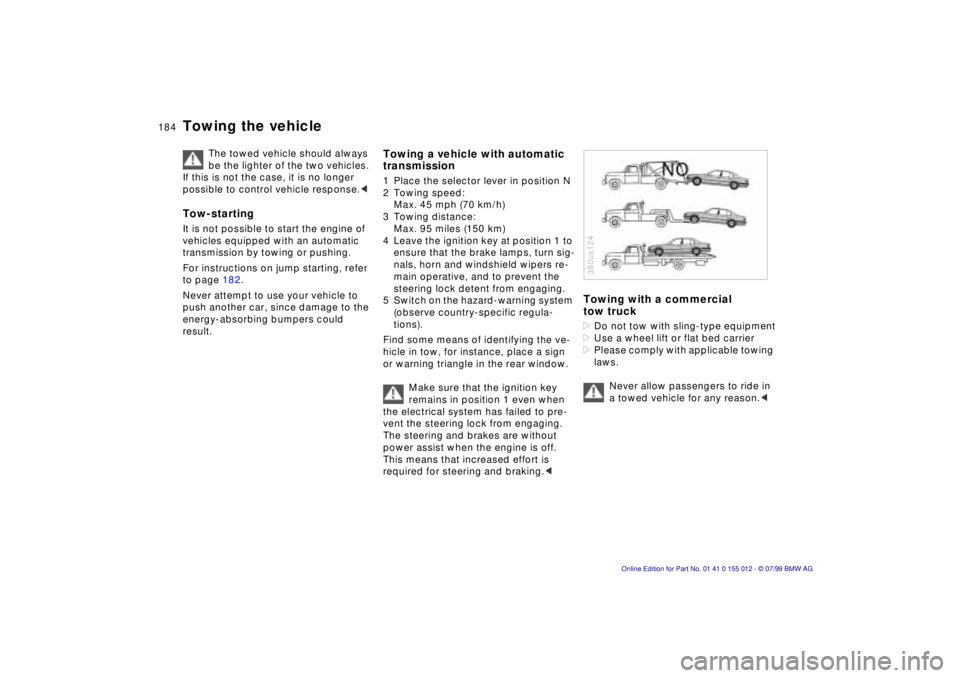
Towing with a commercial
tow truck>Do not tow with sling-type equipment
>Use a wheel lift or flat bed carrier
>Please comply with applicable towing
laws.
Never allow passengers to ride in
a towed vehicle for any reason.<380us124