2000 BMW 540I SEDAN lock
[x] Cancel search: lockPage 114 of 217
114n
Ski bag
*
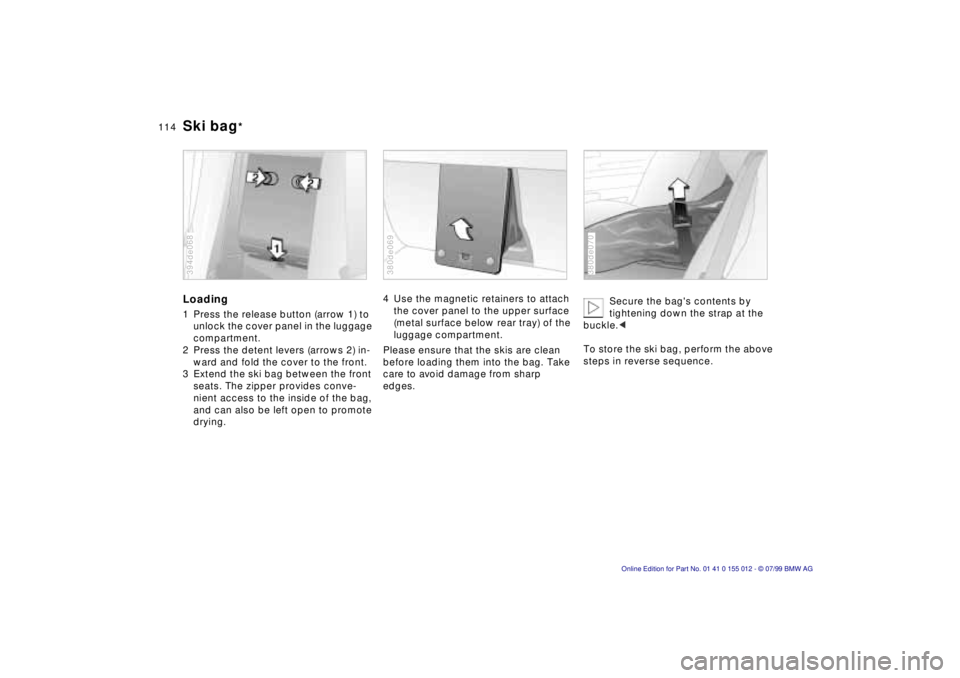
Loading1 Press the release button (arrow 1) to
unlock the cover panel in the luggage
compartment.
2 Press the detent levers (arrows 2) in-
ward and fold the cover to the front.
3 Extend the ski bag between the front
seats. The zipper provides conve-
nient access to the inside of the bag,
and can also be left open to promote
drying.394de068
4 Use the magnetic retainers to attach
the cover panel to the upper surface
(metal surface below rear tray) of the
luggage compartment.
Please ensure that the skis are clean
before loading them into the bag. Take
care to avoid damage from sharp
edges.380de069
Secure the bag's contents by
tightening down the strap at the
buckle.<
To store the ski bag, perform the above
steps in reverse sequence.
380de070
Page 115 of 217
115n
RepairsIndexOverview Controls Car care Technology Data
Ski bag
*
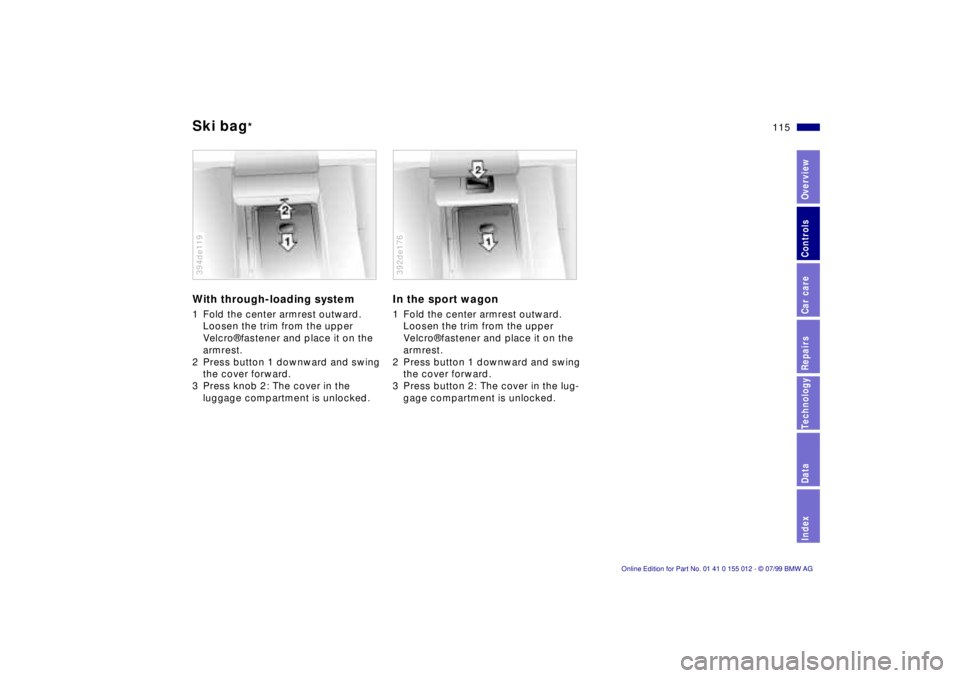
With through-loading system1 Fold the center armrest outward.
Loosen the trim from the upper
Velcro¨ fastener and place it on the
armrest.
2 Press button 1 downward and swing
the cover forward.
3 Press knob 2: The cover in the
luggage compartment is unlocked.394de119
In the sport wagon1 Fold the center armrest outward.
Loosen the trim from the upper
Velcro¨ fastener and place it on the
armrest.
2 Press button 1 downward and swing
the cover forward.
3 Press button 2: The cover in the lug-
gage compartment is unlocked.392de176
Page 116 of 217
116n
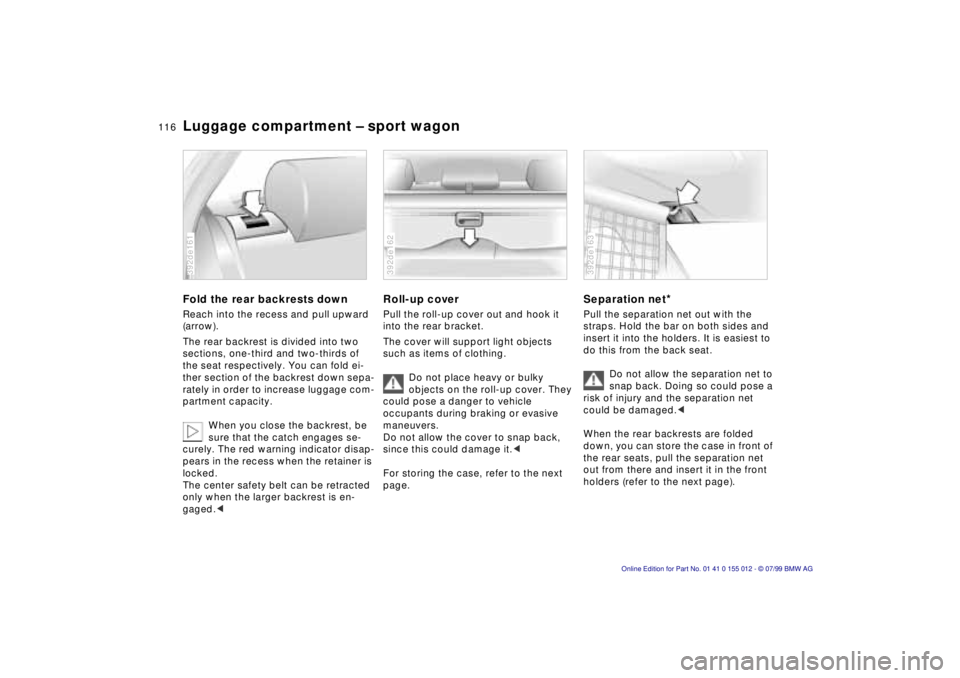
Luggage compartment Ð sport wagonFold the rear backrests downReach into the recess and pull upward
(arrow).
The rear backrest is divided into two
sections, one-third and two-thirds of
the seat respectively. You can fold ei-
ther section of the backrest down sepa-
rately in order to increase luggage com-
partment capacity.
When you close the backrest, be
sure that the catch engages se-
curely. The red warning indicator disap-
pears in the recess when the retainer is
locked.
The center safety belt can be retracted
only when the larger backrest is en-
gaged.<392de161
Roll-up coverPull the roll-up cover out and hook it
into the rear bracket.
The cover will support light objects
such as items of clothing.
Do not place heavy or bulky
objects on the roll-up cover. They
could pose a danger to vehicle
occupants during braking or evasive
maneuvers.
Do not allow the cover to snap back,
since this could damage it.<
For storing the case, refer to the next
page.392de162
Separation net
*
Pull the separation net out with the
straps. Hold the bar on both sides and
insert it into the holders. It is easiest to
do this from the back seat.
Do not allow the separation net to
snap back. Doing so could pose a
risk of injury and the separation net
could be damaged.<
When the rear backrests are folded
down, you can store the case in front of
the rear seats, pull the separation net
out from there and insert it in the front
holders (refer to the next page).392de163
Page 118 of 217
118n
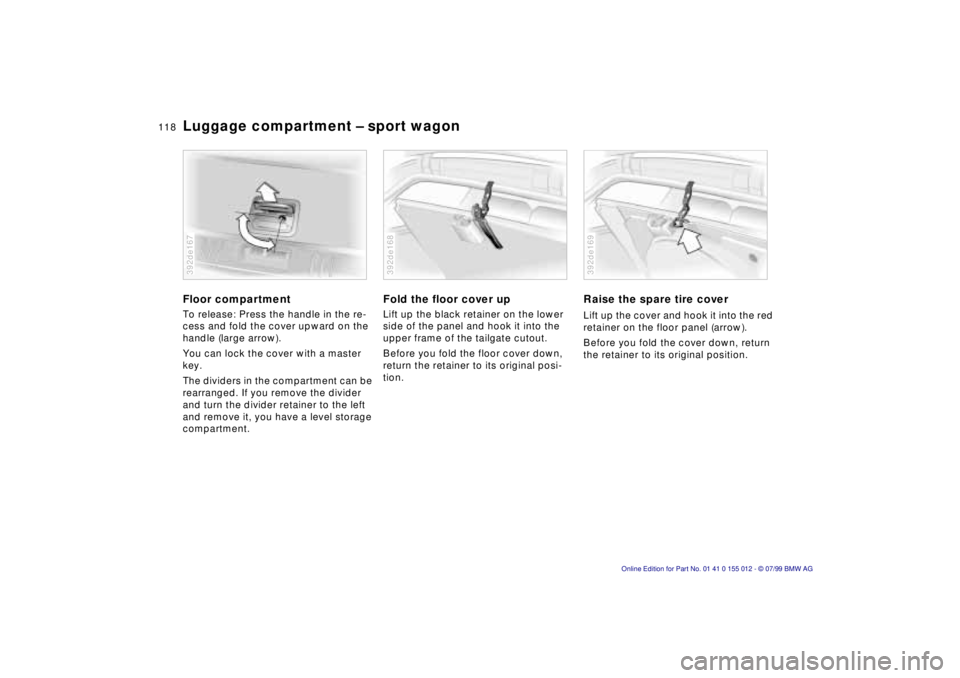
Luggage compartment Ð sport wagonFloor compartmentTo release: Press the handle in the re-
cess and fold the cover upward on the
handle (large arrow).
You can lock the cover with a master
key.
The dividers in the compartment can be
rearranged. If you remove the divider
and turn the divider retainer to the left
and remove it, you have a level storage
compartment.392de167
Fold the floor cover upLift up the black retainer on the lower
side of the panel and hook it into the
upper frame of the tailgate cutout.
Before you fold the floor cover down,
return the retainer to its original posi-
tion.392de168
Raise the spare tire coverLift up the cover and hook it into the red
retainer on the floor panel (arrow).
Before you fold the cover down, return
the retainer to its original position.392de169
Page 123 of 217
Overview
Controls and features
Operation, care
and maintenance
Owner service procedures
Technical data
Index Advanced technology
123n
RepairsIndexOverview Controls Car care Technology Data
Under the hood:
Hood143
Engine compartment144
Washer fluids148
Washer nozzles148
Engine oil149
Coolant151
Brake fluid152
Vehicle Identification
Number153
Care and maintenance:
The BMW Maintenance
System154
Caring for your car155
Airbags160
Vehicle storage160
Laws and regulations:
Technical modifications161
OBD connector162 Special operating instructions:
Break-in procedure124
Driving notes125
Catalytic converter126
Antilock Brake System
(ABS)127
Disc brakes128
Brake system130
Winter operation130
Power steering132
Level control system132
Cellular phone133
Radio reception133
Wheels and tires:
Tire inflation pressure134
Tire condition134
Tire replacement135
Tire rotation136
Wheel and tire
combinations137
Winter tires138
Snow chains139
Approved wheel and tire
specifications140
Page 127 of 217

127n
RepairsIndexOverview Controls Car care Technology Data
Antilock Brake System (ABS)The conceptABS enhances active safety by helping
to prevent the wheels from locking un-
der braking. The reason: Locked wheels
are dangerous. When the front wheels
slide, the driver loses steering control
over the vehicle. Traction loss at the
rear wheels can cause the rear end to
break into an uncontrolled skid.
ABS is designed to meet two essential
requirements during every brake appli-
cation:
>To help provide vehicle stability
>To help retain steering and maneu-
vering capability on all types of road
surface (asphalt, cement, dirt, mois-
ture, snow and ice).
The system can achieve the shortest
braking distances possible under most
conditions (on straight-away and in
curves, on asphalt, ice, wet road sur-
faces, etc.).
Braking with ABSThe system becomes operative once
the vehicle exceeds a speed of approx.
6 mph (10 km/h). The ABS is deacti-
vated whenever the vehicle's speed
drops back below approx. 4 mph
(6 km/h). This means that the wheels
can lock in the final phase of a brake
application Ð a factor of no significance
in actual use.
If you are in a situation which requires
full braking, you will exploit the full ben-
efits of the ABS system if you apply
maximum brake pressure ("panic stop").
Since the vehicle maintains steering re-
sponsiveness, you can avoid possible
obstacles with a minimum of steering
effort, despite the full brake application.
The ABS system closed-loop control
circuit cycles in fractions of a second.
A pulsation at the brake pedal indicates
to the driver that ABS is active, that is,
that the vehicle is within its maximum
braking range. In addition, the audible
pulsation that accompanies the control
operation calls the attention of the
driver to the reduced traction between
the tires and the road surface (slippery
road surface), and serves as a reminder
that the speed of the car should be re-
duced to adapt to road conditions.On road surfaces which have a loose
layer on a firm base (on gravel or snow,
for instance), the braking distances with
ABS may be longer than with the
wheels locked. The same applies when
snow chains have been mounted. How-
ever, ABS continues to provide en-
hanced vehicle stability and steering re-
sponse under these conditions.
Page 128 of 217

128n
Antilock Brake System (ABS) Disc brakesInformation for your safetyNot even ABS can suspend the laws of
physics. ABS alone cannot prevent
accidents when the brakes are applied
without an adequate safety interval
between vehicles, if the car is driven at
an excessive rate of speed in curves, or
if aquaplaning occurs. Responsibility for
these types of situations remains in the
hands (and at the feet) of the driver.
You should never allow the added
safety of ABS to lull you into a false
sense of security, or mislead you into
taking increased risks that could affect
your own safety and that of others.
Do not make any modifications to
the ABS system.
Service procedures on ABS are to be
performed by authorized technicians
only.<
In the event of a fault
If the ABS warning lamp in the
instrument cluster comes on,
refer to page 23. The brake
system then reverts to conven-
tional operation as on vehicles
without ABS. However, have the
brake system checked by your BMW
center as soon as possible. To prevent
undetected defects and cumulative
faults from adversely affecting the brake
system, refer any problems to your
authorized BMW center at the earliest
opportunity.
Disc brakes furnish optimum decelera-
tion and braking control and greater
fade resistance under heavy use.
When the vehicle is driven only occa-
sionally, during extended periods when
the vehicle is not used at all, and in
operating conditions where brake appli-
cations are less frequent, there is an
increased tendency for corrosion of the
rotors and accumulation of contamina-
tion on the brake pads. This occurs
because the minimal pressure which
must be exerted by the pads during
brake applications to clean the rotors is
not reached.
If the brake rotors are corroded, they
will tend to respond to braking with a
pulsating effect which even extended
application will fail to cure.
For your own safety: Use only
brake pads that BMW has
approved for your specific vehicle
model. BMW cannot evaluate non-
approved brake pads to determine if
they are suited for use, and therefore
cannot ensure the operating safety of
the vehicle if they are installed.<
Page 129 of 217

129n
RepairsIndexOverview Controls Car care Technology Data
Disc brakesDriving notesWhen driving in wet conditions and in
heavy rain, it is a good idea to apply
light pressure to the brake pedal every
few miles (kilometers). Watch traffic
conditions to ensure that this maneuver
does not endanger other road users.
The heat which is generated by the
brake applications helps to dry the
brake pads and rotors.
Maximum braking force is obtained
while the wheels continue to rotate,
peaking when the wheels remain on the
verge of locking without actually doing
so. ABS maintains this state automati-
cally. If the ABS fails, you should revert
to the staggered braking technique de-
scribed below (refer to page 131).
Extended or steep mountain descents
do not necessarily have to lead to re-
duced braking efficiency. Shift down to
a gear in which only minimal periodic
brake applications are required or move
the selector lever to the appropriate
lower range with automatic transmis-
sion.
You can increase the engine's braking
effect by selecting progressively lower
gears, downshifting as far as 1st gear,
or the 1st or 2nd shift position, on steep
descents.Should engine braking prove inade-
quate, you should still avoid extended,
continuous braking. Instead of main-
taining low to moderate pressure over
an extended period of time, you should
decelerate by applying more substantial
pressure to the brake pedal (watch for
following traffic!), then releasing the
pedal, then repeating the application.
This staggered braking technique al-
lows the brakes to cool in the intervals
between active braking phases, pre-
venting overheating and ensuring that
full braking capacity remains available
at all times.
Do not coast with the clutch de-
pressed or with the transmission
or selector lever in neutral. Do not coast
with the engine shut off. The engine
provides no braking effect when the
clutch is depressed or the transmission
is in neutral, and there is no power-as-
sist for braking or steering when the
engine is not running.
Never allow floor mats, carpets or any
other objects to protrude into the area
around the accelerator, clutch and
brake pedals and obstruct their move-
ment.<
Dynamic Brake Control (DBC)
*
If you apply the brakes rapidly, this sys-
tem automatically produces the maxi-
mum braking force boost and thus
helps to achieve the shortest possible
braking distance during "panic stops."
All of the benefits of the ABS system
are exploited under these circum-
stances.
Do not reduce the pressure on the
brake pedal for the duration of the
brake application. When the brake
pedal is released, the DBC is deacti-
vated.
In the event of a malfunction, the yellow
warning lamp comes on. Conventional
braking efficiency is available without
limitations.
Have the system checked and repaired
at your BMW center as soon as possi-
ble.
For "Information for your safety"
covering the ABS system, refer to
page 128. This information also gener-
ally applies for DBC.<