2000 BMW 540I SEDAN display
[x] Cancel search: displayPage 100 of 217
100n
Automatic climate controlTips for pleasant drivingUse the automatic system, that is, press
AUTO button 4. Select an interior tem-
perature that is comfortable for you Ð
we recommend 727 (226). When the
outside temperature is above 417
(56), you can also use the air condi-
tioning system (12). This will dry the air
and prevent the window from fogging
(for example if people are wearing
damp clothes in the vehicle). Set the
outlets 2 so that the air flows past you
and is not directed straight at you. Set
the rotary dial between the outlets 2 for
the upper body to a central position.
This will provide cooler air, and help to
prevent fatigue during the journey.
Detailed setting options are described
for you in the following section.
You can make the settings of your
vehicle in such a manner that,
when you unlock the car with your indi-
vidualized remote control, your own
personalized setting for the automatic
climate control is initiated.<
Automatic air distribution
The AUTO program assumes
the adjustment of the air dis-
tribution and the air supply for you and
also adapts the temperature to external
influences (summer, winter) to meet
preferences you can specify. This pro-
gram maintains a comfortable in-car cli-
mate regardless of the season. Select
an interior temperature that is pleasant
for you Ð we recommend 727 (226).
The selected temperature and AUTO for
the air flow appear in the display 7. Re-
fer to the overview on page 98. Open
the ventilation outlets for the upper
body. Switch on the air conditioner in
warm weather. The maximum cooling
capacity is achieved when you set the
rotary dial 3 (refer to page 102) to cold.
Individual air distribution
You can cancel the AUTO pro-
gram by selecting specific dis-
tribution patterns to suit your
own individual requirements.
You can direct air to flow onto the win-
dows , toward the upper body ,
and into the footwell .
Temperature
You can make individual tem-
perature settings on the
driver's side or the front pas-
senger side. Your settings will be
shown in the display 9. The displayed
temperatures are reference values for
the interior temperature. We recom-
mend 727 (226) as a comfortable
setting, whether the air conditioner is
operating or not.When you start the ve-
hicle, the system ensures that the se-
lected temperature is achieved as
quickly as possible. It then maintains
this temperature, regardless of the sea-
son.
Set the rotary dial 3 (refer to "Draft-free
ventilation" on page 102) to a medium
position to provide somewhat cooler
air. This helps to promote driving with-
out fatigue. Make use of this means of
mixing air especially for making minor
adjustments for personal comfort.
You can set uncontrolled heater
output at up to 907 (326). Full
cooling output is available from the air
conditioner down to 607 (166).<
Page 101 of 217
101n
RepairsIndexOverview Controls Car care Technology Data
Automatic climate controlAir supply
In the "AUTO" program, the air
flow is controlled automati-
cally. AUTO will appear in the display
(refer to the overview on page 98). Use
"+" and "-" to vary the air flow. When
your setting is displayed by bars, the
automatic air flow is switched off. Auto-
matic air distribution maintains its set-
ting. You can reactivate the automatic
air flow by pressing the "AUTO" button.
When you press "Ð " during operation at
minimum blower speed all displays are
canceled: The fan, heating and air con-
ditioner are switched off. The outside
air supply is closed. By pressing any
button of the automatic climate control
(except the "REST" button 16), you can
switch the system back on.
To defrost windshield and door
windows
This program quickly removes
ice and condensation from the
windshield and the side windows.
Air conditioner
The air is cooled and dehu-
midified and Ð depending on
the temperature setting Ð warmed again
when the air conditioner system is
switched on. Depending on the
weather, the windshield may fog over
briefly when the engine is started.
Use the button to switch off the air con-
ditioner at outside temperatures below
approx. +417 (+56). This will help to
prevent the windows from fogging up.
If the windows fog over after switching
the air conditioner off, switch it back on.
Condensation forms in the air con-
ditioner system during operation,
which then exits under the vehicle.
Traces of condensed water of this kind
are thus normal.<
Automatic recirculated-air
control (AUC)
You can respond to unpleas-
ant external odors by tempo-
rarily stopping the flow of outside air.
The system then recirculates the air
currently within the vehicle. Press the
button repeatedly to run through the
following control sequence:
>Indicator lamps off: Outside air flow
operational.
>Left-hand indicator lamp on Ð AUC
mode: The system recognizes pollut-
ants in the outside air and blocks the
flow of air when necessary. The sys-
tem then recirculates the air currently
within the vehicle.
Depending on the air quality, the au-
tomatic system then switches back
and forth between outside air supply
and recirculation of the air within the
vehicle.
>Right-hand indicator lamp on: The
flow of external air into the vehicle is
permanently blocked. The system
then recirculates the air currently
within the vehicle.
If you have a multifunction steering
wheel with the recirculated-air button
(refer to page 25), you can also use it to
switch between "Off" and the recircu-
lated-air mode or AUC and the recircu-
lated-air mode.
Page 139 of 217
139n
RepairsIndexOverview Controls Car care Technology Data
Winter tires Snow chains
*
Do not exceed specified
maximum speeds
Never exceed the maximum
speed for which the tires are
rated.
Unprofessional attempts by laymen to
service tires can lead to damage and
accidents.
Have this work performed by skilled
professionals only. Any BMW center
has the required technical knowledge
and the proper equipment and will be
happy to assist you.<
Tire condition, tire pressureWinter tires display a perceptible loss in
their ability to cope with winter driving
conditions once the tread wears to be-
low 0.16 inches (4 mm), and should
thus be replaced.
Comply with the specified tire inflation
pressures Ð and be sure to have the
wheel and tire assemblies balanced
every time you change the tires.
StorageStore tires in a cool, dry place, away
from light whenever possible. Protect
the tires against contact with oil, grease
and fuel.Use narrow-link BMW snow chains
on
summer or winter tires only in pairs and
only on the rear wheels. Comply with all
manufacturer's safety precautions when
mounting the chains.
It is not possible to mount snow
chains on tires with 17-inch
wheels.<
Page 154 of 217
154n
The BMW Maintenance System has
been designed as a reliable means of
providing maximum driving and operat-
ing safety Ð and as cost-effectively as
possible for you.
Please keep in mind that regular main-
tenance is not only necessary for the
safety of your vehicle, but also plays a
significant role in maintaining the resale
value of the vehicle.
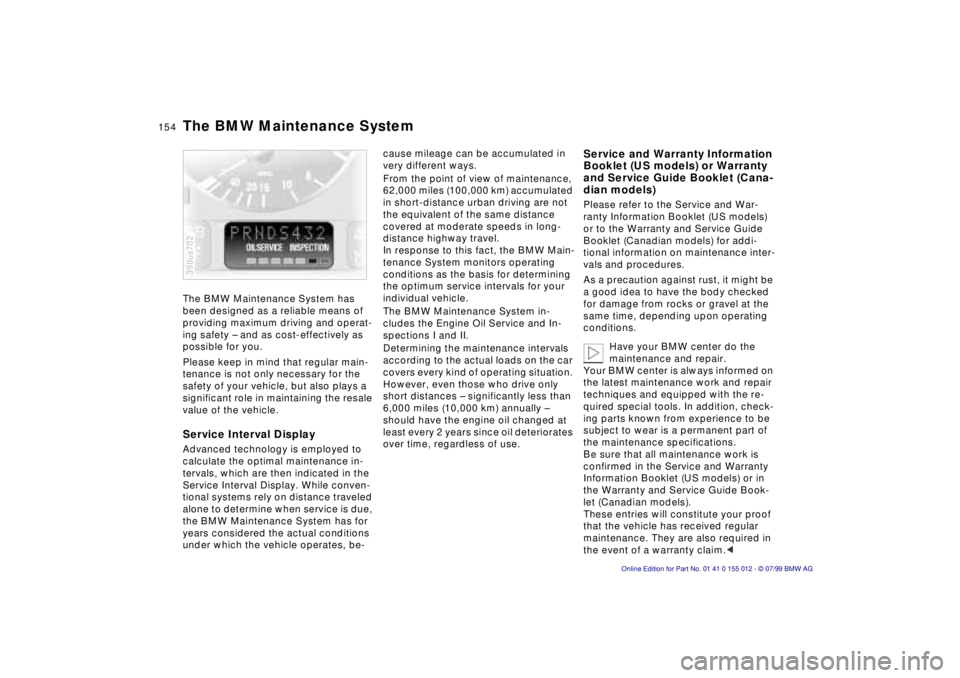
Service Interval DisplayAdvanced technology is employed to
calculate the optimal maintenance in-
tervals, which are then indicated in the
Service Interval Display. While conven-
tional systems rely on distance traveled
alone to determine when service is due,
the BMW Maintenance System has for
years considered the actual conditions
under which the vehicle operates, be-390us702
cause mileage can be accumulated in
very different ways.
From the point of view of maintenance,
62,000 miles (100,000 km) accumulated
in short-distance urban driving are not
the equivalent of the same distance
covered at moderate speeds in long-
distance highway travel.
In response to this fact, the BMW Main-
tenance System monitors operating
conditions as the basis for determining
the optimum service intervals for your
individual vehicle.
The BMW Maintenance System in-
cludes the Engine Oil Service and In-
spections I and II.
Determining the maintenance intervals
according to the actual loads on the car
covers every kind of operating situation.
However, even those who drive only
short distances Ð significantly less than
6,000 miles (10,000 km) annually Ð
should have the engine oil changed at
least every 2 years since oil deteriorates
over time, regardless of use.
Service and Warranty Information
Booklet (US models) or Warranty
and Service Guide Booklet (Cana-
dian models)Please refer to the Service and War-
ranty Information Booklet (US models)
or to the Warranty and Service Guide
Booklet (Canadian models) for addi-
tional information on maintenance inter-
vals and procedures.
As a precaution against rust, it might be
a good idea to have the body checked
for damage from rocks or gravel at the
same time, depending upon operating
conditions.
Have your BMW center do the
maintenance and repair.
Your BMW center is always informed on
the latest maintenance work and repair
techniques and equipped with the re-
quired special tools. In addition, check-
ing parts known from experience to be
subject to wear is a permanent part of
the maintenance specifications.
Be sure that all maintenance work is
confirmed in the Service and Warranty
Information Booklet (US models) or in
the Warranty and Service Guide Book-
let (Canadian models).
These entries will constitute your proof
that the vehicle has received regular
maintenance. They are also required in
the event of a warranty claim.<
The BMW Maintenance System
Page 209 of 217

209n
RepairsIndexOverview Controls Car care Technology Data
Everything from A to Z
Clock, refer to the Radio
Owner's Manual
Cockpit16
Cold start68
Comfort seat51
Compartments108
Compression ratio198
Computer, refer to Onboard
computer88
Consumption display83
Convenience operating
mode of windows and
sliding/tilt sunroof36
Coolant130, 151
Antifreeze130
Capacity203
Temperature gauge84
Cover, sun blinds104
Cruise control80
Cruising range88
Cup holder109
Curb weight201
D
Dashboard16
Data link connector for
Onboard Diagnostics162
Daytime-driving lamp94
DBC (Dynamic Brake
Control)24, 129
Deep water125Defrost windshields101
Digital sound processor192
Dimensions199
Dipstick, engine oil149
Disc brakes124, 128
Disconnect the battery178
Displacement198
Display lighting94
Displays18
Distance warning90
Diversity Antenna
system190
Divided rear-seat
backrest112
Door keys35
Door locks, care130
Doors
Emergency release36
Manual operation36
Unlocking and locking36
Drive belts204
Driving notes125
Driving through water125
DSC (Dynamic Stability
Control)24, 91, 189
Dynamic Brake Control
(DBC)24, 129
Dynamic Stability Control
(DSC)24, 91, 189
E
Electric power seat50
Electric power windows47
Electrical defect
Fuel filler door180
Sliding/Tilt sunroof180
Tailgate181
Electrical heating exterior
mirror55
Electrical steering wheel
adjustment54
Elements of operation16
Emergency operation
Doors36
Fuel filler door180
Luggage compartment lid/
Tailgate41, 181
Sliding/Tilt sunroof180
Energy Control83
Engine
Compartment144
Coolant151
Specifications198
Engine oil
Capacity203
Consumption149
Grades150
Level23
Pressure23
Error indicators85
Exterior finish156
Exterior mirror54
Electrical heating55
F
Failure of an electrical
accessorry180
Failure warnings85
Filler cap cover28
Filling capacities203
First-aid kit27
Fittings, tow-starting and
towing183
Flashlight108
Flat tire134
Footbrake
Footwell lamps96
Forward/Back adjustment,
seat50, 52
Front fog lamps95, 169
bulb replacement169
Front seat adjustment50
Frost protection,
radiator151
Fuel29
Capacity203
Consumption indicator83
Gauge83
Quality29
Reserve203
Fuel filler door release after
electrical fault180
Fuel tank, capacity203
Fuses178
Page 211 of 217

211n
RepairsIndexOverview Controls Car care Technology Data
Everything from A to Z
Manual operation
Doors36
Fuel filler door180
Luggage compartment lid/
Tailgate41, 181
Sliding/Tilt sunroof180
Manual transmission70
Manually controlled
recirculated-air101
Master key34
Mechanical seat52
Memory56
MFL (M Multifunction
steering wheel)26
MFL (Multifunction steering
wheel)25
Microfilter103
Mirror54
Mirror heating55
Mirror memory56
Mobile communications
systems, refer to the
separate Owner's Manual
Mobile phones133
Modifications,
technical6, 161
Multifunction steering wheel
(MFL)25
N
Navigation System, refer to
the separate Owner's
Manual
Nonsmoker equipment110
Nozzles98
O
OBD connector162
Odometer82
Oil
Additives149
Consumption149
Grades150
Oil change interval, see the
Service and Warranty
Information Booklet (US
models) or Warranty and
Service Guide Booklet
(Canadian models)
Oil dipstick149
Oil level, indicator lamp23
Oil quantity, engine203
OILSERVICE84
Old batteries177
Onboard computer88
Average fuel
consumption88
Average speed88
Cruising range88
Outside temperature88
Onboard tool kit166Open luggage compartment
lid/tailgate from
interior41
Opening and closing
From the inside38
From the outside36
Operating range88
Outside temperature88
Outside temperature
display82
P
Paint blemishes156
Paint, care156
Paintwork, minor
repairs157
Paintwork, waxing157
Park Distance Control
(PDC)90
Parking brake23, 69
Parking help90
Parking lamps95
Bulb replacement168
Parking, Winter132
PDC (Park Distance
Control)90
Playing cassettes
Refer to the Radio Owner's
Manual
Playing CDs
Refer to the Radio Owner's
Manual
Pocket light108Pollen filter103
Power output198
Power steering132
Power windows47
Safety switch48
Power-slip control
Refer to ASC+T/DSC91
Pressure, tire30, 134
Monitoring92, 194
R
Radio reception133, 190
Radio, refer to the separate
Owner's Manual
Radios133
Rain sensor155
RDC (Tire Pressure
Control)92, 194
Reading lamps96
Rear view mirror54
Rear window blind104
Rear window
defrosting79, 102
Rear window wiper79
Rear-seat backrest,
removable112
Recirculated-air control101
Reclining seat50
Refueling28
Remote control37
Removable rear-seat
backrest112
Page 212 of 217

Everything from A to Z
Remove condensation from
windshields101
Replacement keys35
Replacement of tires135
Reporting safety defects7
Reserve capacity
Cooling system203
Engine oil203
Fuel tank203
Washer system203
Residual heat102
Restraint system59
Reverse70
Rims137
Roof load201
Roof-mounted luggage
rack121
Rubber parts130
S
Safety belt tensioner191
Safety belts59
Safety lock buttons40
Seat heating103
Seat memory56
Seat, electric power50
Seat, forward/back
adjustment50, 52
Seat, mechanical52
Secure the load44, 120
Selector lever, automatic
transmission71, 74Service and Warranty
Information Booklet
(US models)154
Service Interval
Display84, 154
Servotronic132
Shift lever70
Shoulder support51
Shutting off the engine69
Side airbags60
Side impact Head Protection
System60
Ski bag113
Ski bag in the sport
wagon115
Skid control132
Sliding132
Sliding/Tilt sunroof48
Closure after electrical
fault180
Convenience
operation36
Manual operation180
Power supply
interruption49
Slippery roads131
Snow chains131, 139
Socket110
Sound system192
Spare key35
Spare tire136, 174
Spark plugs204Speaker109
Special oils150
Specifications for engine
oil150
Speed control80
Speedometer18, 20
sport wagon
Compartments in the
luggage
compartment117
Folding down the rear
backrest116
Lashing eyes120
Load-securing
devices120
Luggage
compartment116
Luggage compartment
lamps, bulb
replacement172
Opening the rear
window42
Rear window wiper79
Rear window wiper, wiper
blade replacement166
Roll-up cover116
Securing a load120
Separation net116
Ski bag115
Tail lamp assembly, bulb
replacement170
Tailgate, manual release
after electrical fault180Sports seat52
Start the engine68
Starting help182
Steering132
Steering wheel heating103
Steering wheel lock67
Steering wheel memory56
Storage108
Stroke198
Summer tires137
Sun visors55
Symbols4
T
Tachometer82
Tail lamps170
Tail lamps,
bulb replacement169
Tailgate44, 181
Convenience opening
mode38
Manual release after
electrical fault181
Taillamps170
Technical Data198
Technical
modifications6, 161
Telephone hookup109
Temperature display, engine
coolant84
Temperature gauge, outside
temperature82
Tensioning straps44
Page 214 of 217

A
Add
Antifreeze152
Brake fluid152
Coolant152
Engine coolant152
Engine oil149
Fluid, power steering152
Washer fluids148
Adjust washer nozzles148
Avoid false alarms46
B
Backup lamps, bulb
replacement169
Battery176
Charge condition177
Discharged182
Removing and
installing178
Brake lamps, bulb
replacement170
Brakes, brake faults130
Bulb replacement167
C
Car jack173
Changing tires173
Charging the battery178
Check Control85
Check engine oil level149
Check tire pressures29
Courtesy lamp, bulb
replacement172
D
Deactivating the interior
motion sensor38
Deactivating the tilt sensor
alarm system38, 46
Defrost windshields101
Difficult steering132
Doors
Manual operation36
E
Electrical defect
Fuel filler door180
Sliding/Tilt sunroof180
Emergency operation
Doors36
Fuel filler door180
Sliding/Tilt sunroof180
Tailgate181
Engine oil
specifications150
F
Failure messages85
Filling the washer
reservoir148
First-aid kit27
Fittings, tow-starting and
towing183
Flat tire173Fog lamp, replace the
bulb169
Footwell lamps, bulb
replacement172
Fuel filler door release after
electrical fault180
Fuses179
G
Glove compartment lamp,
bulb replacement172
H
Hazard warning flashers27
Hazard warning triangle27
Headlamp covers,
care155, 167
Help with jump starting182
High beams, bulb
replacement167
Hood release143
I
Indicator lamps22
Bulb replacement169
J
Jack173
Jump starting182
L
Level control system,
inactive132
License plate lamp, bulb
replacement171
Low beams, bulb
replacement167
Lug wrench174
Luggage compartment
lamps, bulb
replacement172
Luggage compartment lid/
Tailgate, unlock in case of
electrical fault41
M
Maintenance84, 154
Malfunction displays85
Manual operation
Doors36
Fuel filler door180
Sliding/Tilt sunroof180
Tailgate181
O
Oil specifications150
Onboard tool kit166
Owner service procedures