2000 AUDI ALLROAD brake light
[x] Cancel search: brake lightPage 215 of 306

VEHICL E CA
RE----------------------------------------------------
Notes
• Do not wash the vehicle in direct sun
light.
• If the vehicle is rinsed with a hose, do not
direct the water into the lock cylinders -
otherwise they may freeze up in the winter.
�W ARNING
• Do not wash, wax or dry the ve
hicle with the engine running.
• Do not clean the underside of
chassis, fenders, wheel covers,
etc. without protecting your
hands and arms. You may cut your
self on sharp-edged metal parts.
• Moisture and ice on brakes may
affect braking efficiency. Test the
brakes carefully after each vehicle
wash.
214 Washing
your vehicle with a power
washer
If you use a power washer, please note the
following:
• Always follow the operating instructions
for the power washer -especially for pres
sure and spraying distance.
• Make sure that the jet on the spray hose
produces a "fan shape" spray. Do not use
a jet which sprays the water out in a direct
stream or one that has a rota ting jet.
• Water temperature should not exceed
140 °F (60 °C).
�W ARNING
Never wash tires with a jet that
sprays the water out in a direct
stream. This could invisibly dam
age and weaken the tires, even if
they are sprayed from a relatively
long distance for a vary short
amount of time. Damaged and
weakened tires can fail and cause
accidents and personal injury. Headli
ghts
Do not clean your headlights with a dry
towel or sponge. They must be cleaned
with a moistened towel.
Never use a sponge designed for removing
dried-on insects, a kitchen scrubber or any
other similar product since the lens surface
can be damaged by scrat ching and scour
ing.
When using high-pressure washing equip
ment or steam-cl eaning units, never spray
the vehicle with the nozzle close the vehicle
surface and never aim the spray at the same
point for a relatively long period of time.
Polishing Please refer to the imp ortant information on
page 212.
Polish your vehicle only if the paint has lost
its shine and the gloss cannot be brought
back with wax. If the polish used doesn't
contain preservative compounds, the paint
must be waxed afterwards.
Do not treat matte- pain�ed and plas
tic parts with polish or wax.
Page 217 of 306
VEHICL E
CA RE-------------------------
Weatherstrips
Keep silicone sprays off the wind
shield to avoid wiper smear in rain.
To seal properly, weatherstrips around
hood, rear lid, doors, etc., must be pliable.
Spray with silicone or coat with talcum pow
der or glycerine to reta in flexibility of the
rubber and to protect against freezing in the
w1nter.
Dull finishes and plastics
Plas .tic pa �s. such as light bulb lenses, dec
orative stnpes, panels, bumpers, etc., will
come clean with regular washing. Should
additional cleaning or spot remova l be nec
essar y, use a soft brush or cloth soaked with
a mild detergent solution. Then rinse thor
oughly and imme diately with clear water.
Do not use anyth ing which could
mar the plastic or dull finished sur
faces, such as wax, polish, abrasive
detergents or chemical cleaning sol
vents.
216 Bright
metal trim
Bright or black anodized metal trim will
come clean with regular washing. Remove
spots or dirt from chrome and stainless
steel with a chrome cleaner. Apply a
chrome polish for continued luster and
protec tion.
Steel wheels
Always include the hub caps and wheel
rims when washing your vehicle to remove
road dirt, salt sprays and brake dust. If nec
essary, use a commercial wheel cleaner to
remove accumulated brake dust. Paint
scratches should be touched up as soon as
possible to prevent corrosion.
Light alloy wheels
To preserve the decorative appearance of
the light alloy wheels, some special care is
necessary. In addition to road dirt and salt
sprays, brake dust is also corrosive. If left on
too long, brake dust can cause pitting. Wash
the wheels with a sponge or hose brush ev
ery other week. Road salt
should be removed weekly with
an acid free cleaning solution. Every three
months (after regular cleaning) coat the
wheels with petroleum jelly or car wax. Rub
it in firmly with a soft cloth. Never use abra
sive or metal polishing cleaning agents.
� WARNING
Moisture, ice, and road salt on
brakes may affect braking effi
ciency. Test the brakes carefully
after each washing. Always heed
WA RNING on page 203.
Page 234 of 306
When
adding fluids, always make
sure that they are poured into the
proper container or filler opening,
otherwise serious damage to ve
hicle systems will occur. r:Gb To detect leaks in time, inspect
� the vehicle floor pen from under
neath regular ly. If you see spots
from oil or other vehicle fluids, have
your vehicle inspected by an autho
ri zed Audi Dealer .
D Always heed all WA RNINGS
� on page 232.
Always exercise extreme caution
when working under the engine
hood. -
VE HICLE CARE
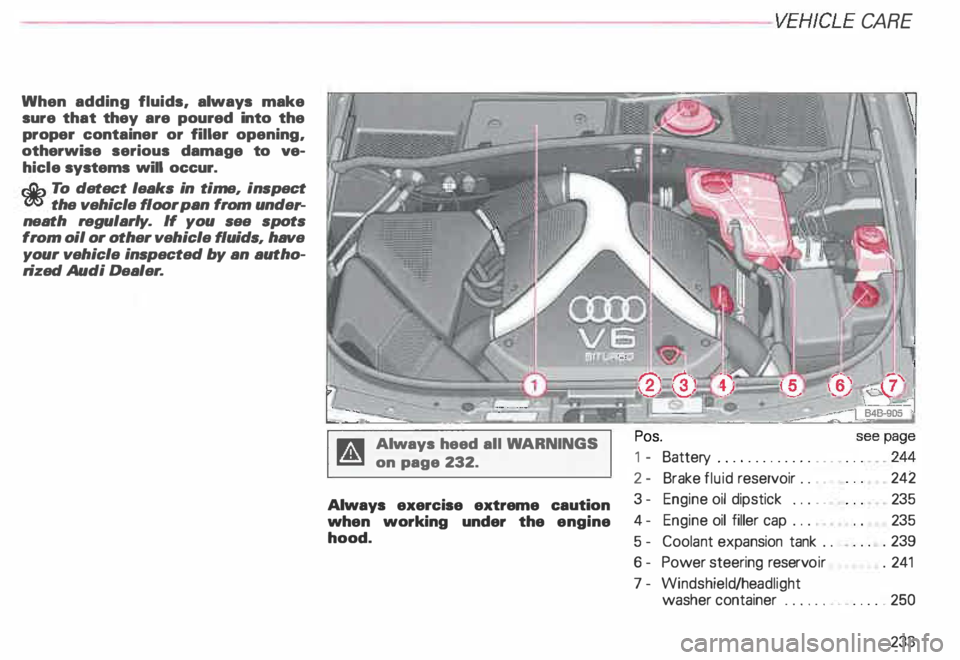
Pos.
1 - Battery ............. . _ .. .. .
2- Brake fluid reservoir . . . 242
3 - Engine oil dipstick ... . _ 235
4- Engine oil filler cap . . . 235
5- Coolant expansion tank . . . 239
6 - Power steering reservoir .
241
7 - Windshield /headlight
washer container ......•• _ .... . 250
233
Page 243 of 306
VE
HICLE CA
RE----------------------------------------------------
Brake fluid
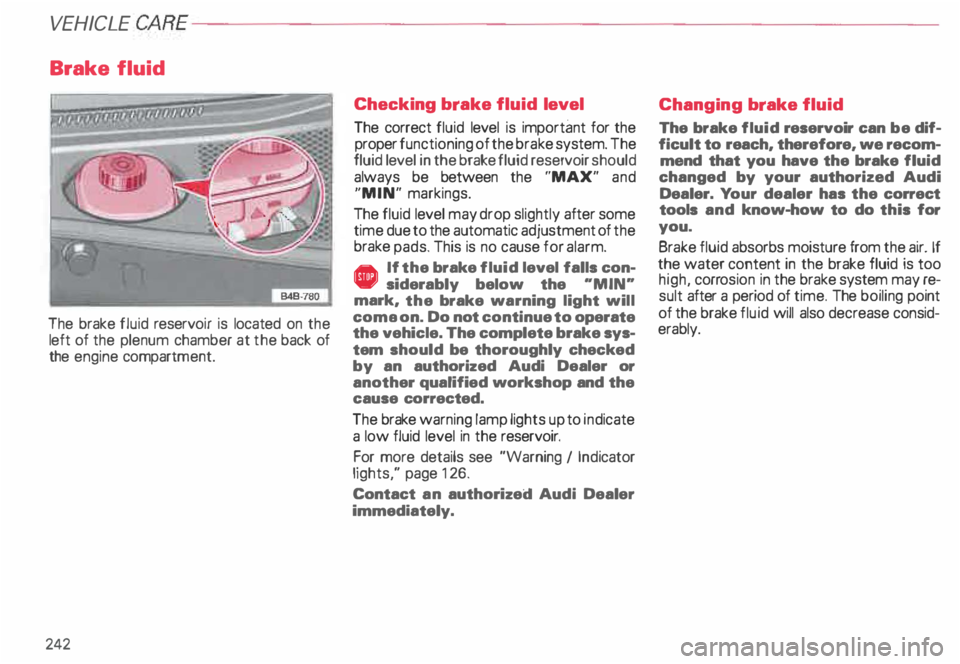
The brake fluid reservo ir is located on the
left of the plenum chamber at the back of
the engine compartm ent.
242 Checking
brake fluid level
The correct fluid level is important for the
proper functioning of the brake system. The
fluid level in the brake fluid reservoir should
always be between the "MAX" and
"MIN" markings.
The fluid level may drop slightly after some
time due to the automatic adjustment of the
brake pads. This is no cause for alarm.
• If the brake fluid level falls con
siderably below the "MIN"
mark, the brake warning light will
coma on. Do not continue to operate
the vehicle. The complete brake sys
tem should be thoroughly checked
by an authorized Audi Dealer or
another qualified workshop and the
cause corrected.
The brake warning lamp lights up to indicate
a low fluid level in the reservoir.
For more details see "Warning I Ind icator
lights," page 126.
Contact an authorized Audi Dealer
immediately. Changing
brake fluid
The brake fluid reservoir can be dif
ficult to reach, therefore, we recom
mend that you have the brake fluid
changed by your authorized Audi
Dealer. Your dealer has the correct
tools and know-how to do this for
you.
Brake fluid absorbs moisture from the air. If
the water content in the brake fluid is too
high, corrosion in the brake system may re
sult after a period of time. The boiling point
of the brake fluid will also decrease consid
erably.
Page 260 of 306
-------------------------VEHICLE
CARE
Te mperature
The temperature grades are A (the highest),
8, and C, repres enting the tire's resistance to
the generation of heat and its ability to dissi
pate heat when tested under contro lled con
ditions on a specified indoor laboratory test
wheel. Sustained high temJ)erature can
cause the material of the tire to degenerate
and reduce tire life, and excessive tempera
ture can lead to sudden tire failure. The
grade C corres ponds to a level of perfor
mance which all passenger car tires must
meet under the Federal Motor Vehicle Safety
Sta ndard No. 1 09. Grades Band A represent
higher levels of performance on the laborato
ry test wheel than the minimum required by
law.
�W ARNIN G
The temperature grade for this tire
is est ablished for a tire that is
properly inflated and not over
loaded. Excessive speed, under
inflation, or excessive loading, ei
ther separately or in combination,
can causa heat buildup and pos
sible tire failure. Wheel
replacement
If you wish to equip your vehicle with tires
or wheels other than those installed at the
factory, please note the following:
• For technical reasons it is not al
ways possible to use wheels from
other vehicles -under certain condi
tions not even wheels from the same
vehicle model.
• Wheel rims and wheel bolts are
matched to fit your Audi. When
installing different wheels (for ax
ample, wheels with winter tires), the
correct wheel bolts with the proper
length and conical shape of the bolt
head must be used. The secure fit of
the wheels and the proper function
ing of the brake system and safety
are dependent upon this.
• Wheel rims and wheal bolts are
matched to fit your Audi. •
Before you plan on exchanging
steel wheels, light alloy wheals, or
winter tires already mounted on
wheel rims, consult your authorized
Audi Dealer. They have the technical
information necessary to advise you
which wheal rims and wheel bolts
are compatible with the original fac
tory installations.
1ft WARNING
• Incorrect tire/wheel parts may
cause an accident and personal in
jury. Such parts will adversely af
fect the safe operation of your ve
hicle. Always use tires, wheel rims
and wheel bolts that meat specifi
cations of the original factory
installed equipment.
• If wheel trim discs or a front
spoiler are Installed, make sura the
airflow for cooling the brakes is
not obstructed.
259
Page 276 of 306

Fuse
arrangement
No. 1 - Heated washer jets !
B45-087C I
A 11
- .. 5
2 - Turn signals . . . . . . . . .
. 10
3 - Headlight washer (relay)
illum ination for glove compartment,
climate control, Automatic
Tr ansmission, instrument cluster ... 5
4 - License plate light . . . 5
l) Amps No.
A1l
5 - Ins trument cluster, seat heating,
test connection for cruise control,
bulb monitor, Automatic
Tr ansmis sion display, switch lighting,
mirror switches and actuators,
airbag warning light, outside
temperature indicator, climate
control, solar roof, acoustic parking
assistance system, navigation
system, car telephone, 4 Level Air
Suspension ............ .. ...... 1 0
6 - Power locking system . . . . . . . . . 5
7 - Anti-lock brake system (ABS),
brake light switch . . . . . . . . . . . . 1 0
8 - Car telephone . . . . . . . . . . . . . . .
. 5
9 - Heated mirrors . . . . . . . . . . . . . . 1 0
1 0- Automatic headlight adjustment
. 5
11 -Cruise control
(Automatic Transmission) . . .
1 0
12- On Board Diagnostic system .... _ 10
13 -Brake lights . . . . . . 1 0 DO-IT-YOURSELF
SERVICE
No. 14 -Interior lights, reading lights,
anti-theft alarm system,
vanity mirror, seat memory ....... 10
15 -Instrument cluster, climate control,
mirror and seat mem ory, .
navigation system . . . . . . . . . . . . . . 1 0
16- Electronic Stability Programm ..... 5
17 -Navigation system, 4 Level Air
Suspension, automatic headlight
adjustment .............. ...... 10
18-Hig h-beam, right ......... ....... 10
19 -H igh-beam, left . . . . . . . . . . . . .. 1 0
20 � Low beam, right, headlight
adjustment . . . . . . . . . . . . . . . • . .
15
21 -Low beam, left, headlight
adjustment . . . . . . . . . . . . . . . .. 15
22 -Side marker and tail light, right . 5
23 -Side marker and tail light, left . . . . . 5
24 -Wiper and washer system . . 25
25 -Blower for heating (climate
control), solar roof 30
275
Page 277 of 306

DO-IT-YOURSELF
SERVICE----------------------
No.
A11 No.
A 11 Automatic
circuit breakers
26 -Rear window defogger,
air recirculation . . . . . . . .
30
27 -Heated steering wheel,
rear window wiper , . . . . . 15
28 -Fuel pump . . . . . . . , . . . . 20
29 - Engine timing . . . . . . . . . .
30
30 -Power roof . . . . . .
. ... 20
31 -Back-up lights, cruise control,
Automatic Transmission,
data link connector for
On Board Diagnostic,
automatic dimmng inside mirror
15
32 -Engine timing . . . . . . . . . . . . . . . . . 20
33 -Ciga rette lighter 15
34 - Engine timing
1l Amps
276 15 35
-Va cant
36 -Front fog lights,
rear fog light ...... .
37 -Radio ........... .
38 - Luggage compartment light, . . .
15
. . ... 20
power locking system . . . . . . . . . . 20
39 -Emergency flasher system ....... 15
40 -Horn . . . . . . . . . . . . . . . . . . . . . . . 25
41 -Anti-lock brake system (ABS) .. .. 25
42 -Electronic Stability Programm .... 25
43 -$-contact (radio) . . . . . . . . . . . . . . 5
44 -Seat heating . ... ... . ... ... ..... 30 The
electric power windows and the elec
tric seat adjusters are protected with circuit
breakers which reset automatically after
the circuit overload has been correcte d.
Page 280 of 306

----------------------DO-IT-YOURSELF SERVICE
Note
• Applying a higher voltage booster
battery will cause expensive dam
age to sensitive electronic compo
nents, such as control units, relays,
radio, etc.
• Ve hicle with discharged battery:
Turn off lights and accessories, move lever
of automatic transmission to N (Neutral)
or P (Park) and set parking brake. Use
of jumper cables
�W ARNING
• To avoid serious personal Injury
and damage to the vehicle, heed
all warnings and instructions of
the jumper cable manufacturer.
If in doubt, call for road service.
• The jumper cables must be long
enough so that the vehicles do not
touch.
• When
connecting jumper
cables, make sure that they cannot
get caught in any moving parts in
the engine compartment. Removing
the battery cover -see
page 245.
Improper hook-up of jumper cables
can ruin the generator.
Always connect POSITIVE (+ ) to
POSITIVE (+ ). and NEGATIVE (-)to
NEGATIVE (-).
279