2000 AUDI ALLROAD battery
[x] Cancel search: batteryPage 233 of 306
VEH
ICLE CARE---------------------------------------------------
Engine compartment
�W ARNING
To help avoid injury, before you
check anything under the hood:
• Switch off the engine. Remove
the ignition key.
• Set the parking brake fully.
Move the selector lever toP (Park).
• Always let the engine cool
down. Hot components will burn
skin on contact.
• Never spill fluids on hot engine
components. They can cause a
fire.
• Never touch the radiator fan.
The auxiliary electric fan can
switch on suddenly and injure you.
232 r4
WARNING continued
• If work on the fuel system or the
electrical system is necessary:
- Always disconnect the battery.
Never smoke or work near heat
ers or open flames. Fluids in the
engine compartment could start
a fire.
Keep an approved fire extin
guisher immediately available.
• To avoid electrical shock and
personal injury while the engine is
running or being started, never
touch:
- Ignition cables
- Other components of the high
voltage electronic ignition system. M
WARNING continued
• If you must perform a check or
repair with the engine running:
First, fully apply the parking
brake, move selector lever to
P (Park).
Always use extreme caution to
prevent clothing, jewelry, or
long hair from getting caught in
the radiator fan, V-belts or other
moving parts, or from contact
ing hot parts. Tie back hair be
fore starting, and wear no cloth
ing that will hang or droop into
the engine.
Page 234 of 306
When
adding fluids, always make
sure that they are poured into the
proper container or filler opening,
otherwise serious damage to ve
hicle systems will occur. r:Gb To detect leaks in time, inspect
� the vehicle floor pen from under
neath regular ly. If you see spots
from oil or other vehicle fluids, have
your vehicle inspected by an autho
ri zed Audi Dealer .
D Always heed all WA RNINGS
� on page 232.
Always exercise extreme caution
when working under the engine
hood. -
VE HICLE CARE
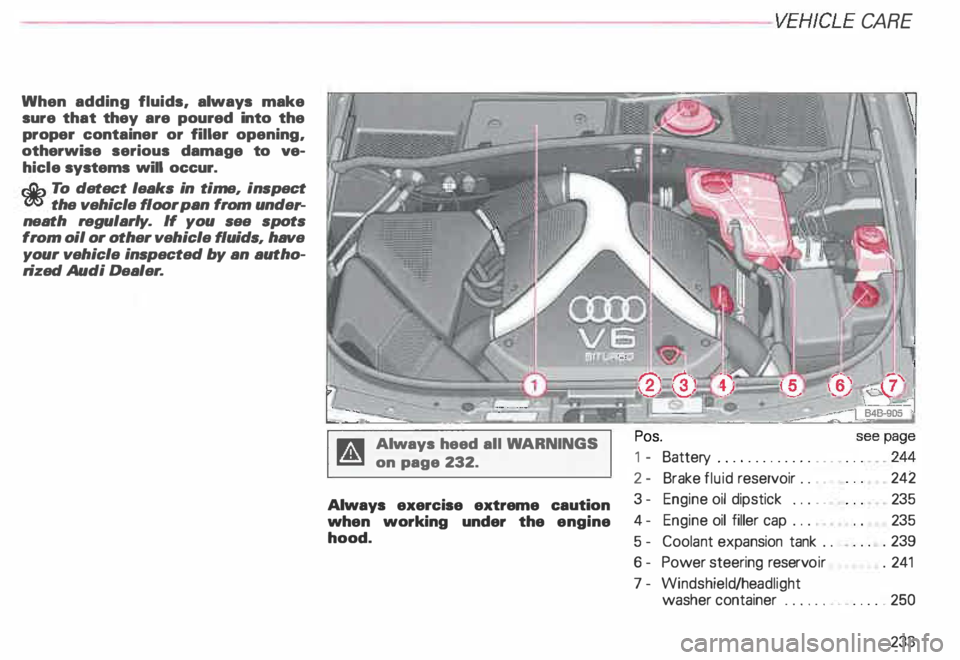
Pos.
1 - Battery ............. . _ .. .. .
2- Brake fluid reservoir . . . 242
3 - Engine oil dipstick ... . _ 235
4- Engine oil filler cap . . . 235
5- Coolant expansion tank . . . 239
6 - Power steering reservoir .
241
7 - Windshield /headlight
washer container ......•• _ .... . 250
233
Page 245 of 306
VE
HICLE CA
RE----------------------------------------------------
Battery
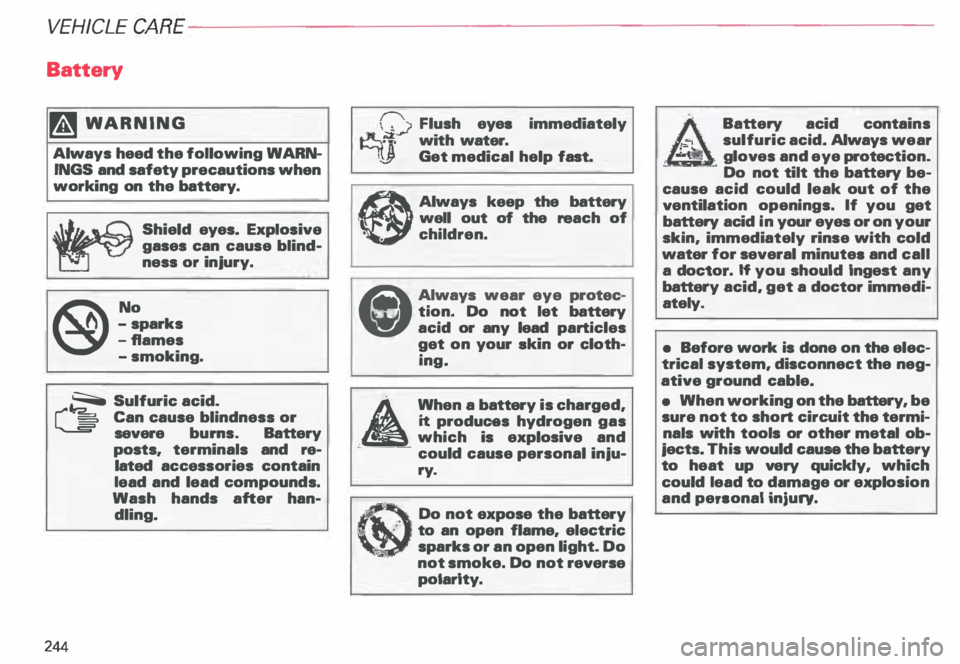
�W ARNING
Always heed the following WARN
INGS and safety precautions when
working on the battery.
Shield eyes. Explosive
gases can cause blind
ness or injury.
@ No
-s parks
-f lames
-s moking.
� Sulfuric acid.
� Can cause blindness or
severe bums. Battery
posts, terminals and re
lated accessories contain
lead and lead compounds.
Wash hands after han dling.
244
() Flush eyes immediately
�i'l with water.
� Get medical help fast.
@ Always keep the battery
well out of the reach of
children.
f) Always wear eye protec
tion. Do not let battery
acid or any lead particles
get on your akin or cloth
ing.
A . When a battery is charged,
it
produces hydrogen gas
. which is explosive and
·
could cause personal inju
ry.
® Do not expose the battery
to an open flame, electric
"""' sparks or an open light. Do
not smoke. Do not reverse
polarity.
&·. Battery acid contains
sulfuric acid. Always wear
gloves and eye protection.
Do not tilt the battery be
cause acid could leak out of the
ventilation openings. If you get
battery acid in your eyes or on your
skin, immediately rinse with cold
water for several minutes and call
a doctor. If you should ingest any
battery acid, get a doctor immedi
ately.
• Before work is done on the elec
trical system, disconnect the neg
ative ground cable.
• When working on the battery, be
sure not to short circuit the termi
nals with tools or other metal ob
jects. This would cause the battery
to heat up very quickly, which
could lead to damage or expl osion
and personal injury.
Page 246 of 306
-------------------------VEHICL E CA RE
Do not disconnect the vehicle bat
tery when the ignition is switched
on or when the engine is running.
Otherwise, you will damage elec
tronic components in the electrical
system.
When working on the engine, pro
tect the battery housing from ultra
violet (UV) rays by not parking the
vehicle in direct sunlight. Winter
operation
During the winter months, battery capacity
tends to decrease as temperatures drop.
More power is also consumed while start
ing, and the headli ghts, rear window defog
ger, etc., are used more often.
Av oid unne cessary power consumption,
particularly in city traffic or when trave:ling
only short distances. Let your authonzed
Audi Dealer check the capacity of the ve
hicle battery before winter sets in. A well
charged battery will not only prevent start
ing problems but will also last longer.
If your vehicle is left standing for
several weeks at extremely low tem
peratures, the vehicle battery
should be removed and stored
where it will not freeze. This will
prevent it from being damaged. Location
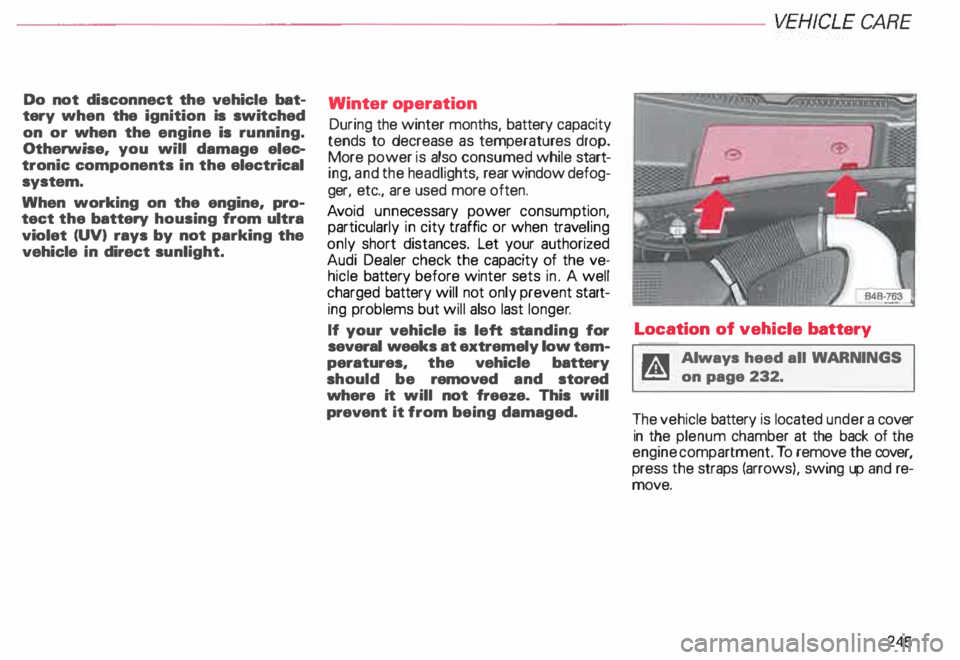
of vehicle battery
g Always heed all WAR NINGS
� on page 232.
The vehicle battery is located under a cover
in the plenum chamber at the back of the
engine compartment. To remove the cover,
press the straps (arrows ), swing up and re
move.
245
Page 247 of 306
VEHICLE CA
RE---------------------------------------------------
Battery acid level
g Always heed all WA RNINGS
� on page 232.
Under normal operating conditions, the
battery in your Audi does not need any
maintenance.
At high outside temperatures it is advisable,
however, to check the fluid level at regular
intervals through the transparent battery
housing. Also check the fluid level each
time you charge the battery.
The fluid level should always be between
the "min" and "max" marks in each cell.
If the fluid level has reached the "min"
marks, let your authorized Audi Dealer cor
rect the condition.
�W ARNIN G
• Always shield your eyes and
avoid leaning over the battery
whenever possible.
• Do not let battery acid come in
contact with skin, eyes, fabric, or
painted surfaces.
246 ��
WARNING continued
• If you get battery acid in your
eyes or on your skin, immediately
rinse with cold water for several
minu tes and call a doctor.
• Do not expose the battery to an
open flame or electric spark.
Hydrogen gas generated by the
battery can explode and cause per
sonal injury.
Note Do not overfill the battery. Other
wise battery acid will overflow
through the vent opening. This will
damage the paint and cause corro
sion.
�W ARNIN G
Battery posts, terminals and re
lated accessories contain lead and
lead compounds. Wash hands af
ter handling. Charging
of battery
�W ARNING
• The battery contains sulfuric
acid. Therefore, keep battery out
of reach of children.
• Charge the battery in a well ven
tilated area. Keep away from open
flame or electrical spark. Do not
smoke. Hydrogen gas generated
by the battery is explosive.
• Always shield your eyes and
avoid leaning over the battery
whenever possible.
• If you gat battery acid in your
eyes or on your skin, immediately
rinse with cold water for several
minu tes and call a doctor.
• Fast charging a battery is dan
gerous and should only be at
tempted by a competent mechanic
with the proper equipment.
Page 248 of 306

f4 WARNING
continued
• Never charge a frozen battery. It
may explode because of gas
trapped in the ice. Allow a frozen
battery to thaw out first.
• Do not reuse batteries which
have fr ozen. The baUery housing
may have cracked and weakened
when the battery froze.
Always heed all WA RNINGS
on page 232.
• Battery acid that may spill during
charging should be washed off with
a solution of warm water and baking
soda to neutralize the acid.
• Never use a fast charger as a boo
ster to start the engine. This will se
riously damage sensitive electronic
components, such as control units,
relays, radio, etc., as well as the bat
tery charger. Slow
battery charging
�W ARNING
Heed all WA RNINGS and follow in
structions that come with your
battery charger.
• Before charging the battery, switch off
the ignition and all electrical consumers.
• Make sure the area is well ventilated
when you charge the battery.
• It is not necessary to remove the battery
from the engine compartment, and it is also
not necessary to disconn ect the cables.
• Make sure the electrolyte level in each
cell is between the .. min" and "max ..
marks. If the fluid level is below the "min"
mark, let your authorized Audi Dealer cor
rect the condition. VE
HICLE CARE
• Conne ct charger cables.
Charger cables must be connected
POSITIVE (+ ) to POSITIVE (+ ) and
NEGATIVE (-) to NEGATIVE (-).
�W ARNING
To reduce the danger of explosion,
never connect or disconnect char
ger cables while the charger is op
erating.
• Switch on charger.
• Charging rate not over 6 amps.
Normal ly, a battery should be charged at no
more than 1 0 percent of its rated capacity.
For example, a charging current of 4.5 amps
would be used on a battery rated at 45 Ah.
Rated capacity of the battery in your vehicle
is listed on the battery housing.
• After charging, first turn off the charger
and then disconnect charger cables. g Always heed all WARNINGS
� on page 232.
247
Page 249 of 306
VEHICLE CA
RE----------------------------------------------------
When disconnecting and
connecting the battery ...
When you disconnect the vehicle battery
please note the following:
- some data stored in the driver informa-
tion system are erased,
- the clock goes out,
- the factory installed radio locks up,
- the Engine management system,
- the one-touch-u p and one-touch-down
functions of the power windows no lon
ger work,
- all stored seat positions in the memory*
are erased.
Af teryou reconnect the battery, you must
reset the clock. � page 118.
You also have to reset the Engine manage
ment system -see "Starter Switch "
�pa ge 113.
You also have to reset the one-touch-up and
one-touch�down feature on power win
dows -see "Power windows "
�p age 71.
248 You
have also reset the seat memory* -see
"Seats"
� page 81.
The radio must be re-coded with the correct
radio code - see your radio Operating In
structions.
Replacement battery
A replacement battery must have the same
specifications and dimensions as the origi
nal equipment battery. Specifications are
listed on the battery housing.
When installing the battery, make sure the
ignition and all electrical consumers are
switched off.
r.Gb. Because of the problem of �proper di
sposal of a battery, we
recommend that you have your au
thorized Audi Dealer change the
battery for you. Batteries contain
sulfuric acid and lead and must al
ways be disp osed of properly ob
serving all environmental regula
tions. Air
cleaner
A dir ty air cleaner element not only reduces
the engine output and increases fuel con
sumption considerably but can also cause
premature engine wear.
Normally, it is not necessary to service the
air cleaner more often than recommended
in the Maintenance booklet. If the vehicle is
driven on very dusty roads, the air cleaner
must be serviced more frequently, even dai
ly.
If your air cleaner element must be
changed mora frequently, we rec
ommend that you have the air clean
er serviced by your authorized Audi
Dealer or a qualified workshop.
The air cleaner element must never
be cleaned or soaked with gasoline,
cleaning solvents or oil.
g Always heed all WARN INGS
t!!3 on page 232.
Page 279 of 306
DO-IT-Y
OURSELF SERVICE----------------------
Emergency starting
Note
Starting by pushing or towing
Yo ur vehicle with automatic trans
mission cannot be started by push
ing or towing.
Star ting with jumper cables
�W ARNING
• Batteries contain electricity.
acid. and gas. Any of these can
cause vary serious or fatal injury.
Follow the instructions below for
safe handling of your vahicle"s bat·
tery.
• Always shield your ayes and
avoid leaning over the battery
whenever possible.
278 �,
WAR NING continued
• A discharged battery can al
ready freeze at temperatures just
below 32 °F (0 °C). Before connect·
ing a jumper cable. the frozen bat
tery must be thawed completely.
otherwise it could explode.
• Do not allow battery acid to con·
tact ayes or skin. Flush any con
tacted area with water immediate
ly.
• Improper use of a booster bat
tery to start a vehicle may cause an
explosion.
• Vehicle batteries generate ex
plosive gases. Keep sparks. flame
and lighted cigarettes away from
batteries.
• Do not try to jump start any ve
hicle with a low acid level in the
battery. ,Al
WARNING continued
• The voltage of the booster bat
tery must also have a 12- Volt rat
ing.
The capacity (Ah) of the booster
battery should not be lower than
that of the discharged battery. Use
of batteries of different voltage or
substantially different Ah rating
may cause an explosion and per
sonal injur y.
• Use of batteries of different
voltage or substantially different
amp. (Ah) rating may causa an ex
plosion and Injury. The capacity
(Ah) of the booster battery should
not be lower than that of the dis
charged battery.