2000 AUDI ALLROAD oil level
[x] Cancel search: oil levelPage 198 of 306
----------------------VEHICLE
OPERATION
,:lib Remove
supplementary roof
� rack components when not In
use.
At high road speeds, the increased air �e
sistance caused by the cross bars also In
creases fuel consumption.
,:lib Switch oH any electrical equip
� ment when no longer needed.
The more electricity you consume, the
higher the fuel consumption.
,:lib Check your vehicle 's fuel co?'l!�Sr sumption regularly. Keep a writ
ten record or use the trip odometer .
Check your fuel consumption ea?h time you
refu el. By doing this, you can d1scov �r a �y
inc onsistencies which could result 1n In
creased fuel consumption and have these
checked before other problems appear. •
Check your oil each time you fill
your tank
The amount of oil used is related to engine
load and speed.
It is normal for the oil consumption of a new
engine to reach its lowest value after a cer
tain mileage has been driven.
You must drive your vehicle about 3,000
miles (5 000 kilome tres) before you can
properly assess oil consumption.
This also applies to fuel consumption and
engine output.
• The published ENVIRONME NTAL
PROTECTION AGENCY (EPA) and
Tr ansport Canada consumption esti
mates may not correspond to your
actual consumption on the road.
which will vary depending upon ve
hicle load and speed. road and
weather conditions. trip length. etc. The
catalytic converter is an efficient
"clean-up" device built into the exhaust
system of the vehicle. The catalyttc convert
er burns many of the pollutants in the ex
haust gas before they are released into the
atmosphere.
The exclusive use of unleaded fuel is
critically important fo.r the life of
the catalytic converter and proper
functioning of the engine - see
page 225.
The catalytic converter will be per
manently damaged by:
• Exc eeding the correct engine oil
level - see page 236;
• Driving until the fuel tank be
comes completely empty. The en
gine could misfire. Unburned fuel
could also get into the exhaust sys
tem and this could cause the catalyt
ic converter to overheat;
197
Page 201 of 306

VE
HICL E OPER ATION
Driving on slopes
• If you find that you cannot climb a grade,
never try to turn. Back down the hill in re
verse gear. If you don't. the vehicle may
tip or roll over!
• To reduce the danger of rolling the ve
hicle, drive the vehicle as close as possible
to the "fall line" (direction of maximum
slope) -not at an angle to the fall line.
If it feels like the vehicle is about to
roll over when you are trav eling at
an angle to the fall line, turn into the
fall line immediately.
• Never park your vehicle on extreme
uphill or down hill slopes.
Deep snow
• You should promptly install wheels
equipped with winter or all-season tires
when you expect winter road conditions -
see page 260.
• Install snow chains before attempting to
drive through deep, unplowed snow - see
page 261.
200 Driving
through water
• Always make certain that the ride level
system is in the highest level before cross
ing streams and similar water obstacles.
• You should always determine how deep
the water is before you drive through it.
• When crossing through water, travel only
at a walking speed. If possible, do not
stop and do not shut off the engine.
• Avo id driving through salt water
(beaches, for example).
After you have traveled through wa
ter, mud or slush, your brakes may
be slow to respond due to wet brake
rotors and pads. To get back the full
braking effectiveness, apply the
brakes cautiously to dry them out
The brakes must be dry before you
can get full brake performance. Sand,
quicksand and similar unsta
ble soils
Cross sandy or other unstable terrain briskly
and, if possible, do not stop.
Page 231 of 306
VEHI
CLE CARE
J'4 WARN ING continued
• If you must work underneath
the vehicle with the wheels on the
ground, always make sure the ve
hicle is on level ground. that the
wheels are always securely
blocked and that the engine can
not be started. Always remove the
ignition key before anyone gets
under the vehicle.
Always make sure the transmis
sion selector lever (automatic
transmission) is in "P" (Park posi
tion) and the hand brake is firmly
applied.
• Always be extremely careful
when working on the vehicle. Always follow commonly accepted safety practices and general com
mon sense. Never risk personal in
jury.
230 �
Changing the engine settings
will adversely aHect emission
levels. This Is detrimental to the en
vi ronment and increases fuel con
sumption.
Always observe environmental reg
ulations when disposing of old en
gine oil. used brake fluid, dirty en
gine coolant, spent batteries or
worn out tires.
Page 236 of 306
Engine
oil consumption
The rate of the oil consumption depends on
the quality and viscosity of oil, the speed at
which the engine is operated, the climate,
and road conditions as well as amount of
dilution and oxidation of the lubricant.
Because of these variables, no standard
rate of oil consumption can be established,
but drivers should expect higher oil con
sumption at high speeds and when the en
gine is new.
Therefore, we recommend that you check
the oil level at regular intervals (for example,
each time you are refuelling, or before going
on a long trip).
If the oil level should go below the minimal
level, the check engine oil level warn
ing light* in the instrument cluster will
come on. See page 144. You should check
the oil level using the oil dip stick as soon as
possible, and then top off the oil as neces
sary. Notes
• The engine in your vehicle de
pends on oil to lubricate and cool all
of its moving parts. Therefore the
engine oil should be checked regu
larly and kept at the required level.
• Lack of sufficient engine oil may
lead to severe engine damage.
• The oil pressure warning light is
not an oil level indicator.
A Always
heed all WAR NINGS
� on page 232.
Checking the engine oil level
The best time to check the engine oil level
is when the oil is warm.
To get a true reading, the vehicle must be on
level ground.
A Always heed all WAR NINGS
� on page 232.
• After turning off the engine, wait a few
minu tes for the oil to return to the oil pan. VE
HICLE CARE
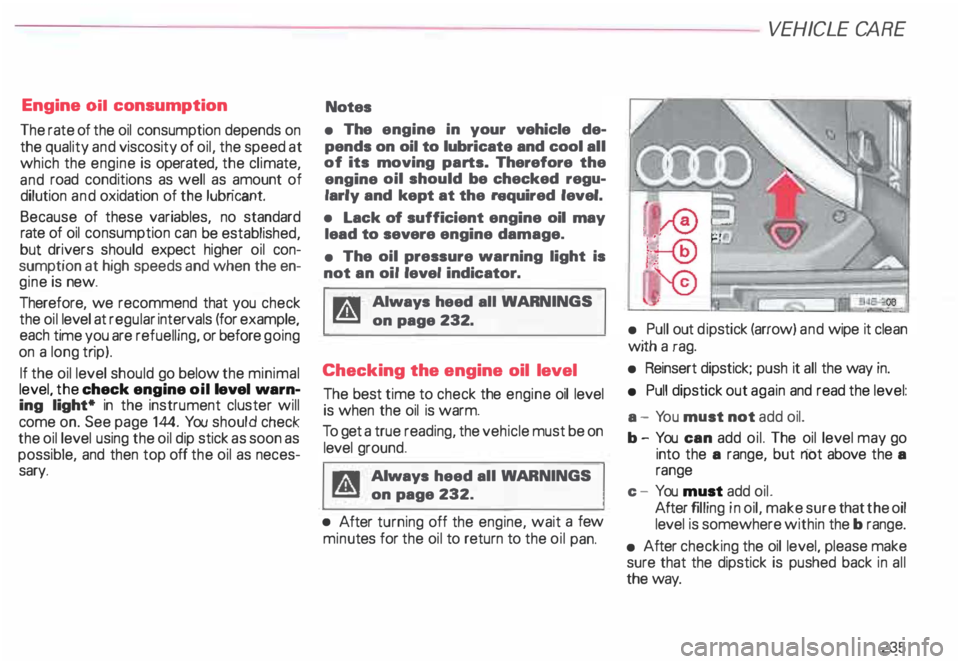
• Pull out dipstick (arrow) and wipe it clean
with a rag.
• Reinsert dipstick; push it all the way in.
• Pull dipstick out again and read the level:
a - Yo u must not add oil.
b- You can add oil. The oil level may go
into the a range, but riot above the a
range
c - You must add oil.
After filling in oil, make sure that the oil
level is somewhere within the b range.
• After checking the oil level, please make
sure that the dipstick is pushed back in all
the way.
235
Page 237 of 306
VEHICLE CA
RE---------------------------------------------------
Adding engine oil
A Always heed all WA RNINGS
r!!J on page 232.
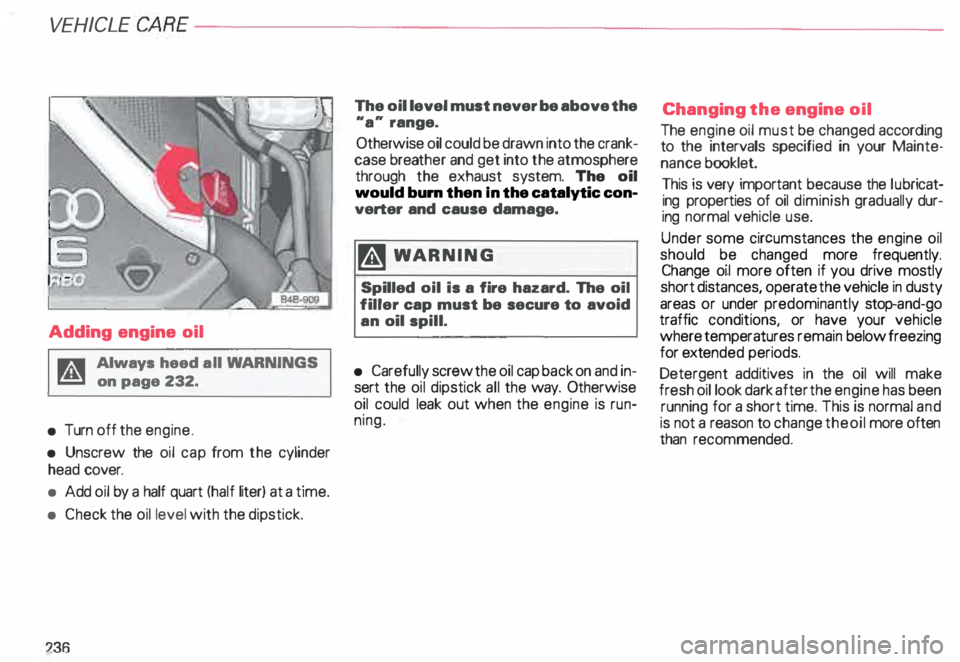
• Turn off the engine.
• Unscrew the oil cap from the cylinder
head cover.
• Add oil by a half quart (half liter) at a time.
• Check the oil level with the dipstick.
:236 The
oil level must never be above the
"a .. range.
Otherwise oil could be drawn into the crank
case breather and get into the atmosphere
through the exhaust system. The oil
would bum then In the catalytic con
verter and cause damage.
� WARNING
Spilled oil is a fire hazard. The oil
filler cap must be secure to avoid
an oil spill.
• Carefully screw the oil cap back on and in
sert the oil dipstick all the way. Otherwise
oil could leak out when the engine is run
ning. Changing
the engine oil
The engine oil must be changed according
to the intervals specified in your Mainte
nance booklet.
This is very important because the lubricat
ing properties of oil diminish gradually dur
ing normal vehicle use.
Under some circumstances the engine oil
should be changed more frequently.
Change oil more often if you drive mostly
short distances, operate the vehicle in dusty
areas or under predominantly stop-and-go
traffic conditions, or have your vehicle
where temperatures remain below freezing
for exte nded periods.
Detergent additives in the oil will make
fresh oil look dark after the engine has been
running for a short time. This is normal and
is not a reason to change the oil more often
than recommended.
Page 240 of 306
Checking the
engine coolant
level
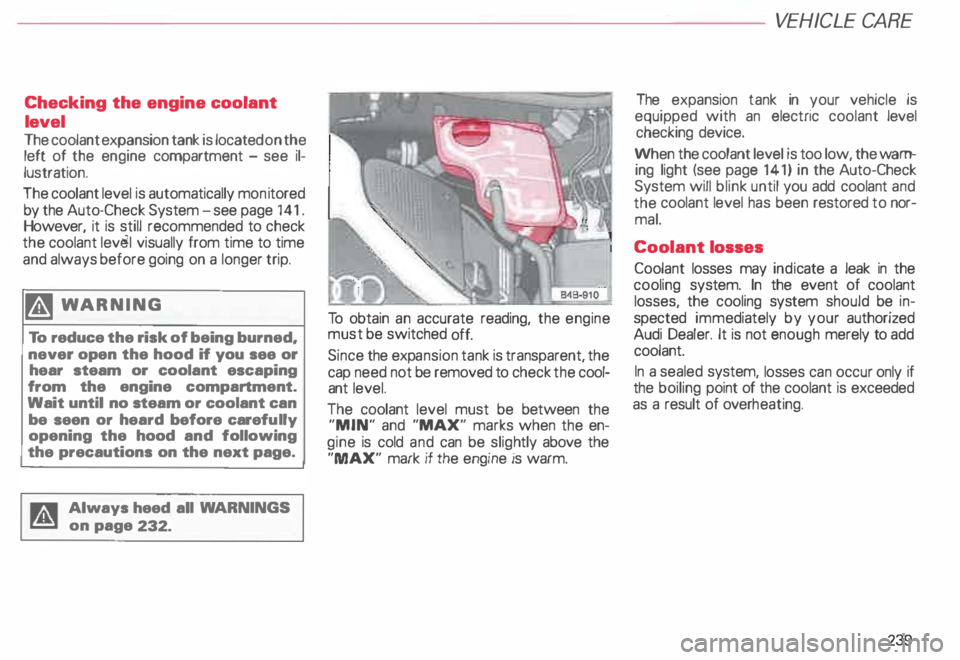
The coolant expansion tank is located on the
left of the engine compartment -see il
lustration.
The coolant level is automatically monitored
by the Auto-Check System -see page 141.
However, it is still recommended to check
the coolant lev�l visually from time to time
and always before going on a longer trip.
�W ARNING
To reduce the risk of being burned.
never open the hood if you see or
hear steam or coolant escaping
from the engine compartment.
Wait until no steam or coolant can
be seen or heard before carefully
opening the hood and following
the precautions on the next page.
Always heed all WA RNINGS
on page 232. To
obtain an accurate reading, the engine
must be switched off.
Since the expa nsion tank is transparent, the
cap need not be removed to check the cool
ant level.
The coolant level must be between the
"MIN" and "MAX" marks when the en
gine is cold and can be slig htly above the
"MAX" mark if the engine is warm. VE
HICLE CARE
The expansion tank in your vehicle is
equipped with an electric coolant level
checking device.
When the coolant level is too low, the warn
ing light (see page 141) in the Auto-Check
System will blink until you add coolant and
the coolant level has been restored to nor
mal.
Coolant losses
Coolant losses may indicate a leak in the
cooling system. In the event of coolant
losses, the cooling system should be in
spected immediately by your authorized
Audi Dealer. It is not enough merely to add
coolant.
In a sealed system, losses can occur only if
the boiling point of the coolant is exceeded
as a result of overheating.
239
Page 243 of 306
VE
HICLE CA
RE----------------------------------------------------
Brake fluid
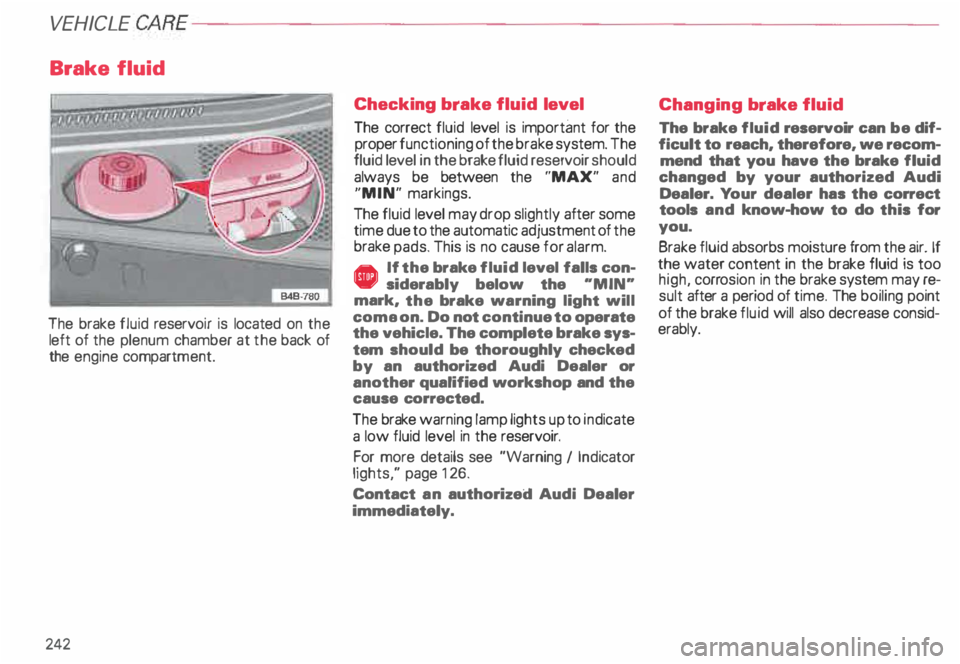
The brake fluid reservo ir is located on the
left of the plenum chamber at the back of
the engine compartm ent.
242 Checking
brake fluid level
The correct fluid level is important for the
proper functioning of the brake system. The
fluid level in the brake fluid reservoir should
always be between the "MAX" and
"MIN" markings.
The fluid level may drop slightly after some
time due to the automatic adjustment of the
brake pads. This is no cause for alarm.
• If the brake fluid level falls con
siderably below the "MIN"
mark, the brake warning light will
coma on. Do not continue to operate
the vehicle. The complete brake sys
tem should be thoroughly checked
by an authorized Audi Dealer or
another qualified workshop and the
cause corrected.
The brake warning lamp lights up to indicate
a low fluid level in the reservoir.
For more details see "Warning I Ind icator
lights," page 126.
Contact an authorized Audi Dealer
immediately. Changing
brake fluid
The brake fluid reservoir can be dif
ficult to reach, therefore, we recom
mend that you have the brake fluid
changed by your authorized Audi
Dealer. Your dealer has the correct
tools and know-how to do this for
you.
Brake fluid absorbs moisture from the air. If
the water content in the brake fluid is too
high, corrosion in the brake system may re
sult after a period of time. The boiling point
of the brake fluid will also decrease consid
erably.
Page 260 of 306
-------------------------VEHICLE
CARE
Te mperature
The temperature grades are A (the highest),
8, and C, repres enting the tire's resistance to
the generation of heat and its ability to dissi
pate heat when tested under contro lled con
ditions on a specified indoor laboratory test
wheel. Sustained high temJ)erature can
cause the material of the tire to degenerate
and reduce tire life, and excessive tempera
ture can lead to sudden tire failure. The
grade C corres ponds to a level of perfor
mance which all passenger car tires must
meet under the Federal Motor Vehicle Safety
Sta ndard No. 1 09. Grades Band A represent
higher levels of performance on the laborato
ry test wheel than the minimum required by
law.
�W ARNIN G
The temperature grade for this tire
is est ablished for a tire that is
properly inflated and not over
loaded. Excessive speed, under
inflation, or excessive loading, ei
ther separately or in combination,
can causa heat buildup and pos
sible tire failure. Wheel
replacement
If you wish to equip your vehicle with tires
or wheels other than those installed at the
factory, please note the following:
• For technical reasons it is not al
ways possible to use wheels from
other vehicles -under certain condi
tions not even wheels from the same
vehicle model.
• Wheel rims and wheel bolts are
matched to fit your Audi. When
installing different wheels (for ax
ample, wheels with winter tires), the
correct wheel bolts with the proper
length and conical shape of the bolt
head must be used. The secure fit of
the wheels and the proper function
ing of the brake system and safety
are dependent upon this.
• Wheel rims and wheal bolts are
matched to fit your Audi. •
Before you plan on exchanging
steel wheels, light alloy wheals, or
winter tires already mounted on
wheel rims, consult your authorized
Audi Dealer. They have the technical
information necessary to advise you
which wheal rims and wheel bolts
are compatible with the original fac
tory installations.
1ft WARNING
• Incorrect tire/wheel parts may
cause an accident and personal in
jury. Such parts will adversely af
fect the safe operation of your ve
hicle. Always use tires, wheel rims
and wheel bolts that meat specifi
cations of the original factory
installed equipment.
• If wheel trim discs or a front
spoiler are Installed, make sura the
airflow for cooling the brakes is
not obstructed.
259