1999 TOYOTA LAND CRUISER warning light
[x] Cancel search: warning lightPage 90 of 202
New L/C100(U)
98
CAUTION
To restore the park function, shift the
four- wheel drive control out of ºNº,
or the vehicle can move.
(k) Automatic Transmission Fluid Tem- perature Warning Light
This light warns that the automatic trans-
mission fluid temperature is too high.
If this light comes on while you are driv-
ing, slow down and pull off the road. Stop
the vehicle at a safe place and put the
selector lever in ºPº and leave the engine
idling until the light goes off. If the light
goes off, you can start the vehicle again.
If the light does not go off, call a Toyota
dealer or qualified repair shop for assis-
tance.
NOTICE
Continued driving with the warning light on may damage the automatictransmission.
(l) Key Reminder Buzzer
This buzzer reminds you to remove the
key when you open the driver 's door with
the ignition key in the ºACCº or ºLOCKº
position.
CHECKING SERVICE REMINDER INDICA-
TORS (except the low fuel level warning
light)
1. Apply the parking brake.
2. Open one of the side doors or back door.
The open door warning light should
come on.
3. Close the door. The open door warning light should go
off.
4. Place the four- wheel drive control lever in ºNº position and the selector lever
in ºPº position. 5. Turn the ignition key to ºACCº.
The SRS warning light should come on.
It goes off after 6 seconds.
6. Turn the ignition key to ºONº, but do not start the engine.
All the service reminder indicators ex-
cept the open door warning light and
SRS warning light should come on. The
ºABSº warning light goes off after a
few seconds.
There may be the case that the ºABSº
warning light stays on for about 60
seconds after the engine is started. It
is normal if it goes out after a while.
If any service reminder indicator or warn-
ing buzzer does not function as described
above, either the bulb is burned out or the
circuit is in need of repair. Have it
checked by your Toyota dealer as soon as
possible.
Page 98 of 202
New L/C100(U)
106
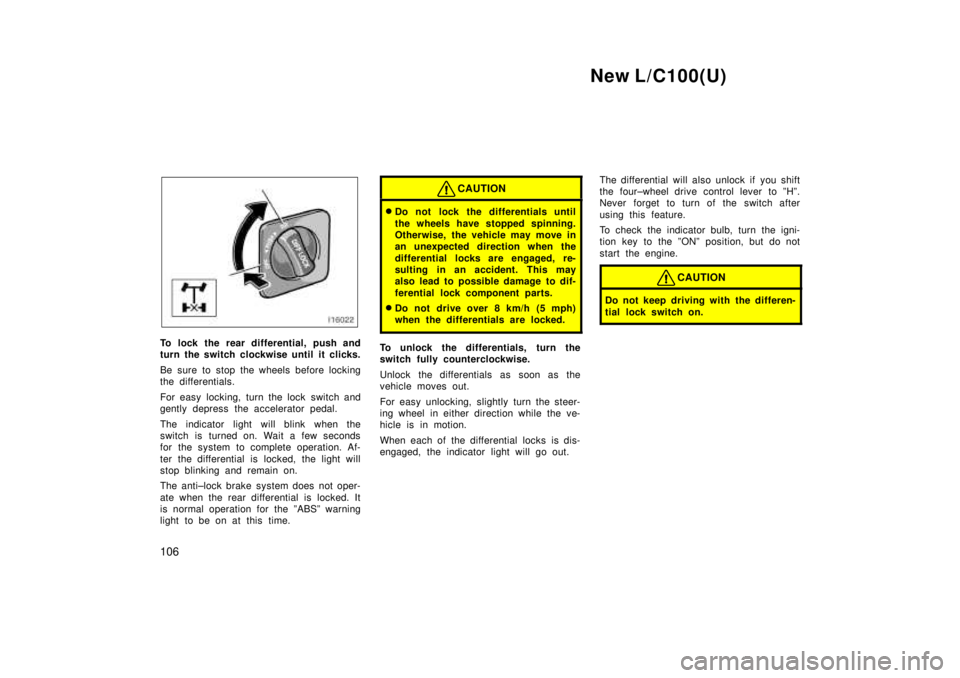
To lock the rear differential, push and
turn the switch clockwise until it clicks.
Be sure to stop the wheels before locking
the differentials.
For easy locking, turn the lock switch and
gently depress the accelerator pedal.
The indicator light will blink when the
switch is turned on. Wait a few seconds
for the system to complete operation. Af-
ter the differential is locked, the light will
stop blinking and remain on.
The anti±lock brake system does not oper-
ate when the rear differential is locked. It
is normal operation for the ºABSº warning
light to be on at this time.
CAUTION
Do not lock the differentials until
the wheels have stopped spinning.
Otherwise, the vehicle may move in
an unexpected direction when the
differential locks are engaged, re-
sulting in an accident. This may
also lead to possible damage to dif-
ferential lock component parts.
Do not drive over 8 km/h (5 mph)
when the differentials are locked.
To unlock the differentials, turn the
switch fully counterclockwise.
Unlock the differentials as soon as the
vehicle moves out.
For easy unlocking, slightly turn the steer-
ing wheel in either direction while the ve-
hicle is in motion.
When each of the differential locks is dis-
engaged, the indicator light will go out. The differential will also unlock if you shift
the four±wheel drive control lever to ºHº.
Never forget to turn of the switch after
using this feature.
To check the indicator bulb, turn the igni-
tion key to the ºONº position, but do not
start the engine.
CAUTION
Do not keep driving with the differen-
tial lock switch on.
Page 101 of 202
New L/C100(U)109
RESETTING AT A FASTER SPEED
Push the lever up in the ºRES/ACCº direc-
tion and hold it. Release the lever when
the desired speed is attained. While the
lever is held up, the vehicle will gradually
gain speed.
However, a faster way to reset is to ac-
celerate the vehicle and then push the
control lever down in the ºSET/COASTº
direction.
RESETTING AT A SLOWER SPEED
Push the lever down in the ºSET/COASTº
direction and hold it. Release the lever
when the desired speed is attained. While
the lever is held down, the vehicle speed
will gradually decrease.
However, a faster way to reset is to de-
press the brake pedal and then push the
control lever down in the ºSET/COASTº
direction.
Even if you downshift the transmission by
turning off the overdrive switch, with the
cruise control on, engine braking will not
be applied because the cruise control is
not cancelled. To decrease the vehicle
speed, reset to a slower speed with the
cruise control lever or depress the brake
pedal. If you use the brake pedal, cruise
control is cancelled.
RESUMING THE PRESET SPEED
If the preset speed is cancelled by pu
lling
the control lever or by depressing the
brake pedal or clutch pedal, pushing the
lever up in the ºRES/ACCº direction will
restore the speed set prior to cancellation.
However, once the vehicle speed falls be-
low about 40 km/h (25 mph), the preset
speed will not be resumed.
CRUISE CONTROL FAILURE WARNING
If the ºCRUISEº indicator light in the
instrument cluster flashes when using the
cruise control, press the ºCRUISE
ON´OFFº button to turn the system off and
then press it again to turn it on. If any of the following conditions then oc-
curs, there is some trouble in the cruise
control system.
The indicator light does not come on.
The indicator light flashes again.
The indicator light goes out after it
comes on.
If this is the case, contact your Toyota
dealer and have your vehicle inspected.
Page 150 of 202
New L/C100(U)
158
For detailed information on oil level check,
see ºChecking the engine oil levelº in
Chapter 7- 2.
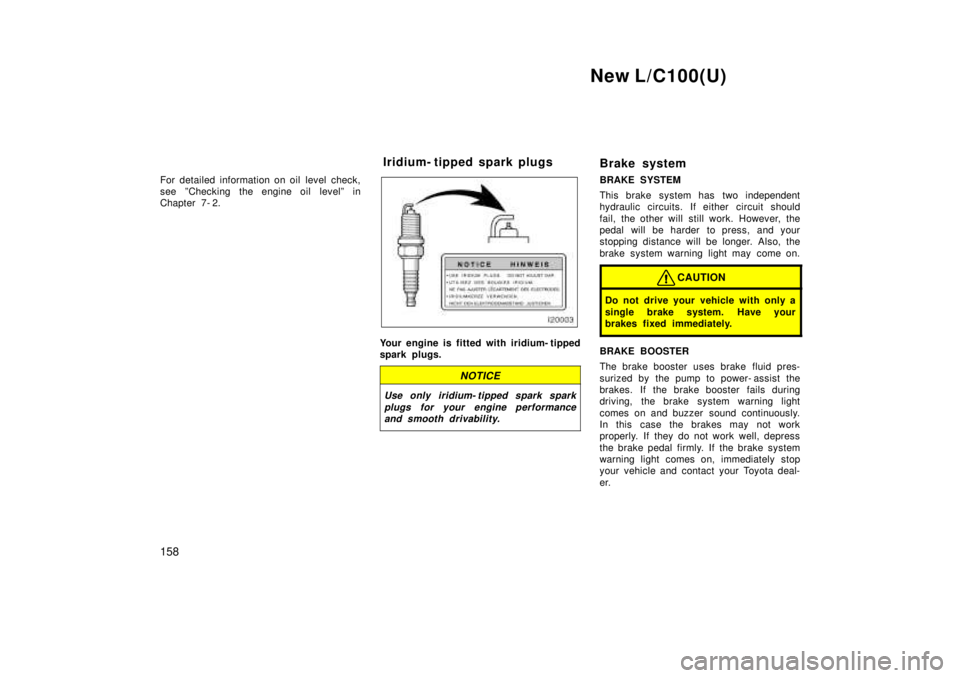
Your engine is fitted with iridium- tipped
spark plugs.
NOTICE
Use only iridium- tipped spark spark
plugs for your engine performanceand smooth drivability.
Brake system
BRAKE SYSTEM
This brake system has two independent
hydraulic circuits. If either circuit should
fail, the other will still work. However, the
pedal will be harder to press, and your
stopping distance will be longer. Also, the
brake system warning light may come on.
CAUTION
Do not drive your vehicle with only a
single brake system. Have your
brakes fixed immediately.
BRAKE BOOSTER
The brake booster uses brake fluid pres-
surized by the pump to power- assist the
brakes. If the brake booster fails during
driving, the brake system warning light
comes on and buzzer sound continuously.
In this case the brakes may not work
properly. If they do not work well, depress
the brake pedal firmly. If the brake system
warning light comes on, immediately stop
your vehicle and contact your Toyota deal-
er.
Iridium- tipped spark plugs
Page 151 of 202
New L/C100(U)159
There may be the case that the brake
system warning light stays on for a
bout
60 seconds after the engine is started. It
is normal if the light goes out after a
while.
Depressing the brake pedal repeatedly
may turn on the brake system warning
light and buzzer. It is normal if the light
goes out and the buzzer stops sounding
after a few seconds.
You may hear a small sound in the engine
compartment after the engine is started or
the brake pedal is depressed repeatedly.
This is a pump pulsating sound of the
brake system, and it is not a malfunction.
CAUTION
Do not pump the brake pedal if the
engine stalls. Each push on the
pedal uses up your brake fluid
pressure reserve.
Even if the power assist is com-
pletely lost, the brakes will still
work. But you will have to push the
pedal hardÐmuch harder than nor-
mal. And your braking distance will
be longer.
ANTI- LOCK BRAKE SYSTEM (with
ºABSº warning light)
The anti-lock brake system is designed to
automatically help prevent lock-up of the
wheels during sudden braking or braking
on slippery road surfaces. This assists in
providing directional stab ility and steering
performance of the vehicle under these
circumstances.
The anti- lock brake system becomes op-
erative after the vehicle has accelerated
to a speed in excess of approximately 10
km/h (6 mph). It stops operating when the
vehicle decelerates to a speed below
approximately 5 km/h (3 mph).
You may hear a sound in the engine
compartment for a few seconds when the
engine is started or just after the vehicle
is started. This means that the anti- lock
brake system is in the self check mode,
and does not indicate a malfunction.
Effective way to press the ºABSº brake
pedal: When the anti- lock brake system
function is in action, you may feel the
brake pedal pulsating and hear a noise.
In this situation, to let the anti- lock
brake system work for you, just hold the
brake pedal down more firmly. Do not
pump the brake in a panic stop. Pump-
ing the brake pedal makes the stopping
distance longer.
The brake pedal pulsation caused by the
anti- lock brake system may indicate haz-
ardous road surface conditions. Although
the anti- lock brake system assists in pro-
viding vehicle control, it is still important
to drive with all due care, because the
anti- lock brake system cannot overcome
the laws of physics that act on your ve-
hicle: Braking capab ility is dependent on tire
friction with the road surface.
Even though the anti- lock brake sys-
tem is operating, a driver cannot main-
tain full control on certain slippery road
surfaces, when cornering at high
speeds, or in violent maneuvers.
Page 152 of 202
New L/C100(U)
160
Avoid high speeds on wet roads. The
anti- lock brake system cannot elimi-
nate the risk of hydroplaning and loss
of tire friction.
Always maintain a safe distance from the
vehicle in front of you. Compared with
vehicles not fitted with an anti- lock brake
system, your vehicle may r equire a longer
stopping distance in the following cases:
Driving on rough, gravel or snow- cov-
ered roads.
Driving with tire chains installed.
Driving on roads where the road sur-
face is pitted or has other differences
in surface height.
CAUTION
Do not use tires other than the
manufacturer 's designated tires, and
do not mix tires or wheels of differ-
ent sizes. You may prevent the anti-
lock brake system from operating at
full effectiveness.
Vehicles with rear differential lock sys-
tem 'The anti- lock brake system does not
operate when the rear differential is
locked. It is normal operation for the
ºABSº warning light to be on at this time.
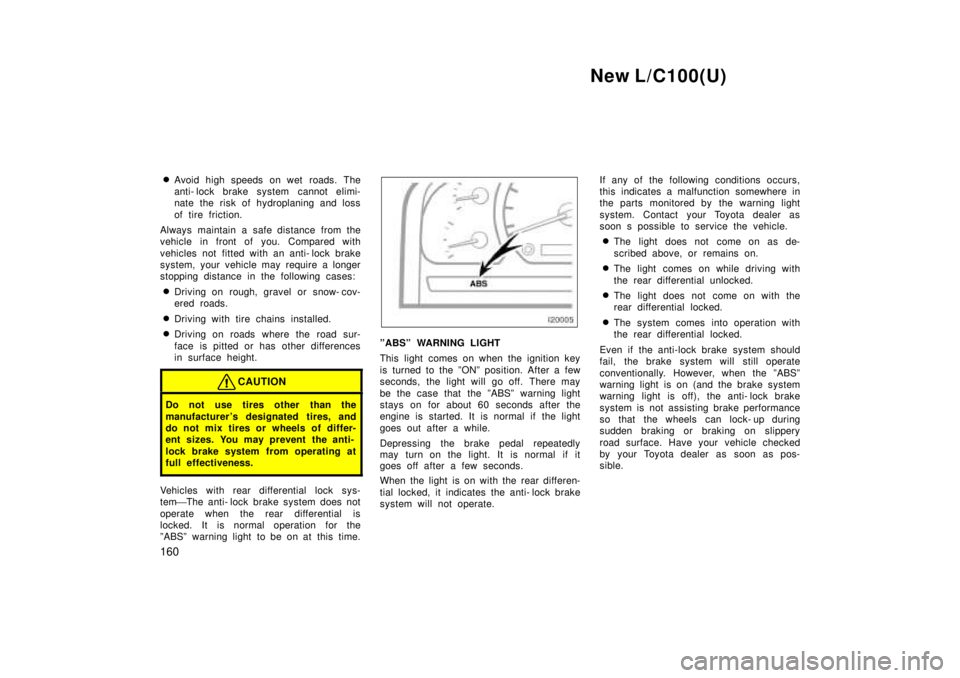
ºABSº WARNING LIGHT
This light comes on when the ignition key
is turned to the ºONº position. After a few
seconds, the light will go off. There may
be the case that the ºABSº warning light
stays on for about 60 seconds after the
engine is started. It is normal if the light
goes out after a while.
Depressing the brake pedal repeatedly
may turn on the light. It is normal if it
goes off after a few seconds.
When the light is on with the rear differen-
tial locked, it indicates the anti- lock brake
system will not operate. If any of the following conditions occurs,
this indicates a malfunction somewhere in
the parts monitored by the warning light
system. Contact your Toyota dealer as
soon s possible to service the vehicle.
The light does not come on as de-
scribed above, or remains on.
The light comes on while driving with
the rear differential unlocked.
The light does not come on with the
rear differential locked.
The system comes into operation with
the rear differential locked.
Even if the anti-lock brake system should
fail, the brake system will still operate
conventionally. However, when the ºABSº
warning light is on (and the brake system
warning light is off), the anti- lock brake
system is not assisting brake performance
so that the wheels can lock- up during
sudden braking or braking on slippery
road surface. Have your vehicle checked
by your Toyota dealer as soon as pos-
sible.
Page 181 of 202

New L/C100(U)209
Tire surface and wheel nuts
Check the tires carefully for cuts, damage
or excessive wear. See Chapter 7- 2 for
additional information. When checking the
tires, make sure no nuts are missing, and
check the nuts for looseness. Tighten
them if necessary.
Tire rotation
Rotate the tires every 12000 km (7500
miles). See Chapter 7- 2 for additional in-
formation.
Fluid leaks
Check underneath for leaking fuel, oil, wa-
ter or other fluid after the vehicle has
been parked for a while. If you smell fuel
fumes or notice any leak, have the cause
found and corrected immediately.
Doors and engine hood
Check that all doors and back door oper-
ate smoothly and all latches lock securely.
Make sure the engine hood secondary
latch secures the hood from opening when
the primary latch is released.
INSIDE THE VEHICLE
Items listed below should be checked
regularly, e.g. while performing periodic
services, cleaning the vehicle, etc.
Lights
Make sure the headlights, stop lights, tail
lights, turn signal lights, and other lights
are all working. Check headlight aim.
Service reminder indicators and warning
buzzers
Check that all service reminder indicators
and warning buzzers function properly.
Steering wheel
Be alert for changes in steering condition,
such as hard steering or strange noise.
Seats
Check that all front seat controls such as
seat adjusters, seatback recliner, etc. op-
erate smoothly and that all latches lock
securely in any position. Check that the
head restraint move up and down smooth-
ly and that the locks hold securely in any
latched position. For folding- down rear
seatbacks, swing- up rear seat cushions
and detachable third seats, check that the
latches lock securely.Seat belts
Check that the seat belt system such as
buckles, retractors and anchors operate
properly and smoothly. Make sure that the
belt webbing is not cut, frayed, worn or
damaged.
Accelerator pedal
Check the pedal for smooth operation and
uneven pedal effort or catching.
Brake pedal
Check the pedal for smooth operation and
that the pedal has the proper clearance.
Check the brake booster function.
Brakes
At a safe place, check that the brakes do
not pull to one side when applied.
Parking brake
Check that the lever has the proper travel
and that, on a safe incline, your vehicle
is held securely with only the parking
brake applied.
Page 195 of 202
New L/C100(U)245
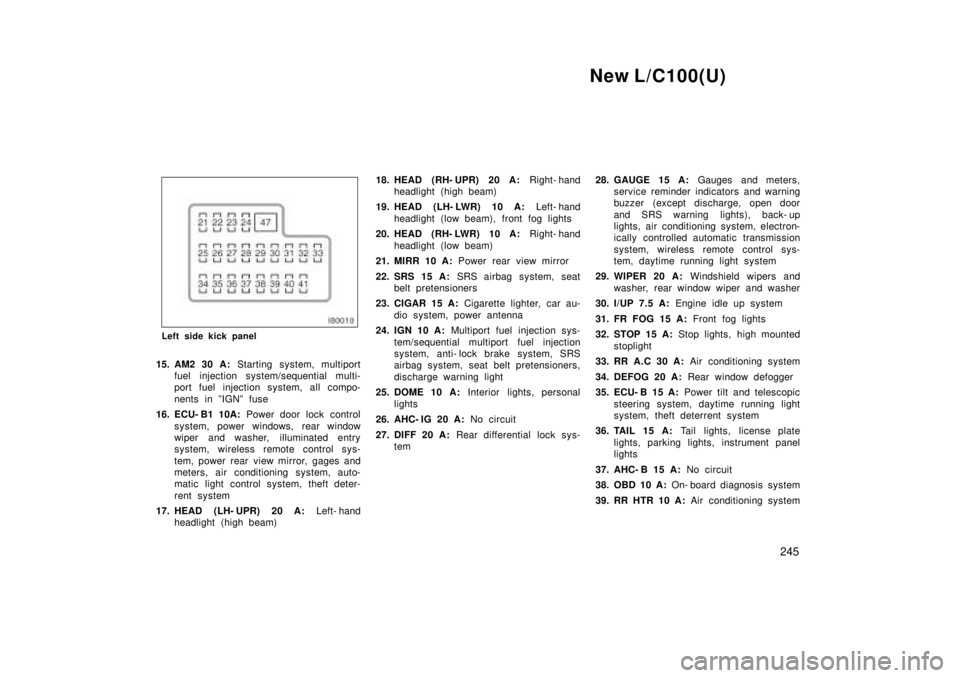
Left side kick panel
15. AM2 30 A: Starting system, multiport
fuel injection system/sequential multi-
port fuel injection system, all compo-
nents in ºIGNº fuse
16. ECU- B1 10A: Power door lock control
system, power wi ndows, rear window
wiper and washer, illuminated entry
system, wireless remote control sys-
tem, power rear view mirror, gages and
meters, air conditioning system, auto-
matic light control system, theft deter-
rent system
17. HEAD (LH- UPR) 20 A: Left- hand
headlight (high beam) 18. HEAD (RH- UPR) 20 A:
Right- hand
headlight (high beam)
19. HEAD (LH- LWR) 10 A: Left- hand
headlight (low beam), front fog lights
20. HEAD (RH- LWR) 10 A: Right- hand
headlight (low beam)
21. MIRR 10 A: Power rear view mirror
22. SRS 15 A: SRS airbag system, seat
belt pretensioners
23. CIGAR 15 A: Cigarette lighter, car au-
dio system, power antenna
24. IGN 10 A: Multiport fuel injection sys-
tem/sequential multiport fuel injection
system, anti- lock brake system, SRS
airbag system, seat belt pretensioners,
discharge warning light
25. DOME 10 A: Interior lights, personal
lights
26. AHC- IG 20 A: No circuit
27. DIFF 20 A: Rear differential lock sys-
tem 28. GAUGE 15 A:
Gauges and meters,
service reminder indicators and warning
buzzer (except discharge, open door
and SRS warning lights), back- up
lights, air conditioning system, electron-
ically controlled automatic transmission
system, wireless remote control sys-
tem, daytime running light system
29. WIPER 20 A: Windshield wipers and
washer, rear window wiper and washer
30. I/UP 7.5 A: Engine idle up system
31. FR FOG 15 A: Front fog lights
32. STOP 15 A: Stop lights, high mounted
stoplight
33. RR A.C 30 A: Air conditioning system
34. DEFOG 20 A: Rear window defogger
35. ECU- B 15 A: Power tilt and telescopic
steering system, daytime running light
system, theft deterrent system
36. TAIL 15 A: Tail lights, license plate
lights, parking lights, instrument panel
lights
37. AHC- B 15 A: No circuit
38. OBD 10 A: On- board diagnosis system
39. RR HTR 10 A: Air conditioning system