1999 TOYOTA LAND CRUISER oil viscosity
[x] Cancel search: oil viscosityPage 149 of 202
New L/C100(U)157
FUNCTIONS OF ENGINE OIL
Engine oil has the primary functions of
lubricating and cooling the inside of the
engine, and plays a major role in main-
taining the engine in proper working order.
ENGINE OIL CONSUMPTION
It is normal that an engine should con-
sume some engine oil during normal
engine operation. The causes of oil
consumption in a normal engine are as
follows.
Oil is used to lubricate pistons, piston
rings and cylinders. A thin film of oil
is left on the cylinder wall when a pis-
ton moves downwards in the cylinder.
High negative pressure generated when
the vehicle is decelerating sucks some
of this oil into the combustion chamber.
This oil as well as some part of the oil
film left on the cylinder wall is burned
by the high temperature combustion
gases during the combustion process.
Oil is also used to lubricate the stems
of the intake valves. Some of this oil
is sucked into the combustion chamber
together with the intake air and is
burned along with the fuel. High tem-
perature exhaust gases also burn the
oil used to lubricate the exhaust valve
stems.
The amount of engine oil consumed de-
pends on the viscosity of the oil, the
quality of the oil and the conditions the
vehicle is driven under.
More oil is consumed by high- speed driv-
ing and frequent acceleration and decel-
eration.
A new engine consumes more oil, since
its pistons, piston rings and cylinder walls
have not become conditioned.
When judging the amount of oil con-
sumption, note that the oil may become
diluted and make it difficult to judge
the true level accurately. As an example, if a vehicle is used for
repeated short trips, and consumes a nor-
mal amount of oil, the dipstick may not
show any drop in the oil level at all, even
after 1000 km (600 miles) or more. This
is because the oil is gradually becoming
diluted with fuel or moisture, making it
appear that the oil level has not changed.
The diluting ingredients evaporate out
when the vehicle is then driven at high
speeds, as on an expressway, making it
appear that oil is excessively consumed
after driving at high speeds.
IMPORTANCE OF ENGINE OIL LEVEL CHECK
One of the most important points in prop-
er vehicle maintenance is to keep the en-
gine oil at the optimum level so that oil
function will not be impaired. Therefore, it
is essential that the oil level be checked
regularly. Toyota recommends that the oil
level be checked every time you refuel
the vehicle.
NOTICE
Failure to check the oil level regularly
could lead to serious engine troubledue to insufficient oil.
Facts about engine oil
consumption
Page 163 of 202
New L/C100(U)171
Winter driving tips
Make sure you have a proper freeze
protection of engine coolant.
Your coolant must contain ethylene- glycol
type coolant for a proper corrosion
protection of aluminum components. Use
ºToyota Long Life Coolantº or equivalent.
See Chapter 7- 2 for details about coolant
type selection.
NOTICE
Do not use alcohol type antifreeze or
plain water alone.
When it is extremely cold, we recommend
to use 60% solution for your Toyota, to
provide protection down to about -50 5C
(- 58 5F). Do not use more than 70% solu-
tion for better coolant performance.
Check the condition of the battery and
cables.
Cold temperatures reduce the capacity of
any battery, so it must be in top shape
to provide enough power for winter start-
ing. Chapter 7- 3 tells you how to visually
inspect the battery. Your Toyota dealer
and most service stations will be pleased
to check the level of charge. Make sure the engine oil viscosity is
suitable for the cold weather.
See Chapter 7- 2 for recommended viscos-
ity. Leaving a heavy summer oil in your
vehicle during winter months may cause
harder starting. If you are not sure about
which oil to use, call your Toyota dealer±
he will be pleased to help.
Keep the door locks from freezing.
Squirt lock de- icer or glycerine into the
locks to keep them from freezing.
Use a washer fluid containing an anti-
freeze solution.
This product is available at your Toyota
dealer and most auto parts stores. Follow
the manufacturer 's directions for how
much to mix with water.
NOTICE
Do not use engine antifreeze or any
other substitute as washer fluid be-cause it may damage your vehicle's paint.
Do not use your parking brake when
there is a possibility it could freeze.
When parking, put the transmission into
ºPº and block the front wheels. Do not
use the parking brake, or snow or water
accumulated in and around the parking
brake mechanism may freeze, making it
hard to release.
Keep ice and snow from accumulating
under the fenders.
Ice and snow built up under your fenders
can make steering difficult. During bad
winter driving, stop and check under the
fenders occasionally.
Depending on where you are driving,
we recommend you carry some emer-
gency equipment.
Some of the things you might put in the
vehicle are tire chains, window scraper,
bag of sand or salt, flares, small shovel,
jumper cables, etc.
Page 189 of 202
New L/C100(U)217
NOTICE
Remember that battery and ignitioncables carry high currents or volt-ages. Be careful of accidentally causing a short circuit.
Add only demineralized or distilledwater to fill the radiator. And if you spill some of the coolant, be sure
to wash it off with water to preventit from damaging the parts or paint.
Do not allow dirt or anything elseto fall through the plug holes.
Do not pry the outer electrode of a
spark plug against the center elec-trode.
Use only spark plugs of the speci-fied type. Using other types will cause engine damage, loss of per-
formance or radio noise.
Do not reuse iridium- tipped sparkplugs by cleaning or regapping.
Do not overfill automatic transmis-sion fluid, transfer oil and power
steering fluid, or the transmission,transfer and power steering couldbe damaged.
Do not drive with the air cleaner
filter removed, or excessive enginewear could result. Also backfiringcould cause a fire in the engine
compartment.
Be careful not to scratch the glasssurface with the wiper frame.
When closing the engine hood,check to see that you have not for-
gotten any tools, rags, etc.
Parts and tools
Here is a list of parts and tools you will
need on performing do- it- yourself mainte-
nance. Remember all Toyota parts are de-
signed in metric sizes, so your tools must
be metric.
Checking the engine oil level
Parts (if level is low):
Engine oil API grade SJ,
ºEnergy- Conservingº multigrade or
ILSAC multigrade having viscosity
proper for your climate
Tools: Rag or paper towel
Funnel (only for adding oil)
Checking the engine coolant level
Parts (if level is low): ºToyota Long Life Coolantº or equiva-
lent
See Chapter 7- 2 for details about cool-
ant type selection.
Demineralized or distilled water
Tools:
Funnel (only for adding coolant)
Page 192 of 202
New L/C100(U)
242
Fuel
Fuel type:
Premium unleaded gasoline, Octane Rat-
ing 91 (Research Octane Number 96) or
higher for optimum engine performance.
However, if such premium type cannot
be obtained, you may temporarily use
unleaded gasoline with an Octane Rat-
ing as low as 87 (Research Octane
Number 91).
Fuel tank capacity, L (gal., Imp. gal.): 96 (25.4, 21.1) Service specifications
ENGINE
Valve clearance (engine cold), mm (in.):
Intake 0.15Ð0.25 (0.006Ð0.010)
Exhaust 0.25Ð0.35 (0.010Ð0.014)
Spark plug type: DENSO SK20R11
NGK IFR6A11
Spark plug gap, mm (in.): 1.1 (0.043)
ENGINE LUBRICATION
Oil capacity (drain and ref ill), L (qt., Imp.
qt.)
With filter 6.8 (7.2, 6.0)
Without filter 6.4 (6.8, 5.6)
Oil grade: API grade SJ, ºEnergy- Conservingº mul-
tigrade engine oil or ILSAC multigrade
engine oil is recommended.
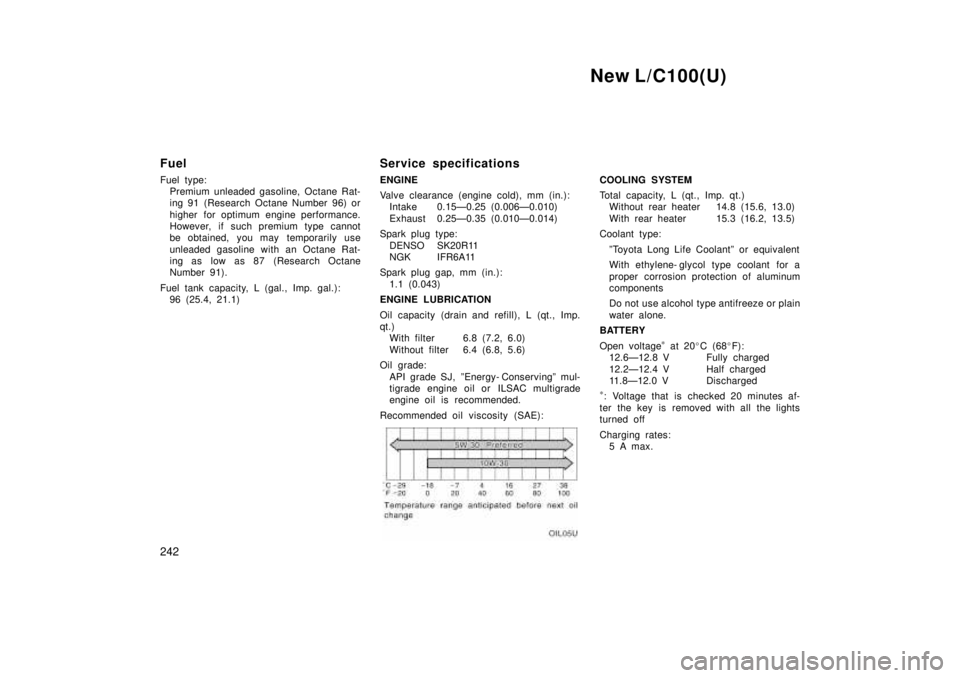
Recommended oil viscosity (SAE):
COOLING SYSTEM
Total capacity, L (qt., Imp. qt.) Without rear heater 14.8 (15.6, 13.0)
With rear heater 15.3 (16.2, 13.5)
Coolant type:
ºToyota Long Life Coolantº or equivalent
With ethylene- glycol type coolant for a
proper corrosion protection of aluminum
components
Do not use alcohol type antifreeze or plain
water alone.
BATTERY
Open voltage *
at 20 C (68 F):
12.6Ð12.8 V Fully charged
12.2Ð12.4 V Half charged
11.8Ð12.0 V Discharged
* : Voltage that is checked 20 minutes af-
ter the key is removed with all the lights
turned off
Charging rates: 5 A max.
Page 193 of 202

New L/C100(U)243
AUTOMATIC TRANSMISSION
Fluid capacity (drain and ref
ill), L (qt.,
Imp. qt.)
Up to 3.5 (3.7, 3.1)
Fluid type: Automatic transmission fluid D±II or DEXRON
III (DEXRON
II)
TRANSFER
Oil capacity, L (qt., Imp. qt.) 1.3 (1.4, 1.1)
Oil type: Gear oil API GL- 4 or GL- 5
Recommended oil viscosity: SAE 75W- 90
DIFFERENTIAL
Oil capacity, L (qt., Imp. qt.): Front 1.7 (1.8, 1.5) Rear
With rear differential lock system
3.2 (3.4, 2.8)
Without rear differential lock system 3.3 (3.5, 2.9) Oil type:
Standard differential Hypoid gear oil API GL- 5
Limited slip differential Hypoid gear oil for limited slip differ-
ential API GL- 5
Recommended oil viscosity: Above -18 C (0 F)
SAE 90
Below -18 C (0 F)
SAE 80W or 80W- 90
CHASSIS LUBRICATION
Wheel bearings: Lithium base wheel bearing grease,
NLGI No.2
Front drive shaft thrust bushings: Synthetic oil and lithium soap base
chassis grease, NLGI No.1
Propeller shafts: Lithium base wheel bearing grease,
NLGI No.2 BRAKES
Minimum pedal clearance when depressed
with the pressure of 490 N (50 kgf, 110
lbf) with the engine running, mm (in.):
116 (4.6)
Pedal freeplay, mm (in.): 1Ð6 (0.04Ð0.24)
Pad wear limit, mm (in.):
1.0 (0.04)
Lining wear limit, mm (in.): 1.0 (0.04)
Parking brake adjustment when pulled with
the force of 196 N (20 kgf, 44 lbf): 4Ð6 clicks
Fluid type: SAE J1703 or FMVSS No.116 DOT 3
STEERING
Wheel freeplay: Less than 40 mm (1.6 in.)
Power steering fluid type: Automatic transmission fluid DEXRON
II
or III