Page 35 of 349

FI7187
IN0379
Sensor Side
ECU Side
IN0378
Sensor SideECU Side
IN0380
Sensor SideECU Side
IN0381
Pull Lightly
Looseness of Crimping
IN–30– INTRODUCTIONHOW TO TROUBLESHOOT ECU CONTROLLED
SYSTEMS
2. CONNECTOR HANDLING
When inserting tester probes into a connector, insert them from
the rear of the connector. When necessary, use mini test leads.
For water resistant connectors which cannot be accessed from
behind, take good care not to deform the connector terminals.
3. CONTINUITY CHECK (OPEN CIRCUIT CHECK)
(a) Disconnect the connectors at both ECU and sensor
sides.
(b) Measure the resistance between the applicable terminals
of the connectors.
Resistance: 1 Ω or less
HINT:
Measure the resistance while lightly shaking the wire harness
vertically and horizontally.
4. RESISTANCE CHECK (SHORT CIRCUIT CHECK)
(a) Disconnect the connectors on both ends.
(b) Measure the resistance between the applicable terminals
of the connectors and body ground. Be sure to carry out
this check on the connectors on both ends.
Resistance: 1 MΩ or higher
HINT:
Measure the resistance while lightly shaking the wire harness
vertically and horizontally.
5. VISUAL CHECK AND CONTACT PRESSURE CHECK
(a) Disconnect the connectors at both ends.
(b) Check for rust or foreign material, etc. in the terminals of
the connectors.
(c) Check crimped portions for looseness or damage and
check that the terminals are secured in lock portion.
HINT:
The terminals should not come out when pulled lightly from the
back.
Page 36 of 349

Z17004
Fig. 1
OPENECU
2 Sensor
22 21 111A B C
Z17005
Fig. 2
ECU
Sensor
21A
B C
1
1
22
B04722
Fig. 3
ECU
Sensor
21A B1 C
1
1
221
2 B2
– INTRODUCTIONHOW TO TROUBLESHOOT ECU CONTROLLED
SYSTEMSIN–31
(d) Prepare a test male terminal and insert it in the female ter-
minal, then pull it out.
NOTICE:
When testing a gold–plated female terminal, always use a
gold–plated male terminal.
HINT:
When the test terminal is pulled out more easily than others,
there may be poor contact in that section.
6. CHECK OPEN CIRCUIT
For the open circuit in the wire harness in Fig. 1, perform ”(a)
Continuity Check” or ”(b) Voltage Check” to locate the section.
(a) Check the continuity.
(1) Disconnect connectors ”A” and ”C” and measure
the resistance between them.
In the case of Fig. 2,
Between terminal 1 of connector ”A” and terminal 1
of connector ”C” → No continuity (open)
Between terminal 2 of connector ”A” and terminal 2
of connector ”C” → Continuity
Therefore, it is found out that there is an open circuit
between terminal 1 of connector ”A” and terminal 1
of connector ”C”.
(2) Disconnect connector ”B” and measure the resis-
tance between the connectors.
In the case of Fig. 3,
Between terminal 1 of connector ”A” and terminal 1
of connector ”B1” → Continuity
Between terminal 1 of connector ”B2” and terminal
1 of connector ”C” → No continuity (open)
Therefore, it is found out that there is an open circuit
between terminal 1 of connector ”B2” and terminal
1 of connector ”C”.
Page 37 of 349

Z17007
Fig. 4
Sensor
21A
C
1
1
22B5V
5V
5V
0V
Z17008
Fig. 5
2 1A C
1
1
22
BSHORT
Z17009
Fig. 6
21A C
1
1
22
BSensorECU IN–32
– INTRODUCTIONHOW TO TROUBLESHOOT ECU CONTROLLED
SYSTEMS
(b) Check the voltage.
In a circuit in which voltage is applied (to the ECU connector ter-
minal), an open circuit can be checked for by conducting a volt-
age check.
As shown in Fig. 4, with each connector still connected,
measure the voltage between body ground and terminal
1 of connector ”A” at the ECU 5V output terminal, terminal
1 of connector ”B”, and terminal 1 of connector ”C”, in that
order.
If the results are:
5V: Between Terminal 1 of connector ”A” and Body Ground
5V: Between Terminal 1 of connector ”B” and Body Ground
0V: Between Terminal 1 of connector ”C” and Body Ground
Then it is found out that there is an open circuit in the wire har-
ness between terminal 1 of ”B” and terminal 1 of ”C”.
7. CHECK SHORT CIRCUIT
If the wire harness is ground shorted as in Fig. 5, locate the sec-
tion by conducting a ”continuity check with ground”.
Check the continuity with ground.
(1) Disconnect connectors ”A” and ”C” and measure
the resistance between terminal 1 and 2 of connec-
tor ”A” and body ground.
In the case of Fig. 6
Between terminal 1 of connector ”A” and body
ground → Continuity (short)
Between terminal 2 of connector ”A” and body
ground → No continuity
Therefore, it is found out that there is a short circuit
between terminal 1 of connector ”A” and terminal 1
of connector ”C”.
Page 38 of 349

Z17808
Fig. 7
Sensor
21A B1 C
1
1
221
2 B2
ECU
IN0383
Example
Ground
IN0384
Ground
Ground
ECU Side
W/H Side
– INTRODUCTIONHOW TO TROUBLESHOOT ECU CONTROLLED
SYSTEMSIN–33
(2) Disconnect connector ”B” and measure the resis-
tance between terminal 1 of connector ”A” and body
ground, and terminal 1 of connector ”B2” and body
ground.
Between terminal 1 of connector ”A” and body
ground → No continuity
Between terminal 1 of connector ”B2” and body
ground → Continuity (short)
Therefore, it is found out that there is a short circuit
between terminal 1 of connector ”B2” and terminal
1 of connector ”C”.
8. CHECK AND REPLACE ECU
First check the ECU ground circuit. If it is faulty, repair it. If it is
normal, the ECU could be faulty, so replace the ECU with a nor-
mal functioning one and check that the symptoms appear.
(1) Measure the resistance between the ECU ground
terminal and the body ground.
Resistance: 1 Ω or less
(2) Disconnect the ECU connector, check the ground
terminals on the ECU side and the wire harness
side for bend and check the contact pressure.
Page 39 of 349

IN044–07
IN–34
– INTRODUCTIONTERMS
TERMS
ABBREVIATIONS USED IN THIS MANUAL
AbbreviationsMeaning
ABSAnti–Lock Brake System
A/CAir Conditioner
ACAlternating Current
ACCAccessory
ACISAcoustic Control Induction System
ACSDAutomatic Cold Start Device
A.D.D.Automatic Disconnecting Differential
AHCActive Height Control Suspension
ALRAutomatic Locking Retractor
ALTAlternator
AMPAmplifier
ANTAntenna
APPROX.Approximately
A/TAutomatic Transmission (Transaxle)
AT FAutomatic Transmission Fluid
AUTOAutomatic
BACSBoost Altitude Compensation System
BATBattery
B/LBi–Level
BVSVBimetallic Vacuum Switching Valve
CBCircuit Breaker
CDCompact Disc
CHChannel
CKDComplete Knock Down
COMB.Combination
CPECoupe
CRSChild Restraint System
CTRCenter
DCDirect Current
DIFF.Differential
DIFF. LOCKDifferential Lock
DLCData Link Connector
DSPDigital Signal Processor
DTCDiagnostic Trouble Code
ECTElectronic Control Transmission
ECUElectronic Control Unit
EDUElectronic Driving Unit
EFIElectronic Fuel Injection
E/GEngine
EGRExhaust Gas Recirculation
ELREmergency Locking Retractor
E–VRVElectronic Vacuum Regulating Valve
Page 91 of 349
DIAGNOSTICS
SUPPLEMENTAL RESTRAINT SYSTEM DI–1. . .
PRE–CHECK DI–1. . . . . . . . . . . . . . . . . . . . . . . . . . . . .
DIAGNOSTIC TROUBLE CODE CHART DI–4. . . . . .
PARTS LOCATION DI–5. . . . . . . . . . . . . . . . . . . . . . . . .
TERMINALS OF ECU DI–6. . . . . . . . . . . . . . . . . . . . . .
CIRCUIT INSPECTION DI–8. . . . . . . . . . . . . . . . . . . . .
REFER TO AVENSIS/CORONA REPAIR MANUAL FOR
CHASSIS AND BODY (Pub. No. RM599E)
NOTE: The above pages contain only the points which differ
from the above listed manual.
Page 98 of 349

DI696–01
H01357
C6C5C4
A B
1 2 3 4 5 6A BA B
7 8 9 10 11 121 2 3 4 5 6
7 8 9 10 11 12 1 2 3 4 5 6
7 8 9 10 11 12
23 24 25 26 27 2813 14 15 16 17
18 19 20 21 22 DI–6
– DIAGNOSTICSSUPPLEMENTAL RESTRAINT SYSTEM
TERMINALS OF ECU
No.SymbolTerminal Name
A–Electrical Connector Check Mechanism
B–Electrical Connector Check Mechanism
C4 – 1SFL–Squib (Side, LH)
C4 – 2SFL+Squib (Side, LH)
C4 – 5PL+Squib (Seat Belt Pretensioner, LH)
C4 – 6PL–Squib (Seat Belt Pretensioner, LH)
C4 – 7ESLSide Airbag Sensor (LH)
C4 – 9FSLSide Airbag Sensor (LH)
C4 – 10SSL+Side Airbag Sensor (LH)
C4 – 12VUPLSide Airbag Sensor (LH)
C5 – 3LASRS Warning Light
C5 – 5IG2Power Source (IGN Fuse)
C5 – 6ACCPower Source (CIG Fuse)
C5 – 7ICL+Squib (Curtain Shield Airbag, LH)
C5 – 8ICL–Squib (Curtain Shield Airbag, LH)
C5 – 9SR+Front Airbag Sensor (RH)
C5 – 10P+Squib (Passenger)
C5 – 11P–Squib (Passenger)
C5 – 12SILDiagnosis
C5 – 13D–Squib (Driver)
C5 – 14D+Squib (Driver)
C5 – 15SL+Front Airbag Sensor (LH)
C5 – 16ICR–Squib (Curtain Shield Airbag, RH)
C5 – 17ICR+Squib (Curtain Shield Airbag, RH)
C5 – 19TcDiagnosis
Page 133 of 349
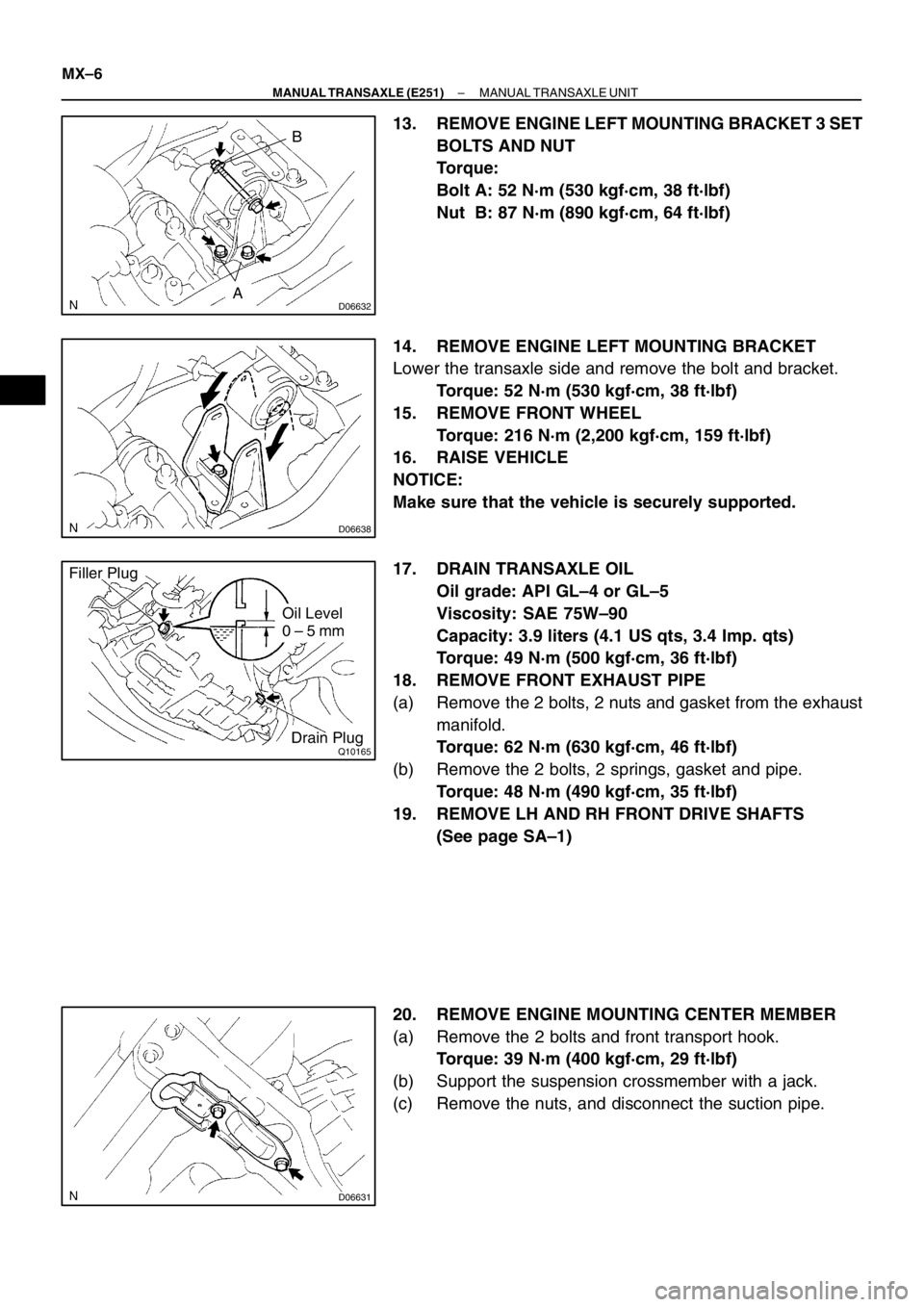
D06632AB
D06638
Q10165
Filler Plug
Oil Level
0 – 5 mm
Drain Plug
D06631
MX–6
– MANUAL TRANSAXLE (E251)MANUAL TRANSAXLE UNIT
13. REMOVE ENGINE LEFT MOUNTING BRACKET 3 SET
BOLTS AND NUT
Torque:
Bolt A: 52 N·m (530 kgf·cm, 38 ft·lbf)
Nut B: 87 N·m (890 kgf·cm, 64 ft·lbf)
14. REMOVE ENGINE LEFT MOUNTING BRACKET
Lower the transaxle side and remove the bolt and bracket.
Torque: 52 N·m (530 kgf·cm, 38 ft·lbf)
15. REMOVE FRONT WHEEL
Torque: 216 N·m (2,200 kgf·cm, 159 ft·lbf)
16. RAISE VEHICLE
NOTICE:
Make sure that the vehicle is securely supported.
17. DRAIN TRANSAXLE OIL
Oil grade: API GL–4 or GL–5
Viscosity: SAE 75W–90
Capacity: 3.9 liters (4.1 US qts, 3.4 Imp. qts)
Torque: 49 N·m (500 kgf·cm, 36 ft·lbf)
18. REMOVE FRONT EXHAUST PIPE
(a) Remove the 2 bolts, 2 nuts and gasket from the exhaust
manifold.
Torque: 62 N·m (630 kgf·cm, 46 ft·lbf)
(b) Remove the 2 bolts, 2 springs, gasket and pipe.
Torque: 48 N·m (490 kgf·cm, 35 ft·lbf)
19. REMOVE LH AND RH FRONT DRIVE SHAFTS
(See page SA–1)
20. REMOVE ENGINE MOUNTING CENTER MEMBER
(a) Remove the 2 bolts and front transport hook.
Torque: 39 N·m (400 kgf·cm, 29 ft·lbf)
(b) Support the suspension crossmember with a jack.
(c) Remove the nuts, and disconnect the suction pipe.