1999 TOYOTA 4RUNNER engine
[x] Cancel search: enginePage 199 of 268

4RUNNER ()199
JUMP STARTING PROCEDURE
1. If the booster battery is installed in another vehicle, make sure the vehicles
are not touching. Turn off all unneces-
sary lights and accessories.
2. If required, remove all the vent plugs from the booster and discharged batter-
ies. Lay a cloth over the open vents
on the batteries. (This helps reduce the
explosion hazard, personal injuries and
burns.)
3. If the engine in the vehicle with the booster battery is not running, start it
and let it run for a few minutes. During
jump starting run the engine at about
2000 rpm with the accelerator pedal
lightly depressed.
Positive
terminal
(º+º mark)
Booster
battery
Positive terminal
(º+º mark)
Jumper cable Discharged
battery
4. Make the cable connections in the or- der a, b, c, d.
a. Connect the clamp of the positive
(red) jumper cable to the positive (+)
terminal on the discharged battery.
b. Connect the clamp at the other end
of the positive (red) jumper cable to
the positive (+) terminal on the booster
battery.
Discharged
battery Jumper cable
Booster battery
Negative
terminal
(º- º mark)
c. Connect the clamp of the negative
(black) jumper cable to the negative (- )
terminal on the booster battery.
d. Connect the clamp at the other end
of the negative (black) jumper cable to
a solid, stationary, unpainted, meta llic
point of the vehicle with the discharged
battery.
The recommended connecting points
are shown in the following illustrations:
Page 200 of 268

4RUNNER ()
200
Connecting point for 5VZ- FE engine
Connecting point for 3RZ- FE engine Do not connect it to or near any part
that moves when the engine is
cranked.
CAUTION
When making the connections, to
avoid serious injury, do not lean over
the battery or accidentally let the
jumper cables or clamps touch any-
thing except the correct battery termi-
nals or the ground.
5. Start your engine in the normal way.
After starting, run it at about 2000 rpm
for several minutes with the accelerator
pedal lightly depressed.
6. Carefully disconnect the cables in the exact reverse order: the negative cable
and then the positive cable.
7. Carefully dispose of the battery cover clothsÐthey may now contain sulfuric
acid.
8. If removed, replace all the battery vent plugs.
If the cause of your battery discharging is
not apparent (for example, lights left on),
you should have it checked. If your engine stalls while driving...
1. Reduce your speed gradually, keeping a straight line. Move cautiously off the
road to a safe place.
2. Turn on your emergency flashers.
3. Try starting the engine again.
If the engine will not start, see ºIf your
vehicle will not startº.
CAUTION
If the engine is not running, the pow-
er assist for the brakes and steering
will not work so steering and braking
will be much harder than usual.
If your engine stalls while
driving
Page 201 of 268

4RUNNER ()201
If your vehicle overheats
If your engine coolant temperature
gauge indicates overheating, if you ex-
perience a loss of power, or if you hear
a loud knocking or pinging noise, the
engine has probably overheated. You
should follow this procedure...
1. Pull safely off the road, stop the ve- hicle and turn on your emergency
flashers. Put the transmission in ºPº
(automatic) or neutral (manual) and ap-
ply the parking brake. Turn off the air
conditioning if it is being used.
2. If coolant or steam is boiling out of the radiator or reservoir, stop the engine.
Wait until the steam subsides before
opening the hood. If there is no coolant
boiling over or steam, leave the engine
running.
CAUTION
To help avoid personal injury, keep
the hood closed until there is no
steam. Escaping steam or coolant is
a sign of very high pressure.
3. Visually check to see if the engine drive belt (fan belt) is broken or loose.
Look for obvious coolant leaks from the
radiator, hoses, and under the vehicle.
However, note that water draining from
the air conditioning is normal if it has
been used.
CAUTION
When the engine is running, keep
hands and clothing away from the
moving fan and engine drive belts.
4. If the engine drive belt is broken or thecoolant is leaking, stop the engine im-
mediately. Call a Toyota dealer for as-
sistance.
5. If the engine drive belt is O.K. and there are no obvious leaks, you may
help the engine cool down more quickly
by running it at about 1500 rpm for a
few minutes with the accelerator pedal
lightly depressed.
6. Check the coolant reservoir. If it is dry, add coolant to the reservoir while the
engine is running. Fill it about half full.
CAUTION
Do not attempt to remove the radiator
cap when the engine and radiator are
hot. Serious injury could result from
scalding hot fluid and steam blown
out under pressure.
7. After the engine coolant temperaturehas cooled to normal, again check the
coolant level in the reservoir. If neces-
sary, bring it up to half full again. Seri-
ous coolant loss indicates a leak in the
system. You s hould have it checked as
soon as possible at your Toyota dealer.
Page 202 of 268
4RUNNER ()
202
If you have a flat tireÐ
1. Reduce your speed gradually, keeping a straight line. Move cautiously off the
road to a safe place well away from
the traffic. Avoid stopping on the center
divider of a highway. Park on a level
spot with firm ground.
2. Stop the engine and turn on your emergency flashers.
3. Firmly set the parking brake and put the transmission in ºPº (automatic) or
reverse (manual).
4. Have everyone get out of the vehicle on the side away from traffic.
5. Read the following instructions thor- oughly.
CAUTION
When jacking, be sure to observe the
following to reduce the possibility of
personal injury: Follow jacking instructions.
Do not put any part of your body
under the vehicle supported by the
jack. Personal injury may occur.
Do not start or run the engine while
your vehicle is supported by the
jack.
Stop the vehicle on a level firm
ground, firmly set the parking brake
and put the transmission in ºPº
(automatic) or reverse (manual).
Block the wheel diagonally opposite
to the one being changed if neces-
sary.
Make sure to set the jack properly
in the jack point. Raising the ve-
hicle with jack improperly posi-
tioned will damage the vehicle or
may allow the vehicle to fall off the
jack and cause personal injury.
Never get under the vehicle when
the vehicle is supported by the jack
alone.
Use the jack only for lifting your
vehicle during wheel changing.
Do not raise the vehicle with some-
one in the vehicle.
When raising the vehicle, do not
put an object on or under the jack.
Raise the vehicle only high enough
to remove and change the tire.NOTICE
Do not continue driving with a de-
flated tire. Driving even a short dis-tance can damage a tire beyond re- pair.
Page 212 of 268
4RUNNER ()
212
NOTICE
Use only a cable or chain specifically intended for use in towing vehicles.Securely fasten the cable or chain tothe towing hook provided.
Before towing, release the parking brake
and put the transmission in neutral (manu-
al) or ºNº (automatic) and the transfer in
ºH2º (four- wheel drive models). The key
must be in ºACCº (engine off) or ºONº
(engine running).
CAUTION
If the engine is not running, the pow-
er assist for the brakes and steering
will not work so steering and braking
will be much harder than usual.
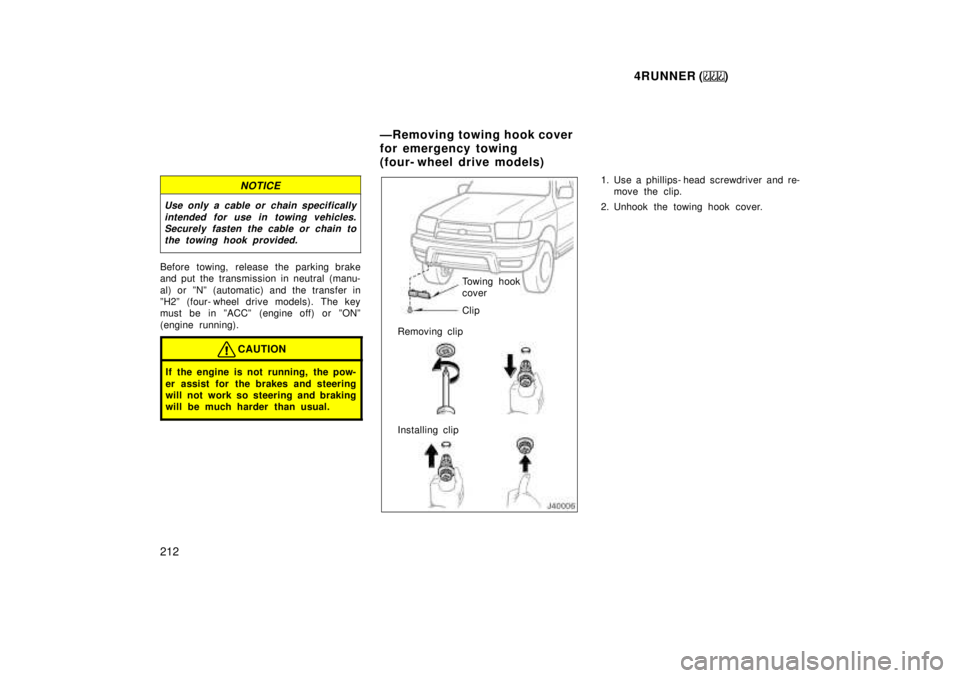
Towing hook
cover
Clip
Removing clip
Installing clip 1. Use a phillips-
head screwdriver and re-
move the clip.
2. Unhook the towing hook cover.
ÐRemoving towing hook cover
for emergency towing
(four- wheel drive models)
Page 214 of 268
4RUNNER ()
214
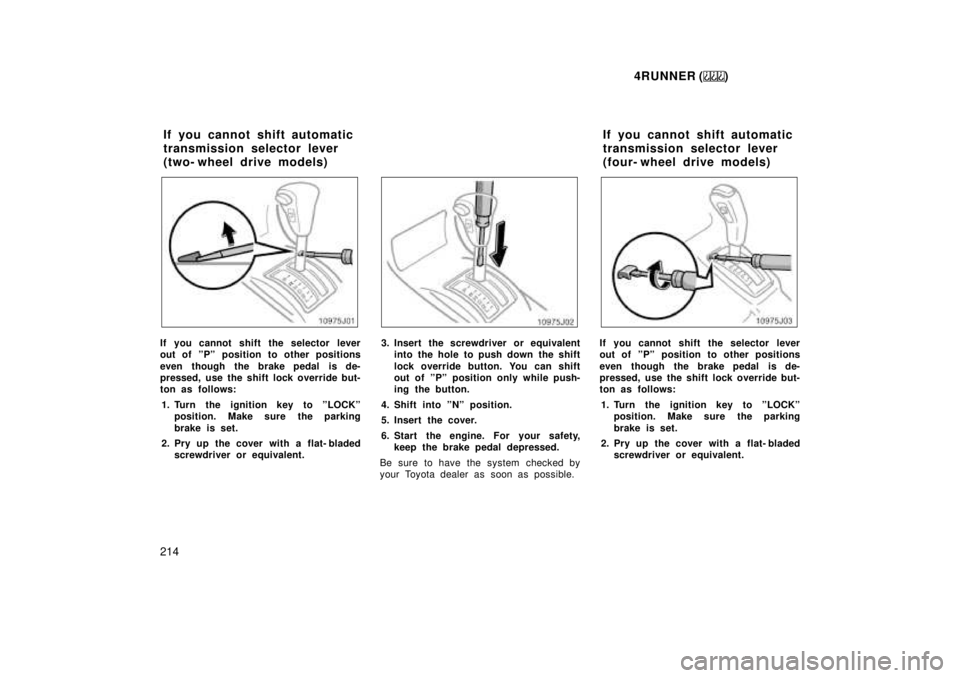
If you cannot shift the selector lever
out of ºPº position to other positions
even though the brake pedal is de-
pressed, use the shift lock override but-
ton as follows: 1. Turn the ignition key to ºLOCKº position. Make sure the parking
brake is set.
2. Pry up the cover with a flat- bladed screwdriver or equivalent.3. Insert the screwdriver or equivalent into the hole to push down the shift
lock override button. You can shift
out of ºPº position only while push-
ing the button.
4. Shift into ºNº position.
5. Insert the cover.
6. Start the engine. For your safety, keep the brake pedal depressed.
Be sure to have the system checked by
your Toyota dealer as soon as possible.If you cannot shift the selector lever
out of ºPº position to other positions
even though the brake pedal is de-
pressed, use the shift lock override but-
ton as follows: 1. Turn the ignition key to ºLOCKº position. Make sure the parking
brake is set.
2. Pry up the cover with a flat- bladed screwdriver or equivalent.
If you cannot shift automatic
transmission selector lever
(two- wheel drive models)
If you cannot shift automatic
transmission selector lever
(four- wheel drive models)
Page 215 of 268

4RUNNER ()215
3. Insert your finger into the hole tomove the shift lock overdrive lever
backward. You can shift out of ºPº
position only while holding back the
lever.
4. Shift into ºNº position.
5. Insert the cover.
6. Start the engine. For your safety, keep the brake pedal depressed.
Be sure to have the system checked by
your Toyota dealer as soon as possible. If you lose your keys
Many Toyota dealers can make a new
key if you can give them the key num-
ber. If your vehicle is equipped with the
engine immobiliser system, the dealer
will also need your master key.
See the suggestion given in ºKeysº in
Chapter 1- 2.
If your keys are locked in the vehicle and
you cannot get a duplicate, many Toyota
dealers can still open the door for you,
using their special tools. If you must
break a window to get in, we suggest
breaking the smallest side window be-
cause it is the least expensive to replace.
Be extremely cautious to avoid cuts from
the glass.
Vehicles with engine immobiliser systemÐ
Even if you lose only one key, contact
your Toyota dealer to make a new key. If
you lose all your master keys, you cannot
make new keys; the whole system must
be replaced.
If you lose your transmitter, you can
purchase a new one at your Toyota
dealer.
You can use the wireless remote control
system with the new transmitter. Contact
your Toyota dealer for detailed information.
If you lose your wireless
remote control transmitter
Page 224 of 268
4RUNNER ()
224
Where to go for service?
Toyota technicians are well- trained spe-
cialists and are kept up to date with the
latest service information through technical
bulletins, service tips, and in- dealership
training programs. They learn to work on
Toyotas before they work on your vehicle,
rather than while they are working on it.
You can be confident that your Toyota
dealer 's service department performs the
best job to meet the maintenance require-
ments on your vehicleÐreliably and eco-
nomically.
Your copy of the repair order is proof that
all required maintenance has been per-
formed for warranty coverage. And if any
problems should arise with your vehicle
while under warranty, your Toyota dealer
will promptly take care of it. Again, be
sure to keep a copy of the repair order
for any service performed on your Toyota.
What about do- it- yourself maintenance?
Many of the maintenance items are easy
to do yourself if you have a little mechani-
cal ability and a few basic automotive
tools. Simple instructions for how to per-
form them are presented in Part 7.
If you are a skilled do- it- yourself mechan-
ic, the Toyota service manuals are recom-
mended. Please be aware that do- it- your-
self maintenance can affect your warranty
coverage. See ºOwner 's Warranty Informa-
tion Bookletº or ºOwner 's Manual Supple-
mentº for the details.
General maintenance
Listed below are the general maintenance
items that should be performed as fre-
quently as specified. In addition to check-
ing the items listed, if you notice any
unusual noise, smell or vibration, you
should investigate the cause or take your
vehicle to your Toyota dealer or a quali-
fied service shop immediately. It is recom-
mended that any problem you notice be
brought to the attention of your dealer or
the qualified service shop for their advice.
CAUTION
Make these checks only where ade-
quate ventilation can be obtained if
you run the engine.
OUTSIDE THE VEHICLE
Items listed below should be performed
from time to time, unless otherwise
specified.
Tire pressure
Check the pressure with a gauge every
two weeks, or at least once a month. See
Chapter 7- 2 for additional information.