Page 238 of 268
4RUNNER ()
238
ENGINE OIL SELECTION
Use API grade SJ, ºEnergy- Conservingº
or ILSAC multigrade engine oil.
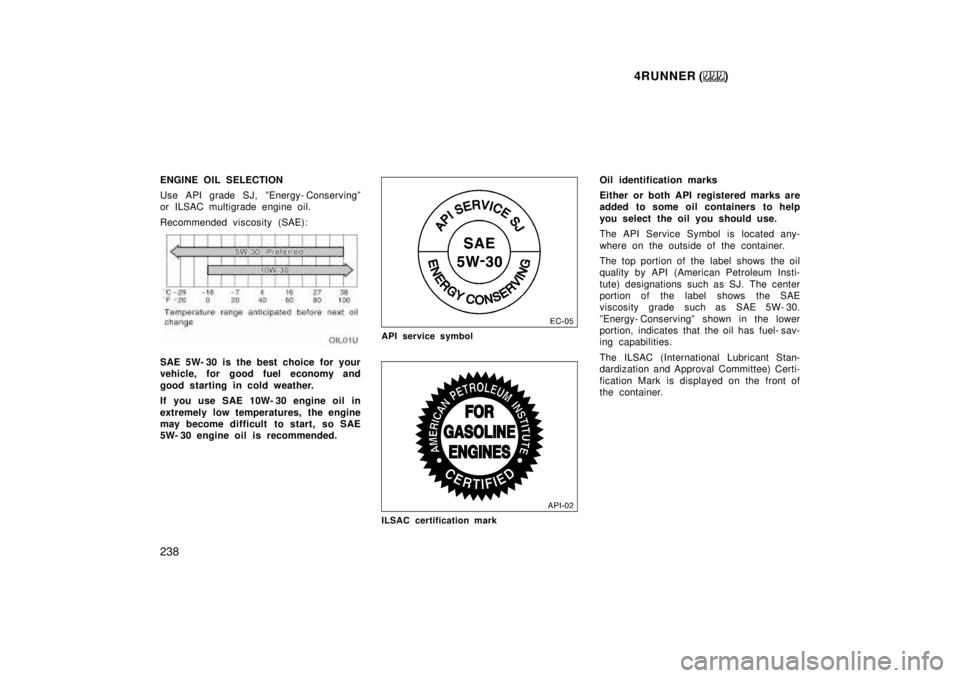
Recommended viscosity (SAE):
SAE 5W- 30 is the best choice for your
vehicle, for good fuel economy and
good starting in cold weather.
If you use SAE 10W- 30 engine oil in
extremely low temperatures, the engine
may become difficult to start, so SAE
5W- 30 engine oil is recommended.
API service symbol
ILSAC certification mark
Oil identification marks
Either or both API registered marks are
added to some oil containers to help
you select the oil you should use.
The API Service Symbol is located any-
where on the outside of the container.
The top portion of the label shows the oil
quality by API (American Petroleum Insti-
tute) designations such as SJ. The center
portion of the label shows the SAE
viscosity grade such as SAE 5W- 30.
ºEnergy- Conservingº shown in the lower
portion, indicates that the oil has fuel- sav-
ing capab
ilities.
The ILSAC (International Lubricant Stan-
dardization and Approval Committee) Certi-
fication Mark is displayed on the front of
the container.
Page 239 of 268
4RUNNER ()239
Look at the see- through coolant reser-
voir when the engine is cold. The cool-
ant level is satisfactory if it is between
the ºFº and ºLº lines on the reservoir.
If the level is low, add ethylene- glycol
type coolant for a proper corrosion
protection of aluminum components.
The coolant level in the reservoir will vary
with engine temperature. However, if the
level is on or below the ºLº line, add
coolant. Bring the level up to the ºFº line.
Always use ethylene- glycol type coolant
for a proper corrosion protection of alumi-
num components. See information in the
next column.
If the coolant level drops within a short
time after replenishing, there may be a
leak in the system. Visually check the
radiator, hoses, radiator cap and drain
cock and water pump.
If you can find no leak, have your Toyota
dealer test the cap pressure and check
for leaks in the cooling system.
CAUTION
To prevent burning yourself, do not
remove the radiator cap when the en-
gine is hot.
Coolant type selection
Use of improper coolants may damage
your engine cooling system. Your coolant
must contain ethylene- glycol type coolant
for a proper corrosion protection of your
engine that contains aluminum
components. Use ºToyota Long Life
Coolantº or equivalent.
In addition to preventing freezing and
subsequent damage to the engine, this
type of coolant will also prevent corrosion.
Further supplemental inhibitors or additives
are neither needed nor recommended.
Read the coolant container for information
on freeze protection. Follow the manufac-
turer's directions for how much to mix
with plain water (preferably demineralized
water or distilled water). The total c
apacity
of the cooling system is given in Part 8. We recommend to use 50% solution for
your Toyota, to provide protection down to
about -35
C (- 31 F). When it is extreme-
ly cold, to provide protection down to
about -50 5C (- 58 5F), 60% solution is rec-
ommended. Do not use more than 70%
solution for better coolant performance.NOTICE
Do not use alcohol type antifreeze or
plain water alone.
Checking the engine coolant level
Page 240 of 268

4RUNNER ()
240
Checking brake fluid
To check the fluid level, simply look at
the see- through reservoir. The level
should be between the ºMAXº and
ºMINº lines on the reservoir.
It is normal for the brake fluid level to go
down slightly as the brake pads wear. So
be sure to keep the reservoir filled.
If the reservoir needs frequent ref
illing, it
may indicate a serious mechanical prob-
lem.
If the level is low, add SAE J1703 or
FMVSS No.116 DOT 3 brake fluid to the
brake reservoir. Remove and replace the reservoir cover
by hand.
Use only newly opened brake fluid. Once
opened, brake fluid absorbs moisture from
the air, and excess moisture can cause a
dangerous loss of braking.
CAUTION
Take care when filling the r
eservoir
because brake fluid can harm your
eyes and damage painted surfaces. If
fluid gets in your eyes, flush your
eyes with clean water.
NOTICE
If you spill the fluid, be sure to wash
it off with water to prevent it fromdamaging the parts or paint.
Checking power steering fluid
If cold add
If cold O.K.
If hot add If hot O.K.
Check the fluid level on the dipstick. If
necessary, add automatic transmission
fluid DEXRON II or III.
If the vehicle has been driven around 80
km/h (50 mph) for 20 minutes (a little
more in frigid temperatures), the fluid is
hot (60 CÐ80 C or 140 FÐ175 F). You
may also check the level when the fluid
is cold (about room temperature,10 CÐ30 C or 50 FÐ85 F) if the engine
has not been run for about five hours.
a. Clean all dirt from outside of the reser-
voir tank.
b. Remove the filler cap by turning it
counterclockwise and wipe the dipstick
clean.
Page 248 of 268

4RUNNER ()
248
ÐChecking battery exterior
TerminalsGround
cable
Hold- down
clamp
Check the battery for corroded or loose
terminal connections, cracks, or loose
hold- down clamp.
a. If the battery is corroded, wash it off
with a solution of warm water and baking
soda. Coat the outside of the terminals
with grease to prevent further corrosion.
b. If the terminal connections are loose, tighten their clamp nutsÐbut do not
overtighten.
c. Tighten the hold- down clamp only enough to keep the battery firmly in
place. Overtightening may damage the
battery case.
NOTICE
Be sure the engine and all accesso-
ries are off before performing main-tenance.
When checking the battery, remove
the ground cable from the negativeterminal (º- º mark) first and rein-stall it last.
Be careful not to cause a short cir- cuit with tools.
Take care no solution gets into thebattery when washing it.
ÐChecking battery fluid
Ty p e A
Green Dark Clear or
light yellow
Ty p e B Blue White Red
CHECKING BY THE HYDROMETER
Check the battery condition by the
hydrometer color. Hydrometer color
ConditionTy p e ATy p e BCondition
GREENBLUEGood
DARKWHITE
Charging necessary.
Have battery
checked by your
Toyota dealer.
CLEAR
or LIGHTYELLOW
RED
Have battery
checked by your
Toyota dealer.
Page 249 of 268
4RUNNER ()249
Battery recharging precautions
During recharging, the battery is pro-
ducing hydrogen gas.
Therefore, before recharging:
1. If recharging with the battery installed on the vehicle, be sure to disconnect
the ground cable.
2. Be sure the power switch on the re- charger is off when connecting the
charger cables to the battery and when
disconnecting them.
CAUTION
Always charge the battery in an un-
confined area. Do not charge the
battery in a garage or closed room
where there is not sufficient ventila-
tion.
Only do a slow charge (5 A or
less). Charging at a quicker rate is
dangerous. The battery may ex-
plode, causing personal injuries.
NOTICE
Never recharge the battery while the
engine is running. Also, be sure allaccessories are turned off.
Checking and replacing fuses
Ty p e A
Ty p e B
Ty p e C Good
Good
Good Blown
Blown
Blown
Page 251 of 268

4RUNNER ()251
Adding washer fluid
If any washer does not work, the wash-
er tank may be empty. Add washer
fluid.
You may use plain water as washer fluid.
However, in cold areas where tempera-
tures range below freezing point, use
washer fluid containing antifreeze. This
product is available at your Toyota dealer
and most auto parts stores. Follow the
manufacturer 's directions for how much to
mix with water.
NOTICE
Do not use engine antifreeze or any
other substitute because it may dam-age your vehicle's paint.
Replacing light bulbsÐ
The following illustrations show how to
gain access to the bulbs. When replacing
a bulb, make sure the ignition switch and
light switch are off. Use bulbs with the
wattage ratings given in the table.
CAUTION
Halogen bulbs have pressurized gas
inside and require special handling.
They can burst or shatter if scratched
or dropped. Hold a bulb only by its
plastic or metal case. Do not touch
the glass part of a bulb with barehands.
NOTICE
Only use a bulb of the listed type.
Light bulbsBulb
No.WTy p e
HeadlightsÐ60/55A
Front fog lightsÐ55B
Par k i ng and fr ont
side marker lightsÐ5C
Front turn signal
lightsÐ21C
Rear turn signal
lightsÐ21C
Stop and tail lightsÐ21/5C
Back- up lightsÐ21C
License plate lightÐ5C
High mounted
stop light92118C
Interior lightÐ8D
Personal lightsÐ8D
Glove box lightÐ1.4C
Luggage
compartment lightÐ8D
A: HB2 halogen bulbs
B: H3 halogen bulbs
C: Wedge base bulbs
D: Double end bulbs
Page 259 of 268
4RUNNER ()259
Part 8
SPECIFICATIONS
Dimensions and weight
Engine
Fuel
Service specifications
Ti r es
Fuses
Dimensions and weight
mm (in.)
P265/70R 16 tire
Without wheel
opening extension With wheel
opening extension
P225/75R 15 tire
Overall length 4655 (183.3) 4655 (183.3) 4655 (183.3)
Overall width 1690 (66.5) 1730 (68.1) 1800 (70.9)
Overall height 1715 (67.5) *
1760 (69.3) *
1760 (69.3) *
Wheelbase 2675 (105.3) 2675 (105.3) 2675 (105.3)
Front tread 1505 (59.3) 1505 (59.3) 1505 (59.3)
Rear tread 1495 (58.9) 1510 (59.5) 1510 (59.5)
Cargo weight rating kg (lb.): 113 (250)
* : Unladen vehicle
Page 260 of 268
4RUNNER ()
260
Engine
Model:
3RZ- FE and 5VZ- FE
Type: 3RZ- FE engine4 cylinder in line, 4 cycle, gasoline
5VZ- FE engine 6 cylinder V type 4 cycle, gasoline
Bore and stroke, mm (in.): 3RZ- FE engine95.0 95.0 (3.74 3.74)
5VZ- FE engine
93.5 82.0 (3.68 3.23)
Displacement, cm 3
(cu. in.):
3RZ- FE engine 2694 (164.3)
5VZ- FE engine
3378 (206.1) Fuel
Fuel type:
Unleaded gasoline, Octane Rating 87 (Re-
search Octane Number 91) or higher
Fuel tank capacity, L (gal., Imp. gal.): 70 (18.5, 15.4) Service specifications
ENGINE
Valve clearance (engine cold), mm (in.):
3RZ- FE engineIntake 0.15Ð0.25 (0.006Ð0.010)
Exhaust 0.25Ð0.35 (0.010Ð0.014)
5VZ- FE engine Intake 0.13Ð0.23 (0.006Ð0.009)
Exhaust 0.27Ð0.37 (0.011Ð0.014)
Spark plug type: 3RZ- FE engineDENSO K16R- U
NGK BKR5EYA
5VZ- FE engine DENSO K16TR11
NGK BKR5EKB- 11
Spark plug gap, mm (in.): 3RZ- FE engine 0.8 (0.031)
5VZ- FE engine 1.1 (0.043)