1999 SUZUKI BALENO lock
[x] Cancel search: lockPage 56 of 65
60G-74E
INSPECTION AND MAINTENANCE
70F-07-060
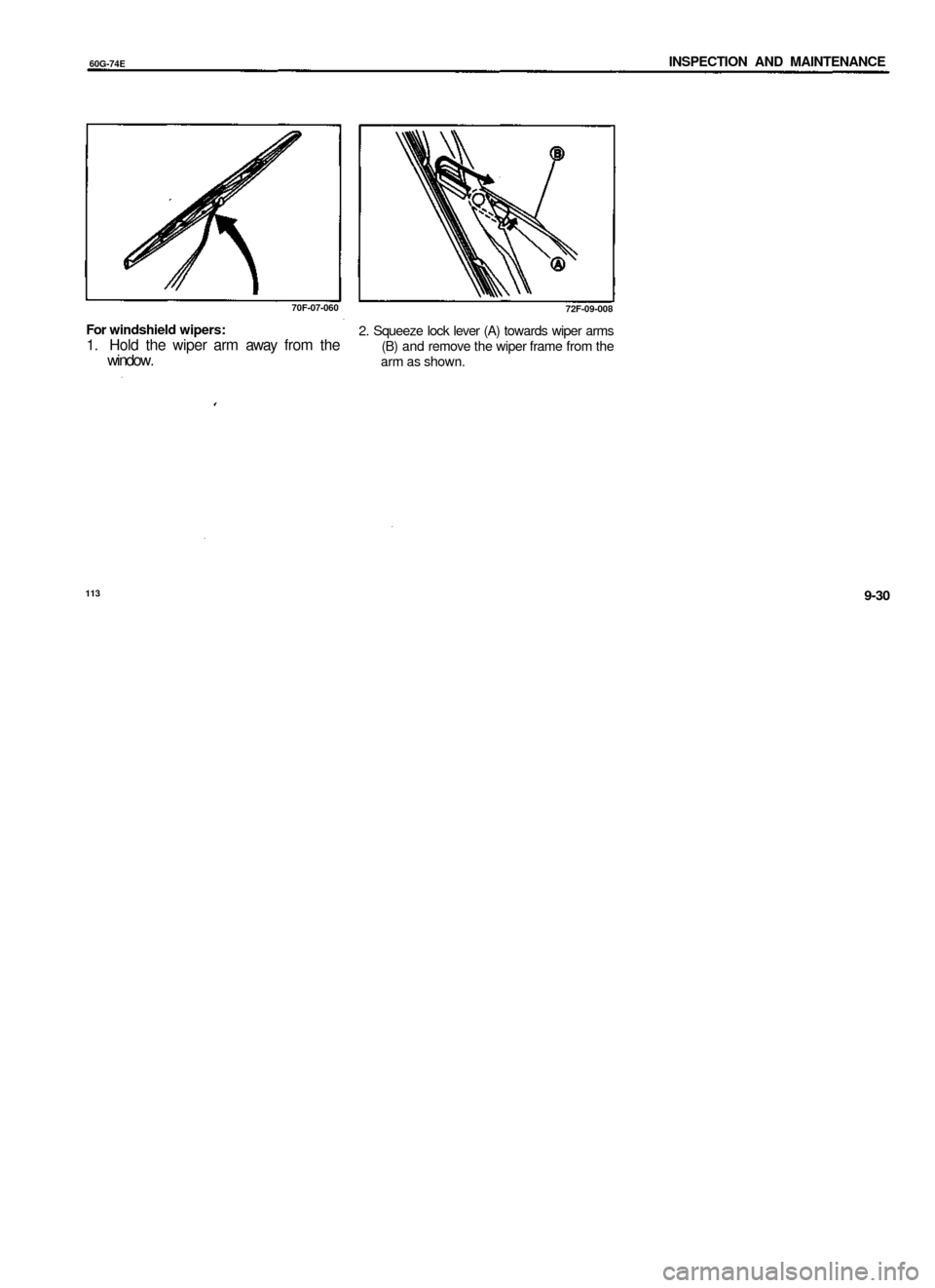
For windshield wipers:
1. Hold the wiper arm away from the
window.
72F-09-008
2. Squeeze lock lever (A) towards wiper arms
(B) and remove the wiper frame from the
arm as shown.
113
9-30
60G-74E
EMERGENCY SERVICE
EMERGENCY SERVICE
Jacking Instructions 10-1
Jump Starting Instructions 10-2
Towing 10-4
Emergency Remedies 10-4
Warning Triangle 10-5
115
Page 57 of 65
60G-74E
INSPECTION AND MAINTENANCE
70F-07-060
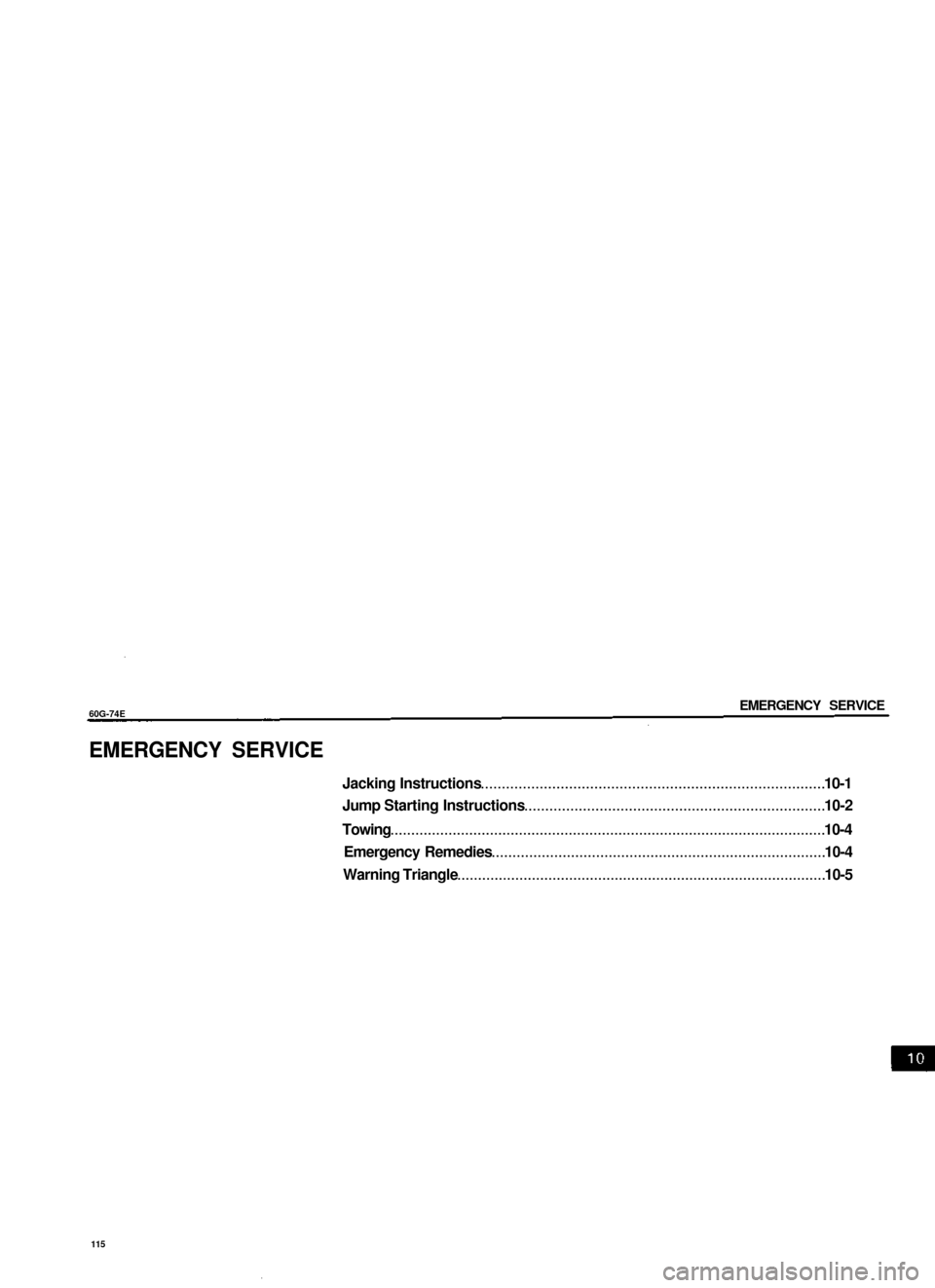
For windshield wipers:
1. Hold the wiper arm away from the
window.
72F-09-008
2. Squeeze lock lever (A) towards wiper arms
(B) and remove the wiper frame from the
arm as shown.
113
9-30
60G-74E
EMERGENCY SERVICE
EMERGENCY SERVICE
Jacking Instructions 10-1
Jump Starting Instructions 10-2
Towing 10-4
Emergency Remedies 10-4
Warning Triangle 10-5
115
Page 58 of 65

EMERGENCY SERVICE
60G-74E
JACKING INSTRUCTIONS
60G-06-009
1) Park the vehicle securely on hard level
ground.
2) Apply the parking brake firmly and shift into
"R" (Reverse). Choke the front and rear wheel
diagonally opposite the wheel to be changed.
3) Switch on the hazard warning flasher if your
vehicle is in or near traffic.
4) Slacken but do not remove wheel nuts on the
wheel to be changed.
5) Position the jack vertically and raise the jack
by turning the jack handle clockwise until the
jack head recess fits the frame boss.
6) Continue to raise the jack slowly and smoothly
until the tyre clears the ground. Do not raise
the vehicle more than necessary.
10-1
63B-10-001E
70F-08-001
60G-10-001
NOTE:
Use the wheel nut wrench in combination with
jack crank to raise or lower the jack as shown
in the illustration.
Use the jack only to change wheels.
Never jack up the vehicle on an
inclined surface.
Never raise the vehicle with the jack in
a location other than under the frame
boss near the wheel to be changed.
Make sure that the jack is raised at
least 2 inches (51 mm) before it
contacts the vehicle. Use of the jack
when it is within 2 inches of being
fully collapsed may result in failure
of the jack.
Never get under the vehicle when it
is supported by the jack. t=>
116
60G-74E
EMERGENCY SERVICE
JUMP STARTING INSTRUCTIONS
60G-10-002
60G-10-003
Never run the engine when the
vehicle is supported by the jack and
never allow passengers to remain in
the vehicle.
Never attempt to jump start your
vehicle if the battery appears to be
frozen. Batteries in this condition
may explode or rupture if jump
starting is attempted.
When making jump lead
connections, be certain that your
hands and the Jump leads remain
clear from pulleys, belts, or fans.
Batteries produce flammable
hydrogen gas. Keep flames and
sparks away from the battery or an
explosion may occur. Never smoke
when working in the vicinity of the
battery.
If the booster battery you use for
jump starting is installed in another
vehicle, make sure the two vehicles
are not touching each other.
If your battery discharges
repeatedly, for no apparent reason,
have your vehicle inspected by an
authorized MARUTI dealer.
To avoid harm to yourself or damage
to your vehicle or battery, follow the
jump starting instructions below
precisely and in order. If you are in
doubt, call for qualified road service.
10-2
Page 59 of 65

EMERGENCY SERVICE
60G-74E
CAUTION
Vehicle equipped with electronic fuel
injection system will not start by
pushing or towing as the fuel pump
will not work in this condition. This
starting method could also result in
permanent damage to the catalytic
converter. Use jump leads to start a
vehicle with a weak or flat battery.
60G-10-004E
When jump starting your vehicle, use the
following procedure:
1) Use only a 12 volt battery to jump start
your vehicle. Position the good 12V battery
close to your vehicle so that the jump leads
will reach both batteries. When using a
battery installed on another vehicle, DO
NOT LET THE VEHICLES TOUCH. Apply
the parking brakes fully on both vehicles.
2) Turn off all vehicle accessories, except
those necessary for safety reasons (for
example, headlights or hazard lights).
3) Make jump lead connections as follows:
a) Connect one end of the first jump lead
to the positive (+) terminal of the flat
battery.
b) Connect the other end to the positive
(+) terminal of the booster battery.
c) Connect one end of the second jump
lead to the negative (-) terminal of the
booster battery.
d) Make the final connection to an
unpainted, heavy metal part of the
engine of the vehicle with the flat
battery.
Never connect the jump lead directly
to the negative (-) terminal of the
discharged battery, or an explosion
may occur.
10-3
4) If the booster battery you are using is fitted
to another vehicle, start the engine of the
vehicle with the booster battery. Run the
engine at moderate speed.
5) Start the engine of the vehicle with the flat
battery.
6) Remove the jump leads in the exact
reverse order in which you connected
them.
118
60G-74E
EMERGENCY SERVICE
TOWING
If you need to have your vehicle towed, contact
a professional service.
CAUTION
To help avoid damage to your vehicle
during towing, proper equipment and
towing procedures must be used.
Manual Transmission
Whenever possible, your vehicle should be
towed from the front with the front wheels lifted.
If the steering and drivetrain are in good
condition, your vehicle may be towed from the
rear with the rear wheels lifted and the front
wheels on the ground. Before towing, make
sure the steering is unlocked and the
transmission is in neutral.
EMERGENCY REMEDIES
If the Starter Does Not Operate:
1) Try turning the ignition switch to the
"START" position with the headlights
turned on to determine the battery
condition. If the headlights go excessively
dim or go off, it usually means that either
the battery is flat or the battery terminal
contact is poor. Recharge the battery or
correct battery terminal contact as
necessary.
2) If the headlights remain bright, check the
fuses. If the reason for failure of the starter
is not obvious, there may be a major
electrical problem. Have the vehicle
inspected by your authorized MARUTI
dealer.
If the Engine is Flooded
If the engine is flooded with petrol, it may be
hard to start. If this happens, press the
accelerator pedal all the way to the floor and
hold it there while cranking the engine. (Do
not operate the starter motor for more than
15 seconds). Release the accelerator as soon
as the engine has started.
If the Engine Overheats
The engine could overheat temporarily under
severe driving conditions. If the engine coolant
temperature gauge indicates overheating
during driving:
1) Turn off the air conditioner, if equipped.
2) Take the vehicle to a safe place and park.
3) Let the engine run at normal idle speed
for a few minutes until the indicator is within
the normal, acceptable temperature range
between "H" and "C".
If you see or hear escaping steam, stop
the vehicle in a safe place and
Immediately turn off the engine to let it
cool. Do not open the bonnet when
steam is present. When the steam can
no longer be seen or heard, open the
hood to see if the coolant is still boiling.
If it is, you must wait until it stops
boiling before you proceed.
119
10-4
Page 60 of 65

EMERGENCY SERVICE
60G-74E
WARNING TRIANGLE (TYPE-1)
If the temperature indication does not come
down to within the normal, acceptable range:
1) Turn off the engine and check that the
water pump belt and pulleys are not
damaged or slipping. If any abnormality is
found, correct it.
2) Check the coolant level in the reservoir. If
it is found to be lower than the "LOW" line,
look for leaks at the radiator, water pump,
and radiator and heater hoses. If you
locate any leaks that may have caused the
overheating, do not run the engine until
these problems have been corrected.
3) If you do not find a leak, carefully add
coolant to the reservoir and then the
radiator, if necessary. (Refer to "ENGINE
COOLANr in the "INSPECTION AND
MAINTENANCE" section.)
K is dangerous to remove the radiator
cap when the water temperature is
high, because scalding fluid and steam
may be blown out under pressure. The
cap should only be taken off when the
coolant temperature has lowered.
To help prevent personal Injury, keep
hands, tools and clothing away from the
engine cooling fan and airconditioner
fan (if equipped). These electric fans
can automatically turn on without
warning.
843-10-004
In case of vehicle break-down or during
emergency stopping where your vehicle could
become a potential traffic hazard, please keep
the warning triangle, provided with your
vehicle, on the pathway (road) behind the
vehicle so as to warn the approaching traffic,
at an approximate distance of 5-15 m, such
that reflecting side of the triangle faces the
rear. Please activate the hazard warning lamps
before alighting the vehicle to keep the warning
triangle.
10-5
120
60G-74E
EMERGENCY SERVICE
WARNING TRIANGLE (TYPE-2)
In case of vehicle breakdown or during
emergency stopping where your vehicle
could become a potential traffic hazard,
keep the warning triangle, provided with
your vehicle, on the road free from any
obstacles behind your vehicle so as to warn
the approaching traffic, at an approximate
distance of 50-100 m, the reflecting side of
the triangle should face the on coming
traffic. Please activate the hazard warning
lamps before alighting the vehicle to keep
the warning triangle.
Remove the warning triangle
carefully from the box as shown by arrow
1.
Open both the reflector arms as shown
by arrows and lock arms with each other
with the clip provided in the right arm.
Open the bottom stand in counter clock-
wise direction as shown by arrow 3.
Position the warning triangle behind the
vehicle on a plain surface.
Reverse the removal procedure
keeping inside the box.
for
121
10-6
Page 63 of 65
60G-74E
GENERAL INFORMATION
GENERAL INFORMATION
Vehicle Identification 12-1
127
GENERAL INFORMATION
60G-74E
VEHICLE IDENTIFICATION
70F-10-001
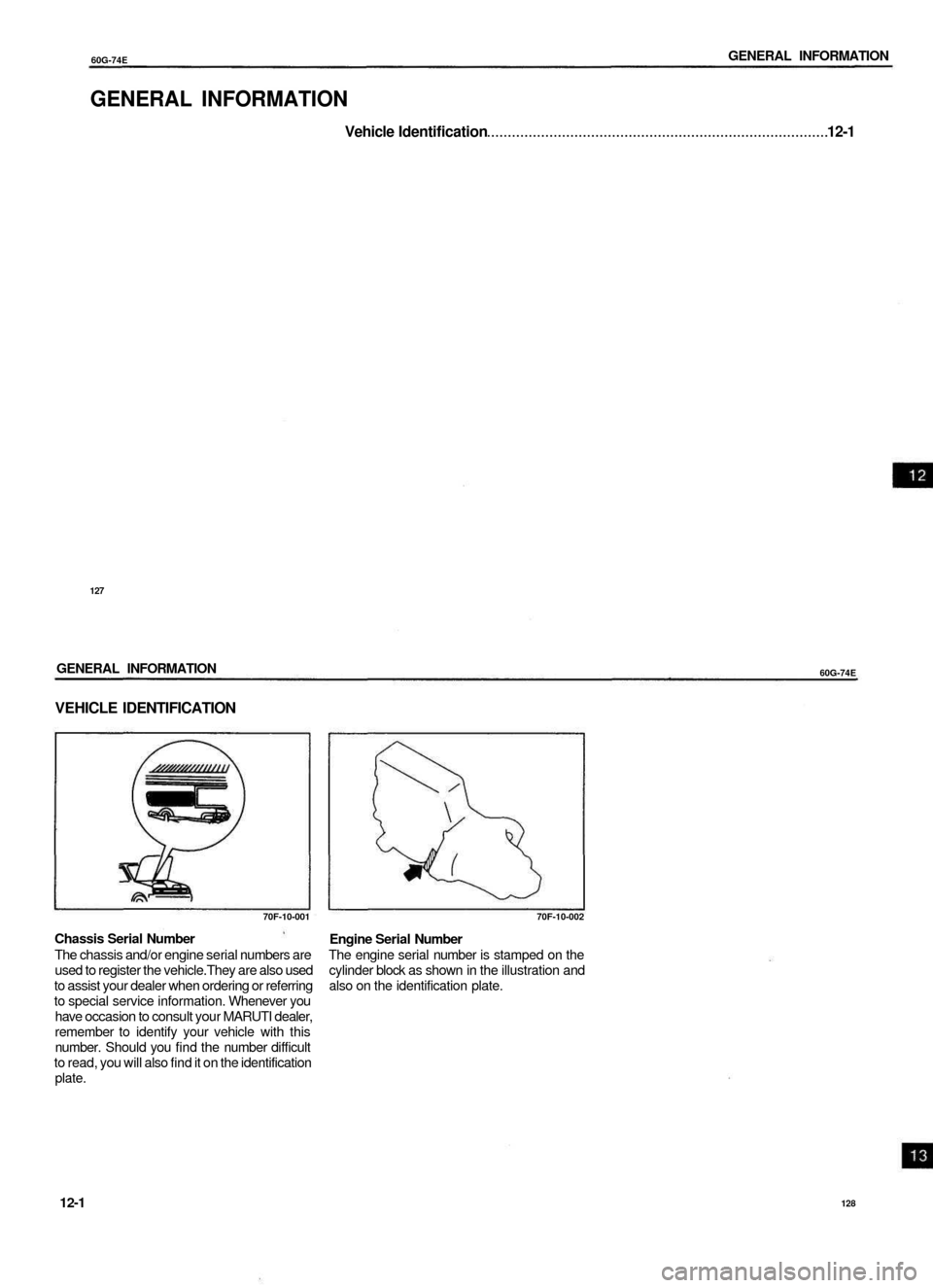
Chassis Serial Number
The chassis and/or engine serial numbers are
used to register the vehicle.They are also used
to assist your dealer when ordering or referring
to special service information. Whenever you
have occasion to consult your MARUTI dealer,
remember to identify your vehicle with this
number. Should you find the number difficult
to read, you will also find it on the identification
plate.
70F-10-002
Engine Serial Number
The engine serial number is stamped on the
cylinder block as shown in the illustration and
also on the identification plate.
12-1
128