1999 SUZUKI BALENO lock
[x] Cancel search: lockPage 33 of 65

60G-74E
OPERATING YOUR VEHICLE
Once a week, or each time you fill your fuel
tank, perform the following under-bonnet
checks:
1) Engine oil level.
2) Coolant level.
3) Brake fluid level.
4) Power steering (if equipped) fluid level.
5) Windscreen washer fluid level.
6) Battery solution level.
7) Bonnet latch operation.
Pull the bonnet release handle inside the
vehicle. Make sure that you can not open
the hood all the way without releasing the
secondary latch. Be sure to close the hood
securely after checking for proper
operation. See "All Latches, Hinges &
Locks" of "PERIODIC MAINTENANCE
SCHEDULE" in the "INSPECTION AND
MAINTENANCE" section for lubrication
schedule.
Make sure the bonnet is fully closed
and latched before driving. If it is not,
it can fly up unexpectedly during
driving, obstructing your view and
resulting in an accident.
STARTING THE ENGINE
Before starting the engine:
1) Make sure the parking brake is applied
fully.
2) Manual Transmission - Shift into "N"
(neutral) and depress the clutch pedal all
the way to the floor. Hold it while starting
the engine.
Make sure that the parking brake is
applied fully and the transmission is in
Neutral before attempting to start the
engine.
CAUTION
Stop turning the starter immediately
after the engine has started or the
starter system can be damaged.
Do not crank the engine for more
than 15 seconds at a time. If the
engine doesn't start on the first try,
wait about 15 seconds before trying
again.
Starting a Cold Engine
Engine which is started after 6 hours should
be treated as cold engine.
For Electronic fuel injection models
• With your foot off the accelerator pedal,
crank the engine by turning the ignition
key to "START1. Release the key when the
engine starts.
• If the engine does not start after 15
seconds of cranking, wait about 15
seconds, then press down the accelerator
pedal to 1/3 of its travel and try cranking
the engine again. Release the key and
accelerator pedal when the engine starts.
• If the engine still does not start, try holding
the accelerator pedal all the way to the
floor while cranking. This should clear the
engine if it is flooded.
Starting a Warm Engine
For Electronic fuel injection models:
Use the same procedure as for "Starting a cold
Engine".
67
7-2
OPERATING YOUR VECHILE
60G-74E
USING THE TRANSMISSION
70F-04-005E
Starting off
To start off, depress and maintain pressure
upon the clutch pedal and change into 1st
gear. After releasing the parking brake,
gradually release the clutch. When you hear
a change in the engine's sound (speed), gently
apply pressure to the accelerator to keep the
engine sound (speed) constant whilst
continuing to gradually release the clutch.
Gear changing
All forward gears are synchronized, which
provides for quiet, easy changing. Always
depress the clutch pedal fully before changing
gears.The following table shows the maximum
allowable speed for each gear.
GEAR
First
Second
Third
Fourth
Fifth
MAXIMUM SPEED
50 km/h
95 km/h
140 km/h
Top Speed
Top Speed
7-3
68
Page 35 of 65

60G-74E
OPERATING YOUR VEHICLE
CATALYTIC CONVERTER
(if equipped)
70F-05-005
The purpose of the catalytic converter installed
on your vehicle is to convert exhaust pollutants
to harmless water vapour, carbon dioxide, and
nitrogen. Use of leaded fuel in vehicles
equipped with catalytic converters is
prohibited, because lead deactivates the
pollutant-reducing components of the catalyst
system.
It is very important to keep the engine properly
tuned. Engine misfiring, which can result from
an improperly tuned engine, may cause
overheating of the catalyst. This may result in
permanent heat damage to the catalyst and
other vehicle components.
CAUTION
To minimize the possibility of catalyst
or other vehicle damage:
• Maintain the engine in the proper
operating condition.
• In the event of an engine
malfunction, particularly one
involving engine misfire or other
apparent loss of performance, have
the vehicle serviced promptly.
• Do not turn off the engine or
interrupt the ignition when the
transmission is in gear and the
vehicle is in motion.
• Do not try to start the engine by
pushing or towing the vehicle, or
coasting down a hill.
• Do not idle the engine with any spark
plug wires disconnected or
removed, such as during diagnostic
testing.
• Do not idle the vehicle for prolonged
periods if idling seems rough or
there are other malfunctions.
• Do not allow the fuel tank to get near
the empty level.
60Q-07-002E
Be careful where you park and drive;
the catalytic converter and other
exhaust components can get very hot.
As with any vehicle, do not park or
operate this vehicle in areas where
combustible materials such as dry
grass or leaves can come in contact
with a hot exhaust system.
7-6
OPERATING YOUR VECHILE
60G-74E
IMPROVING FUEL ECONOMY
The following instructions will help you improve
fuel economy.
Avoid excessive idling:
If you are to wait for more than a minute while
you are parked, stop the engine and start it
again later. When warming up a cold engine,
allow the engine to idle until the temperature
gauge pointer comes up to the "C" position. In
this position, the engine is sufficiently warm
for starting off.
Avoid "fast" starts:
Fast starts away from lights or stop signs will
consume fuel unnecessarily and shorten
engine life. Start off slowly.
Avoid unnecessary stops:
Avoid unnecessary deceleration and stopping.
Try to maintain a slow, steady speed whenever
possible. Slowing down and then accelerating
again uses more fuel.
Keep a steady cruising speed:
Keep as constant a speed as road and traffic
conditions will permit.
Air Outlet side
(Facing up)
60G-09-010
Keep the air cleaner clean:
A dirty air cleaner will cause the carburation
system to supply too much fuel to the engine
for the amount of air being supplied. The result
is waste of fuel due to incomplete combustion.
Keep weight to a minimum:
The heavier the load, the more fuel the vehicle
consumes. Take out any luggage or cargo
when it is not necessary.
Keep tyre pressures correct:
Under-inflation of the tyres can waste fuel due
to increased running resistance of the tyres.
Keep your tyres inflated to the correct pressure
shown on the label on the driver's side door
or door lock pillar.
TRAILER TOWING
Your MARUTI was originally designed to carry
people and a normal amount of cargo, not to
tow a trailer. Maruti does not recommend you
use your vehicle to tow a trailer.Towing a trailer
can adversely affect handling, durability, and
fuel economy.
7-7
72
71
Page 43 of 65
60G-74E
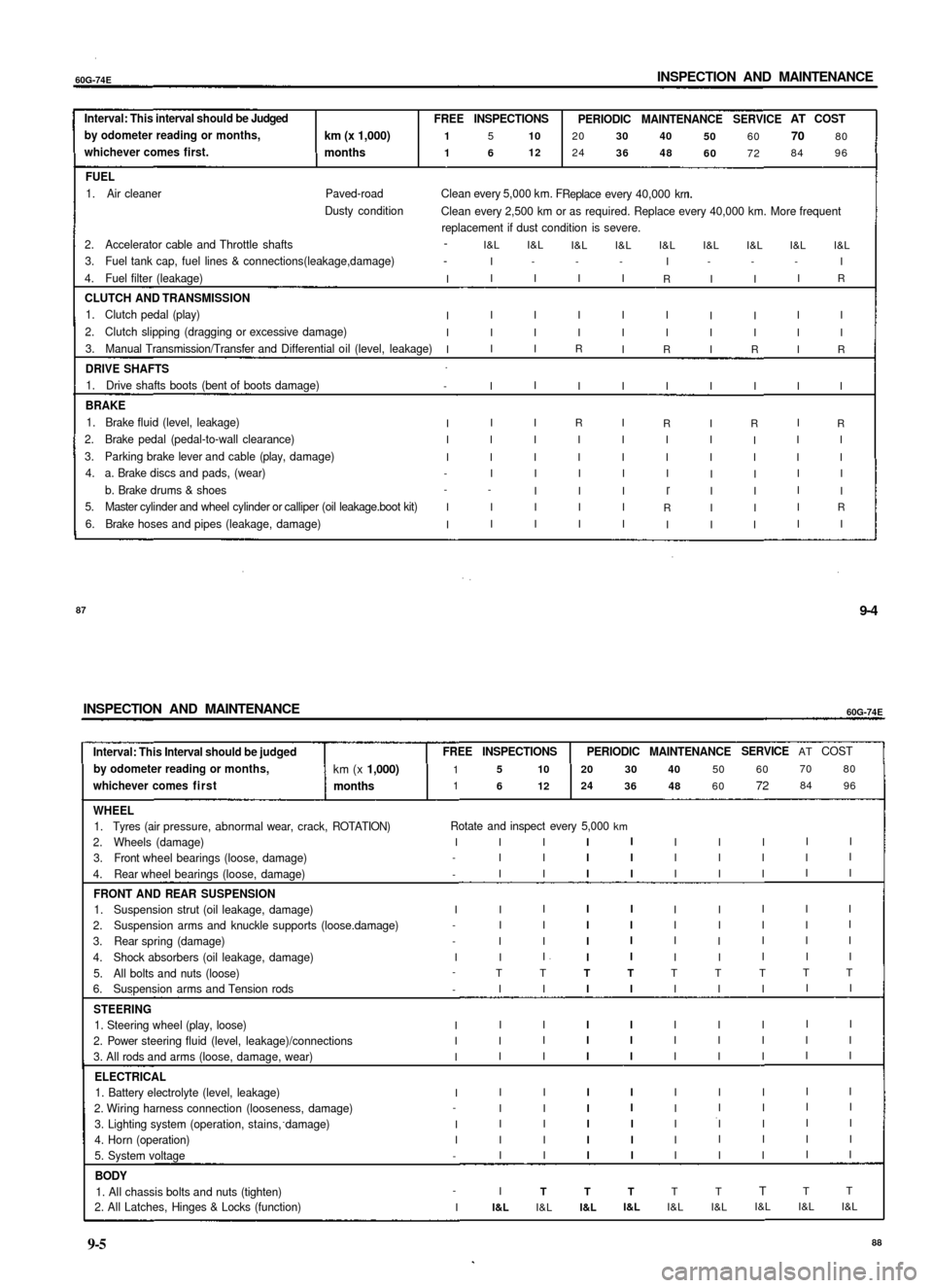
INSPECTION AND MAINTENANCE
Interval: This interval should be Judged
by odometer reading or months,
whichever comes first.
km (x 1,000)
months
FUEL
1. Air cleaner Paved-road
Dusty condition
2. Accelerator cable and Throttle shafts
3. Fuel tank cap, fuel lines & connections(leakage,damage)
4. Fuel filter (leakage)
CLUTCH AND TRANSMISSION
1. Clutch pedal (play)
2. Clutch slipping (dragging or excessive damage)
3. Manual Transmission/Transfer and Differential oil (level, leakage)
DRIVE SHAFTS
1. Drive shafts boots (bent of boots damage)
BRAKE
1. Brake fluid (level, leakage)
2. Brake pedal (pedal-to-wall clearance)
3. Parking brake lever and cable (play, damage)
4. a. Brake discs and pads, (wear)
b. Brake drums & shoes
5. Master cylinder and wheel cylinder or calliper (oil leakage.boot kit)
6. Brake hoses and pipes (leakage, damage)
FREE
1
1
INSPECTIONS
5
6
10
12
Clean every 5,000 km. F
PERIODIC MAINTENANCE
20
24
30
36
40
48
Replace every 40,000 krr
50
60
SERVICE
60
72
AT
70
84
COST
80
96
Clean every 2,500 km or as required. Replace every 40,000 km. More frequent
replacement if dust condition is severe.
-
-
I
I
I
I
-
I
I
I
-
-
I
I
I&L
I
I
I
I
I
I
I
I
I
I
-
I
I
I&L
-
I
I
I
I
I
I
I
I
I
I
I
I
I&L
-
I
I
I
R
I
R
I
I
I
I
I
I
I&L
-
I
I
I
I
I
I
I
I
I
I
I
I
I&L
I
R
I
I
R
I
R
I
I
I
I
R
I
I&L
-
I
I
I
I
I
I
I
I
I
I
I
I
I&L
-
I
I
I
R
I
R
I
I
I
I
I
I
I&L
-
I
I
I
I
I
I
I
I
I
I
I
I
I&L
I
R
I
I
R
I
R
I
I
I
I
R
I
87
9-4
INSPECTION AND MAINTENANCE
60G-74E
Interval: This Interval should be judged
by odometer reading or months,
whichever comes first
km (x 1,000)
months
WHEEL
1. Tyres (air pressure, abnormal wear, crack, ROTATION)
2. Wheels (damage)
3. Front wheel bearings (loose, damage)
4. Rear wheel bearings (loose, damage)
FRONT AND REAR SUSPENSION
1. Suspension strut (oil leakage, damage)
2. Suspension arms and knuckle supports (loose.damage)
3. Rear spring (damage)
4. Shock absorbers (oil leakage, damage)
5. All bolts and nuts (loose)
6. Suspension arms and Tension rods
STEERING
1. Steering wheel (play, loose)
2. Power steering fluid (level, leakage)/connections
3. All rods and arms (loose, damage, wear)
ELECTRICAL
1. Battery electrolyte (level, leakage)
2. Wiring harness connection (looseness, damage)
3. Lighting system (operation, stains, damage)
4. Horn (operation)
5. System voltage
BODY
1. All chassis bolts and nuts (tighten)
2. All Latches, Hinges & Locks (function)
FREE
1
1
INSPECTIONS
5
6
Rotate and
I
-
-
I
-
-
I
-
-
I
I
I
I
-
I
I
-
-
I
I
I
I
I
I
I
I
T
I
I
I
I
I
I
I
I
I
I
I&L
10
12
PERIODIC
20
24
inspect every 5,000
I
I
I
I
I
I
I
T
I
I
I
I
I
I
I
I
I
T
I&L
I
I
I
I
I
I
I
T
I
I
I
I
I
I
I
I
I
T
I&L
30
36
km
I
I
I
I
I
I
I
T
I
I
I
I
I
I
I
I
I
T
I&L
MAINTENANCE
40
48
I
I
I
I
I
I
I
T
I
I
I
I
I
I
I
I
I
T
I&L
50
60
I
I
I
I
I
I
I
T
I
I
I
I
I
I
I
I
I
T
I&L
SERVICE
60
72
I
I
I
I
I
I
I
T
I
I
I
I
I
I
I
I
I
T
I&L
AT
70
84
I
I
I
I
I
I
I
T
I
I
I
I
I
I
I
I
I
T
I&L
COST
80
96
I
I
I
I
I
I
I
T
I
I
I
I
I
I
I
I
I
T
I&L
9-5
88
Page 45 of 65

60G-74E
INSPECTION AND MAINTENANCE
60G-09-002E
Oil Level Cheek
It is important to keep the engine oil at the
correct level for proper lubrication of your
vehicle's engine. Check the oil level with the
vehicle on a level surface. The oil level
indication may be inaccurate if the vehicle is
on a slope. The oil level should be checked
either before starting the engine or at least 5
minutes after stopping the engine.
Pull out the oil dipstick, wipe oil off with a clean
cloth, insert the dipstick all the way into the
engine, then remove it again. The oil on the
stick should be between the upper and lower
limits shown on the stick. If the oil level
indication is near the lower limit, add enough
oil to raise the level to the upper limit.
91
60G-09-003E
Refilling
Remove the oil filler cap and pour oil slowly
through the filler hole to bring the oil level to the
upper limit on the dipstick. Be careful not to
overfill. Too much oil is almost as bad as too
little oil. After refilling, start the engine and allow
it to idle for about a minute. Stop the engine,
wait for five minutes and check the oil level again.
Changing Engine Oil and Fitter
Drain the engine oil while the engine is still
warm.
1) Remove the oil filler cap.
2) Place a drain pan under the drain plug.
3) Using the correct spanner remove the
drain plug and drain out the engine oil.
60G-09-004
The engine oil temperature may be high
enough to burn your fingers when the
drain plug Is loosened. Watt until the
drain plug is cool enough to touch with
your bare hands.
9-8
INSPECTION AND MAINTENANCE
60G-74E
New and used oil can be hazardous.
Children and pets may be harmed by
swallowing new or used oil. Keep new
and used oil and used oil fitters away
from children and pets.
Continuous contact with used engine
oil has been found to cause (skin)
cancer in laboratory animals. Brief
contact with used oil may irritate skin.
To minimize your exposure to used oil,
wear a long-sleeve shirt and
moistureproof gloves (such 'as
dishwashing gloves) when changing
oil. If oil contacts your skin, wash
thoroughly with soap and water.
Launder any clothing or rags if wet with
oil.
Recycle or properly dispose of used oil
and filters.
4) Reinstall the drain plug and gasket.
Tighten the plug to a torque of
5.0 kg-m (36.5 Ib-ft).
70F-07-010
Replace the oil filter
1) Using an oil filter wrench, turn the oil filter
counterclockwise and remove it.
2) Using a clean rag, wipe off the mounting
surface on the engine where the new filter
will be seated.
3) Smear a little engine oil around the rubber
gasket of the new oil filter.
4) Screw on the new filter by hand until the
filter gasket contacts the mounting
surface.
60G-09-005
CAUTION
To tighten the oil filter properly, it is
important to accurately identify the
position at which the filter gasket first
contacts the mounting surface.
5) Tighten the filter 3/4 turn from the point of
contact with the mounting surface, [or to
1.4 kg-m (10.5 Ib-ft)] using an oil filter
wrench.
9-9
92
Page 47 of 65

60G-74E
INSPECTION AND MAINTENANCE
CAUTION
When adding or replacing coolant,
use a high quality ethylene glycol
antifreeze and anticorrosion (Non-
Amine type) diluted with distilled
water. If the lowest ambient
temperature in your area is expected
to be -15°C (5°F) or above, make the
antifreeze concentration of the
mixture you use at least 30% but no
more than 50%. If -16°C (3°F) or
below, make the concentration at
least 50%. If the 50% concentration
does not provide adequate
protection against freezing, follow
the instructions on the antifreeze
container to obtain the desired
freezing point.
When putting the cap on the
reservoir tank, line up the arrow on
the cap and the arrow on the tank,
or coolant can leak out.
70F-07-019E
Coolant Replacement
1) When the engine is cool, remove the
radiator cap by turning it slowly to the left
until a "stop" is felt. Do not press down
while turning the cap. Wait until any
pressure is released, then press down on
the cap and continue turning it
anticlockwise.
60G-09-039E
It is dangerous to remove the radiator
cap when the water temperature is
high, because scalding fluid and steam
may be blown out under pressure. Watt
until the coolant temperature has
lowered before removing the cap.
2) Remove the reservoir tank cap. Remove
the reservoir by lifting it up, and drain the
reservoir completely by pouring the
coolant in to a suitable container.
95
9-12
INSPECTION AND MAINTENANCE
60G-74E
WINDSCREEN WASHER FLUID
AIR CLEANER
60G-09-008
3) Loosen the drain plug attached to the
lower part of the radiator and drain the
coolant into a suitable container.
4) Tighten the drain plug on the radiator, fill
the radiator with coolant and install the
radiator cap.
5) Refit the reservoir and fill it with the correct
coolant to the "FULL" line. Refit the
reservoir tank cap, ensuring the arrows are
correctly aligned.
CAUTION
The coolant must be replaced with the
vehicle on level ground.
63B-09-001
Check that there is washer fluid in the tank.
Refill it if necessary. Use a good quality
windscreen washer fluid, diluted with water as
necessary.
Do not use "antifreeze" solution in the
windscreen washer reservoir.This can
severely impair visibility when sprayed
on the windscreen, and can also
damage your vehicle's paint.
CAUTION
Damage may result if the washer motor
is operated whilst the fluid or fluid
nozzles are frozen or with no fluid in
the washer tank.
6OG-09-009
If the air cleaner is clogged with dust, there
will be greater intake resistance, resulting in
decreased power output and increased fuel
consumption.
Take out the air cleaner element after
unhooking the clamps shown in the illustration.
Blow off dust on air cleaner element by
compressed air. If the air cleaner element
appears to be dirty, replace it with a new one.
9-13
96
Page 49 of 65

60G-74E
INSPECTION AND MAINTENANCE
70F-07-029
Do not use any fluid other than SAE
J1703 or DOT-3 brake fluid. Do not
use reclaimed fluid or fluid that has
been stored in old or open
containers. It is essential that foreign
particles and other liquids are kept
out of the brake fluid reservoir.
CAUTION
The brake fluid should be replaced
every two years or 20,000 km.
panel will come on (the engine must
be running with the parking brake
fully disengaged). Should the light
come on, immediately ask your
MARUTI dealer to inspect the brake
system.
A rapid fluid loss Indicates a leak in
the brake system which should be
inspected by your MARUTI dealer
immediately.
Brake fluid can harm your eyes and
damage painted surfaces. Use
caution when refilling the reservoir.
NOTE:
With disc brakes, the fluid level can be
expected to gradually fall as the brake pads
wear.
99
70F-07-030
Brake Pedal
Check if the brake pedal stops at the regular
height without "spongy" feeling when you
depress it. If not, have the brake system
inspected by your MARUTI dealer. If you doubt
the brake pedal for the regular height, check
it as follows:
With the engine running, measure the distance
between the brake pedal and floor wall when
the pedal is depressed with approximately 30
kg (66 lbs) of force. The minimum distance
required is 80 mm (3.1 in). Since your vehicle's
brake system is self-adjusting, there is no need
for pedal adjustment. If the pedal to floor wall
distance as measured above is less than the
minimum distance required, have your vehicle
inspected by your MARUTI dealer.
9-16
INSPECTION AND MAINTENANCE
60G-74E
STEERING
60G-09-015E
NOTE:
When measuring the distance between the
brake pedal and floor wall, be sure not to
include any floor covering in the measurement.
If you experience any of the following
problems with your vehicle's brake
system, have the vehicle inspected
immediately by your MARUTI dealer.
Poor braking performance
Uneven braking (Brakes not working
uniformly on all wheels.)
Excessive pedal travel
Brake dragging
Excessive noise
Pedal pulsation (Pedal pulsates
when depressed.)
63B-09-00SE
Parking brake
Check the parking brake for proper adjustment
by counting the number of clicks made by the
ratchet teeth as you slowly pull up on the
parking brake lever to the point of full
engagement. The parking brake lever should
stop between the 3rd and 5th ratchet tooth
and the rear wheels should be securely locked.
If the parking brake is not properly adjusted
or the brakes drag after the lever has been
fully released, have the parking brake
inspected and/or adjusted by your MARUTI
dealer.
60G-09-016
Check the play of the steering wheel by gently
turning it from left to right and measuring the
distance that it moves before you feel slight
resistance. The play should be between 0 -
30
mm
(0.0 -1.2 in).
Check that the steering wheel turns easily and
smoothly without rattling by turning it all the
way to the right and to the left while driving
very slowly in an open area. If the amount of
free play is outside the specification or you
find anything else to be wrong, an inspection
must be performed by your MARUTI dealer.
9-17
100
Page 54 of 65
60G-74E
INSPECTION AND MAINTENANCE
60G-09-031
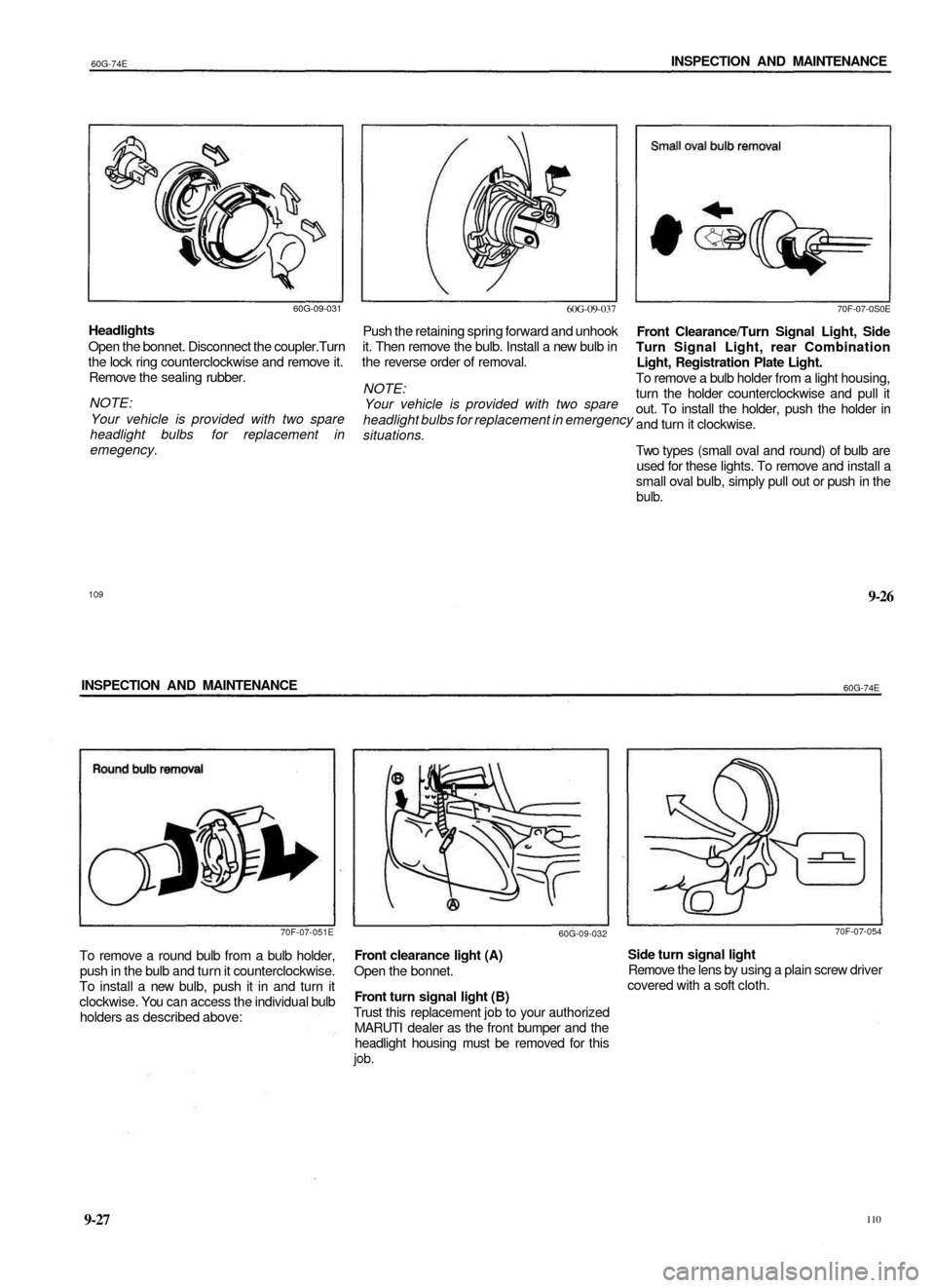
Headlights
Open the bonnet. Disconnect the coupler.Turn
the lock ring counterclockwise and remove it.
Remove the sealing rubber.
NOTE:
Your vehicle is provided with two spare
headlight bulbs for replacement in
emegency.
60G-09-037
Push the retaining spring forward and unhook
it. Then remove the bulb. Install a new bulb in
the reverse order of removal.
NOTE:
Your vehicle is provided with two spare
headlight bulbs for replacement in emergency
situations.
70F-07-0S0E
Front Clearance/Turn Signal Light, Side
Turn Signal Light, rear Combination
Light, Registration Plate Light.
To remove a bulb holder from a light housing,
turn the holder counterclockwise and pull it
out. To install the holder, push the holder in
and turn it clockwise.
Two types (small oval and round) of bulb are
used for these lights. To remove and install a
small oval bulb, simply pull out or push in the
bulb.
109
9-26
INSPECTION AND MAINTENANCE
60G-74E
70F-07-051E
To remove a round bulb from a bulb holder,
push in the bulb and turn it counterclockwise.
To install a new bulb, push it in and turn it
clockwise. You can access the individual bulb
holders as described above:
60G-09-032
Front clearance light (A)
Open the bonnet.
Front turn signal light (B)
Trust this replacement job to your authorized
MARUTI dealer as the front bumper and the
headlight housing must be removed for this
job.
70F-07-054
Side turn signal light
Remove the lens by using a plain screw driver
covered with a soft cloth.
9-27
110
Page 55 of 65
60G-74E
INSPECTION AND MAINTENANCE
60G-09-033
60G-09-034
60G-09-035
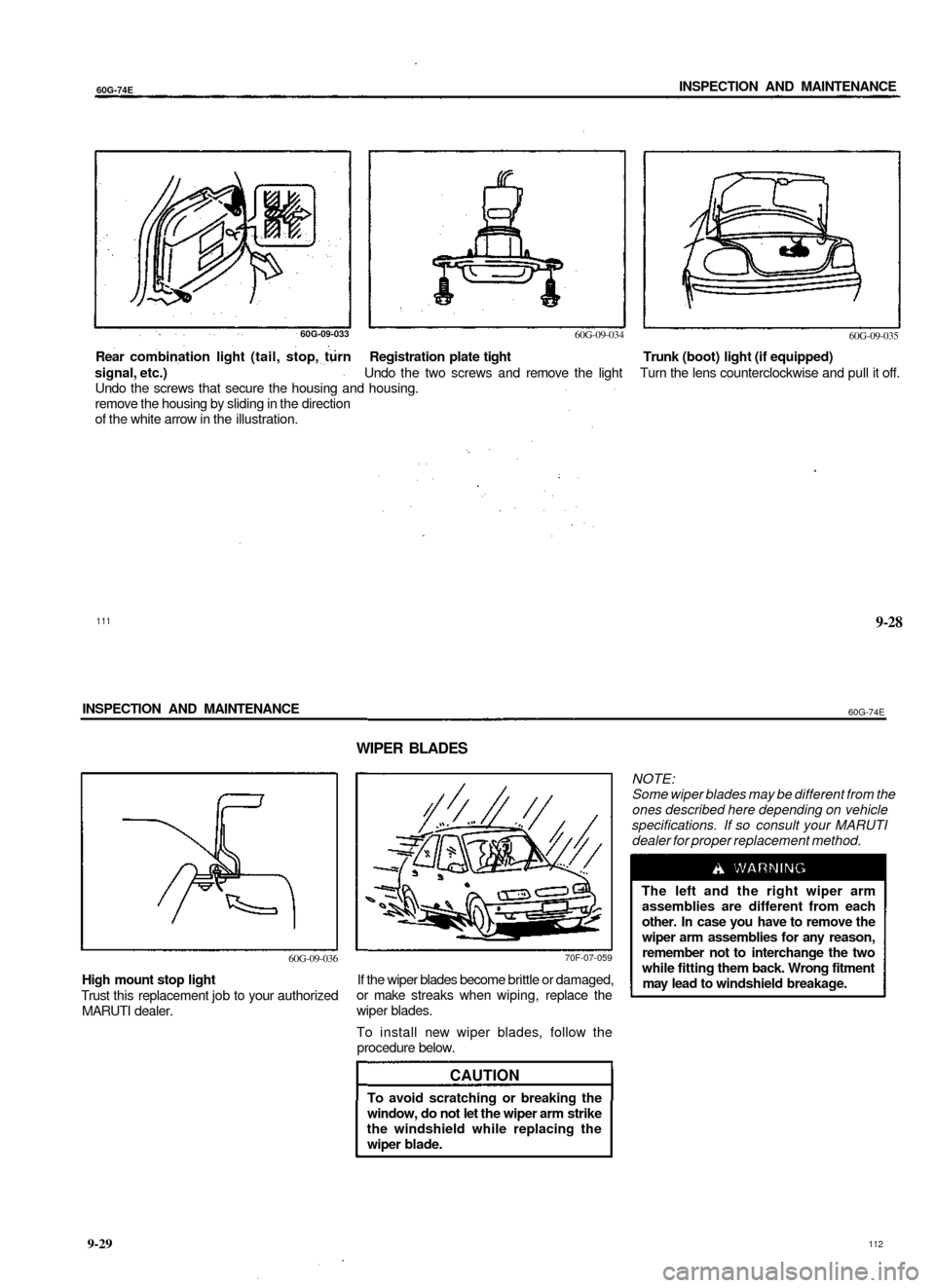
Rear combination light (tail, stop, turn Registration plate tight Trunk (boot) light (if equipped)
signal, etc.) Undo the two screws and remove the light Turn the lens counterclockwise and pull it off.
Undo the screws that secure the housing and housing.
remove the housing by sliding in the direction
of the white arrow in the illustration.
111
9-28
INSPECTION AND MAINTENANCE
60G-74E
WIPER BLADES
60G-09-036
High mount stop light
Trust this replacement job to your authorized
MARUTI dealer.
70F-07-059
If the wiper blades become brittle or damaged,
or make streaks when wiping, replace the
wiper blades.
To install new wiper blades, follow the
procedure below.
CAUTION
To avoid scratching or breaking the
window, do not let the wiper arm strike
the windshield while replacing the
wiper blade.
NOTE:
Some wiper blades may be different from the
ones described here depending on vehicle
specifications. If so consult your MARUTI
dealer for proper replacement method.
The left and the right wiper arm
assemblies are different from each
other. In case you have to remove the
wiper arm assemblies for any reason,
remember not to interchange the two
while fitting them back. Wrong fitment
may lead to windshield breakage.
9-29
112