1999 SUZUKI BALENO ESP
[x] Cancel search: ESPPage 10 of 65

60G-74E
BEFORE DRIVING
MIRRORS
60G-03-013
Day-Night Rearview Mirror (if equipped)
To adjust the interior rearview mirror, set the
selector tab to the day position, then move
the mirror up, down, or sideways to obtain the
best view.
When driving at night, you can move the
selector tab to the night position to reduce
glare from the headlights of vehicles behind
you.
Always adjust the mirror with the
selector set to the day position.
Only use the night position if it is
necessary to reduce glare from the
headlights of vehicles behind you. Be
aware that in this position you may
not be able to see some objects that
could be seen in the day position.
Outside Rearview Mirrors
Adjust the outside rearview mirrors so you can
just see the side of your vehicle in the mirrors.
A WARNING
Be careful when judging the size or
distance of a vehicle or other object
seen in the side convex mirror (if
equipped). Be aware that objects look
smaller and appear farther away than
when seen in a flat mirror.
21
3-8
BEFORE DRIVING
6OG-74E
FRONT SEAT ADJUSTMENT
60G-03-014
Electric Mirrors (If equipped)
The switch to control the electric mirrors is
located on the instrument panel.You can only
adjust the mirrors when the ignition switch is
in the "ON" position. To adjust the mirrors:
1) Move the selector switch to the left or right
to select the mirror you wish to adjust.
2) Press the outer part of the switch that
corresponds to the direction in which you
wish to move the mirror.
3) Return the selector switch to the centre
position to help prevent unintended
adjustment.
72F-03-016
Never attempt to adjust the driver's seat
or seatback while driving. The seat or
seatback could move unexpectedly,
causing loss of control. Make sure that
the driver's seat and seatback are
properly adjusted before you start
driving.
72F-03-013
Adjusting Seat Position
The adjustment lever for each front seat is
located under the front of the seat, on the
inboard side. To adjust the seat position, pull
up on the adjustment lever and slide the seat
forward or rearward. After adjustment, try to
move the seat forward and rearward to ensure
that it is securely latched.
3-9
22
Page 20 of 65

60G-74E
INSTRUMENT PANEL
60G-09-002
CAUTION
If you operate the engine with this
light on, severe engine damage can
result.
Do not rely on the Oil Pressure Light
to indicate the need to add oil. Be
sure to periodically check the engine
oil level (see pages 9-8 and 9-9).
70F-03-009
Charging Light
This light comes on when the ignition switch
is turned on, and goes out when the engine is
started. The light will come on and remain on
if there is something wrong with the battery
charging system. If the light comes on when
the engine is running, the charging system
should be inspected immediately by your
MARUTI dealer.
CAUTION
Do not continue driving long with the
charging light ON as this will drain the
battery 'dead'.
72F-05-027
"Malfunction Indicator" Light
Your vehicle has a computer-controlled
emission control system. A "Malfunction
Indicator" light is provided on the instrument
panel to indicate when it is necessary to have
the emission control system serviced. The
"Malfunction Indicator" light comes on when
the ignition switch is turned to "ON" and goes
out when the engine is started.
If the "Malfunction Indicator" light comes on
when the engine is running, there is a problem
with the emission control system. Take the
vehicle to your MARUTI dealer to have the
problem corrected.
CAUTION
Continuing to drive the vehicle when
the "Malfunction Indicator" light is on
can cause permanent damage to the
vehicle's emission control system, and
can affect fuel economy and
driveability.
5-4
INSTRUMENT PANEL
60G-74E
70F-03-042
Turn Signal Indicators
When you turn on the left or right turn signals,
the corresponding green arrow on the
instrument panel will flash along with the
respective turn signal lights. When you turn
on the hazard warning switch, both arrows will
flash along with all of the turn signal lights.
70F-03-043
Main Beam (High Beam) Indicator Light
This indicator comes on when headlight main
beams (high beams) are turned on.
SPEEDOMETER/ODOMETER/
TRIPMETER (if equipped)
60G-05-003
© Speedometer
© Odometer
(D Trip meter
© Trip meter reset knob
The speedometer indicates vehicle speed in
km/h.The odometer records the total distance
the vehicle has been driven. The tripmeter can
be used to measure the distance travelled on
short trips or between fuel stops. You can reset
the tripmeter to zero by pushing the reset
knob.
CAUTION
Keep track of your odometer reading
and check the maintenance schedule
regularly for required services.
Increased wear or damage to certain
parts can result from failure to perform
required services at the proper mileage
intervals and your warranty rights may
be affected.
5-5
42
41
Page 34 of 65
60G-74E
OPERATING YOUR VEHICLE
Reduce your speed and change
down to a lower gear before going
down a long or steep hill. A lower
gear will allow the engine to provide
braking. Avoid riding the brakes or
they may overheat, resulting in brake
failure.
When driving on slippery roads, be
sure to slow down before changing
down. Excessive and or sudden
changes in engine speed may cause
loss of traction, which could cause
you to lose control.
Make sure that the vehicle is
completely stationary before you
change into reverse.
CAUTION
To help avoid clutch damage, do not
use the clutch pedal as a footrest
while driving or use the clutch to
keep the vehicle stationary on a hill.
Depress the clutch fully when
changing gear.
When changing gears or starting off,
do not race the engine. Racing the
engine can shorten engine life and
prevent smooth operation.
BRAKING
The distance needed to bring any vehicle to a
halt increases with the speed of the vehicle.
The braking distance needed, for example, at
60 km/h will be approximately 4 times greater
than the braking distance needed at 20 km/h.
Start to brake the vehicle when there is plenty
of distance between your vehicle and the
stopping point, and slow down gradually.
69
7-4
OPERATING YOUR VECHILE
60G-74E
RUNNING-IN
Servo assisted brakes
Your vehicle has servo assisted brakes which
works with the assistance of engine vacuum.
Do not switch off the engine while
vehicle is in motion, for example, while
driving down a hill as this will cause
loss of vacuum assistance leading to
reduction of braking efficiency
substantially.
If servo assistance is lost due to a stalled
engine or other failures, the system is still fully
operational on reserve power and you can
bring the vehicle to a complete stop by
pressing the brake pedal once and holding it
down. The reserve power is partly used up
each time you depress the brake pedal. Apply
smooth and constant pressure to the pedal.
Do not pump the pedal.
Even without reserve power in the
brake system, you can still stop the
vehicle by pressing the brake pedal
harder than normally required.
However, the stopping distance may be
lonaer.
On loose surface where the wheels can
easily loose traction (such as gravel,
etc.), the stopping distance required for
your vehicle may be greater than for a
comparable vehicle with a conventional
brake system. Allow for extra stopping
distance when driving on loose
surfaces.
CAUTION
The future performance and reliability
of the engine depends on the care and
restraint exercised during its early life.
It is especially important to observe the
following precautions during the initial
1000 km of vehicle operation.
• After starting, do not race the
engine. Warm it up gradually.
• Avoid prolonged vehicle operation at
a constant speed. Moving parts will
bed in better if you vary your speed.
• Do not exceed 100 km/h.
• Start off from a stop slowly. Avoid
full throttle starts.
• If possible, avoid hard braking,
especially during the first 300 km of
driving.
• Do not drive slowly with the
transmission in a high gear.
• Drive the vehicle at moderate engine
speeds.
7-5
70
If water gets into the brake drums,
brake performance may become poor
and unpredictable. After driving
through water or washing the
underside of the vehicle, test the brakes
while driving at a slow speed to see if
they have maintained their normal
effectiveness. If the brakes are less
effective than normal, dry them by
repeatedly applying the brakes while
driving slowly until the brakes have
regained their normal effectiveness.
Page 39 of 65
60G-74E
DRIVING TIPS AND SAFE DRIVING
72F-08-011
Braking
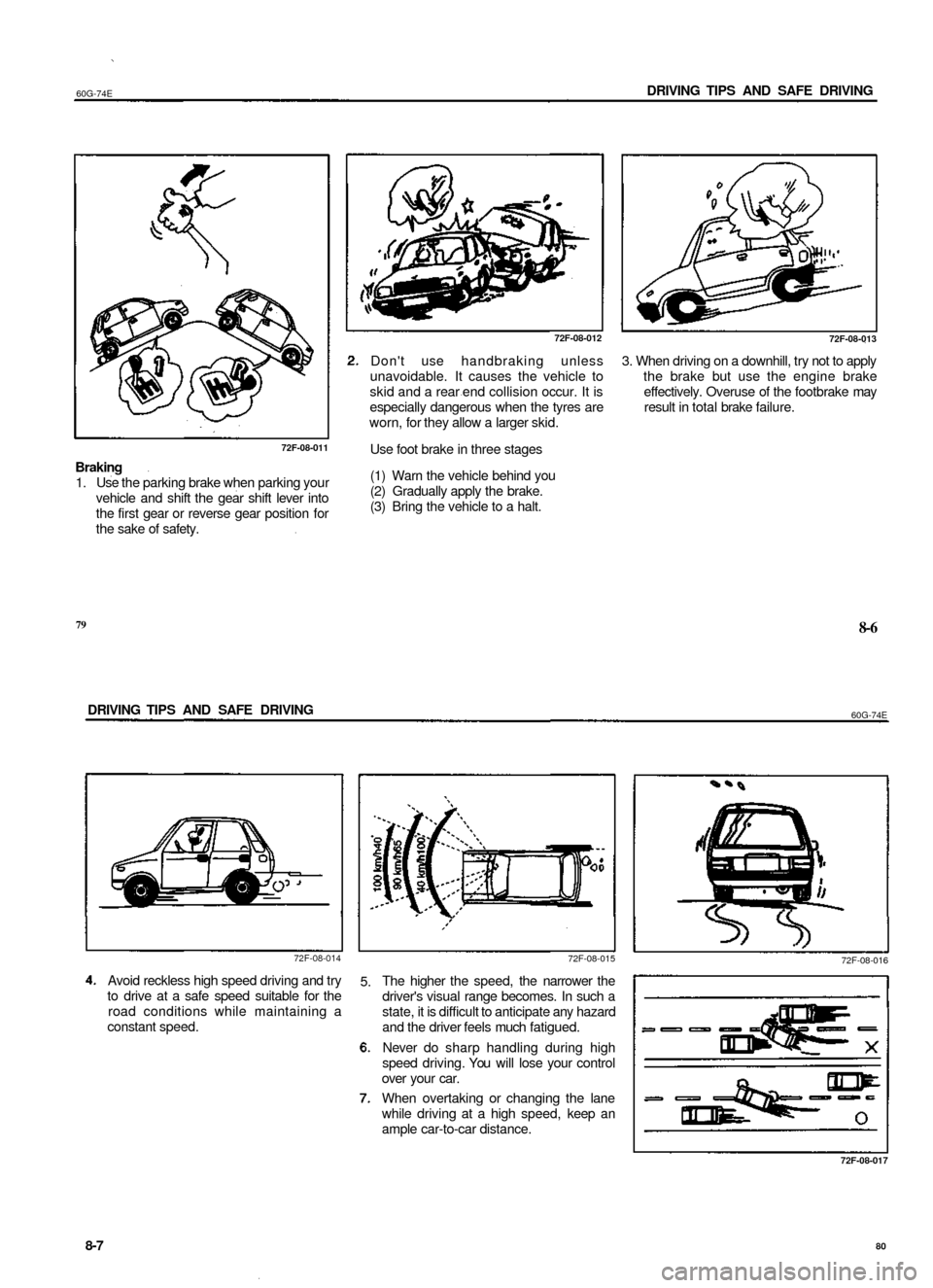
1. Use the parking brake when parking your
vehicle and shift the gear shift lever into
the first gear or reverse gear position for
the sake of safety.
72F-08-012
Don't use handbraking unless
unavoidable. It causes the vehicle to
skid and a rear end collision occur. It is
especially dangerous when the tyres are
worn, for they allow a larger skid.
Use foot brake in three stages
(1) Warn the vehicle behind you
(2) Gradually apply the brake.
(3) Bring the vehicle to a halt.
3. When driving on a downhill, try not to apply
the brake but use the engine brake
effectively. Overuse of the footbrake may
result in total brake failure.
79
8-6
DRIVING TIPS AND SAFE DRIVING
60G-74E
72F-08-014
Avoid reckless high speed driving and try
to drive at a safe speed suitable for the
road conditions while maintaining a
constant speed.
5.
72F-08-015
The higher the speed, the narrower the
driver's visual range becomes. In such a
state, it is difficult to anticipate any hazard
and the driver feels much fatigued.
Never do sharp handling during high
speed driving. You will lose your control
over your car.
When overtaking or changing the lane
while driving at a high speed, keep an
ample car-to-car distance.
72F-08-017
8-7
80
72F-08-013
72F-08-016
Page 41 of 65

60G-74E
INSPECTION AND MAINTENANCE
INSPECTION AND MAINTENANCE
Periodic Maintenance Schedule.. 9-2
Engine Oil and Filter 9-7
Gear OH 9-10
Engine Coolant 9-11
Windscreen Washer Fluid 9-13
Air Cleaner 9-13
Spark Plugs 9-14
Brakes 9-15
Steering 9-17
Power Steering (if equipped) 9-18
Clutch Pedal 9-18
Tyres... 9-19
Battery 9-22
Fuses 9-23
Bulb Replacement , 9-25
Wiper Blades 9-29
83
INSPECTION AND MAINTENANCE
60G-74E
70F-05-002
You should take extreme care when
working on your vehicle to prevent
accidental injury. Here are a few
precautions that you should be
especially careful to observe:
• Do not leave the engine running in
garages or other confined areas.
• When the engine Is running, keep
hands, clothing, tools, and other
objects away from the fan and water
pump belt. Even though the fan may
not be moving, it can automatically
turn on without warning. ^
When it is necessary to do service
work with the engine running, make
sure that the parking brake is applied
fully and the transmission is in
Neutral.
Do not touch ignition wires or other
ignition system parts when starting
the engine or when the engine is
running, or you could receive an
electric shock.
Be careful not to touch a hot engine,
exhaust manifold and pipes, muffler,
radiator and water hoses.
Do not allow smoking, sparks, or
flames around gasoline or the
battery. Flammable fumes are
present.
Do not get under your vehicle if it is
supported only with the portable
jack provided in your vehicle.
Be careful not to cause accidental
short circuits between the positive
and negative battery terminals.
Keep used oil, coolant, and other
fluids away from children and pets.
Dispose of used fluids properly;
never pour them on the ground, into
sewers, etc.
9-1
84
Page 42 of 65

60G-74E
INSPECTION AND MAINTENANCE
PERIODIC MAINTENANCE SCHEDULE
The following table shows when regular
maintenance on your vehicle is required. This
table shows in kilometres and months when
inspections, adjustments, lubrication and other
services should be performed.
Maruti recommends that maintenance
on your Maruti vehicle be performed by
Maruti Authorised Dealer/Service
Station.
CAUTION
Whenever it becomes necessary to
replace parts on your vehicle, it is
recommended that you use MARUTI
GENUINE PARTS (MGP).
85
9-2
INSPECTION AND MAINTENANCE
6OG-74E
PERIODIC MAINTENANCE SCHEDULE
A....Ad]ust. l....lnspect and correct or replace If necessary.
T....Tighten to specified torque. C....CIean.
R....Replace or change. O....Rotate
L....Lubrlcate.
Note:
This table includes services as scheduled up to 80,000 km mileage. Beyond 80,000 km, carry out the same services at the same intervals
respectively.
Interval: This interval should be judged
by odometer reading or months,
whichever comes first.
km (x 1,000)
months
ENGINE
1. Water pump drive belt (tension, wear)
2. Engine coolant (level, leakage)
3. Engine oil (API GRADE SF, SG, SH) & Oil filter
4. Cooling system hoses and connections (leakage, damage)
5. Engine bolts (All cylinder head and manifold fixings)
6. Engine mounting (loose, damage)
7. Valve clearance
8. Camshaft timing belt (damage, wear)
9. Exhaust system (noise, leakage or otherwise defective)
10. Positive crankcase ventilation System (Hoses, connections and valve;
IGNITION
1. Ignition wiring, (damage, deterioration)
2. Spark plugs (clean and adjust the gap)
FREE INSPECTIONS
1
1
A
I
R
I
-
-
-
_
5
6
I
I
I
I
-
-
A
-
10
12
I
I
R
I
T
T
-
-
PERIODIC MAINTENANCE SERVICE AT COST
20
24
I
R
R
I
-
-
A
I
Replace every 1,00,000 km
-
-
-
I
I
-
-
-
-
-
I
I
I
I
R
30
36
I
I
R
I
T
T
-
-
-
-
-
I
40
48
I
R
R
I
-
-
A
I
I
I
I
R
SO
60
I
I
R
I
T
T
-
-
-
-
-
I
60
72
R
R
R
I
-
-
A
I
I
I
I
R
70
84
A
I
R
I
T
T
-
-
-
-
-
I
80
96
I
R
R
I
-
-
A
I
I
I
I
R
9-3
86
Page 52 of 65

60G-74E
INSPECTION AND MAINTENANCE
BATTERY
60G-09-022E
When installing the cover, make sure that it is
positioned so that it does not cover or foul the
air valve.
60G-09-038
Batteries produce flammable hydrogen
gas. Keep flames and sparks away from
the battery or an explosion may occur.
Never smoke when working in the
vicinity of the battery .
When checking or servicing the battery,
disconnect the negative cable. Be
careful not to cause a short circuit by
allowing metal objects to contact the
battery posts and the vehicle at the
same time.
To avoid harm to yourself or damage
to your vehicle or battery, follow the
jump starting instructions in the
EMERGENCY SERVICE section of this
manual if it is necessary to jump start
your vehicle.
The level of the battery solution must be kept
between the "UPPER" and the "LOWER" level
lines at all times. If the level is found to be
below the "LOWER" level line, add distilled
water to the "UPPER" level line. You should
periodically check the battery, battery
terminals, and battery holddown bracket for
corrosion. Remove corrosion using a stiff
brush and ammonia mixed with water, or
baking soda mixed with water. After removing
corrosion, rinse with clean water.
If your vehicle is not going to be driven for a
month or longer, disconnect the cable from
the negative terminal of the battery to help
prevent discharge.
105
9-22
INSPECTION AND MAINTENANCE
60G-74E
FUSES
60G-09-024E
©. Main fuse
®. Primary fuse (Lights)
®. Primary fuse (IG)
©. Radiator fan motor fuse
©. Primary fuse (A/C, HTR)
This vehicle has three types of fuses, as
described below:
Main Fuse - The main fuse takes current
directly from the battery.
Primary Fuses - These fuses are between the
main fuse and individual fuses, and are for
electrical load groups.
Individual Fuses - These fuses are in the fuse
box and for individual electrical circuits.
MAIN FUSE / PRIMARY FUSES
80A
60A
60A
30A
60A
All Electric Load
HEAD-R, HEAD-L, TAIL/DOME,
STOP/HORN, HAZARD
CIGAR/RADIO, I.G. COIL/
METER, WIPER/WASHER,
REAR DEF, TURN/BACK,
HEATER RELAY.
RADIATOR FAN MOTOR
A/C, HTR
Main Fuse and Primary Fuses
The main fuse and primary fuses are located
in the engine compartment. If the main fuse
blows, no electrical component will function.
If a primary fuse blows, no electrical
component in the corresponding load group
will function. When replacing the main fuse or
a primary fuse, use a genuine MARUTI
replacement.
If the main fuse or a primary fuse blows,
be sure to have your vehicle inspected
by an authorized MARUTI dealer.
Always use a genuine MARUTI
replacement. Never use a substitute
such as a wire even for a temporary
repair, or extensive electrical damage
and a fire can result.
60G-09-025E
Fuse Box
The fuse boxes are located in the engine
compartment and under the driver's side of
the dashboard.
To remove the fuse box cover under the
dashboard pull off the cover.
9-23
106
Page 53 of 65

60G-74E
INSPECTION AND MAINTENANCE
60G-09-026
Always be sure to replace a blown fuse
with a fuse of the correct amperage.
Never use a substitute such as
aluminium foil or wire to replace a
blown fuse. If you replace a fuse and
the new one blows In a short period of
time, you may have a major electrical
problem. Have your vehicle Inspected
immediately by your MARUTI dealer.
60G-09-027E
NOTE:
Make sure that the fuse box always carries
spare fuses.
70F-07-04SE
60G-09-028E
107
9-24
INSPECTION AND MAINTENANCE
60G-74E
BULB REPLACEMENT
Light bulbs can be hot enough to
burn your finger right after being
turned off.This is true especially for
halogen headlight bulbs. Replace
the bulbs after they become cool
enough.
The headlight bulbs are filled with
pressurized halogen gas. They can
burst and injure you if they are hit
or dropped. Handle them carefully.
CAUTION
The oils from your skin may cause a
halogen bulb to overheat and burst
when the lights are on. Grasp a new
bulb with a clean cloth.
CAUTION
Frequent replacement of a bulb
indicates the need for an inspection of
the electrical system. This should be
carried out by your MARUTI dealer.
60G-09-029
Interior Light
Press down the lens by using a plain screw
driver covered with a soft cloth as shown. To
install it, simply push it back in.
The bulb can be removed by simply pulling it
out. When replacing the bulb, make sure that
the contact springs are holding the bulb
securely.
60G-09-030
NOTE:
If the air cleaner inlet duct (A) obstructs
replacement of the bulbs in the right headlight
housing, remove the duct (A).
After reinstalling the duct, make sure it is
secured in place
9-25
108