1999 SUBARU LEGACY diff
[x] Cancel search: diffPage 172 of 1456
5. VALVE SPRINGS
1) Check valve springs for damage, free length,
and tension. Replace valve spring if it is not to the
specifications presented in the table.
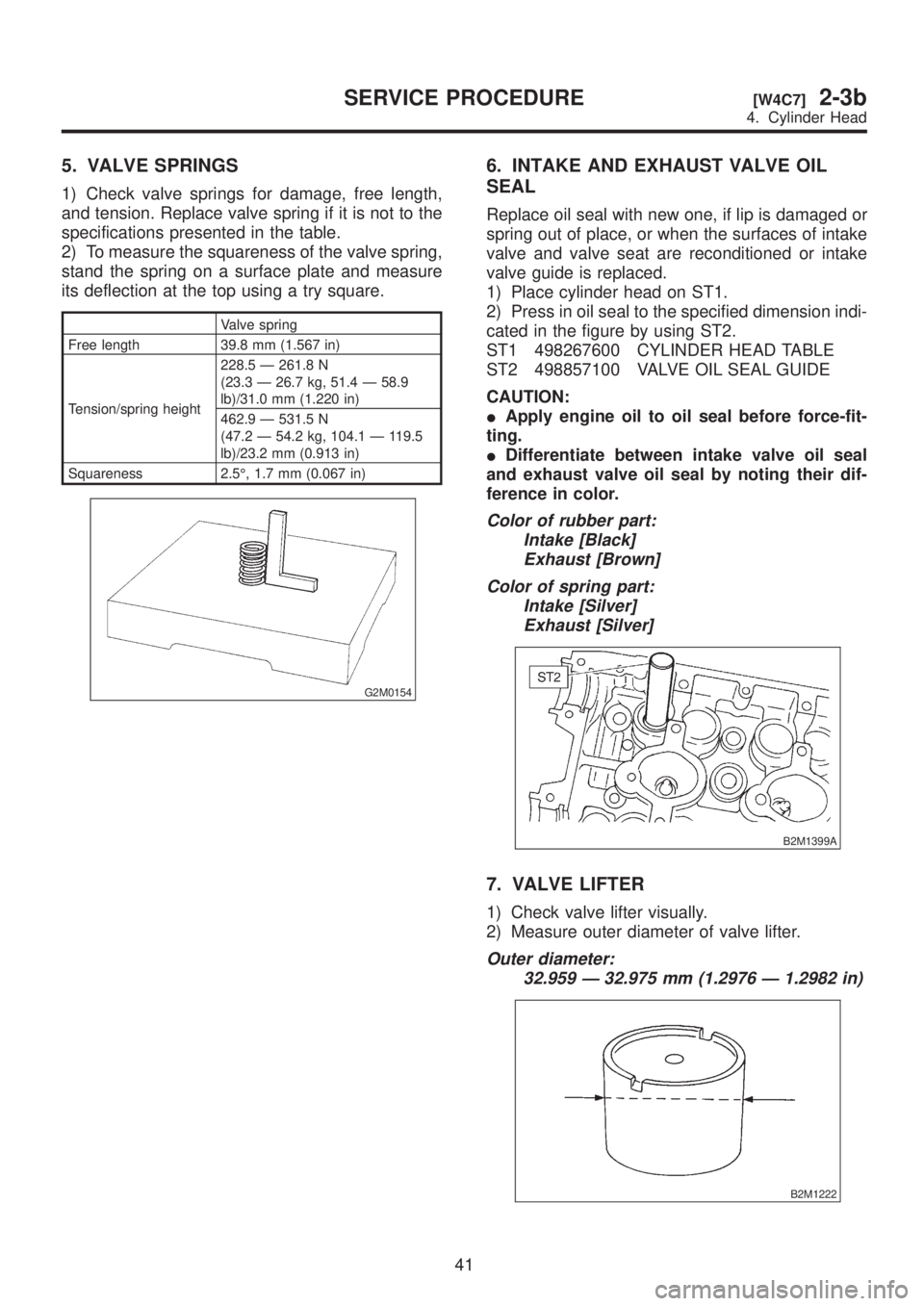
2) To measure the squareness of the valve spring,
stand the spring on a surface plate and measure
its deflection at the top using a try square.
Valve spring
Free length 39.8 mm (1.567 in)
Tension/spring height228.5 Ð 261.8 N
(23.3 Ð 26.7 kg, 51.4 Ð 58.9
lb)/31.0 mm (1.220 in)
462.9 Ð 531.5 N
(47.2 Ð 54.2 kg, 104.1 Ð 119.5
lb)/23.2 mm (0.913 in)
Squareness 2.5É, 1.7 mm (0.067 in)
G2M0154
6. INTAKE AND EXHAUST VALVE OIL
SEAL
Replace oil seal with new one, if lip is damaged or
spring out of place, or when the surfaces of intake
valve and valve seat are reconditioned or intake
valve guide is replaced.
1) Place cylinder head on ST1.
2) Press in oil seal to the specified dimension indi-
cated in the figure by using ST2.
ST1 498267600 CYLINDER HEAD TABLE
ST2 498857100 VALVE OIL SEAL GUIDE
CAUTION:
IApply engine oil to oil seal before force-fit-
ting.
IDifferentiate between intake valve oil seal
and exhaust valve oil seal by noting their dif-
ference in color.
Color of rubber part:
Intake [Black]
Exhaust [Brown]
Color of spring part:
Intake [Silver]
Exhaust [Silver]
B2M1399A
7. VALVE LIFTER
1) Check valve lifter visually.
2) Measure outer diameter of valve lifter.
Outer diameter:
32.959 Ð 32.975 mm (1.2976 Ð 1.2982 in)
B2M1222
41
[W4C7]2-3bSERVICE PROCEDURE
4. Cylinder Head
Page 173 of 1456
3) Measure inner diameter of valve lifter mating
part on cylinder head.
Inner diameter:
32.994 Ð 33.016 mm (1.2990 Ð 1.2998 in)
B2M1400
CAUTION:
If difference between outer diameter of valve
lifter and inner diameter of valve lifter mating
part is over the limit, replace cylinder head.
Standard:
0.019 Ð 0.057 mm (0.0007 Ð 0.0022 in)
Limit:
0.100 mm (0.0039 in)
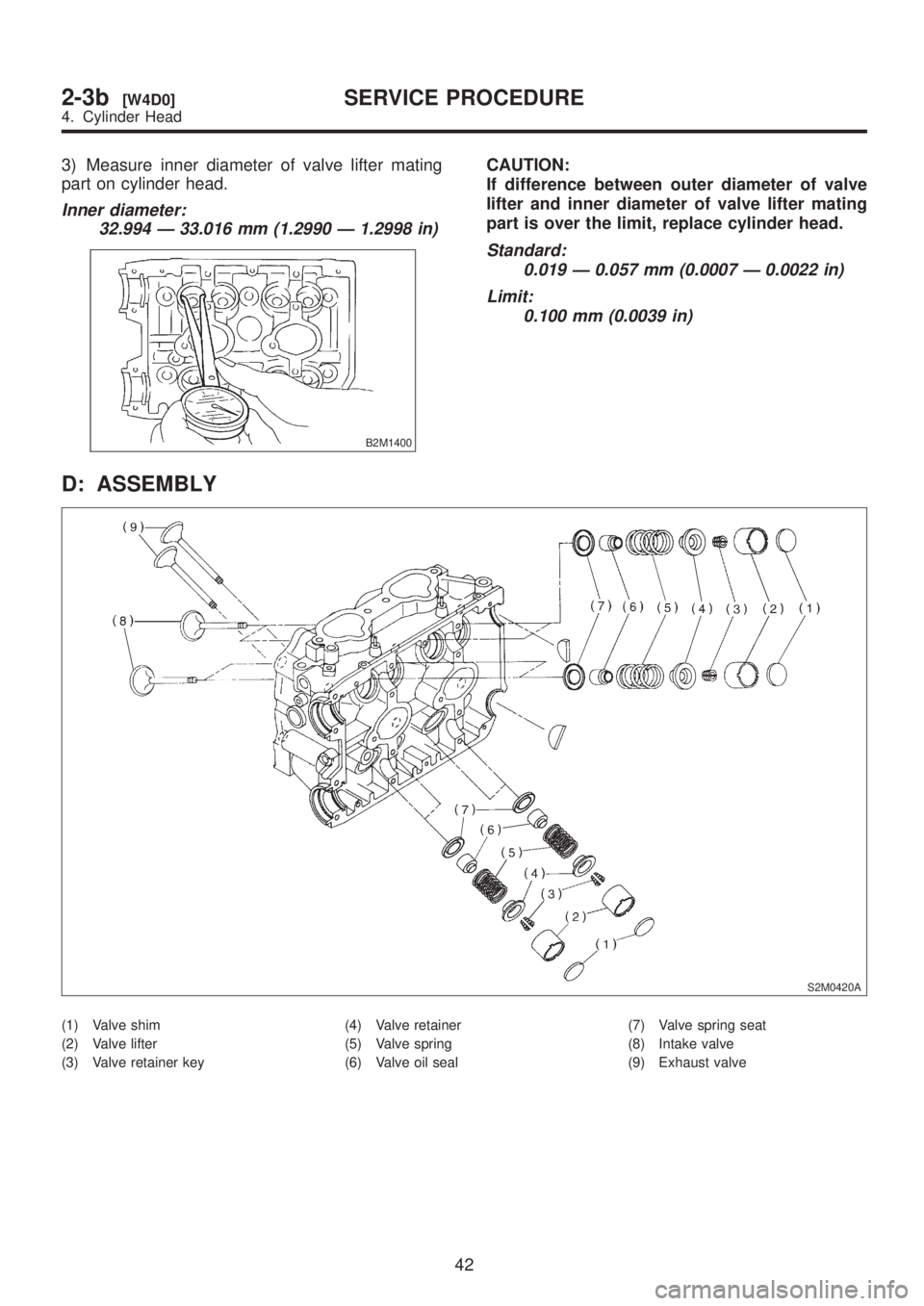
D: ASSEMBLY
S2M0420A
(1) Valve shim
(2) Valve lifter
(3) Valve retainer key(4) Valve retainer
(5) Valve spring
(6) Valve oil seal(7) Valve spring seat
(8) Intake valve
(9) Exhaust valve
42
2-3b[W4D0]SERVICE PROCEDURE
4. Cylinder Head
Page 188 of 1456
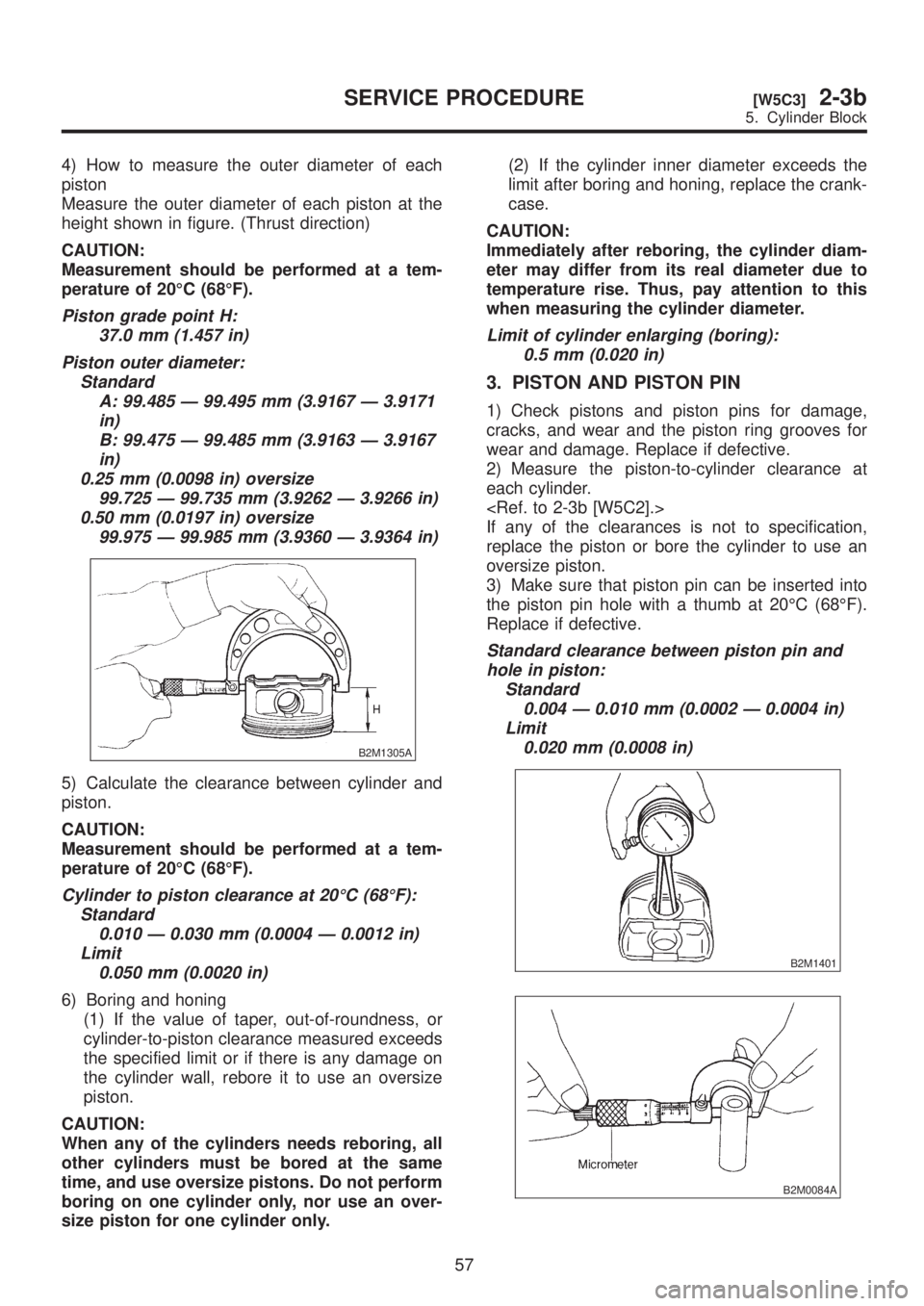
4) How to measure the outer diameter of each
piston
Measure the outer diameter of each piston at the
height shown in figure. (Thrust direction)
CAUTION:
Measurement should be performed at a tem-
perature of 20ÉC (68ÉF).
Piston grade point H:
37.0 mm (1.457 in)
Piston outer diameter:
Standard
A: 99.485 Ð 99.495 mm (3.9167 Ð 3.9171
in)
B: 99.475 Ð 99.485 mm (3.9163 Ð 3.9167
in)
0.25 mm (0.0098 in) oversize
99.725 Ð 99.735 mm (3.9262 Ð 3.9266 in)
0.50 mm (0.0197 in) oversize
99.975 Ð 99.985 mm (3.9360 Ð 3.9364 in)
B2M1305A
5) Calculate the clearance between cylinder and
piston.
CAUTION:
Measurement should be performed at a tem-
perature of 20ÉC (68ÉF).
Cylinder to piston clearance at 20ÉC (68ÉF):
Standard
0.010 Ð 0.030 mm (0.0004 Ð 0.0012 in)
Limit
0.050 mm (0.0020 in)
6) Boring and honing
(1) If the value of taper, out-of-roundness, or
cylinder-to-piston clearance measured exceeds
the specified limit or if there is any damage on
the cylinder wall, rebore it to use an oversize
piston.
CAUTION:
When any of the cylinders needs reboring, all
other cylinders must be bored at the same
time, and use oversize pistons. Do not perform
boring on one cylinder only, nor use an over-
size piston for one cylinder only.(2) If the cylinder inner diameter exceeds the
limit after boring and honing, replace the crank-
case.
CAUTION:
Immediately after reboring, the cylinder diam-
eter may differ from its real diameter due to
temperature rise. Thus, pay attention to this
when measuring the cylinder diameter.
Limit of cylinder enlarging (boring):
0.5 mm (0.020 in)
3. PISTON AND PISTON PIN
1) Check pistons and piston pins for damage,
cracks, and wear and the piston ring grooves for
wear and damage. Replace if defective.
2) Measure the piston-to-cylinder clearance at
each cylinder.
If any of the clearances is not to specification,
replace the piston or bore the cylinder to use an
oversize piston.
3) Make sure that piston pin can be inserted into
the piston pin hole with a thumb at 20ÉC (68ÉF).
Replace if defective.
Standard clearance between piston pin and
hole in piston:
Standard
0.004 Ð 0.010 mm (0.0002 Ð 0.0004 in)
Limit
0.020 mm (0.0008 in)
B2M1401
B2M0084A
57
[W5C3]2-3bSERVICE PROCEDURE
5. Cylinder Block
Page 373 of 1456
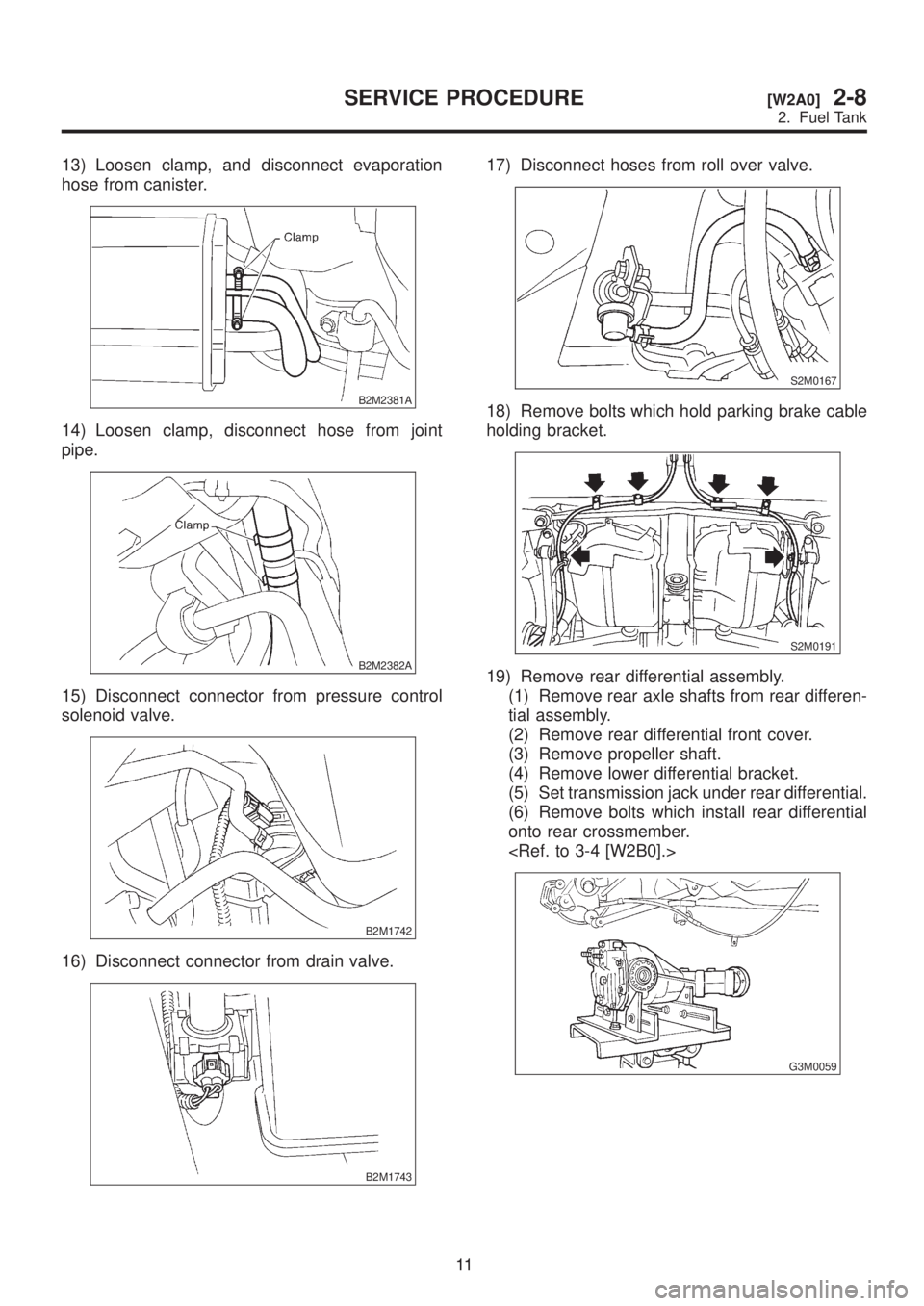
13) Loosen clamp, and disconnect evaporation
hose from canister.
B2M2381A
14) Loosen clamp, disconnect hose from joint
pipe.
B2M2382A
15) Disconnect connector from pressure control
solenoid valve.
B2M1742
16) Disconnect connector from drain valve.
B2M1743
17) Disconnect hoses from roll over valve.
S2M0167
18) Remove bolts which hold parking brake cable
holding bracket.
S2M0191
19) Remove rear differential assembly.
(1) Remove rear axle shafts from rear differen-
tial assembly.
(2) Remove rear differential front cover.
(3) Remove propeller shaft.
(4) Remove lower differential bracket.
(5) Set transmission jack under rear differential.
(6) Remove bolts which install rear differential
onto rear crossmember.
G3M0059
11
[W2A0]2-8SERVICE PROCEDURE
2. Fuel Tank
Page 375 of 1456
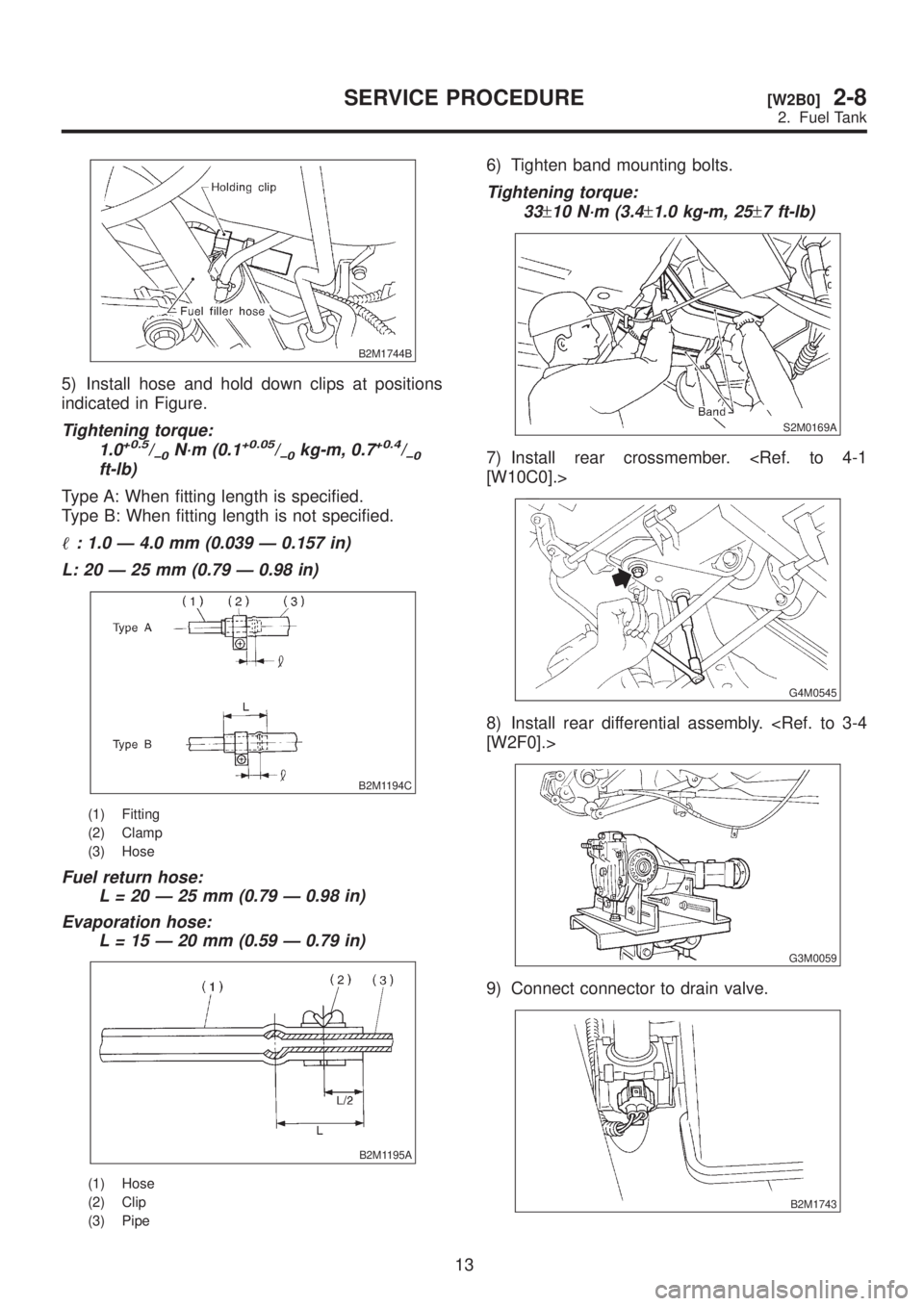
B2M1744B
5) Install hose and hold down clips at positions
indicated in Figure.
Tightening torque:
1.0+0.5/þ0N´m (0.1+0.05/þ0kg-m, 0.7+0.4/þ0ft-lb)
Type A: When fitting length is specified.
Type B: When fitting length is not specified.
: 1.0 Ð 4.0 mm (0.039 Ð 0.157 in)
L: 20 Ð 25 mm (0.79 Ð 0.98 in)
B2M1194C
(1) Fitting
(2) Clamp
(3) Hose
Fuel return hose:
L = 20 Ð 25 mm (0.79 Ð 0.98 in)
Evaporation hose:
L = 15 Ð 20 mm (0.59 Ð 0.79 in)
B2M1195A
(1) Hose
(2) Clip
(3) Pipe
6) Tighten band mounting bolts.
Tightening torque:
33
±10 N´m (3.4±1.0 kg-m, 25±7 ft-lb)
S2M0169A
7) Install rear crossmember.
G4M0545
8) Install rear differential assembly.
G3M0059
9) Connect connector to drain valve.
B2M1743
13
[W2B0]2-8SERVICE PROCEDURE
2. Fuel Tank
Page 415 of 1456
1. General
A: PRECAUTION
When servicing clutch system, pay attention to the
following items.
1. MECHANICAL APPLICATION TYPE
1) Check the routing of clutch cable for smooth-
ness.
2) Excessive tightness or looseness of clutch
cable have a bad influence upon the cable durabil-
ity.
3) Apply grease sufficiently to the connecting por-
tion of clutch pedal.
4) Apply grease sufficiently to the release lever
portion.
5) Position clutch cable through the center of toe
board hole and route it smoothly. Adjustment is
done by moving the outer cable.
6) Make sure not to let the clutch chatter when
starting forward or rearward. If clutch chattering
occurs, readjust so that the bend of clutch outer
cable becomes flatter.
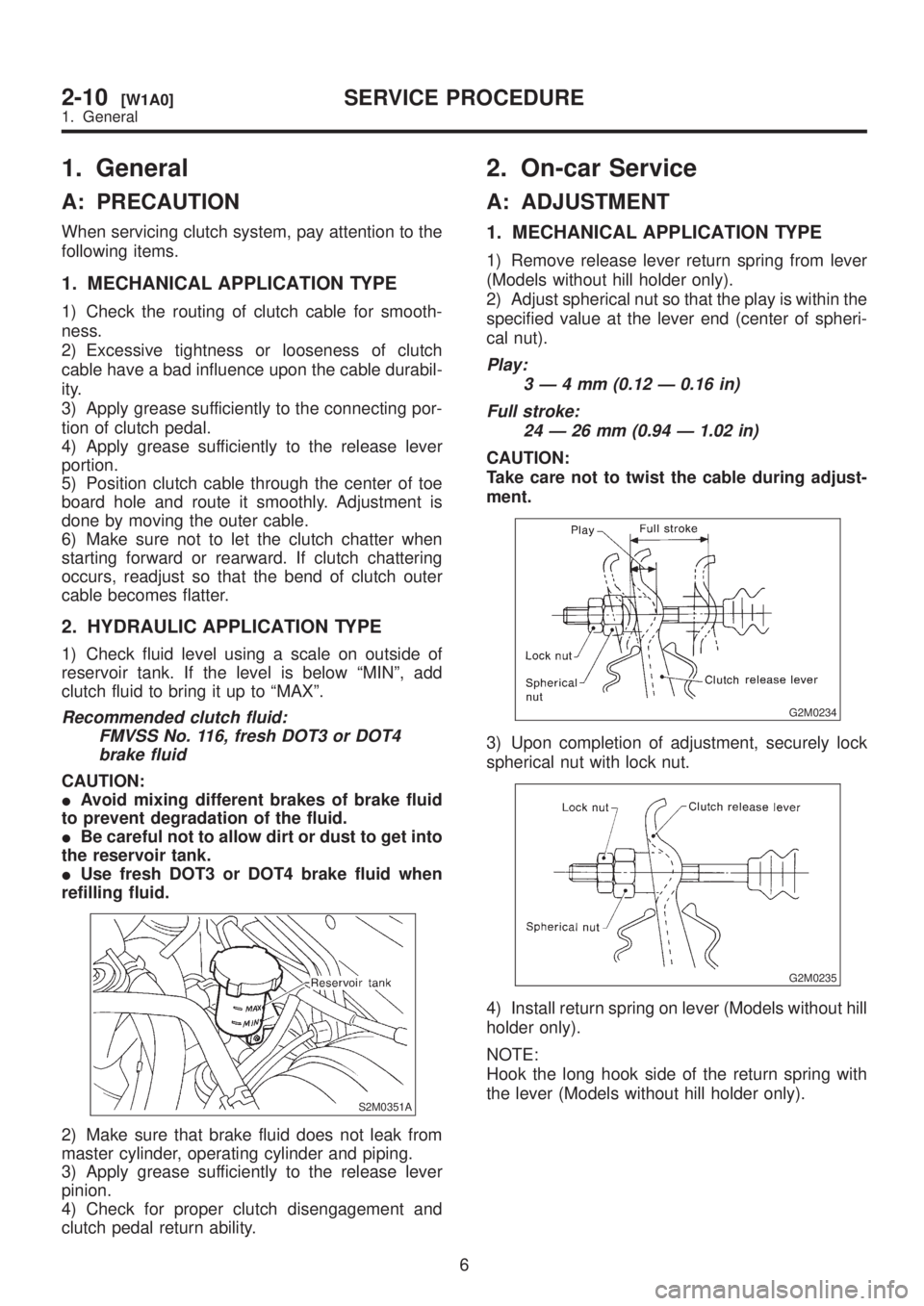
2. HYDRAULIC APPLICATION TYPE
1) Check fluid level using a scale on outside of
reservoir tank. If the level is below ªMINº, add
clutch fluid to bring it up to ªMAXº.
Recommended clutch fluid:
FMVSS No. 116, fresh DOT3 or DOT4
brake fluid
CAUTION:
IAvoid mixing different brakes of brake fluid
to prevent degradation of the fluid.
IBe careful not to allow dirt or dust to get into
the reservoir tank.
IUse fresh DOT3 or DOT4 brake fluid when
refilling fluid.
S2M0351A
2) Make sure that brake fluid does not leak from
master cylinder, operating cylinder and piping.
3) Apply grease sufficiently to the release lever
pinion.
4) Check for proper clutch disengagement and
clutch pedal return ability.
2. On-car Service
A: ADJUSTMENT
1. MECHANICAL APPLICATION TYPE
1) Remove release lever return spring from lever
(Models without hill holder only).
2) Adjust spherical nut so that the play is within the
specified value at the lever end (center of spheri-
cal nut).
Play:
3Ð4mm(0.12 Ð 0.16 in)
Full stroke:
24 Ð 26 mm (0.94 Ð 1.02 in)
CAUTION:
Take care not to twist the cable during adjust-
ment.
G2M0234
3) Upon completion of adjustment, securely lock
spherical nut with lock nut.
G2M0235
4) Install return spring on lever (Models without hill
holder only).
NOTE:
Hook the long hook side of the return spring with
the lever (Models without hill holder only).
6
2-10[W1A0]SERVICE PROCEDURE
1. General
Page 416 of 1456
1. General
A: PRECAUTION
When servicing clutch system, pay attention to the
following items.
1. MECHANICAL APPLICATION TYPE
1) Check the routing of clutch cable for smooth-
ness.
2) Excessive tightness or looseness of clutch
cable have a bad influence upon the cable durabil-
ity.
3) Apply grease sufficiently to the connecting por-
tion of clutch pedal.
4) Apply grease sufficiently to the release lever
portion.
5) Position clutch cable through the center of toe
board hole and route it smoothly. Adjustment is
done by moving the outer cable.
6) Make sure not to let the clutch chatter when
starting forward or rearward. If clutch chattering
occurs, readjust so that the bend of clutch outer
cable becomes flatter.
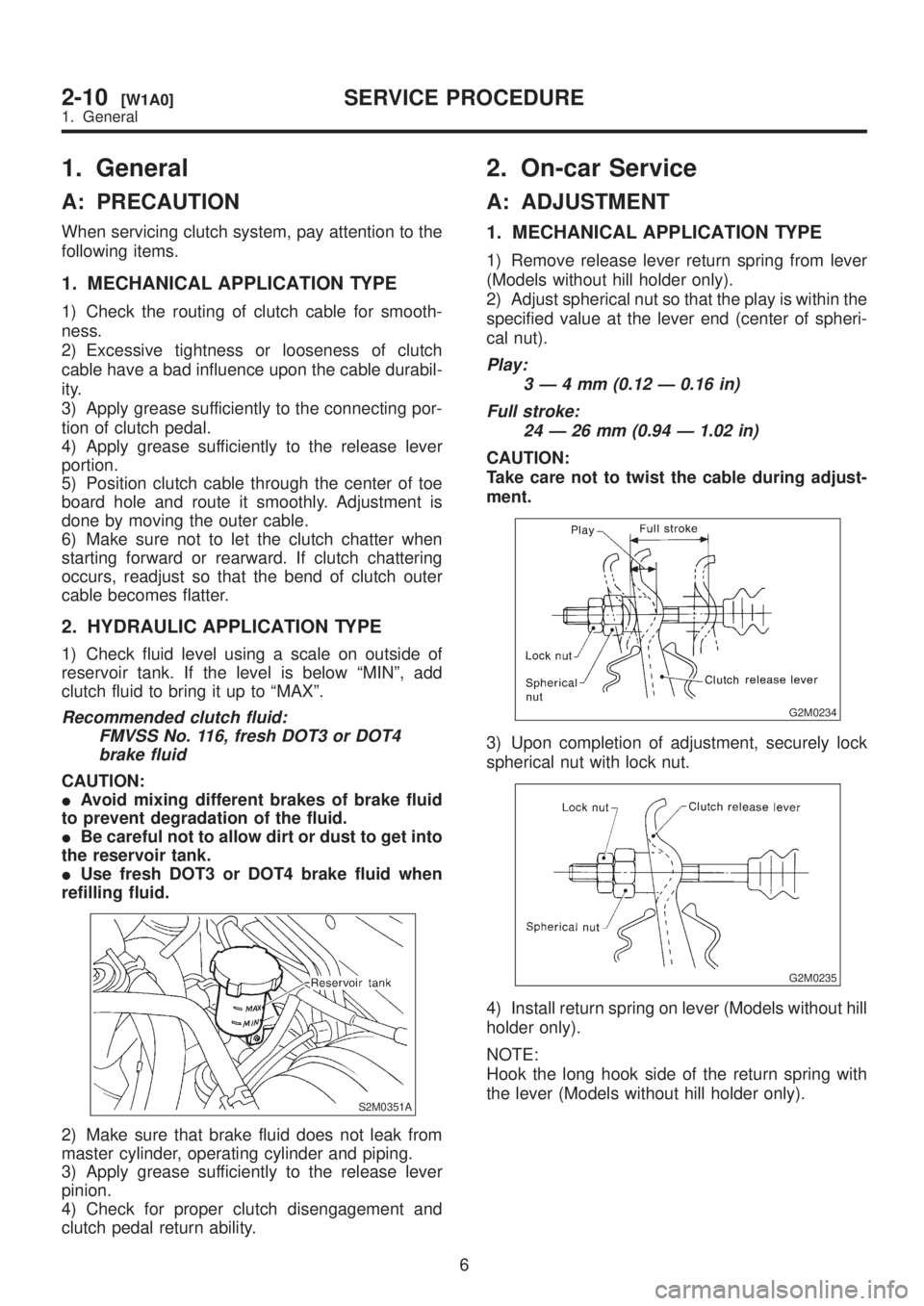
2. HYDRAULIC APPLICATION TYPE
1) Check fluid level using a scale on outside of
reservoir tank. If the level is below ªMINº, add
clutch fluid to bring it up to ªMAXº.
Recommended clutch fluid:
FMVSS No. 116, fresh DOT3 or DOT4
brake fluid
CAUTION:
IAvoid mixing different brakes of brake fluid
to prevent degradation of the fluid.
IBe careful not to allow dirt or dust to get into
the reservoir tank.
IUse fresh DOT3 or DOT4 brake fluid when
refilling fluid.
S2M0351A
2) Make sure that brake fluid does not leak from
master cylinder, operating cylinder and piping.
3) Apply grease sufficiently to the release lever
pinion.
4) Check for proper clutch disengagement and
clutch pedal return ability.
2. On-car Service
A: ADJUSTMENT
1. MECHANICAL APPLICATION TYPE
1) Remove release lever return spring from lever
(Models without hill holder only).
2) Adjust spherical nut so that the play is within the
specified value at the lever end (center of spheri-
cal nut).
Play:
3Ð4mm(0.12 Ð 0.16 in)
Full stroke:
24 Ð 26 mm (0.94 Ð 1.02 in)
CAUTION:
Take care not to twist the cable during adjust-
ment.
G2M0234
3) Upon completion of adjustment, securely lock
spherical nut with lock nut.
G2M0235
4) Install return spring on lever (Models without hill
holder only).
NOTE:
Hook the long hook side of the return spring with
the lever (Models without hill holder only).
6
2-10[W1A0]SERVICE PROCEDURE
1. General
Page 429 of 1456
7. Brake Fluid
A: REPLACEMENT
CAUTION:
IThe FMVSS No. 116, fresh DOT3 or 4 brake
fluid must be used.
ICover bleeder with waste cloth, when loos-
ening it, to prevent brake fluid from being
splashed over surrounding parts.
IAvoid mixing different brands of brake fluid
to prevent degrading the quality of the fluid.
IBe careful not to allow dirt or dust to get into
the reservoir tank.
NOTE:
IDuring bleeding operation, keep the clutch
reserve tank filled with brake fluid to eliminate entry
of air.
IClutch pedal operating must be very slow.
IFor convenience and safety, it is advisable to
have two man working.IThe amount of brake fluid required is approxi-
mately 70 m(2.4 US fl oz, 2.5 Imp fl oz) for total
clutch system.
1) Either jack-up vehicle and place a safety stand
under it, or lift-up vehicle.
2) Remove both front and rear wheels.
3) Draw out the brake fluid from reserve tank with
syringe.
4) Refill reservoir tank with recommended brake
fluid.
Recommended brake fluid:
FMVSS No. 116, fresh DOT3 or 4 brake
fluid
5) Bleed air from oil line with the help of a co-
worker.
18
2-10[W7A0]SERVICE PROCEDURE
7. Brake Fluid