Page 2175 of 2267
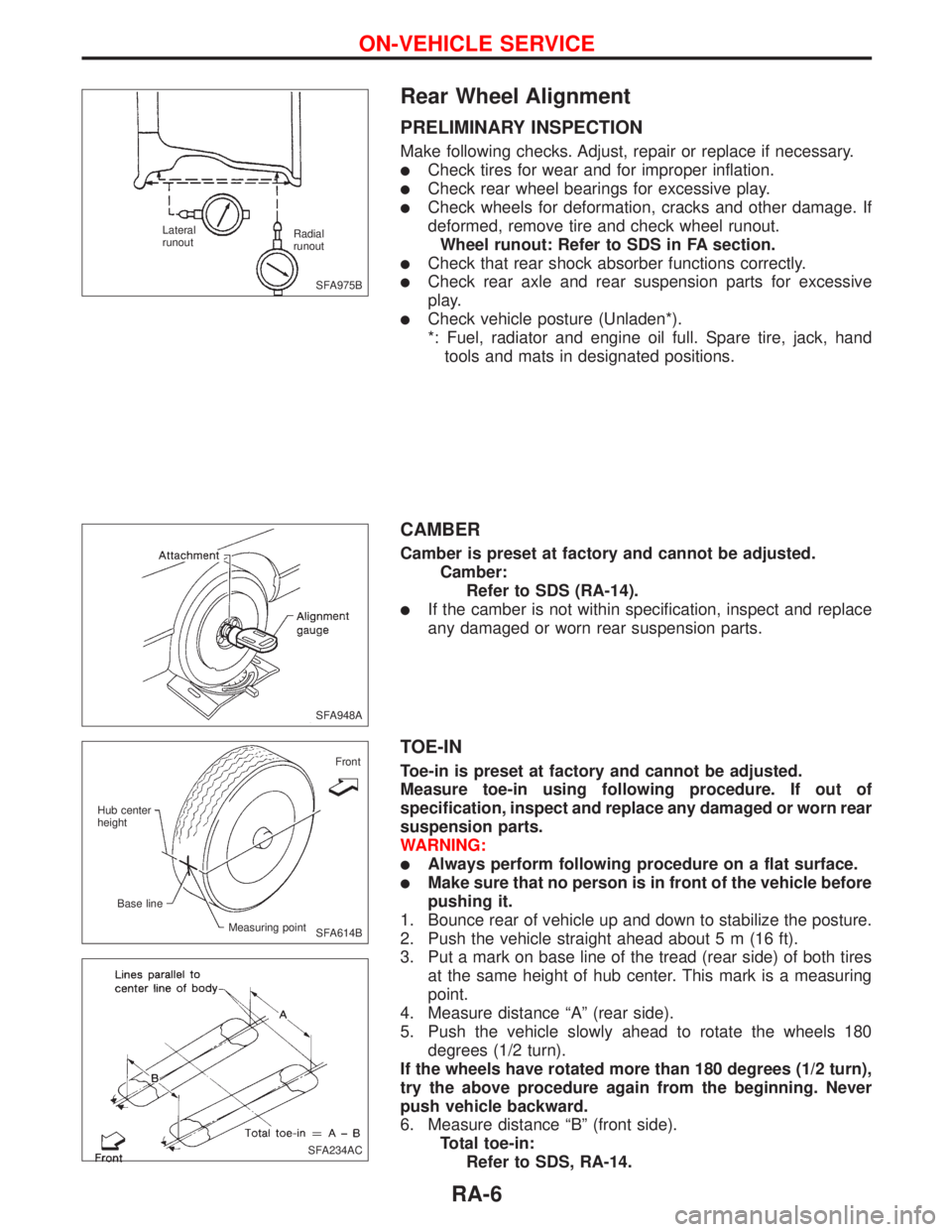
Rear Wheel Alignment
PRELIMINARY INSPECTION
Make following checks. Adjust, repair or replace if necessary.
lCheck tires for wear and for improper inflation.
lCheck rear wheel bearings for excessive play.
lCheck wheels for deformation, cracks and other damage. If
deformed, remove tire and check wheel runout.
Wheel runout: Refer to SDS in FA section.
lCheck that rear shock absorber functions correctly.
lCheck rear axle and rear suspension parts for excessive
play.
lCheck vehicle posture (Unladen*).
*: Fuel, radiator and engine oil full. Spare tire, jack, hand
tools and mats in designated positions.
CAMBER
Camber is preset at factory and cannot be adjusted.
Camber:
Refer to SDS (RA-14).
lIf the camber is not within specification, inspect and replace
any damaged or worn rear suspension parts.
TOE-IN
Toe-in is preset at factory and cannot be adjusted.
Measure toe-in using following procedure. If out of
specification, inspect and replace any damaged or worn rear
suspension parts.
WARNING:
lAlways perform following procedure on a flat surface.
lMake sure that no person is in front of the vehicle before
pushing it.
1. Bounce rear of vehicle up and down to stabilize the posture.
2. Push the vehicle straight ahead about 5 m (16 ft).
3. Put a mark on base line of the tread (rear side) of both tires
at the same height of hub center. This mark is a measuring
point.
4. Measure distance ªAº (rear side).
5. Push the vehicle slowly ahead to rotate the wheels 180
degrees (1/2 turn).
If the wheels have rotated more than 180 degrees (1/2 turn),
try the above procedure again from the beginning. Never
push vehicle backward.
6. Measure distance ªBº (front side).
Total toe-in:
Refer to SDS, RA-14.
SFA975B Radial
runout Lateral
runout
SFA948A
SFA614BFront
Hub center
height
Base line
Measuring point
SFA234AC
ON-VEHICLE SERVICE
RA-6
Page 2178 of 2267
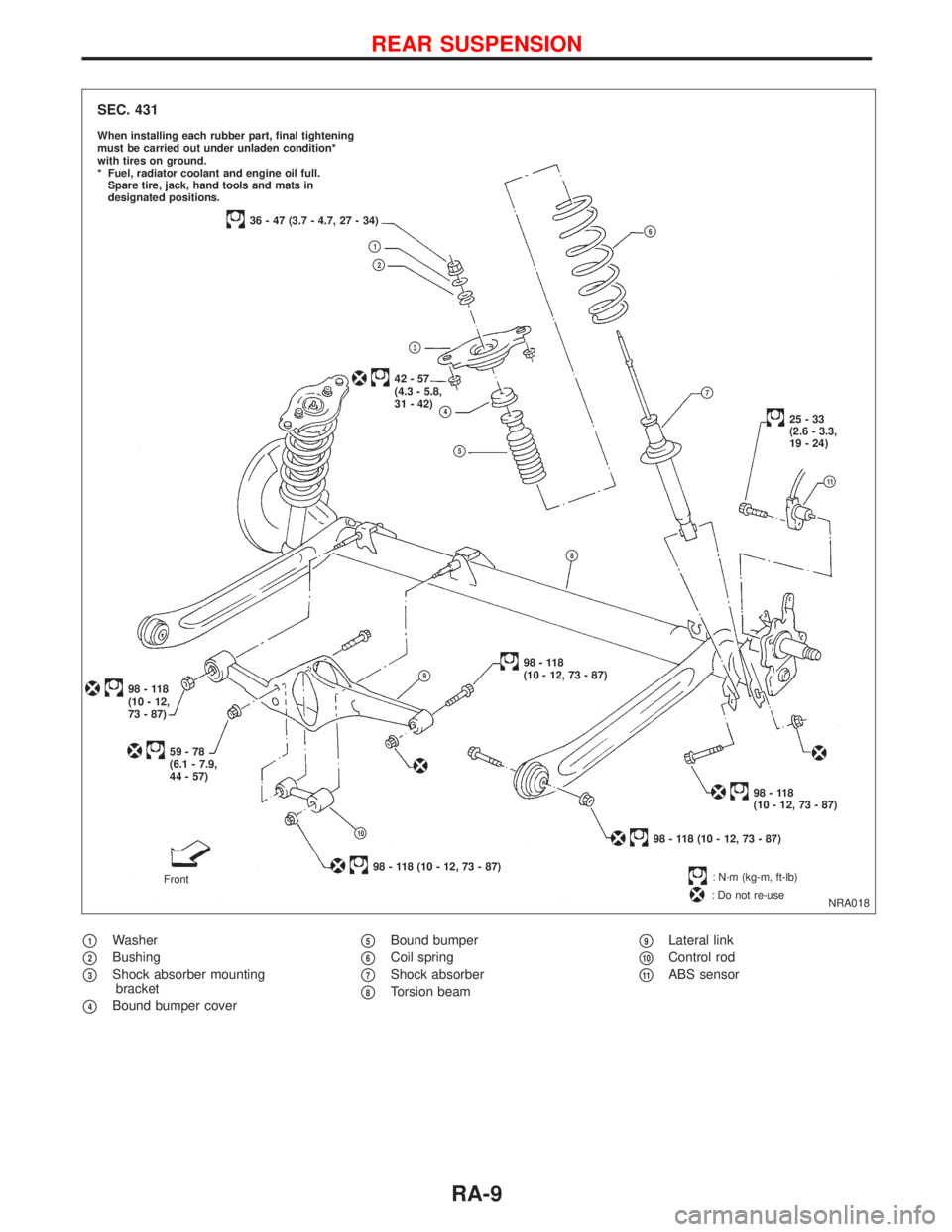
p1Washer
p2Bushing
p3Shock absorber mounting
bracket
p4Bound bumper cover
p5Bound bumper
p6Coil spring
p7Shock absorber
p8Torsion beam
p9Lateral link
p10Control rod
p11ABS sensor
NRA018
SEC. 431
When installing each rubber part, final tightening
must be carried out under unladen condition*
with tires on ground.
* Fuel, radiator coolant and engine oil full.
Spare tire, jack, hand tools and mats in
designated positions.
36 - 47 (3.7 - 4.7, 27 - 34)
p1
p2
p3
42-57
(4.3 - 5.8,
31 - 42)
p4
p5
p6
p7
25-33
(2.6 - 3.3,
19 - 24)
p8
98-118
(10 - 12, 73 - 87)p9
p10
98-118
(10 - 12,
73 - 87)
59-78
(6.1 - 7.9,
44 - 57)
Front
98 - 118 (10 - 12, 73 - 87)
p11
98-118
(10 - 12, 73 - 87)
: N´m (kg-m, ft-lb)
: Do not re-use
98 - 118 (10 - 12, 73 - 87)
REAR SUSPENSION
RA-9
Page 2183 of 2267
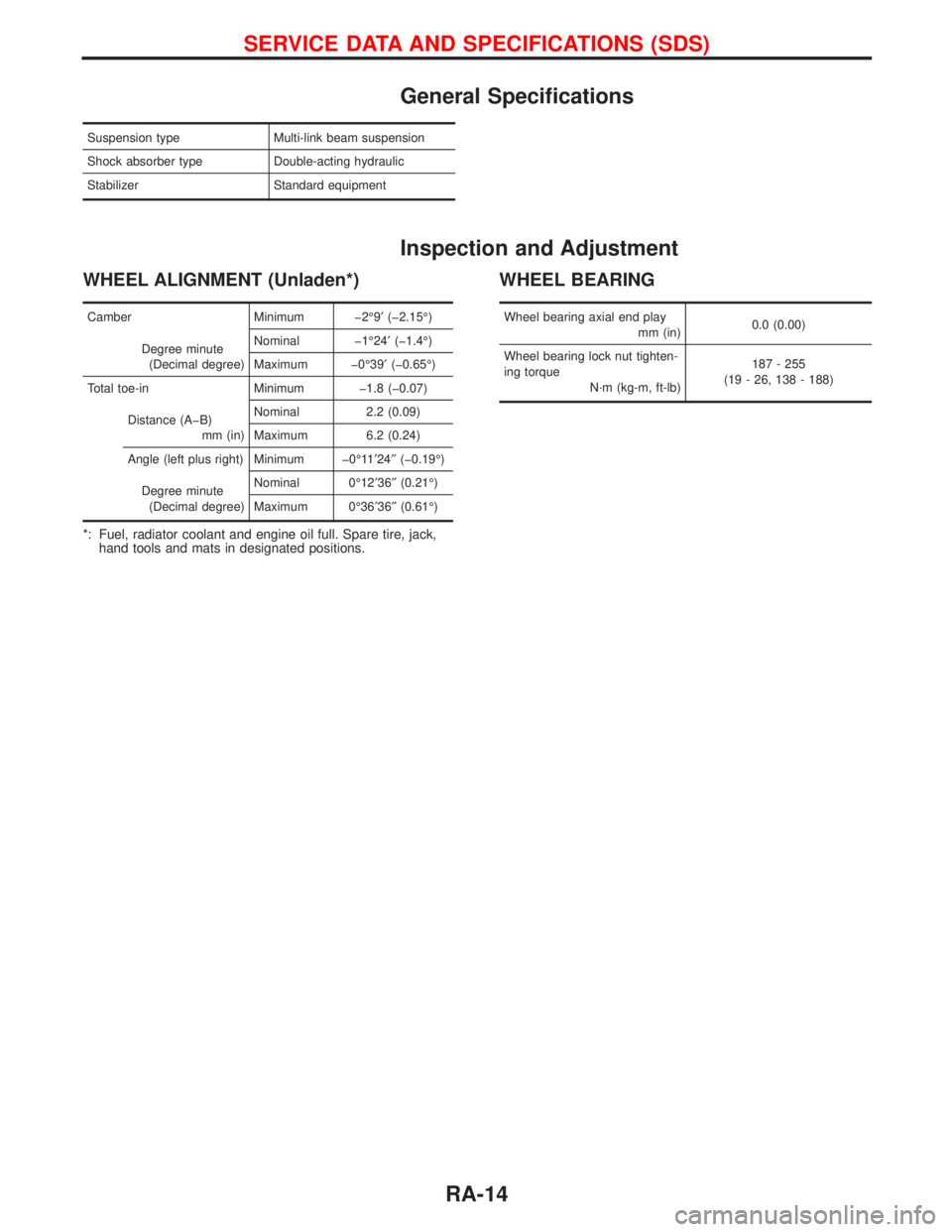
General Specifications
Suspension type Multi-link beam suspension
Shock absorber type Double-acting hydraulic
Stabilizer Standard equipment
Inspection and Adjustment
WHEEL ALIGNMENT (Unladen*)
Camber Minimum þ2É9¢(þ2.15É)
Degree minute
(Decimal degree)Nominal þ1É24¢(þ1.4É)
Maximum þ0É39¢(þ0.65É)
Total toe-in Minimum þ1.8 (þ0.07)
Distance (AþB)
mm (in)Nominal 2.2 (0.09)
Maximum 6.2 (0.24)
Angle (left plus right) Minimum þ0É11¢24²(þ0.19É)
Degree minute
(Decimal degree)Nominal 0É12¢36²(0.21É)
Maximum 0É36¢36²(0.61É)
*: Fuel, radiator coolant and engine oil full. Spare tire, jack,
hand tools and mats in designated positions.
WHEEL BEARING
Wheel bearing axial end play
mm (in)0.0 (0.00)
Wheel bearing lock nut tighten-
ing torque
N´m (kg-m, ft-lb)187 - 255
(19 - 26, 138 - 188)
SERVICE DATA AND SPECIFICATIONS (SDS)
RA-14
Page 2249 of 2267
Checking and Adjusting Drive Belts
Refer to section MA for Drive Belt Inspection.
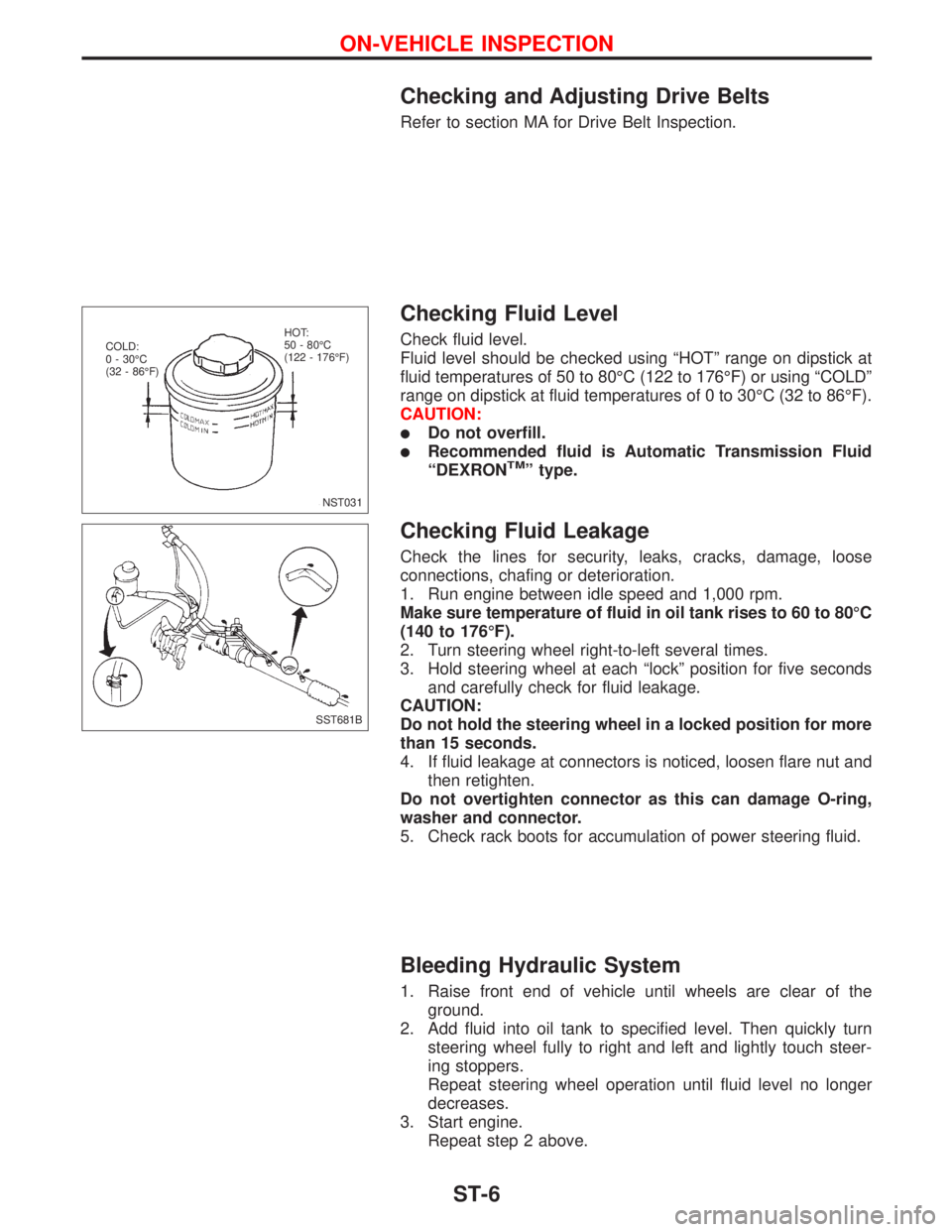
Checking Fluid Level
Check fluid level.
Fluid level should be checked using ªHOTº range on dipstick at
fluid temperatures of 50 to 80ÉC (122 to 176ÉF) or using ªCOLDº
range on dipstick at fluid temperatures of 0 to 30ÉC (32 to 86ÉF).
CAUTION:
lDo not overfill.
lRecommended fluid is Automatic Transmission Fluid
ªDEXRONTMº type.
Checking Fluid Leakage
Check the lines for security, leaks, cracks, damage, loose
connections, chafing or deterioration.
1. Run engine between idle speed and 1,000 rpm.
Make sure temperature of fluid in oil tank rises to 60 to 80ÉC
(140 to 176ÉF).
2. Turn steering wheel right-to-left several times.
3. Hold steering wheel at each ªlockº position for five seconds
and carefully check for fluid leakage.
CAUTION:
Do not hold the steering wheel in a locked position for more
than 15 seconds.
4. If fluid leakage at connectors is noticed, loosen flare nut and
then retighten.
Do not overtighten connector as this can damage O-ring,
washer and connector.
5. Check rack boots for accumulation of power steering fluid.
Bleeding Hydraulic System
1. Raise front end of vehicle until wheels are clear of the
ground.
2. Add fluid into oil tank to specified level. Then quickly turn
steering wheel fully to right and left and lightly touch steer-
ing stoppers.
Repeat steering wheel operation until fluid level no longer
decreases.
3. Start engine.
Repeat step 2 above.
NST031 COLD:
0 - 30ÉC
(32 - 86ÉF)HOT:
50 - 80ÉC
(122 - 176ÉF)
SST681B
ON-VEHICLE INSPECTION
ST-6
Page 2250 of 2267
lIncomplete air bleeding will cause the following to occur.
When this happens, bleed air again.
a. Generation of air bubbles in reservoir tank
b. Generation of clicking noise in oil pump
c. Excessive buzzing in oil pump
While the vehicle is stationary or while moving the steering wheel
slowly, fluid noise may occur in the valve or oil pump. This noise
is inherent in this steering system, and it will not affect perfor-
mance or durability of the system.
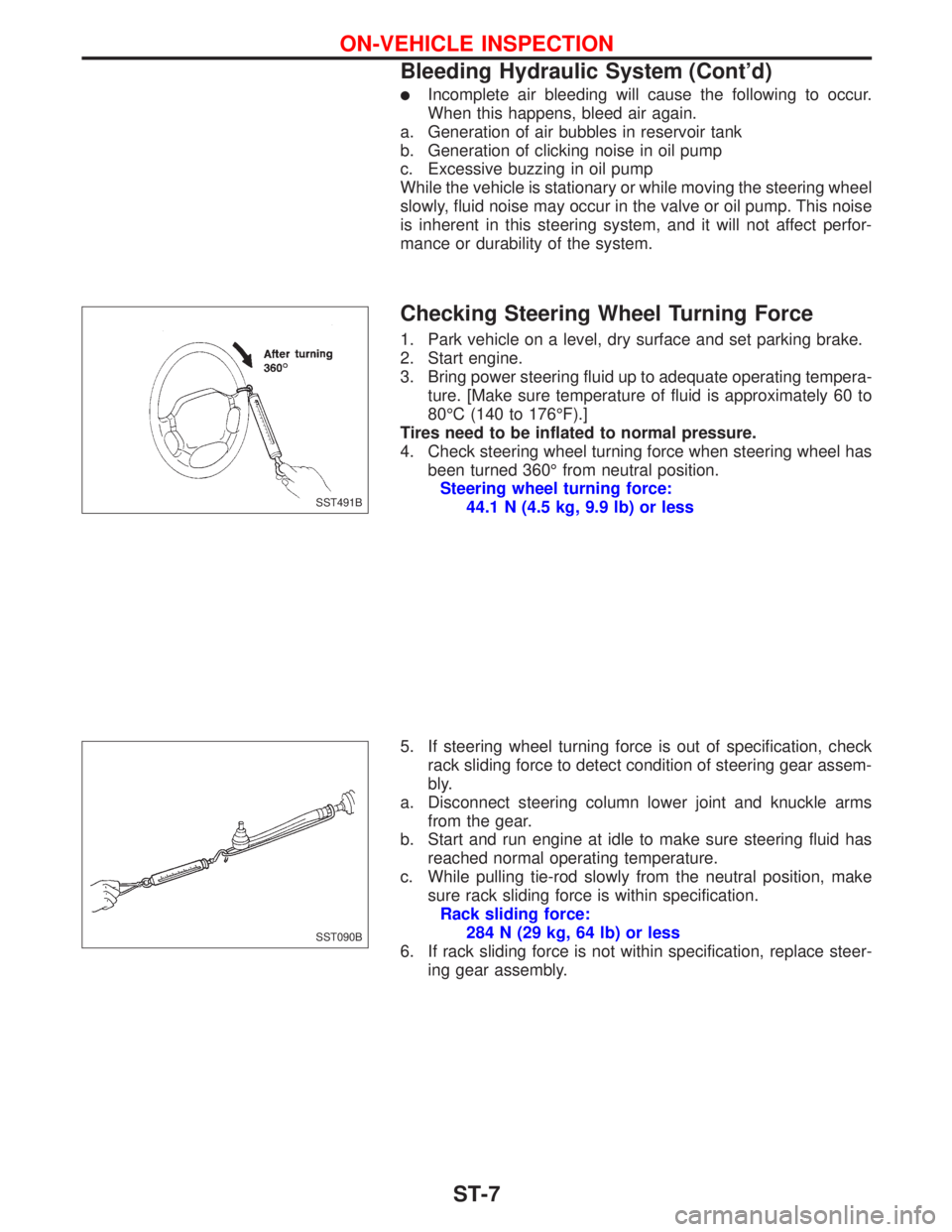
Checking Steering Wheel Turning Force
1. Park vehicle on a level, dry surface and set parking brake.
2. Start engine.
3. Bring power steering fluid up to adequate operating tempera-
ture. [Make sure temperature of fluid is approximately 60 to
80ÉC (140 to 176ÉF).]
Tires need to be inflated to normal pressure.
4. Check steering wheel turning force when steering wheel has
been turned 360É from neutral position.
Steering wheel turning force:
44.1 N (4.5 kg, 9.9 lb) or less
5. If steering wheel turning force is out of specification, check
rack sliding force to detect condition of steering gear assem-
bly.
a. Disconnect steering column lower joint and knuckle arms
from the gear.
b. Start and run engine at idle to make sure steering fluid has
reached normal operating temperature.
c. While pulling tie-rod slowly from the neutral position, make
sure rack sliding force is within specification.
Rack sliding force:
284 N (29 kg, 64 lb) or less
6. If rack sliding force is not within specification, replace steer-
ing gear assembly.
SST491B
SST090B
ON-VEHICLE INSPECTION
Bleeding Hydraulic System (Cont'd)
ST-7
Page 2251 of 2267
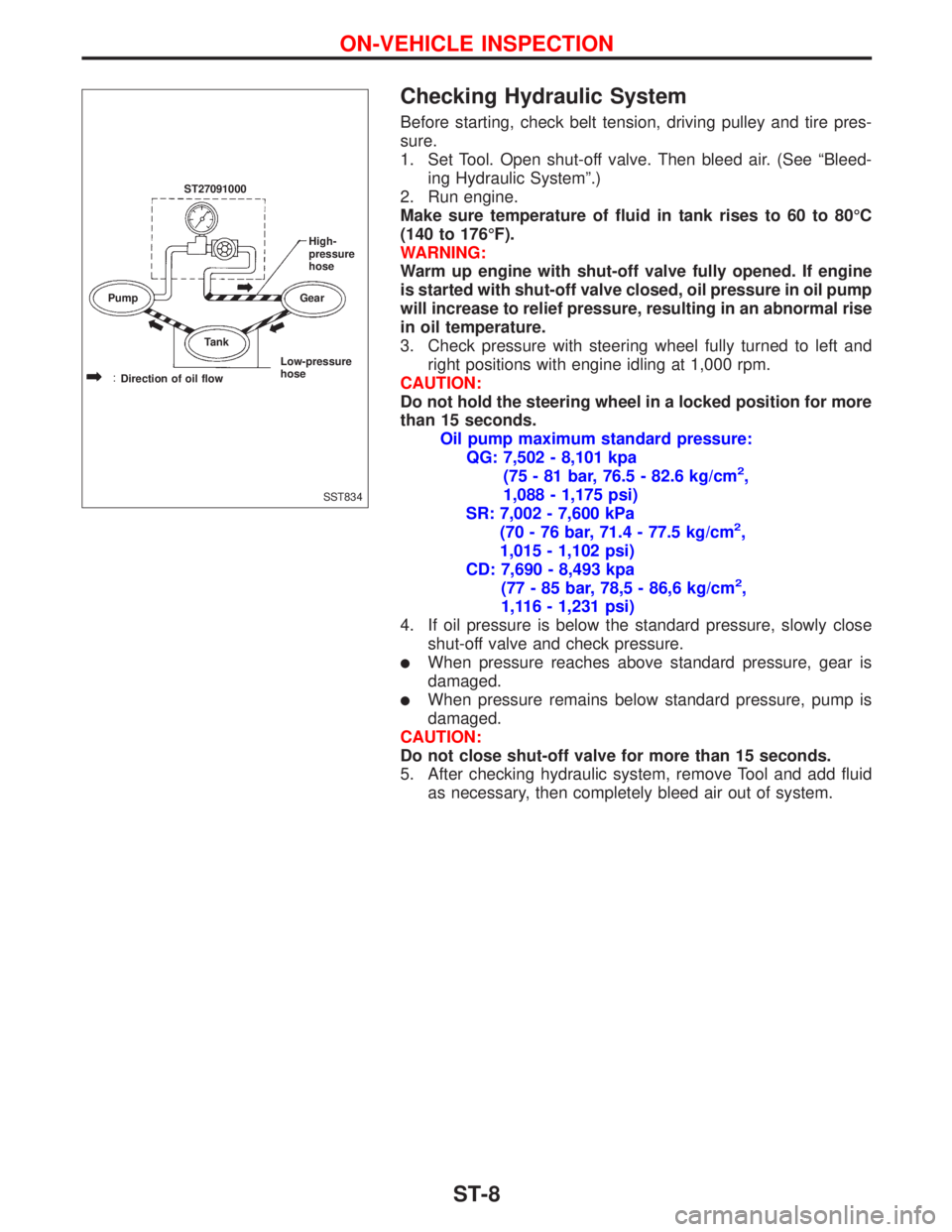
Checking Hydraulic System
Before starting, check belt tension, driving pulley and tire pres-
sure.
1. Set Tool. Open shut-off valve. Then bleed air. (See ªBleed-
ing Hydraulic Systemº.)
2. Run engine.
Make sure temperature of fluid in tank rises to 60 to 80ÉC
(140 to 176ÉF).
WARNING:
Warm up engine with shut-off valve fully opened. If engine
is started with shut-off valve closed, oil pressure in oil pump
will increase to relief pressure, resulting in an abnormal rise
in oil temperature.
3. Check pressure with steering wheel fully turned to left and
right positions with engine idling at 1,000 rpm.
CAUTION:
Do not hold the steering wheel in a locked position for more
than 15 seconds.
Oil pump maximum standard pressure:
QG: 7,502 - 8,101 kpa
(75 - 81 bar, 76.5 - 82.6 kg/cm
2,
1,088 - 1,175 psi)
SR: 7,002 - 7,600 kPa
(70 - 76 bar, 71.4 - 77.5 kg/cm
2,
1,015 - 1,102 psi)
CD: 7,690 - 8,493 kpa
(77 - 85 bar, 78,5 - 86,6 kg/cm
2,
1,116 - 1,231 psi)
4. If oil pressure is below the standard pressure, slowly close
shut-off valve and check pressure.
lWhen pressure reaches above standard pressure, gear is
damaged.
lWhen pressure remains below standard pressure, pump is
damaged.
CAUTION:
Do not close shut-off valve for more than 15 seconds.
5. After checking hydraulic system, remove Tool and add fluid
as necessary, then completely bleed air out of system.
SST834 ST27091000
Pump
TankGearHigh-
pressure
hose
Direction of oil flowLow-pressure
hose
ON-VEHICLE INSPECTION
ST-8