1999 HONDA ODYSSEY service
[x] Cancel search: servicePage 310 of 343
Emergency Towing
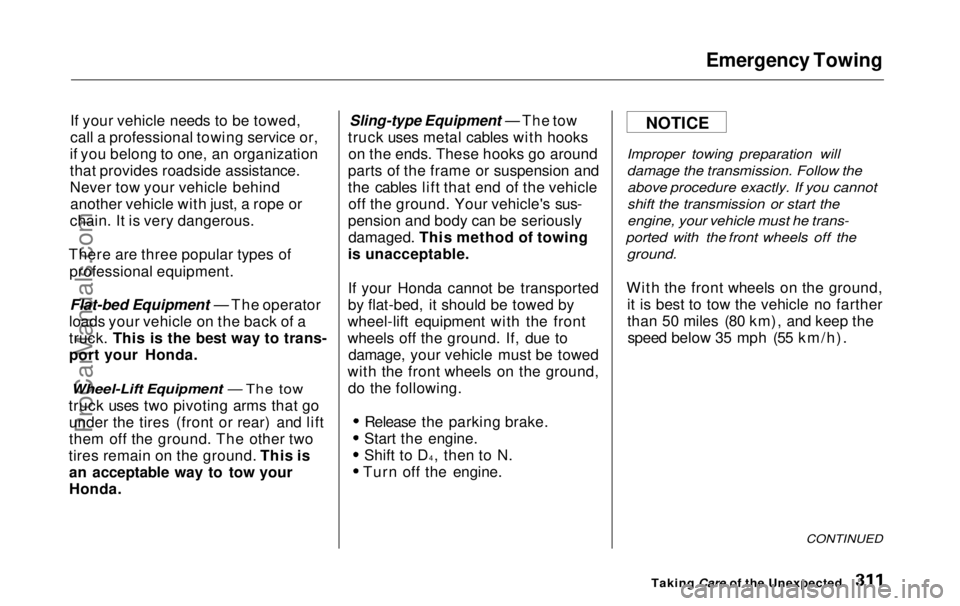
If your vehicle needs to be towed,
call a professional towing service or,
if you belong to one, an organization
that provides roadside assistance.
Never tow your vehicle behind another vehicle with just, a rope or
chain. It is very dangerous.
There are three popular types of professional equipment.
Flat-bed Equipment — The operator
loads your vehicle on the back of a
truck. This is the best way to trans-
port your Honda.
Wheel-Lift Equipment — The tow
truck uses two pivoting arms that go under the tires (front or rear) and lift
them off the ground. The other two
tires remain on the ground. This is an acceptable way to tow your
Honda.
Sling-type Equipment — The tow
truck uses metal cables with hooks on the ends. These hooks go around
parts of the frame or suspension and
the cables lift that end of the vehicle off the ground. Your vehicle's sus-
pension and body can be seriously damaged. This method of towing
is unacceptable.
If your Honda cannot be transported
by flat-bed, it should be towed by
wheel-lift equipment with the front
wheels off the ground. If, due to damage, your vehicle must be towed
with the front wheels on the ground, do the following.
Release the parking brake.
Start the engine.
Shift to D 4, then to N.
Turn off the engine.
Improper towing preparation will
damage the transmission. Follow the
above procedure exactly. If you cannot
shift the transmission or start the
engine, your vehicle must he trans-
ported with the front wheels off the
ground.
With the front wheels on the ground, it is best to tow the vehicle no farther
than 50 miles (80 km), and keep thespeed below 35 mph (55 km/h).
CONTINUED
Taking Care of the Unexpected
NOTICEProCarManuals.comMain Menu Table of Contents s t
Page 318 of 343

Tire Information
DOT Tire Quality Grading
(U.S. Vehicles)
The tires on your vehicle meet all U.S. Federal Safety Requirements.
All tires are also graded for treadwear, traction, and temperature
performance according toDepartment of Transportation (DOT) standards. The following
explains these gradings.
Treadwear
The treadwear grade is a compara- tive rating based on the wear rate of
the tire when tested under controlledconditions on a specified government
test course. For example, a tire
graded 150 would wear one and one half (1-1/2) times as well on the
government course as a tire graded 100. The relative performance of
tires depends upon the actual condi-
tions of their use, however, and may depart significantly from the norm
due to variations in driving habits,service practices, and differences in
road characteristics and climate. Traction
The traction grades, from highest to lowest, are A, B, and C, and they
represent the tire's ability to stop on
wet pavement as measured under controlled conditions on specified
government test surfaces of asphalt and concrete. A tire marked C may
have poor traction performance.
Warning: The traction grade as- signed to this tire is based on brak-
ing (straight ahead) traction tests and does not include cornering (turning) traction.
CONTINUED
Technical InformationProCarManuals.comMain Menu Table of Contents s t
Page 320 of 343

Oxygenated Fuels
Some conventional gasolines are
being blended with alcohol or an
ether compound. These gasolines
are collectively referred to as
oxygenated fuels. To meet clean air
standards, some areas of the United
States and Canada use oxygenated
fuels to help reduce emissions.
If you use an oxygenated fuel, be
sure it is unleaded and meets the
minimum octane rating requirement.
Before using an oxygenated fuel, try
to confirm the fuel's contents. Some
states/provinces require this
information to be posted on the
pump.
The following are the U.S. EPA and
Canada CGSB approved percentages
of oxygenates:
ETHANOL (ethyl or grain alcohol)
You may use gasoline containing up to 10 percent ethanol by volume.Gasoline containing ethanol may be
marketed under the name "Gasohol."
MTBE (Methyl Tertiary Butyl
Ether)
You may use gasoline containing up to 15 percent MTBE by volume.
METHANOL (methyl or wood
alcohol)
You may use gasoline containing up to 5 percent methanol by volume as
long as it also contains cosolventsand corrosion inhibitors to protect
the fuel system. Gasoline containing
more than 5 percent methanol by
volume may cause starting and/or performance problems. It may alsodamage metal, rubber and plastic parts of your fuel system.
If you notice any undesirable
operating symptoms, try another
service station or switch to another
brand of gasoline.
Fuel system damage or performance
problems resulting from the use of an oxygenated fuel containing more
than the percentages of oxygenates
given above are not covered under
warranty.
Technical InformationProCarManuals.comMain Menu Table of Contents s t
Page 326 of 343

Customer Relations Information
Honda dealership personnel are
trained professionals. They should
be able to answer all your questions.
If you encounter a problem that your dealership does not solve to yoursatisfaction, please discuss it with
the dealership's management. The
Service Manager or General Manager can help. Almost all
problems are solved in this way. If you are dissatisfied with the
decision made by the dealership's
management, contact your Honda
Customer Relations Zone Office.
Refer to the U.S. and Canadian Zone Office maps on the following pages.
When you call or write, please give
us this information:
Vehicle Identification Number
(see page 314)
Name and address of the dealer
who services your vehicle Date of purchase
Mileage on your vehicle
Your name, address, and tele- phone number
A detailed description of the problem
Name of the dealer who sold the
vehicle to you
Warranty and Customer RelationsProCarManuals.comMain Menu Table of Contents s t
Page 332 of 343
Authorized Manuals
These Publications cannot be returned for credit without receiving advance authorization within 14days of delivery. On returns, a restocking fee may be applied against the original order. P.O. BOX 07280 DETROIT, MICHIGAN 48207 1-800-782-4356 Service Manual:
This manual covers maintenance and recommended procedures for repair to engine and chassis components.It is written for the Journeyman mechanic, but is simpleenough for most mechanically-inclined owners to under-
stand.
Electrical Troubleshooting Manual:
This manual complements the Service Manual by providing in-depth troubleshooting information for each
electrical circuit in your vehicle.
Body Repair Manual:
This manual describes the procedures involved in the replacement of damaged body parts.ProCarManuals.comMain Menu Table of Contents s t
Page 340 of 343
Index
Safety Labels, Location of.............. 54 Safety Messages................................ ii
Seat Belt, Additional Information.. 45 Lap/Shoulder Belt....................... 45
Seat Belt Maintenance................ 47
Seat Belt System Components... 45
Seat Belts..................................... 8, 45
Cleaning...................................... 280
Maintenance................................. 47
Reminder Light and Beeper................................. 45, 57
System Components.................... 45
Tether Attachment Points.......... 43 Use During Pregnancy................ 20
Wearing a Lap/Shoulder Belt.... 15
Seats.................................................. 99
Adjustments............................... 100
Folding the Third Seat.............. 110
Head Restraints......................... 104
Passenger Seating....................... 99
Reclining the Second Seat........ 101
Reclining the Third Seat........... 101
Removing the Second
Seats................................108, 109
Third Seat Access...................... 105
Serial Number................................ 314
Service Intervals............................ 224
Service Manual* ............................ 333
Service Station Procedures .......... 183
Setting the Clock........................... 117 Shifting the Automatic Transmission.............................. 199
Shift Lever Position Indicator...... 198
Shift Lock Release......................... 201
Side Marker Lights, Bulb
Replacement in.......................... 267
Signaling Turns................................ 68
Sliding Doors.................................... 88
Snow Tires...................................... 263
Solvent-type Cleaners.................... 278
Sound System.........................149, 161
Spare Tire Inflating....................................... 286
Specifications............................. 317
Spark Plugs..................................... 248
Specifications Charts..................... 316
Speed Control................................... 73 Speedometer.................................... 62
SRS, Additional Information........... 48 Additional Safety Precautions.... 52How the Automatic Seat belt Tensioners Work..................... 50
How the SRS Indicator
Works........................................50
How Your Airbags Work............ 48
SRS Components......................... 48
SRS Service................................... 51
SRS Indicator............................. 50, 58
START (Ignition Key Position)..... 79
Starting the Engine........................ 197 In Cold Weather at HighAltitude................................... 197
With a Dead Battery ................. 297
Steam Coming from Engine......... 299
Steering Wheel Adjustment................................... 72
Anti-theft Column Lock.............. 78
Stereo Sound System............149, 161 Storing Your Vehicle..................... 275
Storage Box.................................... 123 Sunglasses Holder......................... 120
Sun Visor......................................... 121
Supplemental Restraint System Servicing....................................... 51
SRS Indicator..........................50, 58
System Components.................... 48
Synthetic Oil................................... 234ProCarManuals.comMain Menu s t
Page 343 of 343
Service Information Summary
Gasoline:
Unleaded gasoline, pump octane
number of 86 or higher.
Fuel Tank Capacity:
20.00 US gal (75.7 l , 16.65 Imp gal)
Recommended Engine Oil:
API Service SJ "Energy Conserving" oil, SAE 5W-30
viscosity (see page 233).
Oil change capacity (including
filter):
4.6 US qt (4.4 l ,3.9 Imp qt)
Automatic Transmission Fluid:
Honda Premium Formula
Automatic Transmission Fluid preferred, or a DEXRON ®
III ATF
as a temporary replacement (see page 243). Power Steering Fluid:
Genuine Honda Power Steering
Fluid preferred, or another brand
of power steering fluid as a
temporary replacement. Do not
use ATF (see page 245).
Brake Fluid:
Genuine Honda DOT 3 Brake Fluidpreferred, or a DOT 3 or DOT 4
brake fluid as a temporary
replacement (see page 244).
Tire Pressure (measured cold):
Front/Rear:
35 psi (240 kPa , 2.4 kgf/cm2)
Compact Spare Tire:
60 psi (420 kPa , 4.2 kgf/cm2)ProCarManuals.comMain Menu s t