Page 210 of 343
Traction Control System
TCS ON/OFF Switch
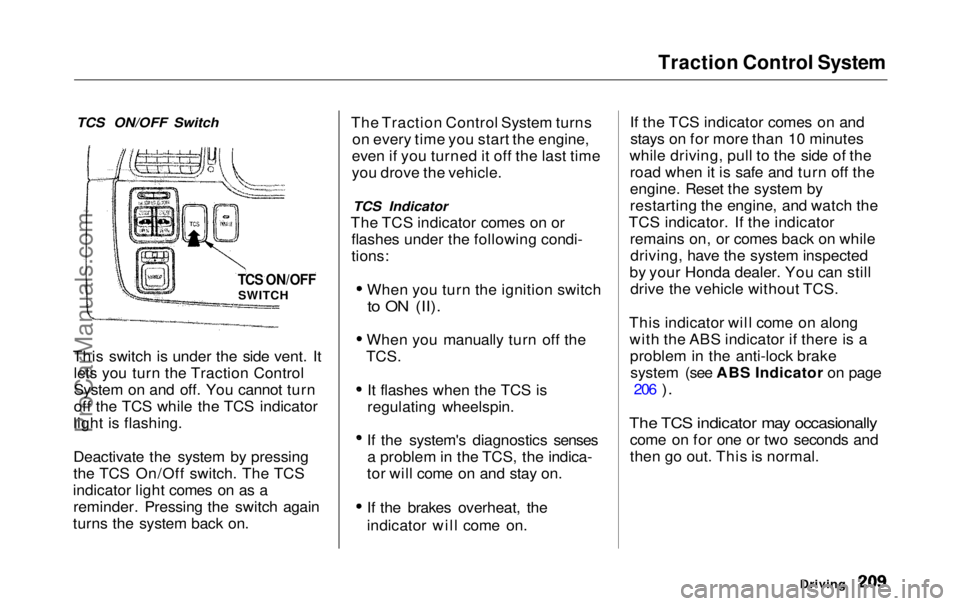
This switch is under the side vent. It lets you turn the Traction Control
System on and off. You cannot turn
off the TCS while the TCS indicator
light is flashing.
Deactivate the system by pressing
the TCS On/Off switch. The TCS
indicator light comes on as a reminder. Pressing the switch again
turns the system back on. The Traction Control System turns
on every time you start the engine,
even if you turned it off the last time
you drove the vehicle.
TCS Indicator
The TCS indicator comes on or flashes under the following condi-
tions:
When you turn the ignition switch
to ON (II).
When you manually turn off the
TCS.
It flashes when the TCS is
regulating wheelspin.
If the system's diagnostics senses a problem in the TCS, the indica-
tor will come on and stay on.
If the brakes overheat, the
indicator will come on. If the TCS indicator comes on and
stays on for more than 10 minutes
while driving, pull to the side of the road when it is safe and turn off the
engine. Reset the system by
restarting the engine, and watch the
TCS indicator. If the indicator remains on, or comes back on whiledriving, have the system inspected
by your Honda dealer. You can still drive the vehicle without TCS.
This indicator will come on along with the ABS indicator if there is aproblem in the anti-lock brakesystem (see ABS Indicator on page 206
).
The TCS indicator may occasionally
come on for one or two seconds and
then go out. This is normal.
Driving
TCS ON/OFF
SWITCHProCarManuals.comMain Menu Table of Contents s t
Page 212 of 343
Driving in Bad Weather
Traction — Check your tires frequently for wear and properpressure. Both are important in
preventing "hydroplaning" (loss of
traction on a wet surface). In the
winter, mount snow tires on all four wheels for the best handling.
Watch road conditions carefully, they can change from moment tomoment. Wet leaves can be as slip-
pery as ice. "Clear" roads can have
patches of ice. Driving conditionscan be very hazardous when the
outside temperature is near freezing.
The road surface can become covered with areas of water puddles
mixed with areas of ice, so your
traction can change without warning.
Be careful when downshifting. If
traction is low, you can lock up the drive wheels for a moment and cause
a skid.
Be very cautious when passing, or
being passed by other vehicles. The spray from large vehicles reduces
your visibility, and the wind buffeting can cause you to lose control.
DrivingProCarManuals.comMain Menu Table of Contents s t
Page 239 of 343
Cooling System
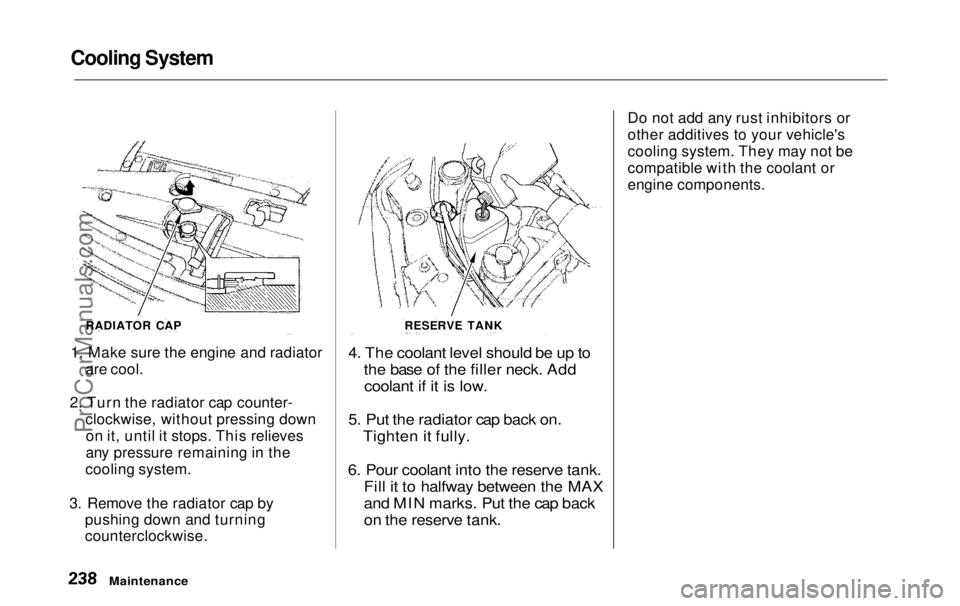
1. Make sure the engine and radiator
are cool.
2. Turn the radiator cap counter- clockwise, without pressing downon it, until it stops. This relieves
any pressure remaining in the
cooling system.
3. Remove the radiator cap by pushing down and turning
counterclockwise.
4. The coolant level should be up to
the base of the filler neck. Addcoolant if it is low.
5. Put the radiator cap back on. Tighten it fully.
6. Pour coolant into the reserve tank. Fill it to halfway between the MAX
and MIN marks. Put the cap back
on the reserve tank.
Do not add any rust inhibitors or
other additives to your vehicle's
cooling system. They may not be
compatible with the coolant or
engine components.
Maintenance
RADIATOR CAP
RESERVE TANKProCarManuals.comMain Menu Table of Contents s t
Page 240 of 343
Cooling System
Replacing Engine Coolant
The cooling system should be completely drained and refilled with
new coolant according to the timeand distance recommendations in
the maintenance schedule. Only use Genuine Honda Antifreeze/Coolant.
Draining the coolant requires access
to the underside of the vehicle. Unless you have the tools and
knowledge, you should have this maintenance done by a skilled
mechanic.
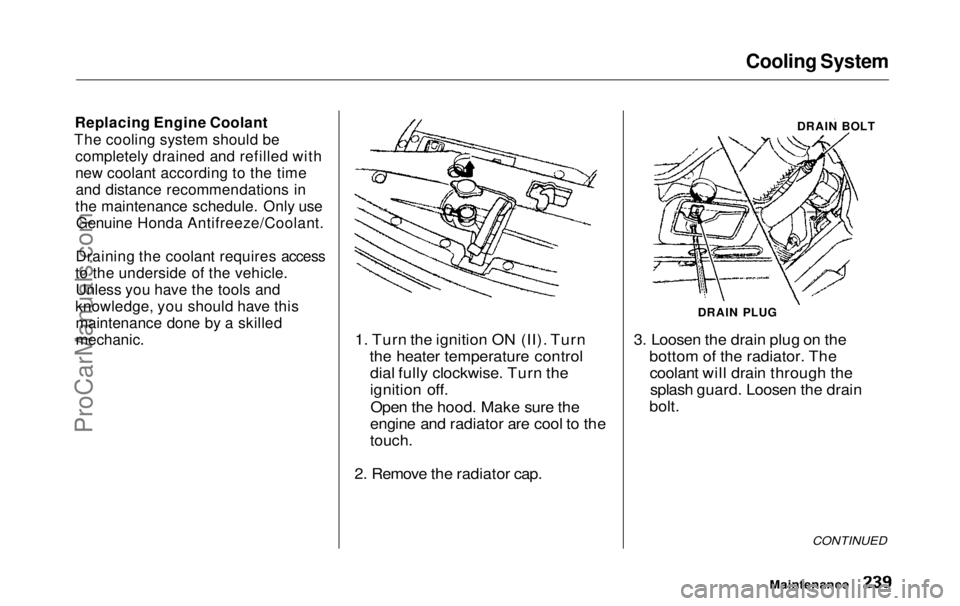
1. Turn the ignition ON (II). Turn
the heater temperature controldial fully clockwise. Turn the
ignition off.
Open the hood. Make sure the
engine and radiator are cool to the
touch.
2. Remove the radiator cap. 3. Loosen the drain plug on the
bottom of the radiator. Thecoolant will drain through thesplash guard. Loosen the drain
bolt.
CONTINUED
Maintenance
DRAIN BOLT
DRAIN PLUGProCarManuals.comMain Menu Table of Contents s t
Page 241 of 343
Cooling System
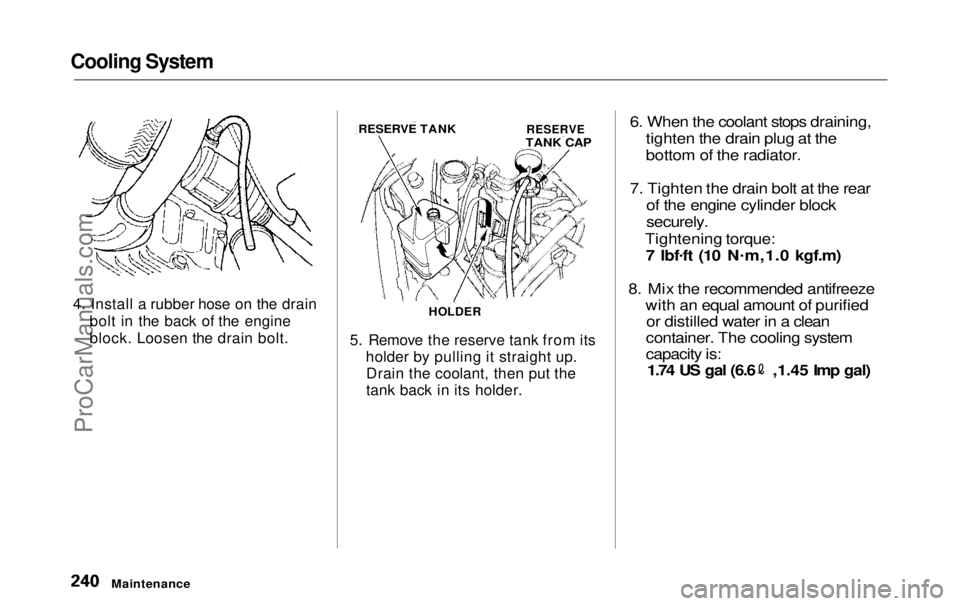
4. Install a rubber hose on the drain bolt in the back of the engine
block. Loosen the drain bolt. 5. Remove the reserve tank from its
holder by pulling it straight up.Drain the coolant, then put the
tank back in its holder.
6. When the coolant stops draining,
tighten the drain plug at the
bottom of the radiator.
7. Tighten the drain bolt at the rear of the engine cylinder block
securely.
Tightening torque: 7 lbf .
ft (10 N .
m,1.0 kgf.m)
8. Mix the recommended antifreeze with an equal amount of purifiedor distilled water in a clean
container. The cooling system
capacity is: 1.74 US gal (6.6 ,1.45 Imp gal)
Maintenance RESERVE TANK
HOLDER
RESERVE
TANK CAPProCarManuals.comMain Menu Table of Contents s t
Page 246 of 343
Power Steering
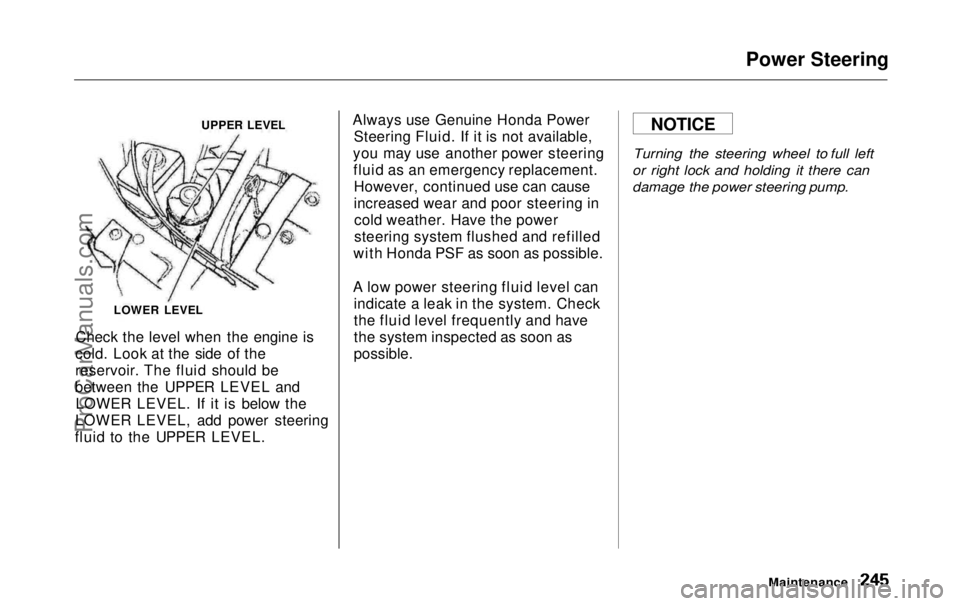
UPPER LEVEL
Check the level when the engine is
cold. Look at the side of the
reservoir. The fluid should be
between the UPPER LEVEL and LOWER LEVEL. If it is below the
LOWER LEVEL, add power steering
fluid to the UPPER LEVEL. Always use Genuine Honda Power
Steering Fluid. If it is not available,
you may use another power steering fluid as an emergency replacement.However, continued use can cause
increased wear and poor steering incold weather. Have the power
steering system flushed and refilled
with Honda PSF as soon as possible.
A low power steering fluid level can indicate a leak in the system. Check
the fluid level frequently and have
the system inspected as soon as
possible.
Turning the steering wheel to full left
or right lock and holding it there can
damage the power steering pump.
Maintenance
LOWER LEVEL
NOTICEProCarManuals.comMain Menu Table of Contents s t
Page 248 of 343
Air Cleaner Element
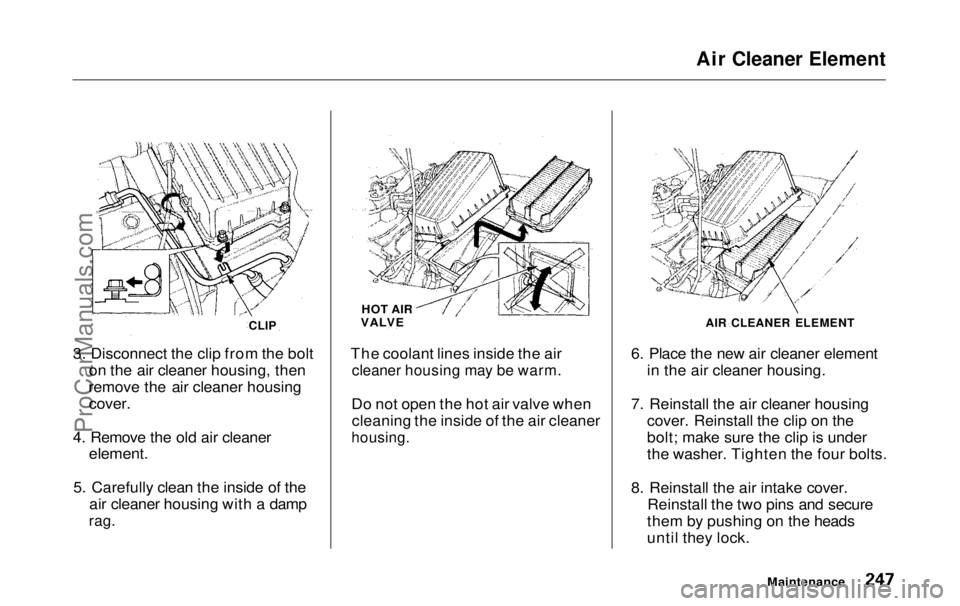
3. Disconnect the clip from the bolt on the air cleaner housing, then
remove the air cleaner housing
cover.
4. Remove the old air cleaner
element.
5. Carefully clean the inside of the air cleaner housing with a damp
rag.
The coolant lines inside the air
cleaner housing may be warm.
Do not open the hot air valve when cleaning the inside of the air cleaner
housing.
6. Place the new air cleaner element
in the air cleaner housing.
7. Reinstall the air cleaner housing cover. Reinstall the clip on the
bolt; make sure the clip is under
the washer. Tighten the four bolts.
8. Reinstall the air intake cover. Reinstall the two pins and secure
them by pushing on the heads
until they lock.
Maintenance
CLIP
HOT AIR
VALVE
AIR CLEANER ELEMENTProCarManuals.comMain Menu Table of Contents s t
Page 249 of 343
Hood Latch, Spark Plugs
Hood Latch
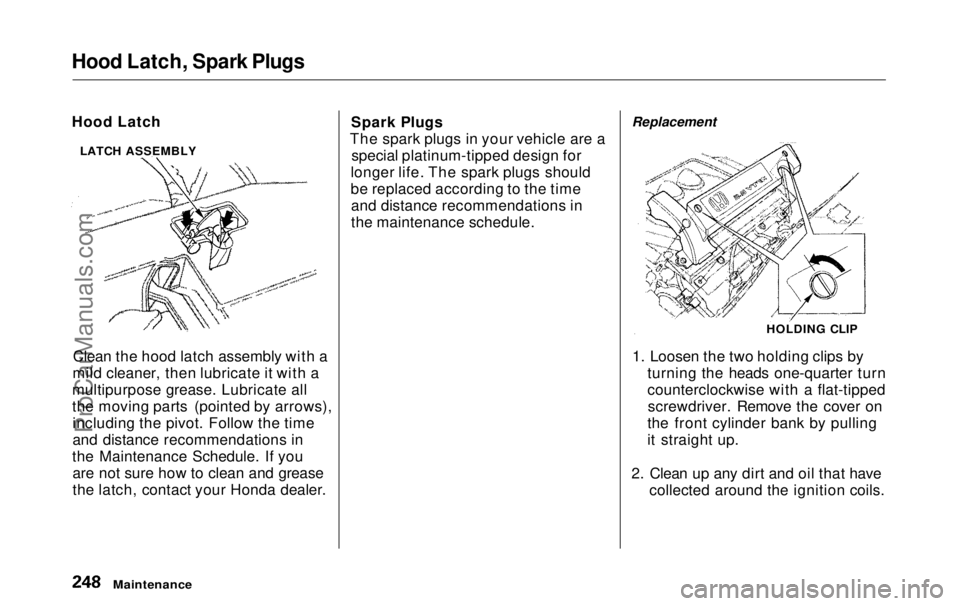
Clean the hood latch assembly with a
mild cleaner, then lubricate it with a
multipurpose grease. Lubricate all
the moving parts (pointed by arrows), including the pivot. Follow the time
and distance recommendations in
the Maintenance Schedule. If you are not sure how to clean and grease
the latch, contact your Honda dealer. Spark Plugs
The spark plugs in your vehicle are a special platinum-tipped design for
longer life. The spark plugs should
be replaced according to the time and distance recommendations in
the maintenance schedule. Replacement
1. Loosen the two holding clips by turning the heads one-quarter turn
counterclockwise with a flat-tippedscrewdriver. Remove the cover on
the front cylinder bank by pulling
it straight up.
2. Clean up any dirt and oil that have collected around the ignition coils.
Maintenance
LATCH ASSEMBLY
HOLDING CLIPProCarManuals.comMain Menu Table of Contents s t