Page 209 of 343
Traction Control System
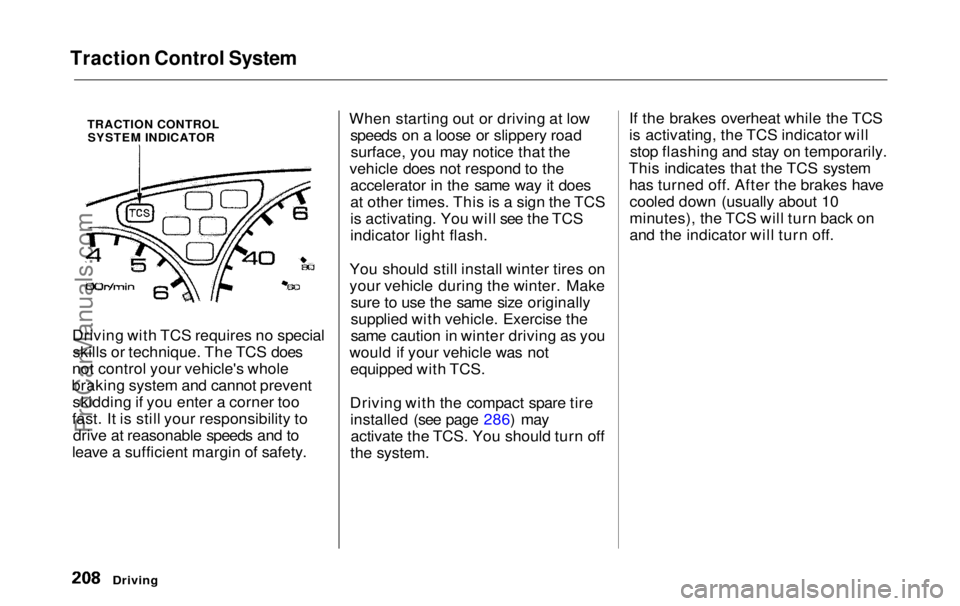
TRACTION CONTROLSYSTEM INDICATOR
Driving with TCS requires no special skills or technique. The TCS does
not control your vehicle's whole
braking system and cannot prevent skidding if you enter a corner too
fast. It is still your responsibility to drive at reasonable speeds and to
leave a sufficient margin of safety. When starting out or driving at low
speeds on a loose or slippery roadsurface, you may notice that the
vehicle does not respond to the accelerator in the same way it does
at other times. This is a sign the TCS
is activating. You will see the TCS
indicator light flash.
You should still install winter tires on
your vehicle during the winter. Make sure to use the same size originally
supplied with vehicle. Exercise the
same caution in winter driving as you
would if your vehicle was not equipped with TCS.
Driving with the compact spare tire installed (see page 286) mayactivate the TCS. You should turn off
the system. If the brakes overheat while the TCS
is activating, the TCS indicator will
stop flashing and stay on temporarily.
This indicates that the TCS system has turned off. After the brakes havecooled down (usually about 10
minutes), the TCS will turn back on
and the indicator will turn off.
DrivingProCarManuals.comMain Menu Table of Contents s t
Page 217 of 343
Towing a Trailer
Spare Vehicle Tire
When towing a trailer, you should carry a full-size wheel and tire as aspare in case you have a flat. If you
use the compact spare tire that came
with the vehicle, it may adversely affect vehicle handling. See page 317 for information on proper tire
size, and page 293 for information on
how to store a full-size tire. When storing a full-size spare tire in the
trailer, follow the trailer maker's
instructions.
Additional Trailer equipment
Many states and provinces require
special outside mirrors when towing
a trailer. Even if they don't, you should install special mirrors if you
cannot clearly see behind you, or if
the trailer creates a blind spot.
Ask your trailer sales or rental agency if any other items are
recommended or required for your
towing situation. Pre-Tow Checklist
When preparing to tow, and before driving away, be sure to check the
following:
The vehicle has been properlyserviced, and the tires, brakes,
suspension, and cooling system
are in good operating condition.
All weights and loads are within limits (see pages 212 and 213).
The hitch, safety chain, and any other attachments are secure.
All items on and in the trailer are properly secured and cannot shift
while you drive.
The lights and brakes on your vehicle and the trailer are workingproperly. Your vehicle tires and spare are
properly inflated (see page 317),and the trailer tires and spare are
inflated as recommended by the
trailer maker.
You may want to fill the fuel tank with premium fuel. Premium fuelprovides improved performance.
DrivingProCarManuals.comMain Menu Table of Contents s t
Page 259 of 343
Tires
Use a gauge to measure the air
pressure at least once a month. Even
tires that are in good condition may
lose one to two psi (10 to 20 kPa, 0.1
to 0.2 kgf/cm2) per month. Remember to check the spare tire at
the same time you check all the other tires.
Check the pressure in the tires when
they are cold. This means the vehicle
has been parked for at least three hours. If you have to drive the
vehicle before checking the tire pressure, the tires can still be
considered "cold" if you drive less
than 1 mile (1.6 km). If you check the pressure when the
tires are hot (the vehicle has been
driven several miles), you will see
readings 4 to 6 psi (30 to 40 kPa, 0.3
to 0.4 kgf/cm2) higher than the cold
reading. This is normal. Do not let air out to match the specified cold
pressure. The tire will be
underinflated.
You should get your own tire pressure gauge and use it whenever
you check your tire pressures. This
will make it easier for you to tell if a pressure loss is due to a tire problemand not due to a variation between
gauges.
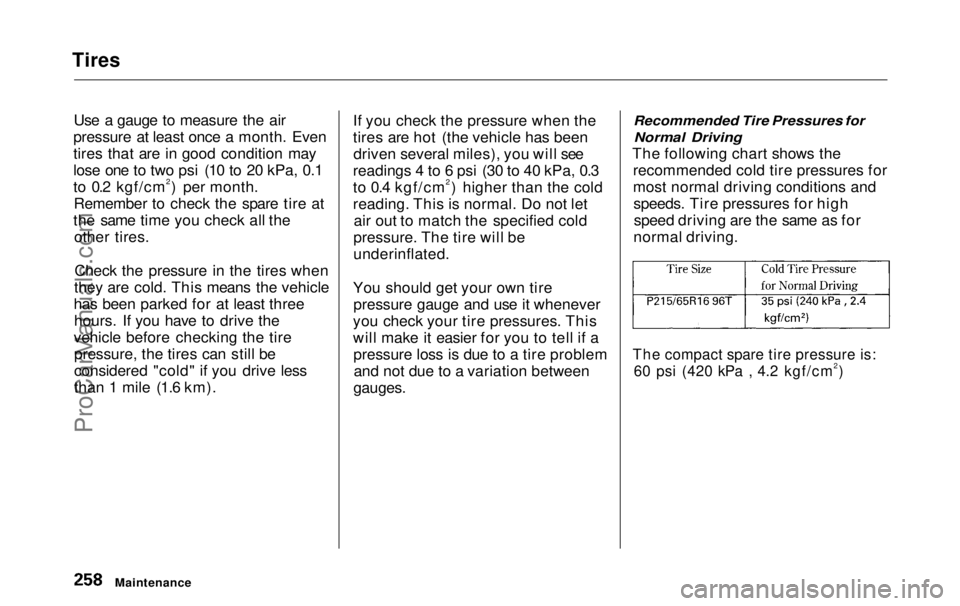
Recommended Tire Pressures for
Normal Driving
The following chart shows the recommended cold tire pressures for
most normal driving conditions andspeeds. Tire pressures for highspeed driving are the same as for
normal driving.
The compact spare tire pressure is: 60 psi (420 kPa , 4.2 kgf/cm2)
MaintenanceProCarManuals.comMain Menu Table of Contents s t
Page 284 of 343

Taking Care of the Unexpected
This section covers the more- common problems that motorists
experience with their vehicles. It
gives you information about how to safely evaluate the problem and what
to do to correct it. If the problem has stranded you on the side of the road,
you may be able to get going again. If not, you will also find instructions
on getting your vehicle towed. Compact Spare Tire....................... 286
Changing a Flat Tire..................... 287
If Your Engine Won't Start........... 296
Nothing Happens or the Starter Motor OperatesVery Slowly......................... 296
The Starter Operates
Normally.................................297
Jump Starting................................. 297 If Your Engine Overheats............. 299
Low Oil Pressure Indicator.......... 301
Charging System Indicator........... 302
Malfunction Indicator Lamp ........ 303
Brake System Indicator................ 304
Fuses............................................... 305
Checking and Replacing........... 306
Emergency Towing....................... 311
Taking Care of the UnexpectedProCarManuals.comMain Menu s t
Page 285 of 343
Compact Spare Tire
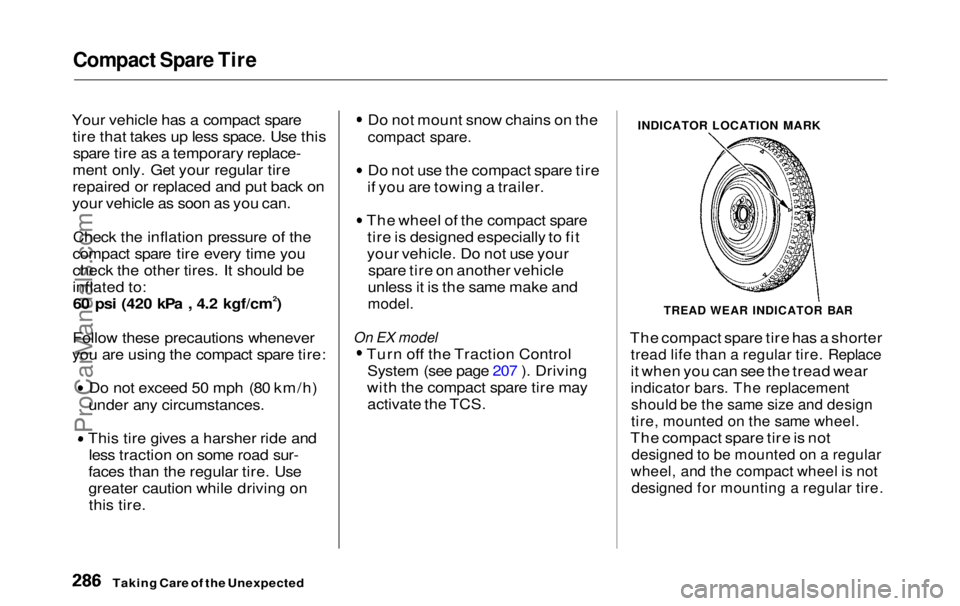
Your vehicle has a compact spare tire that takes up less space. Use thisspare tire as a temporary replace-
ment only. Get your regular tire
repaired or replaced and put back on
your vehicle as soon as you can.
Check the inflation pressure of the
compact spare tire every time you
check the other tires. It should be
inflated to: 60 psi (420 kPa , 4.2 kgf/cm2)
Follow these precautions whenever
you are using the compact spare tire: Do not exceed 50 mph (80 km/h)
under any circumstances. This tire gives a harsher ride and
less traction on some road sur-
faces than the regular tire. Use
greater caution while driving on this tire. Do not mount snow chains on the
compact spare.
Do not use the compact spare tire
if you are towing a trailer. The wheel of the compact spare
tire is designed especially to fit
your vehicle. Do not use your spare tire on another vehicle
unless it is the same make and
model.
On EX model
Turn off the Traction Control
System (see page 207 ). Driving
with the compact spare tire may activate the TCS.
INDICATOR LOCATION MARK
TREAD WEAR INDICATOR BAR
The compact spare tire has a shorter
tread life than a regular tire. Replace
it when you can see the tread wear
indicator bars. The replacement
should be the same size and design
tire, mounted on the same wheel.
The compact spare tire is not
designed to be mounted on a regular
wheel, and the compact wheel is not
designed for mounting a regular tire.
Taking Care of the UnexpectedProCarManuals.comMain Menu Table of Contents s t
Page 286 of 343
Changing a Flat Tire
If you have a flat tire while driving, stop in a safe place to change it.
Stopping in traffic or on the shoulder
of a busy road is dangerous. Drive slowly along the shoulder until you
get to an exit or an area to stop that
is far away from the traffic lanes. JACK
VINYL BAG
TOOLS
1. Park the vehicle on firm, level and non-slippery ground away from
traffic. Put the transmission in
Park. Apply the parking brake. SPARE TIRE
2. Turn on the hazard warning lights and turn the ignition switch to
LOCK (0). Have all the
passengers get out of the vehicle
while you change the tire.
CONTINUED
Taking Care of the Unexpected
The vehicle can easily roll off
the jack, seriously injuring
anyone underneath.
Follow the directions for
changing a tire exactly, and never get under the vehicle
when it is supported only by the
jack.ProCarManuals.comMain Menu Table of Contents s t
Page 287 of 343
Changing a Flat Tire
COVER
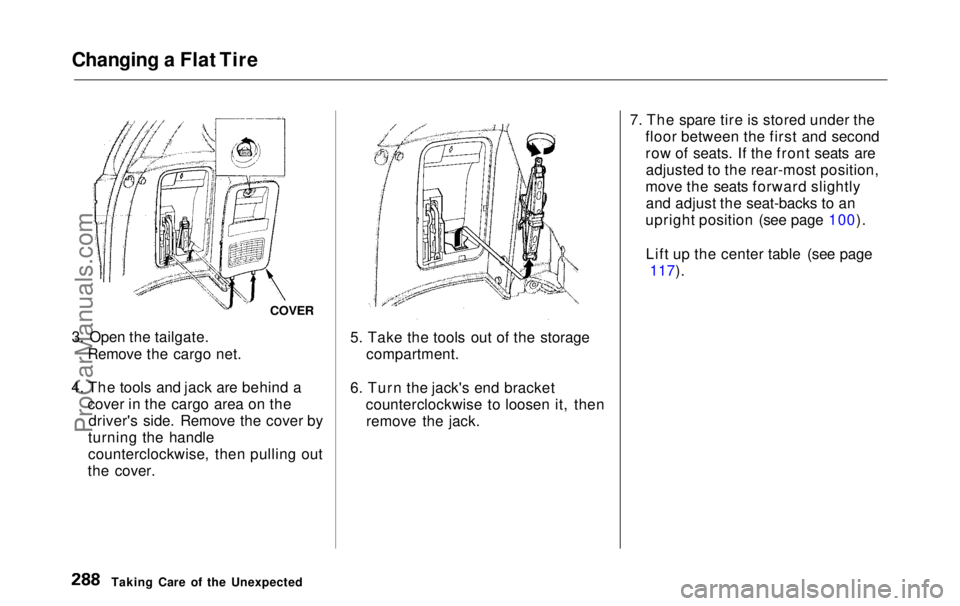
3. Open the tailgate. Remove the cargo net.
4. The tools and jack are behind a cover in the cargo area on thedriver's side. Remove the cover by
turning the handle
counterclockwise, then pulling out
the cover. 5. Take the tools out of the storage
compartment.
6. Turn the jack's end bracket counterclockwise to loosen it, thenremove the jack. 7. The spare tire is stored under the
floor between the first and second
row of seats. If the front seats areadjusted to the rear-most position,
move the seats forward slightly and adjust the seat-backs to an
upright position (see page 100).
Lift up the center table (see page 117).
Taking Care of the UnexpectedProCarManuals.comMain Menu Table of Contents s t
Page 288 of 343
Changing a Flat Tire
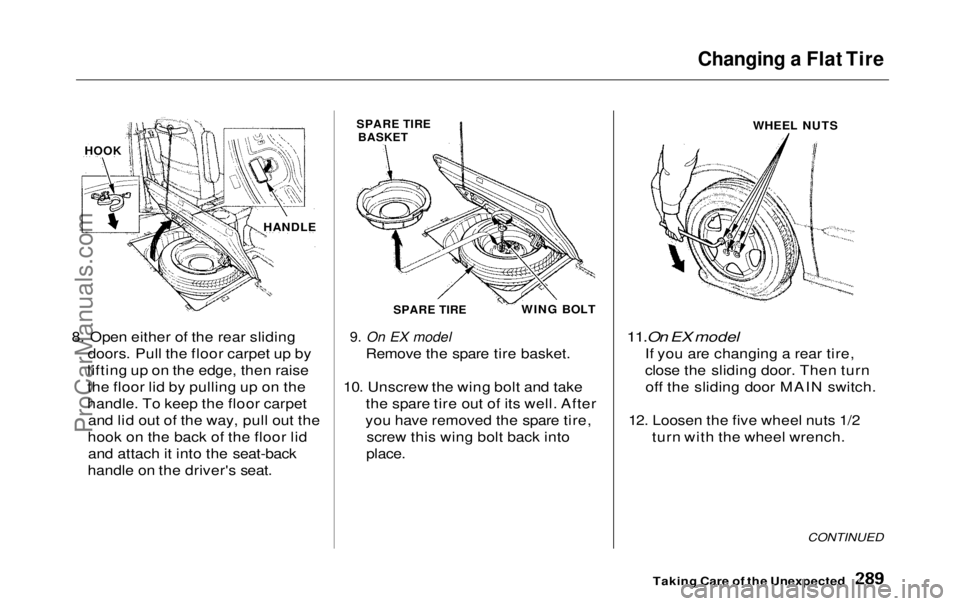
8. Open either of the rear sliding doors. Pull the floor carpet up by
lifting up on the edge, then raise
the floor lid by pulling up on the
handle. To keep the floor carpet and lid out of the way, pull out the
hook on the back of the floor lid and attach it into the seat-back
handle on the driver's seat.
SPARE TIRE
BASKET
SPARE TIRE
WING BOLT
9. On EX model
Remove the spare tire basket.
10. Unscrew the wing bolt and take the spare tire out of its well. After
you have removed the spare tire, screw this wing bolt back into
place.
WHEEL NUTS
11.On EX model
If you are changing a rear tire,
close the sliding door. Then turnoff the sliding door MAIN switch.
12. Loosen the five wheel nuts 1/2 turn with the wheel wrench.
CONTINUED
Taking Care of the Unexpected
HOOK
HANDLEProCarManuals.comMain Menu Table of Contents s t