Page 179 of 269
Windshield Washers, Transmission Fluid
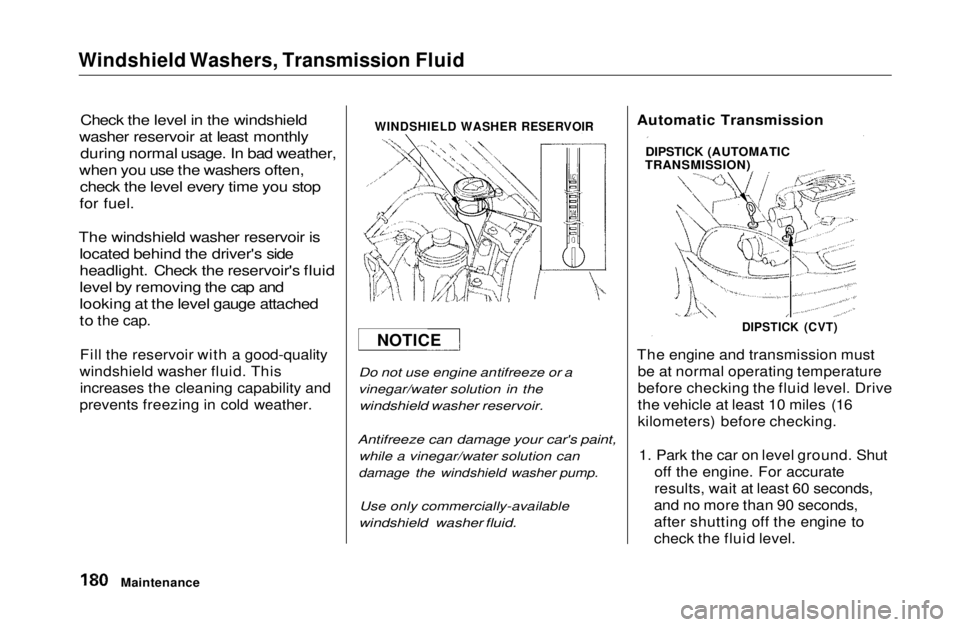
Check the level in the windshield
washer reservoir at least monthly during normal usage. In bad weather,
when you use the washers often, check the level every time you stop
for fuel.
The windshield washer reservoir is located behind the driver's side
headlight. Check the reservoir's fluid
level by removing the cap and
looking at the level gauge attached
to
the cap.
Fill the reservoir with a good-quality
windshield washer fluid. This increases the cleaning capability and
prevents freezing in cold weather.
WINDSHIELD WASHER RESERVOIR
Do not use engine antifreeze or a
vinegar/water solution in the
windshield washer reservoir.
Antifreeze can damage your car's paint,
while a vinegar/water solution can
damage the windshield washer pump.
Use only commercially-available
windshield washer fluid.
The engine and transmission must
be at normal operating temperature
before checking the fluid level. Drive
the vehicle at least 10 miles (16
kilometers) before checking.
1. Park the car on level ground. Shut off the engine. For accurate
results, wait at least 60 seconds,
and no more than 90 seconds,
after shutting off the engine to
check the fluid level.
Maintenance
NOTICE
Automatic Transmission
DIPSTICK (AUTOMATIC
TRANSMISSION)
DIPSTICK (CVT)Main Menu Table of Contents s t
Page 183 of 269
Power Steering
Check the level when the engine is
cold. Look at the side of the
reservoir. The fluid should be
between the UPPER LEVEL and LOWER LEVEL. If it is below the
LOWER LEVEL, add power steering
fluid to the UPPER LEVEL.
Always use Genuine Honda PowerSteering Fluid. If it is not available,
you may use another power steering fluid as an emergency replacement.However, continued use can cause
increased wear and poor steering in cold weather. Have the powersteering system flushed and refilled
with Honda PSF as soon as possible. A low power steering fluid level can
indicate a leak in the system. Check
the fluid level frequently and have
the system inspected as soon as
possible.
Turning the steering wheel to full left
or right lock and holding it there can
damage the power steering pump.
Maintenance
NOTICE
UPPER LEVEL
LOWER LEVELMain Menu Table of Contents s t
Page 184 of 269
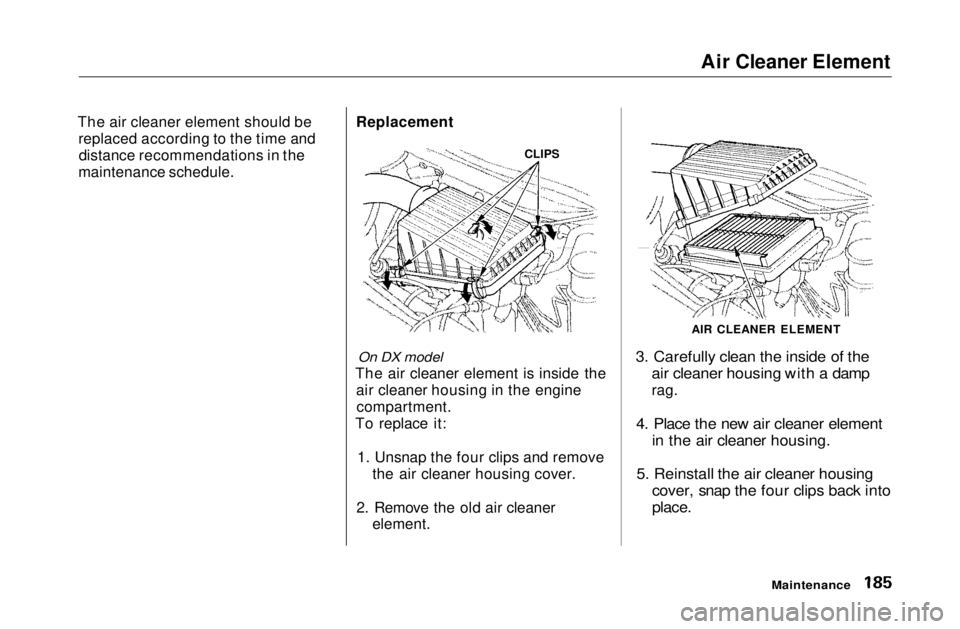
Air Cleaner Element
The air cleaner element should be replaced according to the time anddistance recommendations in the
maintenance schedule. Replacement
CLIPS
On DX model
The air cleaner element is inside the air cleaner housing in the enginecompartment.
To replace it:
1. Unsnap the four clips and remove the air cleaner housing cover.
2. Remove the old air cleaner element. AIR CLEANER ELEMENT
3. Carefully clean the inside of the air cleaner housing with a damp
rag.
4. Place the new air cleaner element in the air cleaner housing.
5. Reinstall the air cleaner housing cover, snap the four clips back into
place.
MaintenanceMain Menu Table of Contents s t
Page 185 of 269
Air Cleaner Element, Hood Latch
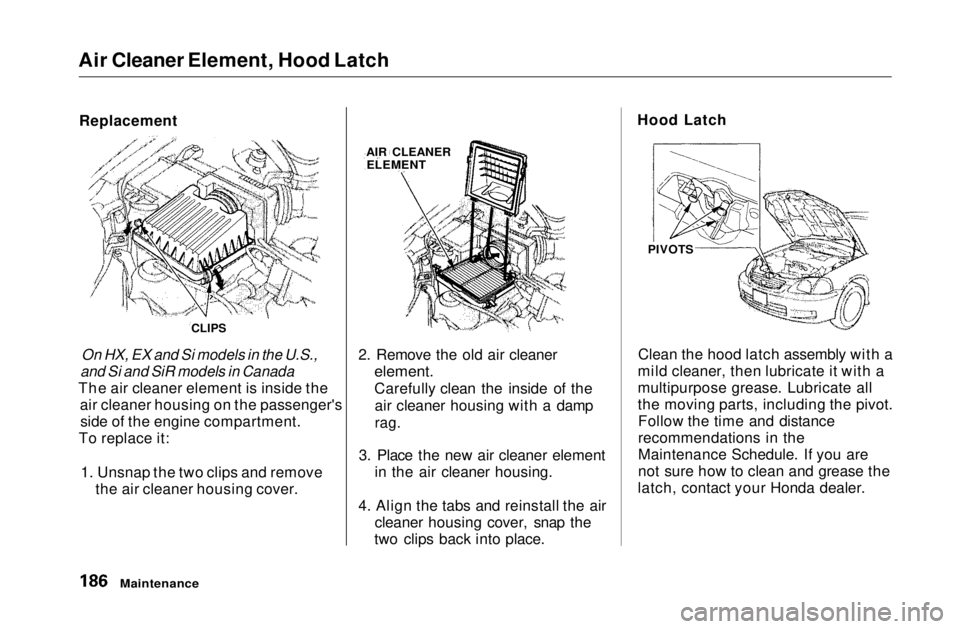
Replacement
On HX, EX and Si models in the U.S.,
and Si and SiR models in Canada
The air cleaner element is inside the air cleaner housing on the passenger'sside of the engine compartment.
To replace it:
1. Unsnap the two clips and remove the air cleaner housing cover. 2. Remove the old air cleaner
element.
Carefully clean the inside of the
air cleaner housing with a damp
rag.
3. Place the new air cleaner element in the air cleaner housing.
4. Align the tabs and reinstall the air cleaner housing cover, snap the
two clips back into place. Hood Latch
Clean the hood latch assembly with a
mild cleaner, then lubricate it with a
multipurpose grease. Lubricate all
the moving parts, including the pivot. Follow the time and distance
recommendations in the
Maintenance Schedule. If you are
not sure how to clean and grease the
latch, contact your Honda dealer.
Maintenance
CLIPS
AIR CLEANER
ELEMENT
PIVOTSMain Menu Table of Contents s t
Page 187 of 269
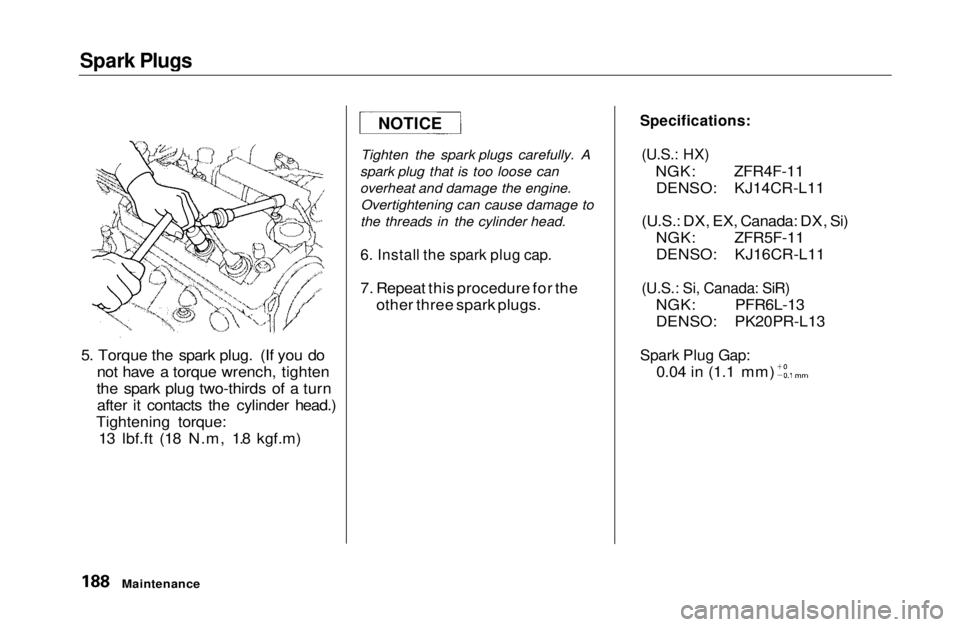
Spark Plugs
5. Torque the spark plug. (If you do not have a torque wrench, tighten
the spark plug two-thirds of a turn after it contacts the cylinder head.)
Tightening torque: 13 lbf.ft (18 N.m, 1.8 kgf.m) Tighten the spark plugs carefully. A
spark plug that is too loose can
overheat and damage the engine. Overtightening can cause damage to
the threads in the cylinder head.
6. Install the spark plug cap.
7. Repeat this procedure for the other three spark plugs.
Specifications:
(U.S.: HX)
NGK: ZFR4F-11DENSO: KJ14CR-L11
(U.S.: DX, EX, Canada: DX, Si) NGK: ZFR5F-11
DENSO: KJ16CR-L11
(U.S.: Si, Canada: SiR)
NGK: PFR6L-13
DENSO: PK20PR-L13
Spark Plug Gap:
0.04 in (1.1 mm)
Maintenance
NOTICEMain Menu Table of Contents s t
Page 192 of 269
Air Conditioning System
Standard on EX and Si models in U. S.,
SiR model in Canada
Your car's air conditioning is a sealed system. Any major maintenance,
such as recharging, should be done
by a qualified mechanic. You can do a couple of things to make sure the
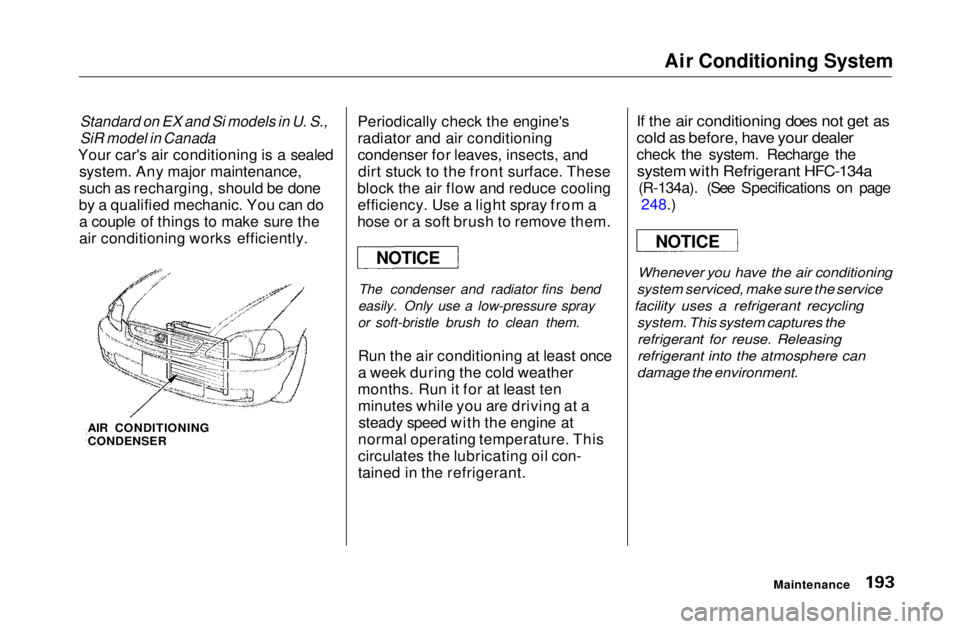
air conditioning works efficiently. Periodically check the engine's
radiator and air conditioning
condenser for leaves, insects, and
dirt stuck to the front surface. These
block the air flow and reduce cooling efficiency. Use a light spray from a
hose or a soft brush to remove them.
The condenser and radiator fins bend
easily. Only use a low-pressure spray
or soft-bristle brush to clean them.
Run the air conditioning at least once
a week during the cold weather
months. Run it for at least ten minutes while you are driving at asteady speed with the engine at
normal operating temperature. This
circulates the lubricating oil con-
tained in the refrigerant.
If the air conditioning does not get as
cold as before, have your dealer
check the system. Recharge the
system with Refrigerant HFC-134a
(R-134a). (See Specifications on page 248.)
Whenever you have the air conditioning
system serviced, make sure the service
facility uses a refrigerant recycling
system. This system captures the
refrigerant for reuse. Releasing
refrigerant into the atmosphere can
damage the environment.
Maintenance
NOTICE
NOTICE
AIR CONDITIONING
CONDENSERMain Menu Table of Contents s t
Page 204 of 269
Lights
4. Unclip the end of the hold-down wire from its slot. Pivot it out ofthe way and remove the bulb.
5. Insert the new bulb into the hole, making sure the tabs are in theirslots. Pivot the hold-down wire
back in place and clip the end into
the slot.
6. Install the rubber seal over the back of the headlight assembly.Make sure it is right side up; it is
marked "TOP."
7. Push the electrical connector onto the tabs of the new bulb. Makesure it locks in place.
Turn on the headlights to test the new bulb.
8. (Driver's side) Reinstall the power steering
reservoir.
Replacing the Front Side Marker/
Turn Signal and Parking Light Bulb
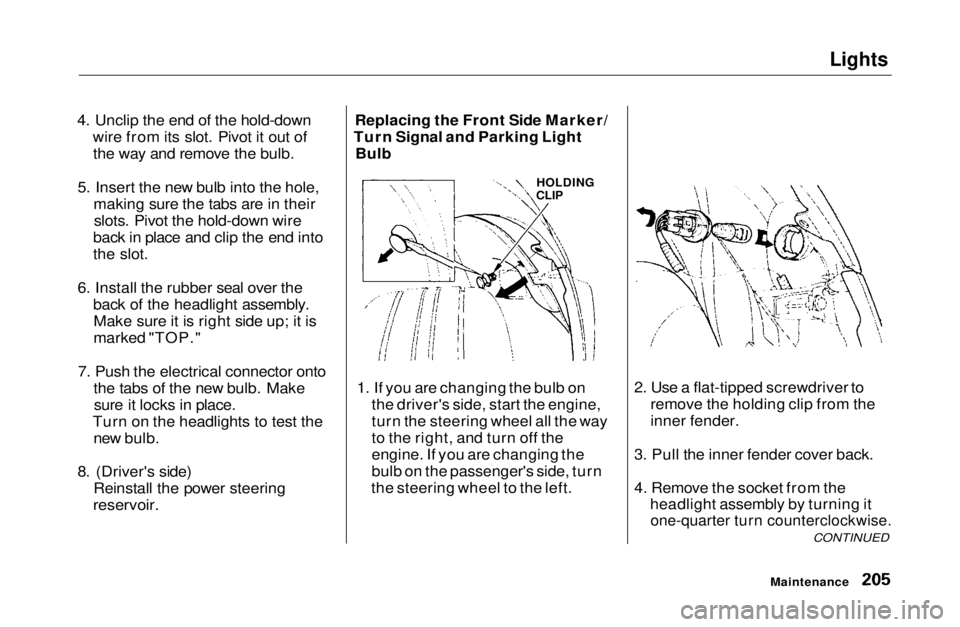
1. If you are changing the bulb on the driver's side, start the engine,
turn the steering wheel all the way
to the right, and turn off the
engine. If you are changing the
bulb on the passenger's side, turn
the steering wheel to the left. 2. Use a flat-tipped screwdriver to
remove the holding clip from the
inner fender.
3. Pull the inner fender cover back.
4. Remove the socket from the headlight assembly by turning it
one-quarter turn counterclockwise.
CONTINUED
Maintenance
HOLDING
CLIPMain Menu Table of Contents s t
Page 211 of 269
Storing Your Car
If you need to park your car for an
extended period (more than one
month), there are several things you
should do to prepare it for storage.
Proper preparation helps prevent
deterioration and makes it easier to
get your car back on the road. If possible, store your car indoors.
Fill the fuel tank.
Change the engine oil and filter
(see page 173).
Wash and dry the exterior
completely.
Clean the interior. Make sure the
carpeting, floor mats, etc. are
completely dry.
Leave the parking brake off. Put
the transmission in Reverse (5-
speed manual) or Park
(automatic). Block the rear wheels.
If the car is to be stored for a
longer period, it should be supported on jackstands so the
tires are off the ground.
Leave one window open slightly (if
the car is being stored indoors).
Disconnect the battery.
Support the front wiper blade
arms with a folded towel or rag so
they do not touch the windshield.
To minimize sticking, apply a silicone spray lubricant to all door
and trunk seals. Also, apply a
vehicle body wax to the painted surfaces that mate with the door
and trunk seals. Cover the car with a "breathable"
cover, one made from a porous
material such as cotton.
Nonporous materials, such as
plastic sheeting, trap moisture,
which can damage the paint.
If possible, run the engine for a
while periodically (preferably once a month).
If you store your car for 12 months
or longer, have your Acura dealer
perform the inspections called for in the 24 months/30,000 miles (48,000
km) maintenance schedule as soos as you take it out of storage (see
page 162). The replacements called
for in the maintenance schedule are not needed unless the car has
actually reached that time or mileage.
MaintenanceMain Menu Table of Contents s t