Page 67 of 328
yellowblue
2-25
If your parking brake doesn't hold the vehicle when
applied, see your GM Truck dealer who can adjust your
parking brake properly.
To release the parking
brake, first push down the
regular brake pedal. Then,
push the parking brake lever
all the way down and shift
the automatic transmission
to NEUTRAL (N).
The PARK BRAKE light will remain illuminated if the
parking brake is not fully released.
NOTICE:
Driving with the parking brake on can overheat
the parts in the system. You may have to replace
them, and you could also damage other parts of
your vehicle.
Electric/Hydraulic Parking Brake
(If Equipped)
CAUTION:
It will take a few seconds for the parking brake
to fully apply, and even longer when it is cold
outside. Do not leave your vehicle until the
parking brake applies fully. Without the parking
brake applied, your vehicle is free to move. It
could hit someone or something.
ProCarManuals.com
Page 68 of 328

yellowblue
2-26
If your vehicle has this
system, you will have a
knob to the right of the
steering column.
To apply the parking brake, pull the knob toward you.
Then shift the transmission to NEUTRAL (N) or
PARK (P).
Push the knob in to release the parking brake. The
ignition must be in RUN and the shift lever out of
PARK (P) in order to release the parking brake.
The parking brake will automatically apply if the
ignition is turned off and in PARK (P) and will also
apply (will not release) if the vehicle's battery is dead
or disconnected.The PARK BRAKE light may flash while the parking
brake is being applied or released. This is normal for
this system.
If your vehicle needs towing or the parking brake will
not release, the towing operator will need to disconnect
the propshaft before towing your vehicle. See ªTowing
Your Vehicleº in the Index.
Air Brake (If Equipped)
CAUTION:
When the yellow SYSTEM PARK and the red
TRAILER AIR SUPPLY knobs are both pushed
in, your rig will be free to move. It could strike
someone or something. When both of these knobs
are pushed in, either hold the regular brake
pedal down or, if you have it, pull out the blue
TRACTOR PARKING knob, to keep your rig
from moving.
ProCarManuals.com
Page 69 of 328

yellowblue
2-27
If your vehicle has air
brakes, you will have this
control. Pulling it out
applies the parking brake.
The PARK BRAKE light
will come on when the air
parking brake is applied.
Vehicles built for use as tractors or towing vehicles have
one or two more air brake controls. They look like this:To charge a trailer's air brake system:
1. Move your tractor into the proper position. Apply the
parking brake by pulling the yellow SYSTEM PARK
knob out.
2. Hook up the trailer air system properly.
3. Get into the tractor. Push and hold down the regular
brake pedal.
4. Push in both the yellow SYSTEM PARK and the red
TRAILER AIR SUPPLY knobs. This will charge
your trailer's air system.
If you have the blue TRACTOR PARKING knob,
pull it out to set the tractor brakes while the air system
is charging.
After a few minutes, the trailer system should be fully
charged. When it is, the air pressure gage will show
about 125 to 135 psi (862 to 931 kPa) and you may hear
the ªpop offº valve operate.
For driving with a trailer, the yellow, red and blue
(if equipped) knobs all must be pushed in. It's the same
when you're not pulling a trailer except that the red
TRAILER AIR SUPPLY knob must be out.
ProCarManuals.com
Page 70 of 328
yellowblue
2-28
CAUTION:
If you apply any one of the air brake parking
controls while the vehicle is moving, your rig will
stop suddenly. If you are not ready for this, you
or others could be injured. Don't apply any one
of these controls while you're driving, unless you
have to make an emergency stop.
If the air pressure drops below 60 to 70 psi (413 to
482 kPa), the PRIMARY BRAKE light will come on. If
the air pressure drops to 40 to 45 psi (275 to 309 kPa), the
yellow knob will automatically pop out and apply the
spring brakes. If you ever have a complete loss of air so
that your air brakes automatically apply, there is a way that
the tow operator can release the parking brakes to tow the
vehicle. See ªTowing Your Vehicleº in the Index.
CAUTION:
If your vehicle is left in gear, the engine can
start if the vehicle starts to roll. This can easily
happen if you have the diesel engine. Shift the
transmission into NEUTRAL (N) before you
leave the vehicle.
ProCarManuals.com
Page 72 of 328

yellowblue
2-30
Running Your Engine While You're
Parked (Automatic Transmission)
It's better not to park with the engine running. But if
ever you have to, here are some things to know.
CAUTION:
Idling the engine with the climate control system
off could allow dangerous exhaust into
your vehicle (see the earlier Caution under
ªEngine Exhaustº).
Also, idling in a closed-in place can let deadly
carbon monoxide (CO) into your vehicle even if
the fan switch is at the highest setting. One place
this can happen is a garage. Exhaust
-- with
CO
-- can come in easily. NEVER park in a
garage with the engine running.
Another closed-in place can be a blizzard.
(See ªBlizzardº in the Index.)
CAUTION:
It can be dangerous to get out of your vehicle
without the parking brake firmly set. Your
vehicle can roll. If you've left the engine running,
the vehicle can move suddenly. You or others
could be injured. To be sure your vehicle won't
move, even when you're on fairly level ground,
always set your parking brake.
Follow the proper steps to be sure your vehicle
won't move.
Windows
Manual Windows
Turn the hand crank on each door to raise or lower
the window.
ProCarManuals.com
Page 78 of 328
yellowblue
2-36 Cruise Control (If Equipped)
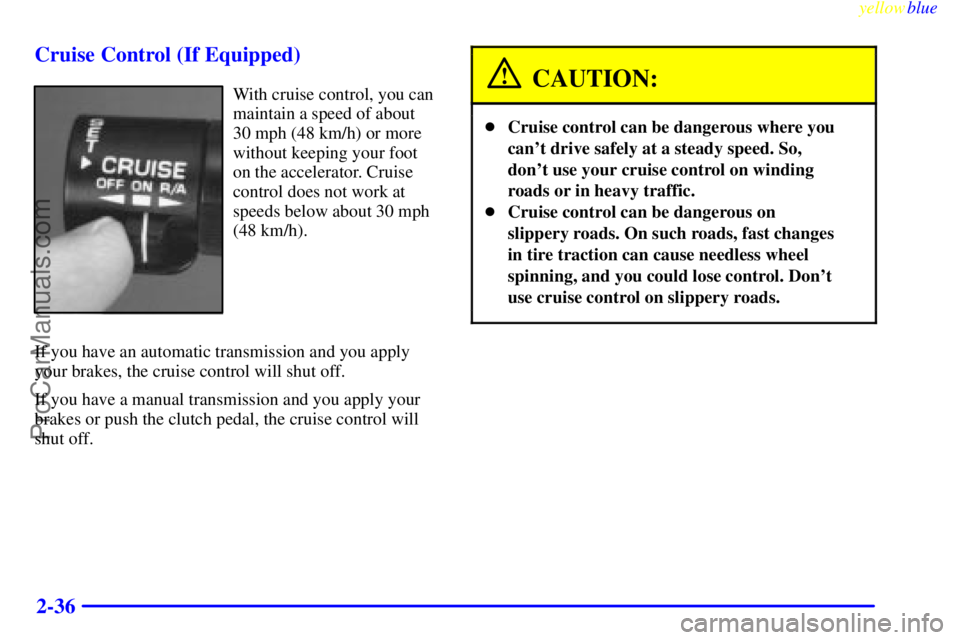
With cruise control, you can
maintain a speed of about
30 mph (48 km/h) or more
without keeping your foot
on the accelerator. Cruise
control does not work at
speeds below about 30 mph
(48 km/h).
If you have an automatic transmission and you apply
your brakes, the cruise control will shut off.
If you have a manual transmission and you apply your
brakes or push the clutch pedal, the cruise control will
shut off.CAUTION:
�Cruise control can be dangerous where you
can't drive safely at a steady speed. So,
don't use your cruise control on winding
roads or in heavy traffic.
�Cruise control can be dangerous on
slippery roads. On such roads, fast changes
in tire traction can cause needless wheel
spinning, and you could lose control. Don't
use cruise control on slippery roads.
ProCarManuals.com
Page 79 of 328

yellowblue
2-37
Setting Cruise Control
CAUTION:
If you leave your cruise control switch on when
you're not using cruise, you might hit a button
and go into cruise when you don't want to. You
could be startled and even lose control. Keep the
cruise control switch off until you want to use it.
1. Move the cruise control switch to ON.
2. Get up to the speed you want.
3. Press in the SET button at the end of the lever and
release it.
4. Take your foot off the accelerator pedal.Resuming a Set Speed
Once you're going about 30 mph (48 km/h) or more,
you can move the cruise control switch from ON to
R/A (Resume/Accelerate) for about half a second.
The vehicle will return to your chosen speed and
stay there.
If you hold the switch at R/A longer than half a second,
the vehicle will keep going faster until you release the
switch or apply the brake, so unless you want to go
faster, don't hold the switch at R/A.
If the switch is held at R/A for longer than 200 seconds,
the cruise control will automatically turn off. The cruise
control function will be made available again the next
time the engine is restarted.
ProCarManuals.com
Page 81 of 328

yellowblue
2-39
Using Cruise Control on Hills
How well your cruise control will work on hills depends
upon your speed, load and the steepness of the hills.
When going up steep hills, you may want to step on the
accelerator pedal to maintain your speed. When going
downhill, you may have to brake or shift to a lower gear
to keep your speed down. Of course, applying the brake
or clutch takes you out of cruise control. Many drivers
find this to be too much trouble and don't use cruise
control on steep hills.
Ending Cruise Control
There are different ways to turn off the cruise control:
�Step lightly on the brake pedal.
�Push the clutch pedal, if you have a
manual transmission.
�Move the cruise switch to OFF.
Erasing Speed Memory
When you turn off the ignition, your cruise control set
speed memory is erased.Trailer Brake Hand Control Valve
(Option)
If your vehicle has this feature, it is mounted on the
steering column.
This control lets you apply the trailer brakes without
applying the tractor brakes. You can apply the trailer
brakes a little or apply them all the way if you have to.
Use this control only when you're driving. Don't use it
for parking or to hold the rig on a hill.
ProCarManuals.com