Page 203 of 328
yellowblue
6-11 1.0L L3 Engine
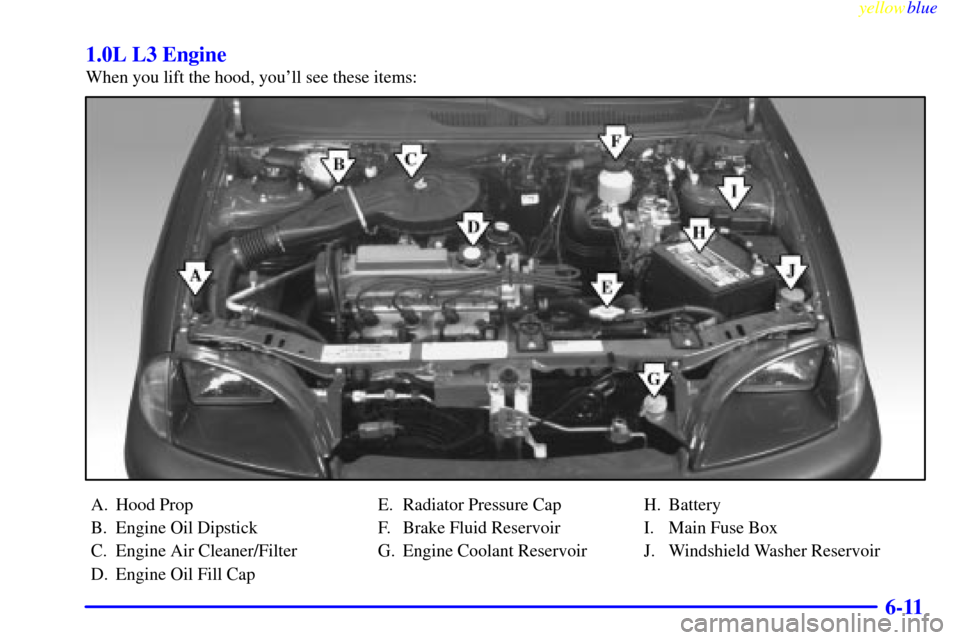
When you lift the hood, you'll see these items:
A. Hood Prop
B. Engine Oil Dipstick
C. Engine Air Cleaner/Filter
D. Engine Oil Fill CapE. Radiator Pressure Cap
F. Brake Fluid Reservoir
G. Engine Coolant ReservoirH. Battery
I. Main Fuse Box
J. Windshield Washer Reservoir
Page 204 of 328
yellowblue
6-12 1.3L L4 Engine
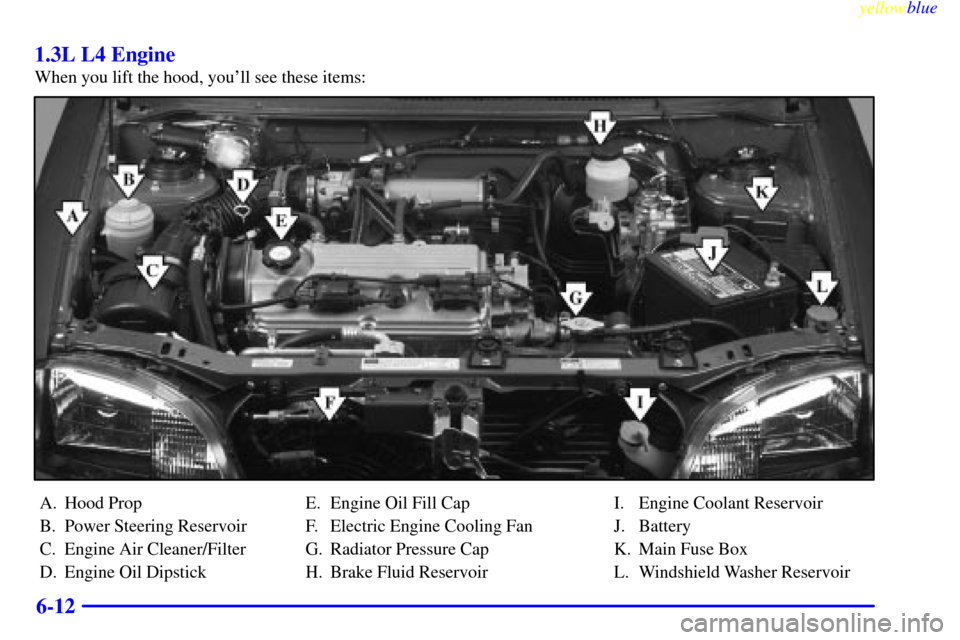
When you lift the hood, you'll see these items:
A. Hood Prop
B. Power Steering Reservoir
C. Engine Air Cleaner/Filter
D. Engine Oil DipstickE. Engine Oil Fill Cap
F. Electric Engine Cooling Fan
G. Radiator Pressure Cap
H. Brake Fluid ReservoirI. Engine Coolant Reservoir
J. Battery
K. Main Fuse Box
L. Windshield Washer Reservoir
Page 216 of 328
yellowblue
6-24 How to Add Fluid
Here's how to add fluid. Refer to the Maintenance
Schedule to determine what kind of fluid to use. See
ªRecommended Fluids and Lubricantsº in the Index.
1. Remove the filler plug.
2. Add fluid at the filler plug hole. Add only enough
fluid to bring the fluid level up to the bottom of the
filler plug hole.
3. Install the filler plug. Be sure the plug is fully seated.
Clutch Adjustment
The clutch linkage in your vehicle should be checked as
recommended in your Maintenance Schedule. To check,
push the clutch pedal down with your hand until you
feel some resistance to the movement of the pedal. If the
pedal moves freely up to 5/8 to 3/4 of an inch (1.5 to 2.0
cm) or so before you feel resistance to the travel,
adjustment isn't needed.
If there is no free travel or very little (less than 5/8 of an
inch (1.5 cm)), see your dealer for adjustment.
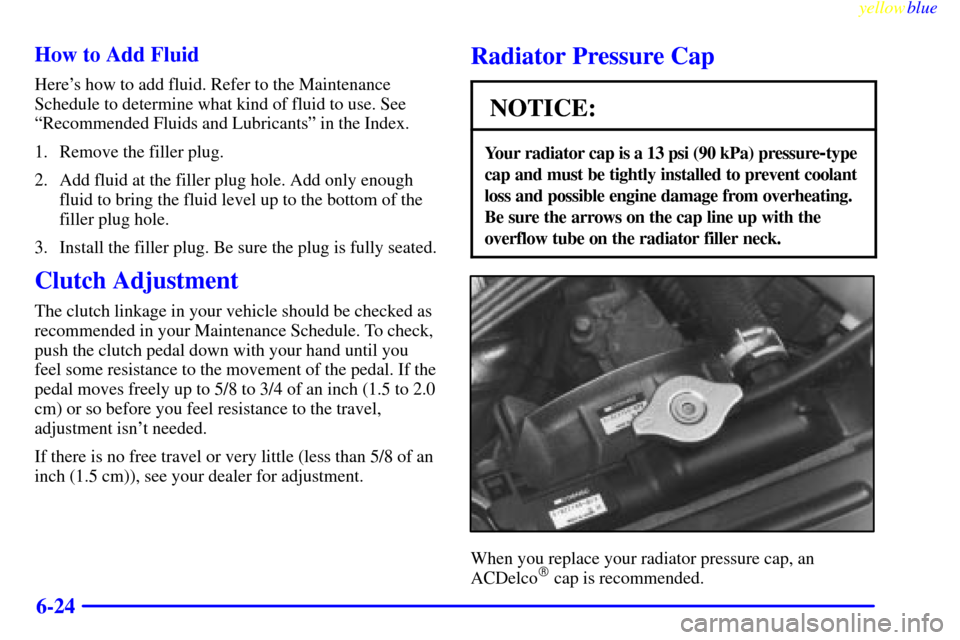
Radiator Pressure Cap
NOTICE:
Your radiator cap is a 13 psi (90 kPa) pressure-type
cap and must be tightly installed to prevent coolant
loss and possible engine damage from overheating.
Be sure the arrows on the cap line up with the
overflow tube on the radiator filler neck.
When you replace your radiator pressure cap, an
ACDelco� cap is recommended.
Page 217 of 328
yellowblue
6-25
Thermostat
Engine coolant temperature is controlled by a thermostat
in the engine coolant system. The thermostat stops the
flow of coolant through the radiator until the coolant
reaches a preset temperature.
When you replace your thermostat, an ACDelco
�
thermostat is recommended.
Engine Coolant
The following explains your cooling system and how to
add coolant when it is low. If you have a problem with
engine overheating, see ªEngine Overheatingº in
the Index.
A 50/50 mixture of clean, drinkable water and the
proper coolant will:
�Give freezing protection down to
-33�F (-36�C).
�Give boiling protection up to 258�F (125�C).
�Protect against rust and corrosion.
�Help keep the proper engine temperature.
�Let the warning lights and gages work as
they should.
What to Use
Use a mixture of one-half clean, drinkable water and
one
-half coolant that meets GM Specification 1825-M,
which won't damage aluminum parts. You can also use a
recycled coolant conforming to GM Specification
1825
-M with a complete coolant flush and refill. If
you use this coolant mixture, you don't need to add
anything else.
CAUTION:
Adding only plain water to your cooling system
can be dangerous. Plain water, or some other
liquid like alcohol, can boil before the proper
coolant mixture will. Your vehicle's coolant
warning system is set for the proper coolant
mixture. With plain water or the wrong mixture,
your engine could get too hot but you wouldn't
get the overheat warning. Your engine could
catch fire and you or others could be burned. Use
a 50/50 mixture of clean, drinkable water and the
proper coolant.
Page 218 of 328
yellowblue
6-26
NOTICE:
If you use an improper coolant mixture, your
engine could overheat and be badly damaged.
The repair cost wouldn't be covered by your
warranty. Too much water in the mixture can
freeze and crack the engine, radiator, heater core
and other parts.
If you have to add coolant more than four times a year,
have your dealer check your cooling system.
NOTICE:
If you use the proper coolant, you don't have to
add extra inhibitors or additives which claim to
improve the system. These can be harmful.
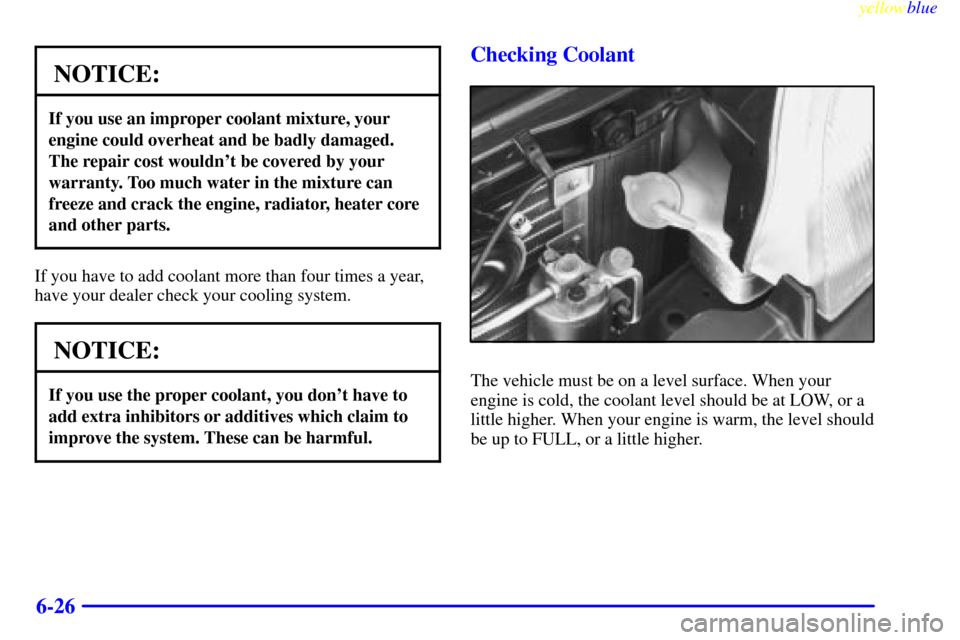
Checking Coolant
The vehicle must be on a level surface. When your
engine is cold, the coolant level should be at LOW, or a
little higher. When your engine is warm, the level should
be up to FULL, or a little higher.
Page 219 of 328
yellowblue
6-27
Adding Coolant
If you need more coolant, add the proper coolant
mixture at the coolant recovery tank, but be careful not
to spill it.
CAUTION:
Turning the radiator pressure cap when the engine
and radiator are hot can allow steam and scalding
liquids to blow out and burn you badly. With the
coolant recovery tank, you will almost never have
to add coolant at the radiator. Never turn the
radiator pressure cap
-- even a little -- when the
engine and radiator are hot.
CAUTION:
You can be burned if you spill coolant on hot
engine parts. Coolant contains ethylene glycol,
and it will burn if the engine parts are hot
enough. Don't spill coolant on a hot engine.
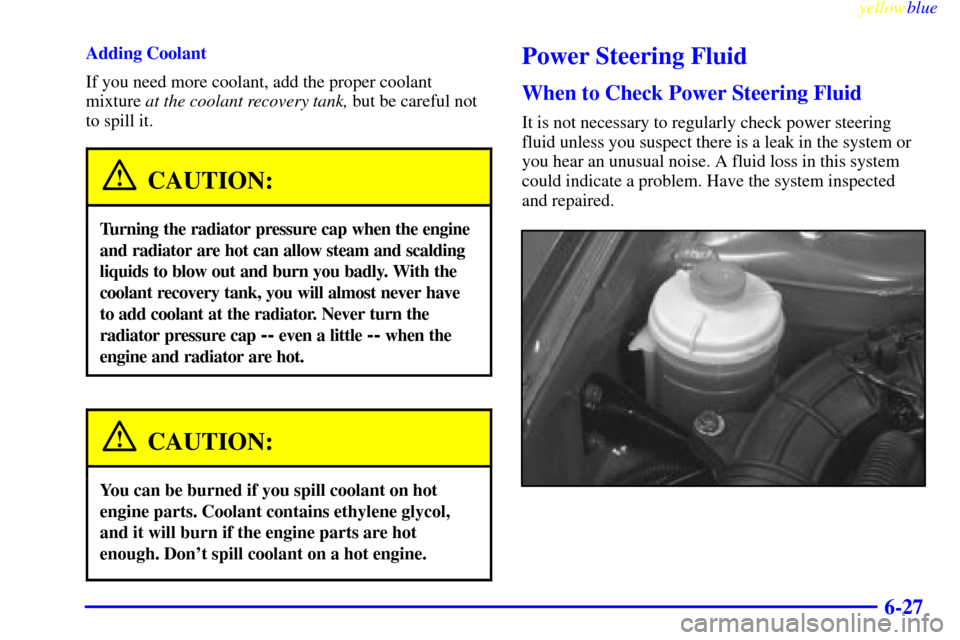
Power Steering Fluid
When to Check Power Steering Fluid
It is not necessary to regularly check power steering
fluid unless you suspect there is a leak in the system or
you hear an unusual noise. A fluid loss in this system
could indicate a problem. Have the system inspected
and repaired.
Page 251 of 328
yellowblue
6-59
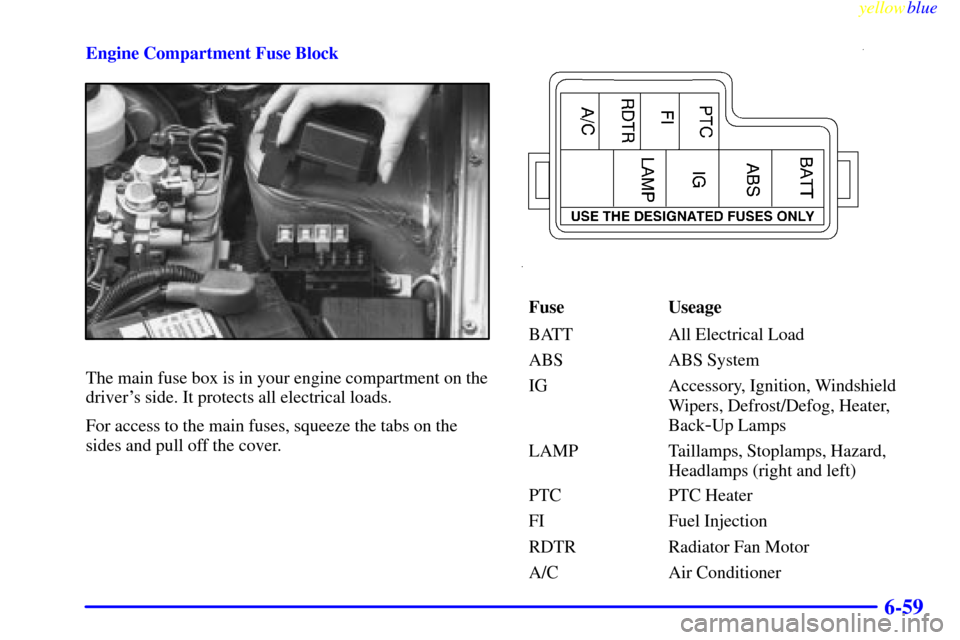
Engine Compartment Fuse Block
The main fuse box is in your engine compartment on the
driver's side. It protects all electrical loads.
For access to the main fuses, squeeze the tabs on the
sides and pull off the cover.
Fuse Useage
BATT All Electrical Load
ABS ABS System
IG Accessory, Ignition, Windshield
Wipers, Defrost/Defog, Heater,
Back
-Up Lamps
LAMP Taillamps, Stoplamps, Hazard,
Headlamps (right and left)
PTC PTC Heater
FI Fuel Injection
RDTR Radiator Fan Motor
A/C Air Conditioner
Page 253 of 328

yellowblue
6-61
*When changing the oil filter, additional oil may be
needed. Recheck the oil level after filling. See ªEngine
Oilº in the Index.
**Recheck the fluid level after filling. See ªAutomatic
Transaxle Fluidº or ªManual Transaxle Fluidº in
the Index.
Engine Specifications
Type
VIN Engine Code 6 L3. . . . . . . . . . . . . . . . . . . . . . .
VIN Engine Code 2 L4. . . . . . . . . . . . . . . . . . . . . . .
Firing Order
VIN Engine Code 6 1
-3-2 . . . . . . . . . . . . . . . . . . . . .
VIN Engine Code 2 1
-3-4-2 . . . . . . . . . . . . . . . . . . .
Horsepower
VIN Engine Code 6 55 hp @ 5700 rpm. . . . . . . . . .
VIN Engine Code 2 79 hp @ 6000 rpm. . . . . . . . . .
Fuel DeliveryFuel Injection . . . . . . . . . . . . . . . . . . .
Piston Displacement
VIN Engine Code 6 61 CID (1.0L). . . . . . . . . . . . . .
VIN Engine Code 2 79 CID (1.3L). . . . . . . . . . . . . .
Valve ArrangementIn
-Head . . . . . . . . . . . . . . . . . . .
Air Conditioning Refrigerants
Not all air conditioning refrigerants are the same.
If the air conditioning system in your vehicle needs
refrigerant, be sure the proper refrigerant is used.
If you're not sure, ask your dealer.
See the refrigerant charge label under the hood for
information regarding refrigerant capacity.
Normal Maintenance
Replacement Parts
Air Cleaner Filter AC Type A1203C. . . . . . . . . . . . . .
Battery 26R
-50S . . . . . . . . . . . . . . . . . . . . . . . . . . . . .
Engine Oil Filter AC Type PF53. . . . . . . . . . . . . . . .
Fuel Filter GM Part No. 96068664 or equivalent. . . . .
PCV Valve GM Part No. 96051849. . . . . . . . . . . . . . .
Radiator Pressure Cap 13 psi (90 kPa). . . . . . . . . . . .
Spark Plugs
1.0L L3 Engine AC Type R42XLS. . . . . . . . . . . . . . .
0.039 to 0.045 inch gap (1.0 to 1.1 mm)
1.3L L4 Engine NGK Type BKR6E11. . . . . . . . . . . .
0.039 to 0.045 inch gap (1.0 to 1.1 mm)
1.3L L4 Engine Denso Type K20PR
-U11 . . . . . . . . .
0.039 to 0.045 inch gap (1.0 to 1.1 mm)