Page 198 of 261
name. SIENNA (U)
198
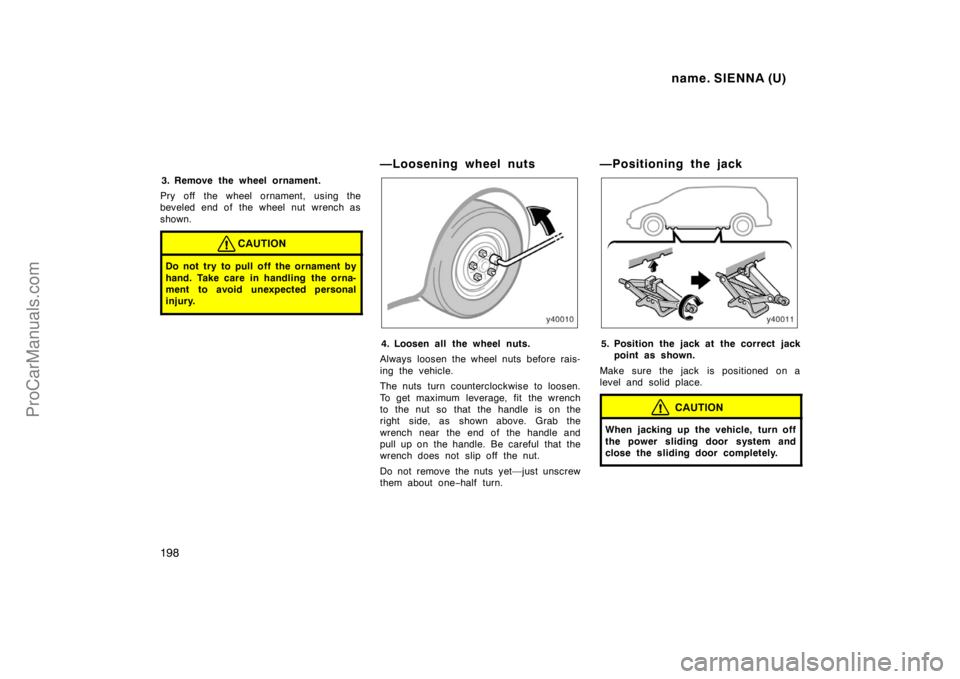
3. Remove the wheel ornament.
Pry off the wheel ornament, using the
beveled end of the wheel nut wrench as
shown.
CAUTION
Do not try to pull off the ornament by
hand. Take care in handling the orna-
ment to avoid unexpected personal
injury.
—Loosening wheel nuts
4. Loosen all the wheel nuts.
Always loosen the wheel nuts before rais-
ing the vehicle.
The nuts turn counterclockwise to loosen.
To get maximum leverage, fit the wrench
to the nut so that the handle is on the
right side, as shown above. Grab the
wrench near the end of the handle and
pull up on the handle. Be careful that the
wrench does not slip off the nut.
Do not remove the nuts yet—just unscrew
them about one−half turn.
—Positioning the jack
5. Position the jack at the correct jack
point as shown.
Make sure the jack is positioned on a
level and solid place.
CAUTION
When jacking up the vehicle, turn off
the power sliding door system and
close the sliding door completely.
ProCarManuals.com
Page 199 of 261
name. SIENNA (U)
199
—Raising your vehicle
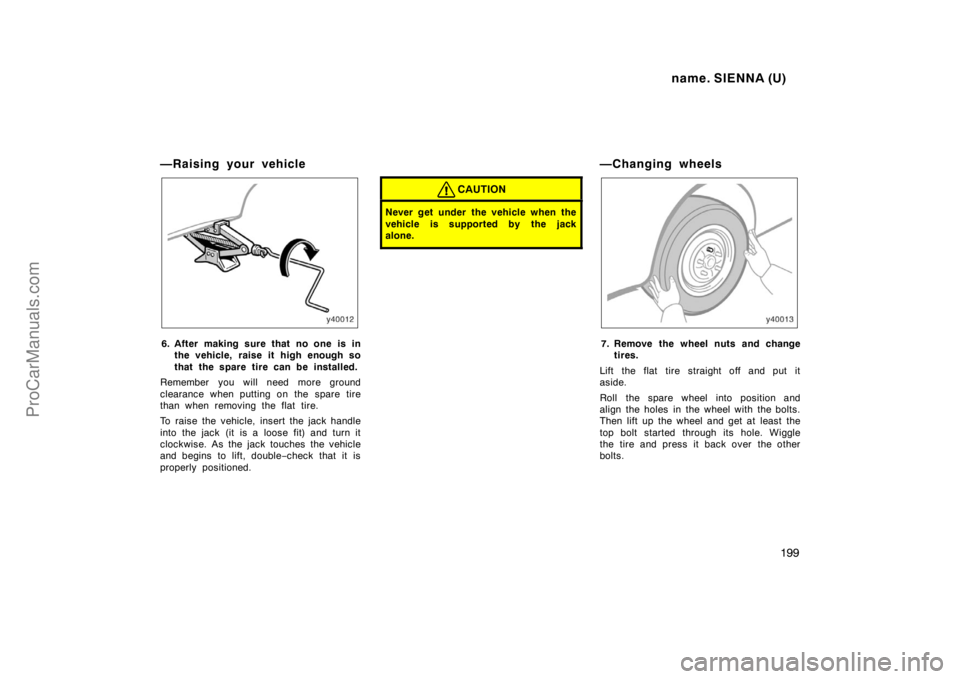
6. After making sure that no one is in
the vehicle, raise it high enough so
that the spare tire can be installed.
Remember you will need more ground
clearance when putting on the spare tire
than when removing the flat tire.
To raise the vehicle, insert the jack handle
into the jack (it is a loose fit) and turn it
clockwise. As the jack touches the vehicle
and begins to lift, double−check that it is
properly positioned.
CAUTION
Never get under the vehicle when the
vehicle is supported by the jack
alone.
—Changing wheels
7. Remove the wheel nuts and change
tires.
Lift the flat tire straight off and put it
aside.
Roll the spare wheel into position and
align the holes in the wheel with the bolts.
Then lift up the wheel and get at least the
top bolt started through its hole. Wiggle
the tire and press it back over the other
bolts.
ProCarManuals.com
Page 200 of 261
name. SIENNA (U)
200
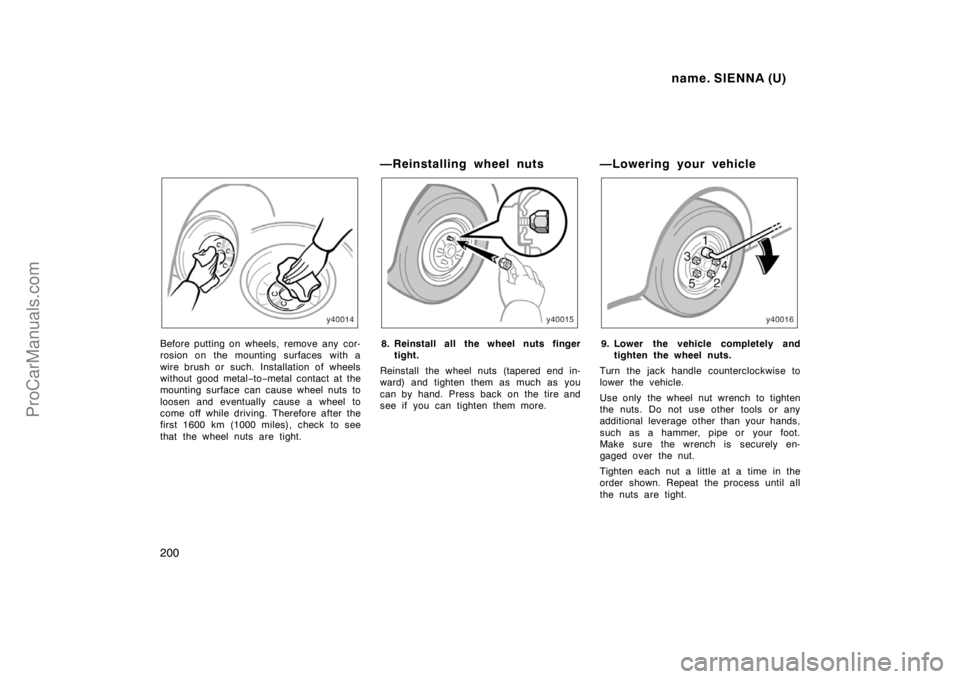
Before putting on wheels, remove any cor-
rosion on the mounting surfaces with a
wire brush or such. Installation of wheels
without good metal−to−metal contact at the
mounting surface can cause wheel nuts to
loosen and eventually cause a wheel to
come off while driving. Therefore after the
first 1600 km (1000 miles), check to see
that the wheel nuts are tight.
—Reinstalling wheel nuts
8. Reinstall all the wheel nuts finger
tight.
Reinstall the wheel nuts (tapered end in-
ward) and tighten them as much as you
can by hand. Press back on the tire and
see if you can tighten them more.
—Lowering your vehicle
9. Lower the vehicle completely and
tighten the wheel nuts.
Turn the jack handle counterclockwise to
lower the vehicle.
Use only the wheel nut wrench to tighten
the nuts. Do not use other tools or any
additional leverage other than your hands,
such as a hammer, pipe or your foot.
Make sure the wrench is securely en-
gaged over the nut.
Tighten each nut a little at a time in the
order shown. Repeat the process until all
the nuts are tight.
ProCarManuals.com
Page 228 of 261
name. SIENNA (U)
228
Use only newly opened brake fluid. Once
opened, brake fluid absorbs moisture from
the air, and excess moisture can cause a
dangerous loss of braking.
CAUTION
Take care when filling the reservoir
because brake fluid can harm your
eyes and damage painted surfaces. If
fluid gets in your eyes, flush your
eyes with clean water.
NOTICE
If you spill some of the fluid, be sure
to wash it off with water to prevent
it from damaging the parts or paint.
Checking power steering fluid
If hot
O.K.Open
If hot
addCloseIf cold
O.K.
If cold
add
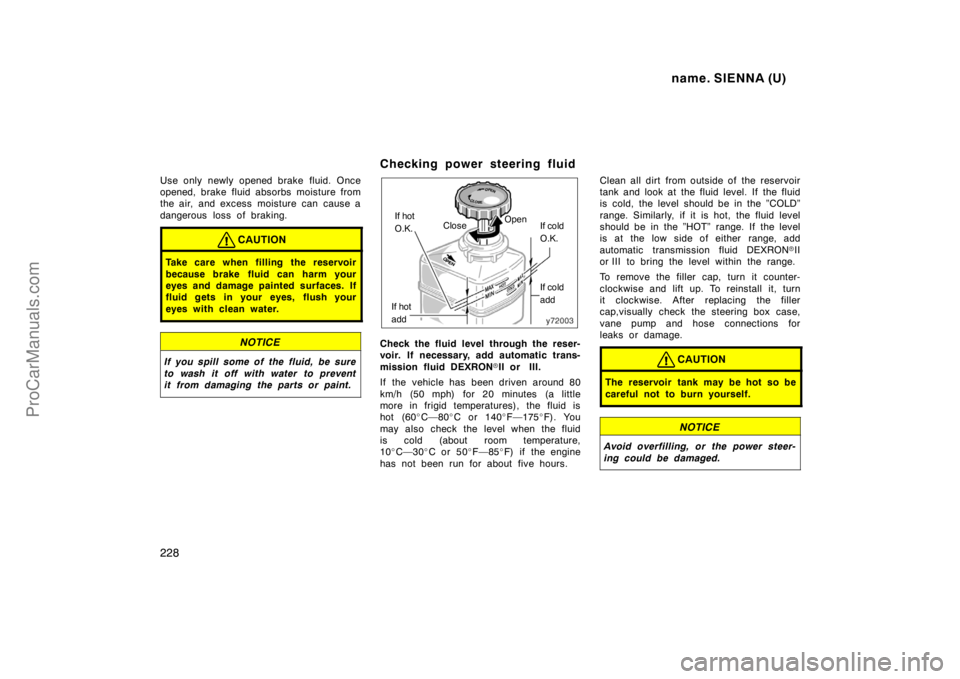
Check the fluid level through the reser-
voir. If necessary, add automatic trans-
mission fluid DEXRON�II or III.
If the vehicle has been driven around 80
km/h (50 mph) for 20 minutes (a little
more in frigid temperatures), the fluid is
hot (60�C—80�C or 140�F—175�F). You
may also check the level when the fluid
is cold (about room temperature,
10�C—30�C or 50�F—85�F) if the engine
has not been run for about five hours.Clean all dirt from outside of the reservoir
tank and look at the fluid level. If the fluid
is cold, the level should be in the ”COLD”
range. Similarly, if it is hot, the fluid level
should be in the ”HOT” range. If the level
is at the low side of either range, add
automatic transmission fluid DEXRON�II
or III to bring the level within the range.
To remove the filler cap, turn it counter-
clockwise and lift up. To reinstall it, turn
it clockwise. After replacing the filler
cap,visually check the steering box case,
vane pump and hose connections for
leaks or damage.
CAUTION
The reservoir tank may be hot so be
careful not to burn yourself.
NOTICE
Avoid overfilling, or the power steer-
ing could be damaged.
ProCarManuals.com
Page 250 of 261
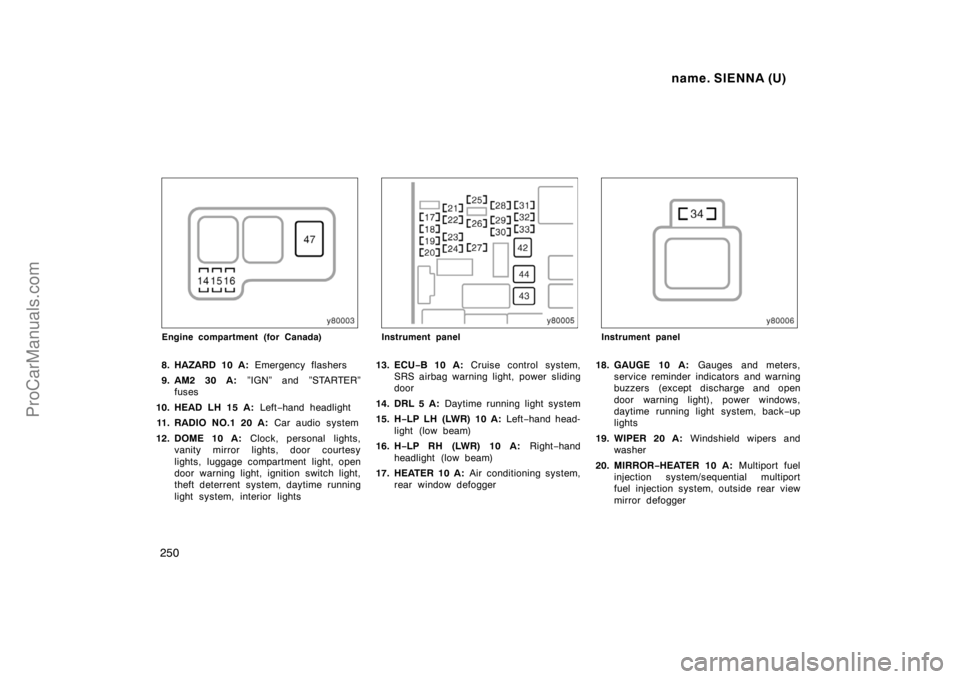
name. SIENNA (U)
250
Engine compartment (for Canada)
8. HAZARD 10 A: Emergency flashers
9. AM2 30 A: ”IGN” and ”STARTER”
fuses
10. HEAD LH 15 A: Left−hand headlight
11. RADIO NO.1 20 A: Car audio system
12. DOME 10 A: Clock, personal lights,
vanity mirror lights, door courtesy
lights, luggage compartment light, open
door warning light, ignition switch light,
theft deterrent system, daytime running
light system, interior lights
Instrument panel
13. ECU−B 10 A: Cruise control system,
SRS airbag warning light, power sliding
door
14. DRL 5 A: Daytime running light system
15. H−LP LH (LWR) 10 A: Left−hand head-
light (low beam)
16. H−LP RH (LWR) 10 A: Right−hand
headlight (low beam)
17. HEATER 10 A: Air conditioning system,
rear window defogger
Instrument panel
18. GAUGE 10 A: Gauges and meters,
service reminder indicators and warning
buzzers (except discharge and open
door warning light), power windows,
daytime running light system, back−up
lights
19. WIPER 20 A: Windshield wipers and
washer
20. MIRROR−HEATER 10 A: Multiport fuel
injection system/sequential multiport
fuel injection system, outside rear view
mirror defogger
ProCarManuals.com
Page 251 of 261

name. SIENNA (U)
251
21. ECU−IG 15 A: Cruise control system,
anti−lock brake system, locking with
wireless remote control system, theft
deterrent system
22. IGN 5 A: Gauges and meters, charg-
ing system, SRS airbag system, seat
belt pretensioners, multiport fuel injec-
tion system/sequential multiport fuel in-
jection system
23. STOP 15 A: Stop lights, cruise control
system, high−mounted stoplight, tail
lights
24. TAIL 10 A: Parking lights, front side
marker lights, license plate lights, tail
lights
25. PWR−VENT 15 A: Power rear quarter
windows
26. OBD 7.5 A: On−board diagnosis sys-
tem
27. PWR−OUTLET 15 A: Power outlet
28. STARTER 5 A: Gauges and meters,
SRS airbag system, seat belt preten-
sioners, multiport fuel injection system/
sequential multiport fuel injection sys-
tem
29. DOOR 20 A: Power door lock system,
theft deterrent system30. PANEL 7.5 A: Gauge and meter, car
audio system, clock, air conditioning
system, instrument panel light control,
rear window defogger, electronically
controlled automatic transmission sys-
tem, emergency flashers, parking lights
31. TURN 7.5 A: Turn signal lights, emer-
gency flashers
32. RADIO NO.2 7.5 A: Car audio system
33. CIG 15 A: Cigarette lighter, clock, pow-
er rear view mirror controls, SRS air-
bag system, seat belt pretensioners,
back−up lights, theft deterrent system
34. A/C 5 A: Air conditioning system
Fuses (type B)
35. CDS 40 A: Electric cooling fans
36. RDI 40 A: Electric cooling fans
37. CDS 30 A: Electric cooling fans
38. RDI 30 A: Electric cooling fans
39. MAIN 40 A: ”DRL”, ”HEAD RH” and
”HEAD LH” fuses
40. R/R A/C 40 A: Rear air conditioning
system
41. HTR 50 A: Air conditioning system
42. DEF 30 A: Rear window defogger,
“MIRROR−HEATER” fuse43. AM1 40 A: “INP” fuse
44. PWR 30 A: Power windows, electric
moon roof, power seat, power sliding
door, “PWR−VENT” fuse
Fuses (type C)
45. ALT 140 A: Charging system, “FL
ABS”, “INP”, “HTR” and “R/R A/C”
fuses
46. INP 100 A: “AM1” and “DEF” fuses
47. FL ABS 60 A: Anti−lock brake system
ProCarManuals.com