1998 PONTIAC BONNEVILLE wheel torque
[x] Cancel search: wheel torquePage 246 of 395
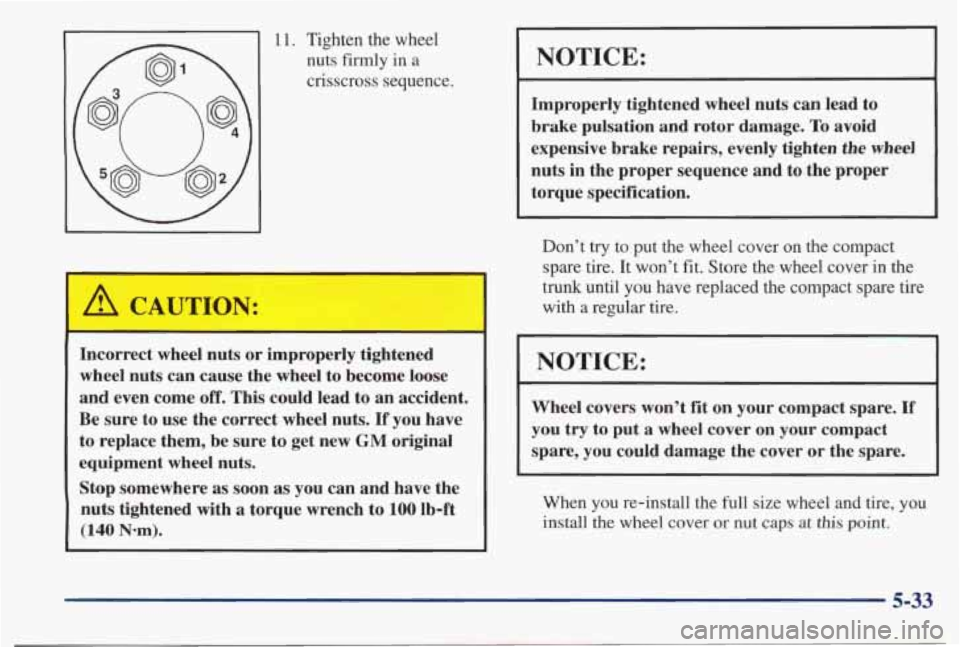
11. Tighten the wheel nuts firmly in a
crisscross sequence.
Incorrect wheel nuts or improperly tightened
wheel nuts can cause the wheel to become loose
and even come
off. This could lead to an accident.
Be sure to use the correct wheel nuts. If you have
to replace them, be sure to get new
GM original
equipment wheel nuts.
Stop somewhere
as soon as you can and have the
nuts tightened with
a torque wrench to 100 lb-ft
(140 Nom).
NOTICE:
Improperly tightened wheel nuts can lead to
brake pulsation and rotor damage.
To avoid
expensive brake repairs, evenly tighten the wheel
nuts in the proper sequence and to the proper
torque specification.
Don’t try to put the wheel cover on the compact
spare tire. It won’t fit. Store the wheel cover in the
trunk until
you have replaced the compact spare tire
with a regular tire.
NOTICE:
Wheel covers won’t fit on your compact spare. If
you try to put a wheel cover on your compact
spare, you could damage the cover or the spare.
When you re-install the full size wheel and tire, you
install
the wheel cover or nut caps at this point.
5-33
Page 282 of 395
Some driving conditions or climates may cause a brake
squeal when the brakes are first applied or lightly
applied.
This does not mean something is wrong with
your brakes.
See “CaliperKnuckle Maintenance Inspection” in
Section
7 of this manual under Part C “Periodic
Maintenance Inspections.”
Properly torqued wheel nuts are necessary to help
prevent brake pulsation. When tires are rotated, inspect brake pads for wear and evenly torque wheel nuts in
the proper sequence to
GM specifications.
Your rear drum brakes don’t have wear indicators, but
if you ever hear a rear brake rubbing noise, have the
rear brake linings inspected immediately. Also, the rear
brake drums should be removed
and inspected each time
the tires are removed for rotation or changing. When
you have the front brake pads replaced, have the rear
brakes inspected, too.
Brake
linings should always be replaced as complete
axle sets.
See “Brake System Inspection” in Section
7 of this
manual under Part C “Periodic Maintenance
Inspections.”
Brake Pedal Travel
See your dealer if the brake pedal does not return to
normal height, or if there is
a rapid increase in pedal
travel.
This could be a sign of brake trouble.
Brake Adjustment
Every time you apply the brakes, with or without the
vehicle moving, your brakes adjust for wear.
Replacing Brake System Parts
The braking system on a modern vehicle is complex.
Its many parts have to be
of top quality and work well
together if the vehicle is to have really good braking. Your vehicle was designed and tested with top-quality
GM brake parts. When you replace parts of your braking
system -- for example, when your brake linings wear
down and you have to have new ones put
in -- be sure
you get new approved
GM replacement parts. If you
don’t, your brakes may no longer work properly. For example,
if someone puts in brake linings that are wrong
for your vehicle, the balance between your front and
rear brakes can change
-- for the worse. The braking
performance you’ve come to expect can change in many
other ways if someone puts in the wrong replacement
brake parts.
6-31
Page 294 of 395
Tire Inspection and Rotation
Tires should be rotated every 6,000 to 8,000 miles
(10 OOO to 13 OOO km). Any time you notice unusual
wear, rotate your tires as soon as possible and check
wheel alignment.
Also check for damaged tires or wheels.
See “When It’s Time for New Tires” and “Wheel
Replacement” later in
this section for more information.
The purpose of regular rotation is to achieve more
uniform wear for all tires on the vehicle. The first
rotation is the most important. See “Scheduled Maintenance Services” in the Index for scheduled
rotation intervals.
m4
Don’t include the compact spare tire in your tire rotation.
After the tires have been rotated, adjust the front
and rear inflation pressures as shown
on the
Tire-Loading Information label. Make certain that all wheel nuts
are properly tightened. See “Wheel
Nut Torque” in the Index.
A CAUTION:
Rust or dirt on a wheel, or on the parts to which
it is fastened, can make wheel nuts become loose
after a time. The wheel could come
off and cause
an accident. When you change a wheel, remove
any rust or dirt from places where the wheel
attaches to the vehicle. In an emergency, you can
use a cloth or
a paper towel to do this; but be
sure to use a scraper or wire brush later,
if you
need to, to get all the rust or dirt
off. (See
“Changing a Flat Tire” in the Index.)
I
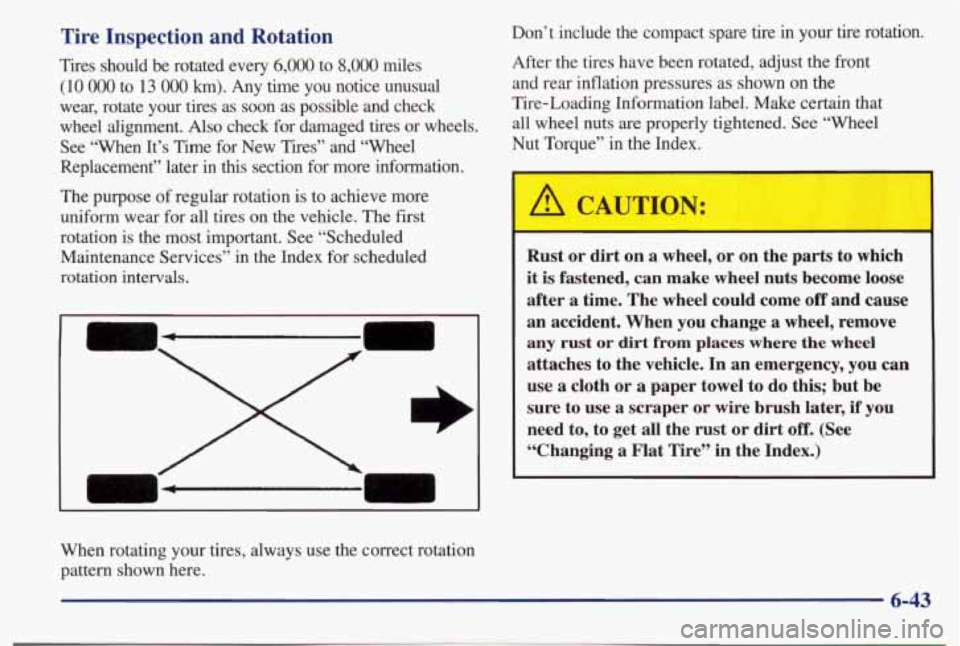
When rotating your tires, always use the correct rotation
pattern shown here.
6-43
Page 316 of 395

Capacities and Specifications
The following approximate capacities are given in English and m\
etric conversions. Please refer to “Recommended
Fluids and Lubricants” in the Index for more information.
Automatic Transaxle (Overdrive)
Pan Removal and Replacement ........... 6 quarts (6.1 L)
Complete Overhaul .................. 11 quarts (10.4 L)
Cooling System ........................ 13 quarts (12.3 L)
When draining or replacing torque converter; more fluid may be needed.
Cooling System ................ ........ 13 quarts (12.3 L)
Engine Crankcase ................... 4.5 quarts (4.3L)
Fuel Tank ............................ 18 gallons (68 L)
Tire Pressures .... >.. . See Ere-Loading Information label on the driver’s dool:
Wheel Nut Torque ......... . 100 lb-ft 140 N-m
R-134a Air Conditioning .... . See refrigerant charge label under the hood.
Oil
change with filter change
.......
.......
.......
All capacities are approximate. When adding, be sure to fill to the appropriate level, as recommended in this manual.
Air Conditioning Refrigerants
Not all air conditioning refrigerants are the same. If the air conditioning system in your vehicle needs refrigerant, be
sure the proper refrigerant is used. If you’re not sure,
ask your dealer.
6-65
Page 384 of 395
TopStrap ................................... 1-39
TorqueLock ................................... 2-32
Torque, Wheel Nut ......................... 5-33, 6-65
Towing a Trailer ................................ 4-31
Towing Your Vehicle ............................. 5-8
Control System Warning Light ............ 2-66, 4-9
Off Warning Light ........................ 2-66, 4-9
Traction Control Svstem .......................... 4-9
Traction
I
Trailer
Brakes
................................... 4-35
Driving with ................................. 4-35
Engine Cooling When Towing ................... 4-38
Maintenance When Towing ..................... 4-38
Parking on Hills .............................. 4-37
Safety Chains ................................ 4-35
Total Weight on Tires .......................... 4-34
Turn Signals ................................. 4-37
Transaxle Fluid, Automatic ....................... 6-20
Transmitters, Matching to Your Vehicle ............. 2- 12
Transmitters, Remote Keyless Entry ................ 2-10
Transportation, Courtesy .......................... 8-8
Trip Odometer ................................. 2-61
Ajar Message ................................ 2-78
Release Lockout, Remote ...................... 2-14
Release, Remote .............................. 2-14
Driving on Grades ........... ............ 4-37
Hitches ..................................... 4-34
Tongueweight ............................... 4-33
Towing ..................................... 4-31
Weight ..................................... 4-33
Trunk
Lock ....................................... 2-14
SecurityOverride ............................. 2-14
TTY Users ..................................... 8-5
Turn Signal and Lane Change Signals ............... 2-37
Turn Signal On Chime ........................... 2-37
Turn Signal On Message ......................... 2-79
Turn Signal/Multifunction Lever ................... 2-36
Turn Signals When Towing a Trailer ................ 4-37
"light Sentinel ............................... 2-45
Underbody Flushing Service ..................... 7-34
Underbody Maintenance ......................... 6-55
Universal Theft-Deterrent System .................. 2-16
Vehicle
Control
...................................... 4-6
Damage Warnings .............................. iv
Dimensions
................................. 6-66
Identification Number ......................... 6-57
Loading .................................... 4-29
Storage ..................................... 6-32
Ventilationsystem ............................... 3-6
Visor Vanity Mirrors ............................ 2-53
Visors, Sun .................................... 2-53
Voltmeter ..................................... 2-64
warning Devices ............................... 5-3
Warning Lights. Gages and Indicators ............... 2-62
Warranty Information ............................ 8-10
Washer Fluid Message ........................... 2-78
Washer muid. Windshield ........................ 6-27
Washing Your Vehicle ........................... 6-52
Weatherstrips .................................. 6-52
9-11
Page 385 of 395
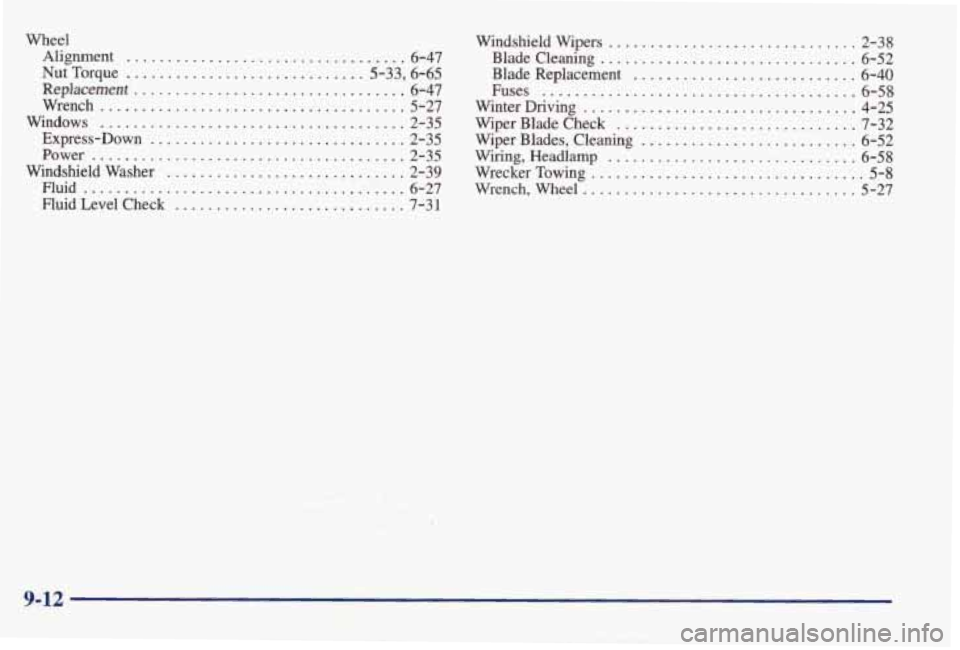
Wheel Alignment
.................................. 6-47
Nut Torque ............................. 5-33, 6-65
Replacement ................................. 6-47
Wrench ..................................... 5-27
Express-Down ............................... 2-35
Windshield Washer ............................. 2-39
Fluid Level Check ............................ 7-31
Windows ..................................... 2-35
Power ...................................... 2-35
Fluid ....................................... 6-27
Windshield Wipers .............................. 2-38
Blade Replacement ........................... 6-40
Winter Driving ................................. 4-25
Wiper Blade Check ............................. 7-32
Wiper Blades, Cleaning .......................... 6-52
Wiring, Headlamp .............................. 6-58
Wrecker Towing ................................. 5-8
Wrench, Wheel ................................. 5-27
Bladecleaning ............................... 6-52
Fuses ...................................... 6-58
9-12