Page 81 of 395
Automatic Transaxle Operation
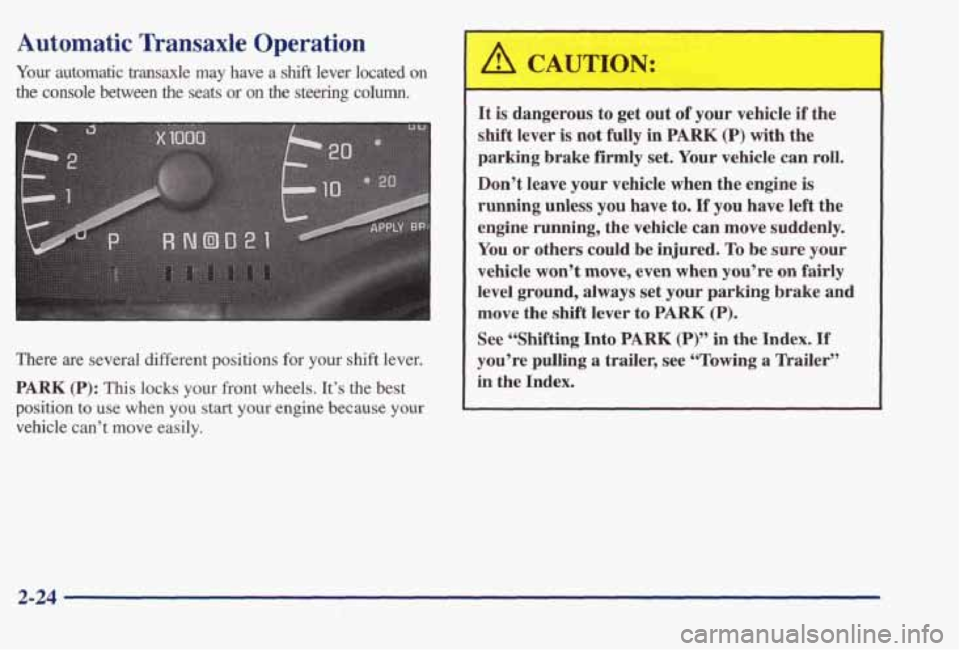
Your automatic transaxle may have a shift lever located on
the console between the seats or on the steering column.
There are several different
positions for your shift lever.
PARK (P): This locks your front wheels. It’s the best
position to use
when you start your engine because your
vehicle can’t move easily.
A CAUTION: I
It is dangerous to get out of your vehicle if the
shift lever is not fully in
PARK (P) with the
parking brake firmly set. Your vehicle
can roll.
Don’t leave your vehicle when the engine is
running unless
you have to. If you have left the
engine
running, the vehicle can move suddenly.
You or others could be injured.
To be sure your
vehicle won’t move, even when you’re on fairly
level ground, always set your parking brake and
move the shift lever to
PARK (P).
See “Shifting Into PARK (P)” in the Index. If
you’re pulling
a trailer, see “Towing a Trailer”
in the Index.
2-24
Page 82 of 395
Ensure the shift lever is fully in PARK (P) range before
starting the engine. Your vehicle has a brake-transaxle shift
interlock. You have to fully apply your regular brakes
b#ore you can shift from PARK (P) when the ignition key
is
in an on position. If you cannot shift out of PARK (P),
ease pressure on the shift lever -- push the shift lever all
the way into PARK (P) and also release the shift lever
button on floor
shift console models as you maintain brake
application. Then move the
shift lever into the gear you
wish. (Press the
shift lever button before moving the shift
lever on floor shift console models.) See “Shifting Out of
PARK (P)” later in this section.
REVERSE (R): Use this gear to back up.
NOTICE:
Shifting to REVERSE (R) while your vehicle is
moving forward could damage your transaxle.
Shift to
REVERSE (R) only after your vehicle
is stopped.
To rock your vehicle back and forth to get out of snow,
ice or sand without damaging your transaxle, see
“Stuck: In Sand, Mud, Ice or Snow” in the Index.
NEUTRAL (N): In this position, your engine
doesn’t connect with the wheels. To restart when you’re
already moving, use NEUTRAL
(N) only. Also, use
NEUTRAL (N) when your vehicle is being towed.
A CAUTION:
Shifting out of PARK (P) or NEUTRAL (N) while
your engine is “racing” (running at
high speed) is
dangerous. Unless your foot is
firmly on the
brake pedal, your vehicle could move very
rapidly. You
could lose control and hit people or
objects. Don’t shift out of PARK (P) or
NEUTRAL (N) while your engine is racing.
NOTICE:
Damage to your transaxle caused by shifting out
of PARK (P) or NEUTRAL (N) with the engine
racing isn’t covered
by your warranty.
2-25
Page 83 of 395
AUTOMATIC OVERDRIVE (@I): This position is
for normal driving.
If you need more power for passing,
and you’re:
Going less than about 35 mph (55 km/h), push your
0 Going about 35 mph (55 km/h) or more, push the
You’ll shift down to the next gear and have more power.
accelerator pedal about halfway down.
accelerator
all the way down.
NOTICE:
If your vehicle seems to start up rather slowly, or
if it seems not to shift gears as you go faster,
something may be wrong with a transaxle system
sensor.
If you drive very far that way, your
vehicle can be damaged.
So, if this happens, have
your
vehicle serviced right away. Until then, you
can use
SECOND (2) when you are driving less
than 35 mph (55 km/h) and AUTOMATIC
OVERDRIVE (0) for higher speeds.
DRIVE @): This position is also used for normal
driving, however, it offers more power and lower fuel
economy than AUTOMATIC OVERDRIVE (@).
Here are some times you might choose DRIVE (D)
instead of AUTOMATIC OVERDRIVE (0):
When driving on hilly, winding roads
When towing a trailer, so there is less shifting
When going down a steep hill
SECOND (2): This position gives you more power but
lower fuel economy.
You can use SECOND (2) on hills.
It can help control your speed as you go down steep
mountain roads, but then
you would also want to use
your brakes
off and on.
between gears
NOTICE:
Don’t drive in SECOND (2) for more than
5 miles (8 km), or at speeds over 55 mph
(90 M), or you can damage your transaxle.
Use AUTOMATIC OVERDRIVE (0) or
DRIVE @) as much as possible.
Don’t shif’t into SECOND (2) unless you are going
slower than 65 mph (105 km/h), or you can
damage your engine.
2-26
Page 86 of 395
If you try to drive away with the parking brake on, the
brake light stays on and a chime sounds until you release
the parking brake.
NOTICE:
Driving with the parking brake on can cause
your rear brakes to overheat. You may have to
replace them, and you could also damage other
parts of your vehicle.
3
If you are towing a trailer and are parking on any hill,
see “Towing a Trailer” in the Index. That section shows
what to do first to keep the trailer from moving.
Shifting Into PARK (P)
It can be dangerous to get out of your vehicle if
the shift lever is not fully in PARK (P) with the
parking brake firmly set. Your vehicle
can roll. If
you have left the engine running, the vehicle can
move suddenly. You or others could be injured.
To be sure your vehicle won’t move, even when
you’re on fairly level ground, use the
steps that
follow.
If you’re pulling a trailer, see “Towing a
Trailer” in the Index.
Steering Column Shift Lever
1. Hold the brake pedal down with your right foot and
set
the parking brake.
2-29
Page 87 of 395
2. Move the shift lever into PARK (P) like this:
0 Pull the lever toward you.
0 Move the lever up as far as it will go.
3. Move the ignition key to LOCK.
4. Remove the key and take it with you. If you can
leave your vehicle with the ignition key in your
hand, your vehicle is in PARK (P).
2-30
Page 88 of 395

Console Shift Lever Leaving Your Vehicle With
the
Engine Running
1. Hold the brake pedal down with your right foot and
2. Move the shift lever into PARK (P) like this:
set the parking brake.
,I
0 Hold in the button on the lever.
0 Push the lever all the way toward the front of
the vehicle.
3. Move the ignition key to LOCK.
4. Remove the key and take it with you. If you can
leave your vehicle with the ignition key in your
hand, your vehicle is in PARK
(P).
A CAUTION:
It can be dangerous to leave your vehicle with the
engine running. Your vehicle could move
suddenly
if the shift lever is not fully in PARK (P)
with the parking brake firmly set. And, if you
leave the vehicle with the engine running,
it could
overheat and even catch fire. You or others could
be injured. Don’t leave your vehicle with the
engine running unless you have to.
If you have to leave your vehicle with the engine
running, be sure your vehicle is in PARK (P) and your
parking brake is firmly set before you leave it. After you’ve moved the shift lever into the PARK (P)
position, hold the regular brake pedal down. Then,
see if
you can move the shift lever away from PARK (P)
without first pulling it toward you (or,
if you have the
console shift lever, without first pushing
the button). If
you can, it means that the shift lever wasn’t fully locked
into PARK (P).
2-31
Page 91 of 395

Running Your Engine While
You’re Parked
It’s better not to park with the engine running. But if you
ever have to, here are some things to know.
&A CAUTION:
Idling the engine with the climate control
system
off could allow dangerous exhaust into
your vehicle
(see the earlier Caution under
“Engine Exhaust”).
Also, idling in a closed-in place can let deadly
carbon monoxide
(CO) into your vehicle even
if the fan switch is at the highest setting. One
place this can happen is a garage. Exhaust
-- with
CO -- can come in easily. NEVER park in a
garage with the engine running.
Another closed-in place can be
a blizzard.
(See
“Blizzard” in the Index.)
-
1
I
It can be dangerous to get out of your vehicle if
the shift lever is not
fully in PARK (P) with the
parking brake
firmly set. Your vehicle can roll.
Don’t leave your vehicle when the engine
is
running unless you have to. If you’ve left the
engine running, the vehicle can move suddenly.
You or others could be injured.
To be sure your
vehicle won’t move, even when you’re
on fairly
level ground, always set your parking brake and
move the shift lever
to PARK (P).
Follow the proper steps to be sure your vehicle won’t
move. See “Shifting Into
PARK (P)” in the Index.
If you are parking on a hill and if you’re pulling a
trailer, also see “Towing a Trailer” in the Index.
2-34
Page 95 of 395
Headlamp HighLow Beam Changer
To change the headlamps from low beam to high beam
or high beam to low beam, pull the turn signal lever
toward you. Then release it.
Flash-To-Pass Feature
When the high beams are on, this light
on the
instrument panel will
also be on.
This feature lets you use your high-beam headlamps to
signal
a driver in front of you that you want to pass. It
works even
if your headlamps are off.
To use it, pull the turn signal lever toward you a little,
but not
so far that you hear a click.
If your headlamps are off or on low beam, your
high-beam headlamps
will turn on. They’ll stay on as
long as you hold
the lever toward you and the
high-beam indicator on the dash will come on. Release
the lever
to turn the high-beam headlamps off.
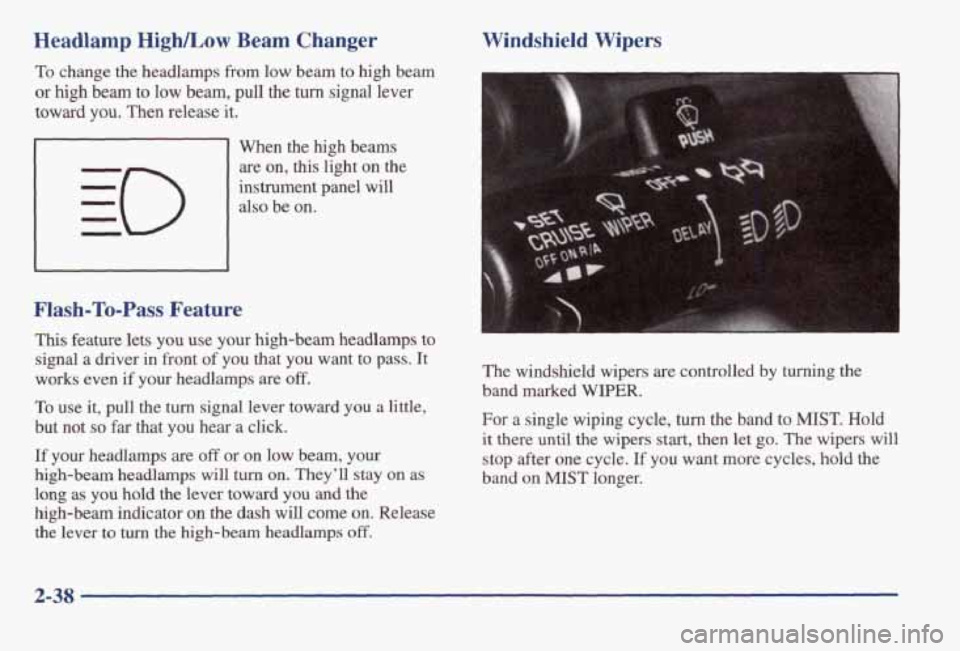
Windshield Wipers
The windshield wipers are controlled by turning the
band marked WIPER.
For a single wiping cycle, turn the band to MIST. Hold
it there
until the wipers start, then let go. The wipers will
stop after one cycle.
If you want more cycles, hold the
band on MIST longer.
2-38