1998 OPEL FRONTERA door lock
[x] Cancel search: door lockPage 3367 of 6000

8H–28SECURITY AND LOCKS
Main Data and Specifications
Torque Specifications
ApplicationNꞏmKgꞏmLb FtLb In
Front Door Lock Assembly Fixing Screws70.7—61
Front Outside Handle and Key Switch Fixing Bolts90.9—78
Rear Door Lock Assembly Fixing Screws70.7—61
Rear Outside Handle Fixing Bolts90.9—78
Tailgate Lock Assembly (LH) Fixing Screws70.7—61
Tailgate Lock Assembly (RH) Fixing Bolts111.1—95
Tailgate Outside Handle and Key Cylinder Fixing Bolts90.9—78
Page 3381 of 6000
8J–2EXTERIOR/INTERIOR TRIM
Quarter Flipper Glass Assembly (SꞏWꞏB) 8J–33. . .
Quarter Flipper Glass Assembly and
Associated Parts 8J–33. . . . . . . . . . . . . . . . . . . . . .
Removal 8J–33. . . . . . . . . . . . . . . . . . . . . . . . . . . . .
Installation 8J–33. . . . . . . . . . . . . . . . . . . . . . . . . . . .
Tailgate Trim Panel (LH) 8J–34. . . . . . . . . . . . . . . . .
Tailgate Trim Panel (LH) and Associated
Parts 8J–34. . . . . . . . . . . . . . . . . . . . . . . . . . . . . . . .
Removal 8J–34. . . . . . . . . . . . . . . . . . . . . . . . . . . . .
Installation 8J–35. . . . . . . . . . . . . . . . . . . . . . . . . . . .
Tailgate Trim Panel (RH) 8J–36. . . . . . . . . . . . . . . . .
Parts Location 8J–36. . . . . . . . . . . . . . . . . . . . . . . .
Removal 8J–36. . . . . . . . . . . . . . . . . . . . . . . . . . . . .
Installation 8J–36. . . . . . . . . . . . . . . . . . . . . . . . . . . .
Luggage Floor Box 8J–37. . . . . . . . . . . . . . . . . . . . . .
Luggage Floor Box and Associated Parts 8J–37.
Remove 8J–37. . . . . . . . . . . . . . . . . . . . . . . . . . . . . .
Installation 8J–37. . . . . . . . . . . . . . . . . . . . . . . . . . . .
Rope Hook Set 8J–37. . . . . . . . . . . . . . . . . . . . . . . . . Rope Hook Set and Associated Parts 8J–37. . . .
Removal 8J–37. . . . . . . . . . . . . . . . . . . . . . . . . . . . .
Installation 8J–37. . . . . . . . . . . . . . . . . . . . . . . . . . . .
Power Door Mirror System 8J–38. . . . . . . . . . . . . . .
General Description 8J–38. . . . . . . . . . . . . . . . . . . . . .
Door Mirror Switch Assembly (Control Switch, Fold-
ing Switch and Defogger Switch) Removal 8J–38
Installation 8J–38. . . . . . . . . . . . . . . . . . . . . . . . . . . .
Power Door Mirror 8J–38. . . . . . . . . . . . . . . . . . . . . . .
General Description 8J–38. . . . . . . . . . . . . . . . . . . .
Removal and Installation 8J–38. . . . . . . . . . . . . . .
Power Window System 8J–39. . . . . . . . . . . . . . . . . .
General Description 8J–39. . . . . . . . . . . . . . . . . . . . . .
Power Window Switch Removal and
Installation 8J–39. . . . . . . . . . . . . . . . . . . . . . . . . . .
Power Window Motor Removal and
Installation 8J–40. . . . . . . . . . . . . . . . . . . . . . . . . . .
Main Data and Specifications 8J–41. . . . . . . . . . . . .
Service Precaution
WARNING: IF SO EQUIPPED WITH A
SUPPLEMENTAL RESTRAINT SYSTEM (SRS),
REFER TO THE SRS COMPONENT AND WIRING
LOCATION VIEW IN ORDER TO DETERMINE
WHETHER YOU ARE PERFORMING SERVICE ON OR
NEAR THE SRS COMPONENTS OR THE SRS
WIRING. WHEN YOU ARE PERFORMING SERVICE
ON OR NEAR THE SRS COMPONENTS OR THE SRS
WIRING, REFER TO THE SRS SERVICE
INFORMATION. FAILURE TO FOLLOW WARNINGS
COULD RESULT IN POSSIBLE AIR BAG
DEPLOYMENT, PERSONAL INJURY, OR
OTHERWISE UNNEEDED SRS SYSTEM REPAIRS.
CAUTION: Always use the correct fastener in the
proper location. When you replace a fastener, use
ONLY the exact part number for that application.
ISUZU will call out those fasteners that require a
replacement after removal. ISUZU will also call out
the fasteners that require thread lockers or thread
sealant. UNLESS OTHERWISE SPECIFIED, do not
use supplemental coatings (Paints, greases, or other
corrosion inhibitors) on threaded fasteners or
fastener joint interfaces. Generally, such coatings
adversely affect the fastener torque and the joint
clamping force, and may damage the fastener. When
you install fasteners, use the correct tightening
sequence and specifications. Following these
instructions can help you avoid damage to parts and
systems.
Page 3387 of 6000
8J–8EXTERIOR/INTERIOR TRIM
632RW001
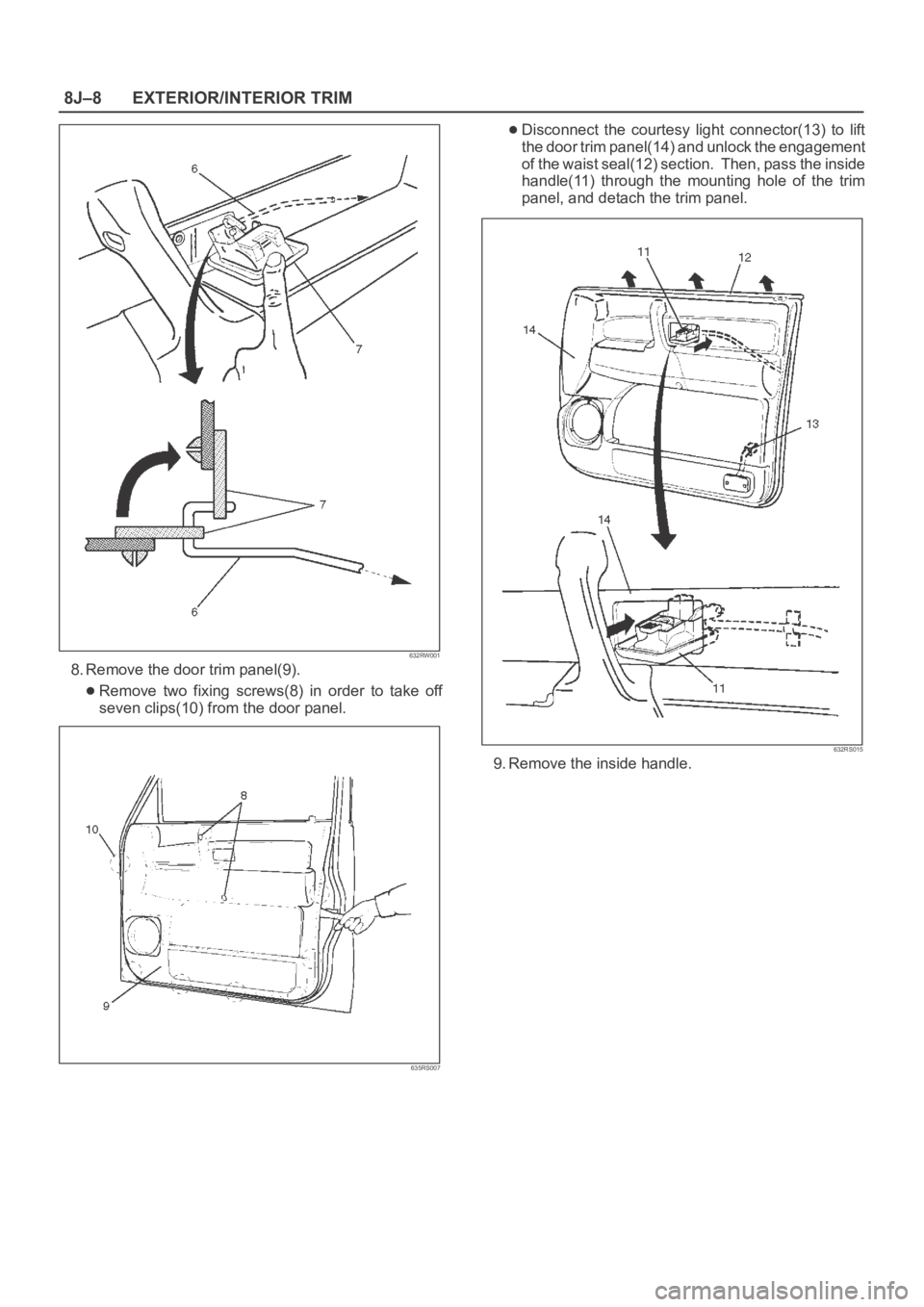
8. Remove the door trim panel(9).
Remove two fixing screws(8) in order to take off
seven clips(10) from the door panel.
635RS007
Disconnect the courtesy light connector(13) to lift
the door trim panel(14) and unlock the engagement
of the waist seal(12) section. Then, pass the inside
handle(11) through the mounting hole of the trim
panel, and detach the trim panel.
632RS015
9. Remove the inside handle.
Page 3390 of 6000
EXTERIOR/INTERIOR TRIM8J–11
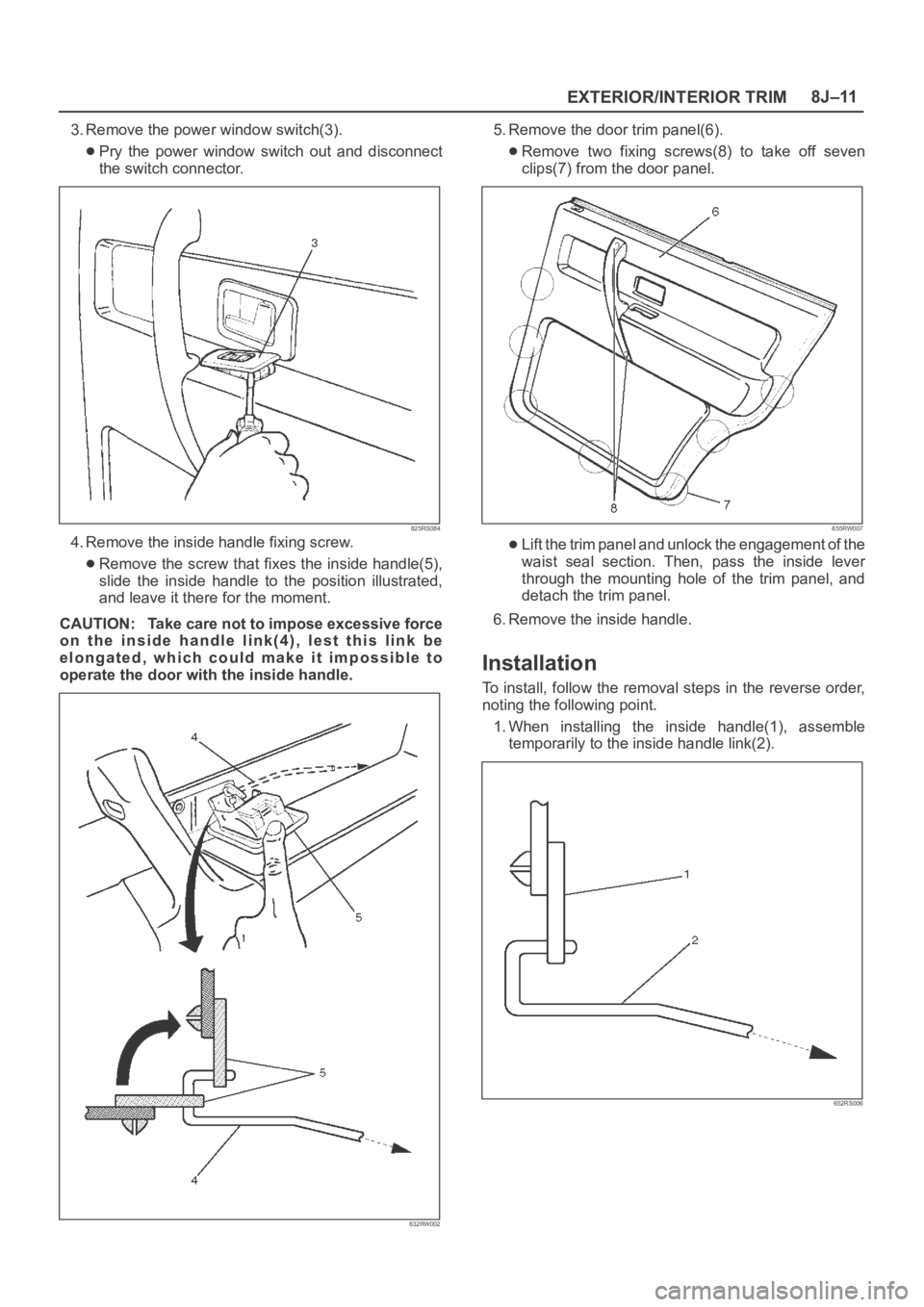
3. Remove the power window switch(3).
Pry the power window switch out and disconnect
the switch connector.
825RS084
4. Remove the inside handle fixing screw.
Remove the screw that fixes the inside handle(5),
slide the inside handle to the position illustrated,
and leave it there for the moment.
CAUTION: Take care not to impose excessive force
on the inside handle link(4), lest this link be
elongated, which could make it impossible to
operate the door with the inside handle.
632RW002
5. Remove the door trim panel(6).
Remove two fixing screws(8) to take off seven
clips(7) from the door panel.
655RW007
Lift the trim panel and unlock the engagement of the
waist seal section. Then, pass the inside lever
through the mounting hole of the trim panel, and
detach the trim panel.
6. Remove the inside handle.
Installation
To install, follow the removal steps in the reverse order,
noting the following point.
1. When installing the inside handle(1), assemble
temporarily to the inside handle link(2).
652RS006
Page 3417 of 6000
8J–38EXTERIOR/INTERIOR TRIM
Power Door Mirror System
General Description
The circuit consists of the starter switch, door mirror
control switch, folding switch, defogger switch and door
mirrors on both sides.
The door mirror switch consists of the control switch,
folding switch and defogger switch.
When the control switch is operated with the starter
switch at either “ACC” or “ON” position, the motors
incorporated in the door mirrors on both sides rotates to
allow the horizontal and vertical adjustment of mirror
angles.
The folding switch can be used to fold the mirror and
return it to its original position.
When turning on the door mirror defogger switch with the
starter switch at “ON” position, built-in heater in the mirror
is activated to perform the defogger function.
Door Mirror Switch Assembly (Con-
trol Switch, Folding Switch and De-
fogger Switch) Removal
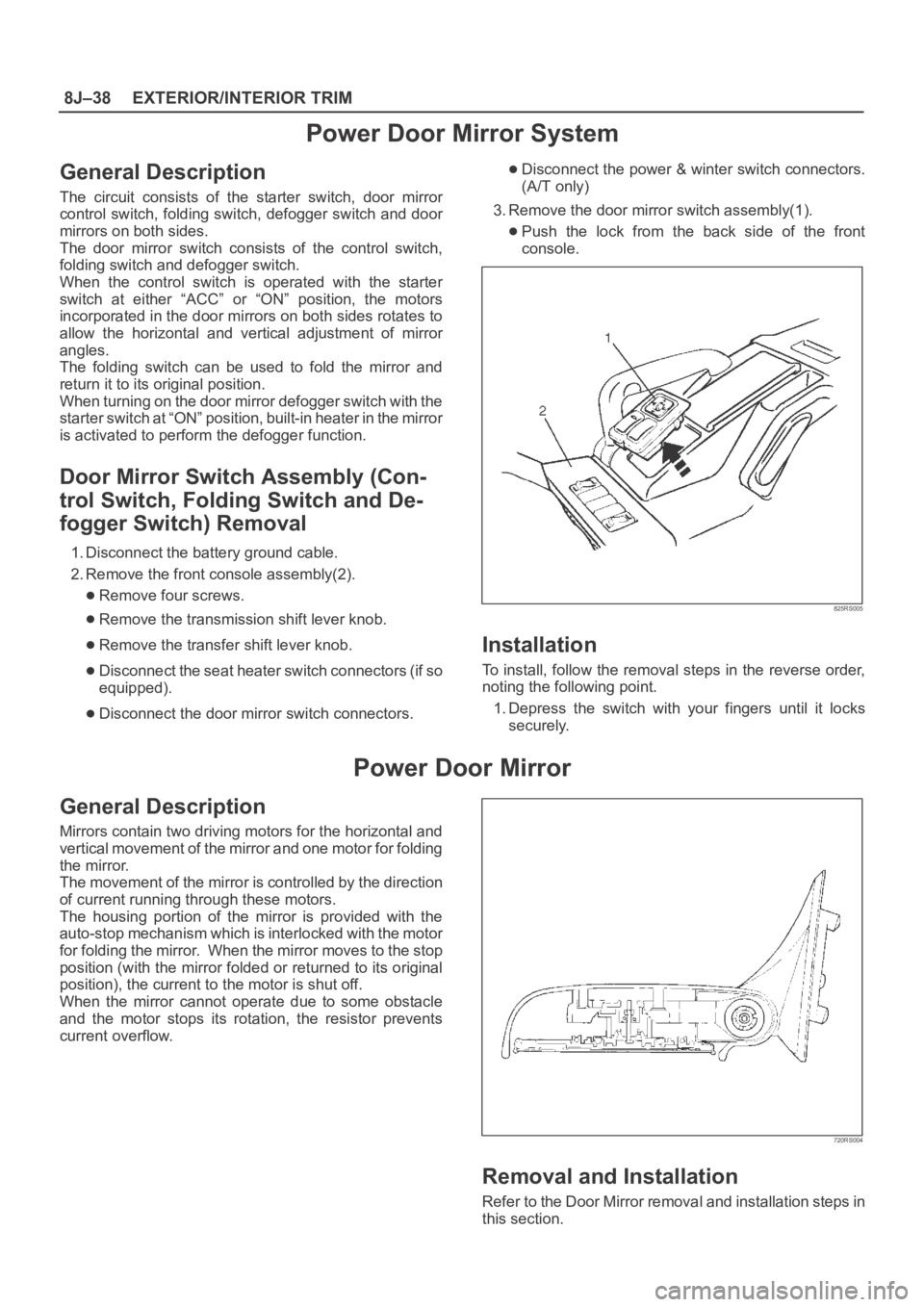
1. Disconnect the battery ground cable.
2. Remove the front console assembly(2).
Remove four screws.
Remove the transmission shift lever knob.
Remove the transfer shift lever knob.
Disconnect the seat heater switch connectors (if so
equipped).
Disconnect the door mirror switch connectors.
Disconnect the power & winter switch connectors.
(A/T only)
3. Remove the door mirror switch assembly(1).
Push the lock from the back side of the front
console.
825RS005
Installation
To install, follow the removal steps in the reverse order,
noting the following point.
1. Depress the switch with your fingers until it locks
securely.
Power Door Mirror
General Description
Mirrors contain two driving motors for the horizontal and
vertical movement of the mirror and one motor for folding
the mirror.
The movement of the mirror is controlled by the direction
of current running through these motors.
The housing portion of the mirror is provided with the
auto-stop mechanism which is interlocked with the motor
for folding the mirror. When the mirror moves to the stop
position (with the mirror folded or returned to its original
position), the current to the motor is shut off.
When the mirror cannot operate due to some obstacle
and the motor stops its rotation, the resistor prevents
current overflow.
720RS004
Removal and Installation
Refer to the Door Mirror removal and installation steps in
this section.
Page 3418 of 6000
EXTERIOR/INTERIOR TRIM8J–39
Power Window System
General Description
The circuit consists of the starter switch, (door lock &)
power window switch for each of the front windows,
p o w e r w i n d o w s w i t c h f o r r e a r w i n d o w s a n d p o w e r w i n d o w
motors.
When the starter switch is turned on, the battery voltage is
applied to each of the power window switches through the
circuit breaker and the power window relay on the circuit.
The “Down” switch of the driver’s power window switch
has a built-in function which can be operated by just
touching it.
Accordingly, the window will roll down automatically by
just setting the switch to the “AUTO” position.
When the driver’s power lock switch at the driver side is
depressed, the power source to the passenger’s power
window switches are shut off. So, even if these switches
are operated, the power window motor will not operate.
Power Window Switch Removal and
Installation
Driver Seat Side
Removal
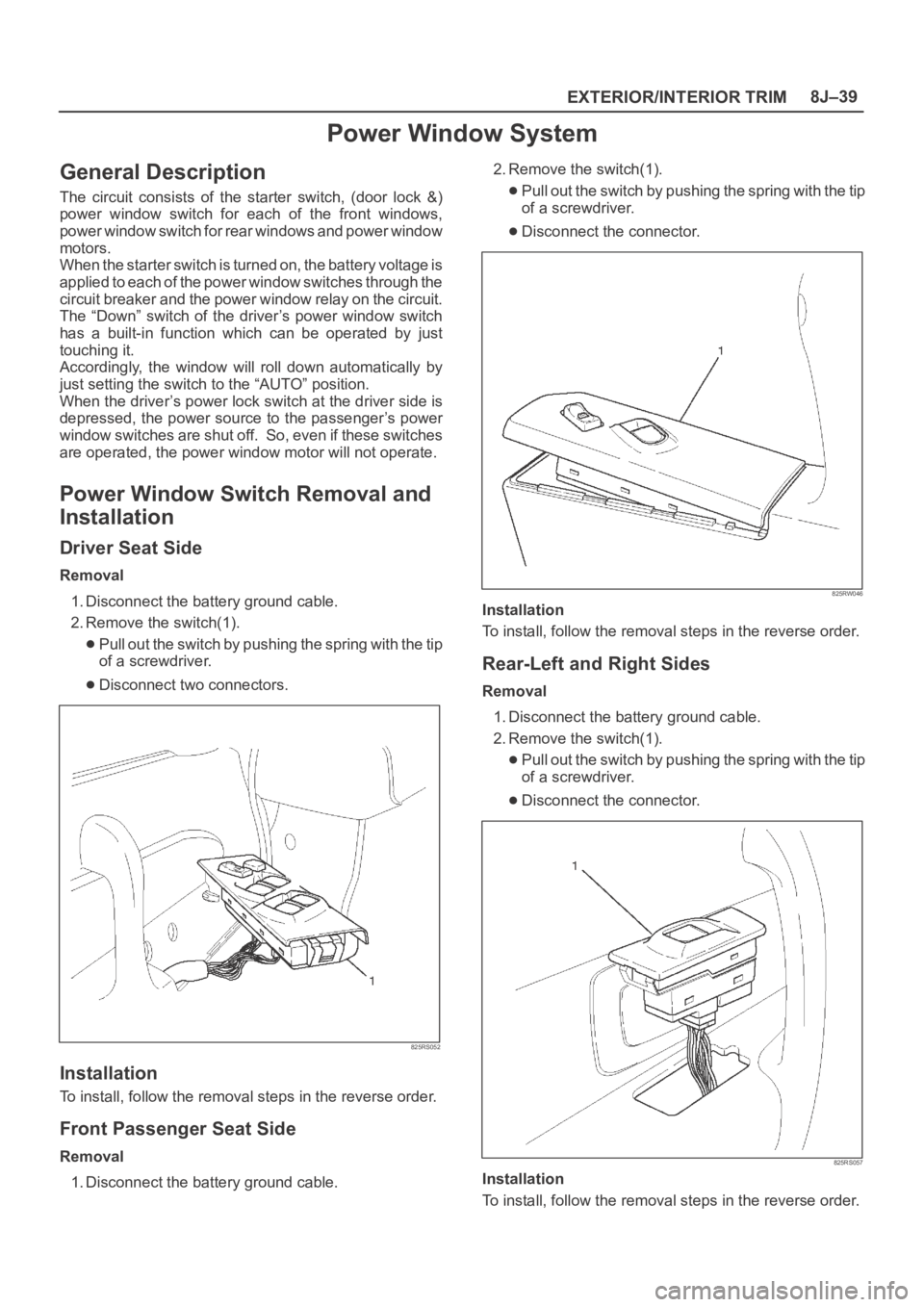
1. Disconnect the battery ground cable.
2. Remove the switch(1).
Pull out the switch by pushing the spring with the tip
of a screwdriver.
Disconnect two connectors.
825RS052
Installation
To install, follow the removal steps in the reverse order.
Front Passenger Seat Side
Removal
1. Disconnect the battery ground cable.2. Remove the switch(1).
Pull out the switch by pushing the spring with the tip
of a screwdriver.
Disconnect the connector.
825RW046
Installation
To install, follow the removal steps in the reverse order.
Rear-Left and Right Sides
Removal
1. Disconnect the battery ground cable.
2. Remove the switch(1).
Pull out the switch by pushing the spring with the tip
of a screwdriver.
Disconnect the connector.
825RS057
Installation
To install, follow the removal steps in the reverse order.
Page 3449 of 6000
SUPPLEMENTAL RESTRAINT SYSTEM 9J–12
Deployed Air Bag Assembly (Driver Side)
“You should wear gloves and glasses. After the air bag
assembly has been deployed, the surface of the air bag
may contain solid particulate. This solid particulate
c o n s i s t s p r i m a r i l y o f b y p r oducts of the chemical reaction,
Potassium Chloride and copper metal dust. Compounds
of Potassium Borate, Strontium Chloride, Copper
Chloride, and Ammonium Chloride may be found in
amounts of about 1% (each) of the total particulate.”
Deployed Pretensioner Seat Belt.
You should wear gloves and safety glasses. After the
pretensioner seat belt has been deployed, the surface of
the pretensioner seat belt cylinder may heating up.
Air Bag Assembly and/or Pretensioner
Seat Belt Scrapping Procedure.
During the cause of vehicle’s useful life, certain situations
may arise which will necessitate the disposal of a live air
bag and/or pretensioner seat belt. (This information
covers proper procedures for disposing of a live air bag
assembly and/or pretensioner seat belt.)
Before a live air bag assembly can be dispose off, it must
be deployed.
A live air bag assembly and/or pretensioner seat belt
must not be disposed of though normal refuse channels.
WARNING: FAILURE TO FOLLOW PROPER
SUPPLEMENTAL RESTRAINT SYSTEM (SRS) AIR
BAG ASSEMBLY DISPOSAL PROCEDURES CAN
RESULT IN AIR BAG DEPLOYMENT WHICH MAY
CAUSE PERSONAL INJURY. AN UNDPLOYED AIR
BAG ASSEMBLY MUST NOT BE DISPOSED OF
THROUGH NORMAL REFUSE CHANNELS. THE
UNDEPLOYED AIR BAG ASSEMBLY CONTAINS
SUBSTANCES THAT CAN CAUSE SEVERE ILLNESS
OR PERSONAL INJURY IF THE SEALED CONTAINER
IS DAMAGED DURING DISPOSAL. DISPOSAL IN
ANY MANNER INCONSISTENT WITH PROPER
PROCEDURES MAY BE A VIOLATION OF LOCAL
LAW.
In situations which require deployment of a live air bag
assembly, deployment may be accomplished inside or
outside the vehicle. The method employed depends
upon the final disposition of the particular vehicle, as
noted in “Deployment Outside Vehicle” and “Deployment
Inside Vehicle” in this section.
Cautions About Air Bag Deployment And
Disposal
Failure to follow proper procedures could result in
erroneous air bag deployment which may cause personal
injury be sure to follow proper procedures.
1. Turn off (Lock) the ignition switch and disconnect the
minus terminal of the battery, then start the work 15 or
more sec later. (Air bag is designed to work by the
back-up power source even if the battery power
source is cut off at vehicle collision).
2. Be sure not to disassemble the air bag.
3. Do not give an impact to the air bag and bring the air
bag close to magnet. (The air bag could deploy
unexpectedly).4. Place the air bag with its trim cover up.
5. Do not let the air bag deploy directly on the floor. (The
air bag may be blown off 2
3 m (6.5 or 10 feet)).
6. Be sure to install the air bag firmly to a deployment
tool (fixing tool).
7. Set a battery 10 m (33 feet) or more away from the air
bag.
8. Before disconnecting air bag harness, ground the
worker by touching the vehicle outer panel with bare
hand.
9. When connecting or disconnecting the harness, do
not work just in front of the air bag.
10. As deployment gives rise to big sound, warn the
people around against it. Further, try to reduce the
sound by covering the steering wheel or tires, and
shut the vehicle windows in case of deployment
inside the vehicle.
11. As deployment generates smoke, select a well
ventilated place. (In case of deployment indoors,
avoid deployment just under a fire alarm, smoke
sensor, and fluorescent lamps).
12. Be careful not to inhale the smoke after deployment.
13. If part of the vehicle glass is damaged, cover the
vehicle with a car cover to prevent the glass from
braking at the time of deployment.
14. Do not touch the air bag immediately after
deployment, since it remains hot for 30 minutes.
15. Do not water the air bag immediately after
deployment.
16. Wear safety glasses and gloves throughout the work
and wash the glasses and gloves after the work.
17. Do not reuse the removed air bag for another vehicle.
(Deployment characteristic is different with vehicle
types).
Deployment Outside Vehicle (Driver Air
Bag Assembly)
Deployment outside the vehicle is proper when the
vehicle is to be returned to service. This includes, for
example, situations in which the vehicle will be returned to
useful service after a functionally or cosmetically deficient
air bag assembly is replaced. Deployment and disposal
of a malfunctioning air bag assembly is, of course, subject
to any required retention period.
For deployment of a live (undeployed) air bag assembly
outside the vehicle, the deployment procedure must be
followed exactly. Always wear safety glasses during this
deployment procedure until a deployed air bag assembly
is scrapped or until an undeployed air bag assembly is
shipped. Before performing the procedures you should
be familiar with servicing the SRS and with proper
handling of the air bag assembly. Procedures should be
read fully before they are performed.
The following procedure requires use of 5–8840–2468–0
SRS deployment harness with appropriate pigtail
adapter. Do not attempt procedure without
5–8840–2468–0 adapter.
WARNING: FAILURE TO FOLLOW PROCEDURES IN
THE ORDER LISTED MAY RESULT IN PERSONAL
INJURY. NEVER CONNECT DEPLOYMENT
Page 3450 of 6000
SUPPLEMENTAL RESTRAINT SYSTEM9J–13
HARNESS TO ANY POWER SOURCE BEFORE
CONNECTING DEPLOYMENT HARNESS TO THE
DRIVER AIR BAG ASSEMBLY. DEPLOYMENT
HARNESS SHALL REMAIN SHORTED AND NOT BE
CONNECTED TO A POWER SOURCE UNTIL THE AIR
BAG IS TO BE DEPLOYED. THE AIR BAG
ASSEMBLY WILL IMMEDIATELY DEPLOY THE AIR
BAG WHEN A POWER SOURCE IS CONNECTED TO
IT. WEAR SAFETY GLASSES THROUGHOUT THIS
ENTIRE DEPLOYMENT AND DISPOSAL
PROCEDURE.
NOTE: This information applies only to driver air bag
assembly . Refer to “Deployment Outside Vehicle
(Passenger Air Bag assembly)” in this section for
information on passenger air bag assembly scrapping.
1. Turn ignition switch to “LOCK”, remove key.
2. Inspect 5–8840–2468–0 SRS Deployment Harness
and appropriate pigtail adapter for damage. If
harness or pigtail adapter is damaged, discard and
obtain a replacement.
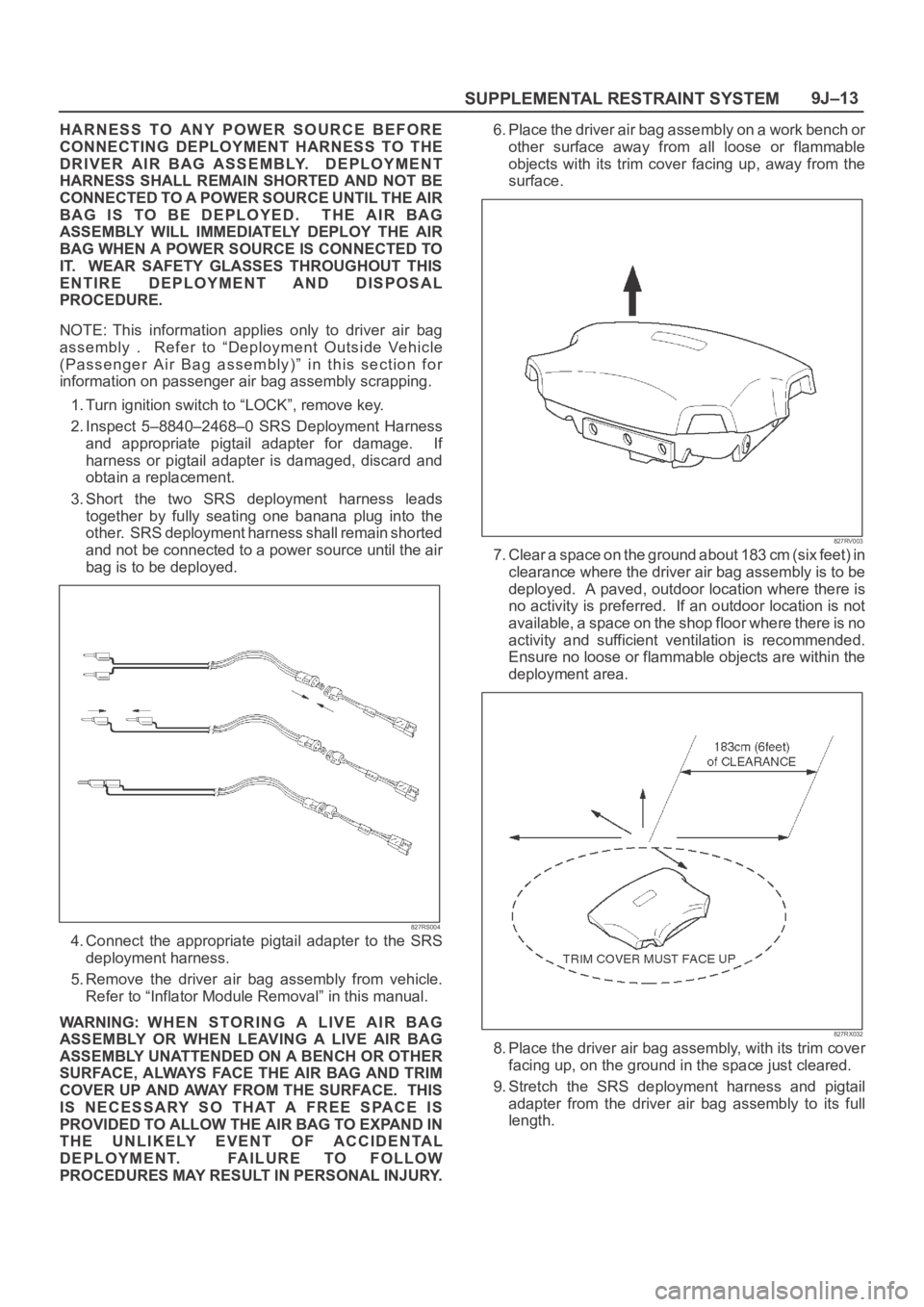
3. Short the two SRS deployment harness leads
together by fully seating one banana plug into the
other. SRS deployment harness shall remain shorted
and not be connected to a power source until the air
bag is to be deployed.
827RS004
4. Connect the appropriate pigtail adapter to the SRS
deployment harness.
5. Remove the driver air bag assembly from vehicle.
Refer to “Inflator Module Removal” in this manual.
WARNING: WHEN STORING A LIVE AIR BAG
ASSEMBLY OR WHEN LEAVING A LIVE AIR BAG
ASSEMBLY UNATTENDED ON A BENCH OR OTHER
SURFACE, ALWAYS FACE THE AIR BAG AND TRIM
COVER UP AND AWAY FROM THE SURFACE. THIS
IS NECESSARY SO THAT A FREE SPACE IS
PROVIDED TO ALLOW THE AIR BAG TO EXPAND IN
THE UNLIKELY EVENT OF ACCIDENTAL
DEPLOYMENT. FAILURE TO FOLLOW
PROCEDURES MAY RESULT IN PERSONAL INJURY.6. Place the driver air bag assembly on a work bench or
other surface away from all loose or flammable
objects with its trim cover facing up, away from the
surface.
827RV003
7. Clear a space on the ground about 183 cm (six feet) in
clearance where the driver air bag assembly is to be
deployed. A paved, outdoor location where there is
no activity is preferred. If an outdoor location is not
available, a space on the shop floor where there is no
activity and sufficient ventilation is recommended.
Ensure no loose or flammable objects are within the
deployment area.
827RX032
8. Place the driver air bag assembly, with its trim cover
facing up, on the ground in the space just cleared.
9. Stretch the SRS deployment harness and pigtail
adapter from the driver air bag assembly to its full
length.