Page 5815 of 6000
7A–34 AUTOMATIC TRANSMISSION (AW30-40LE)
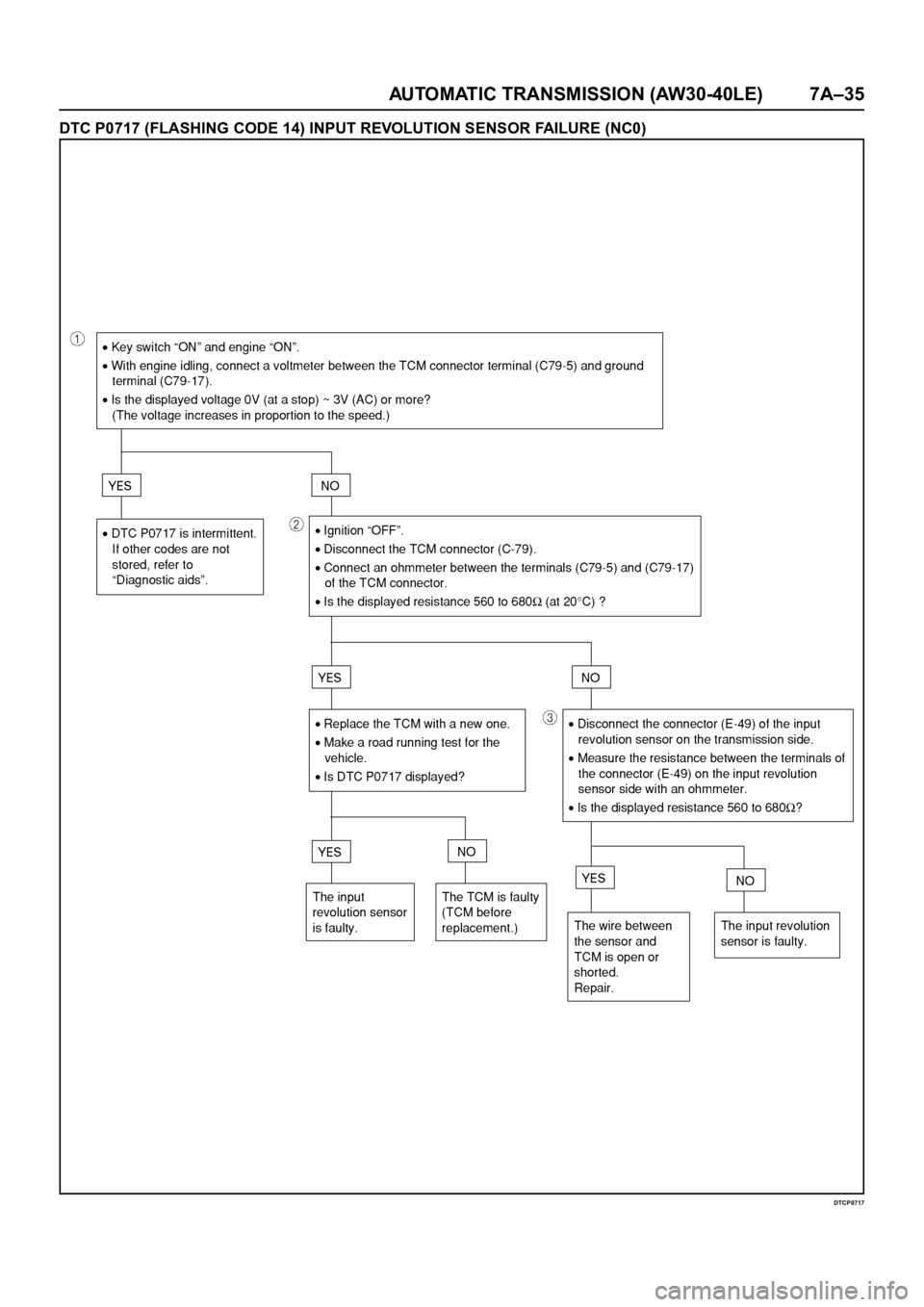
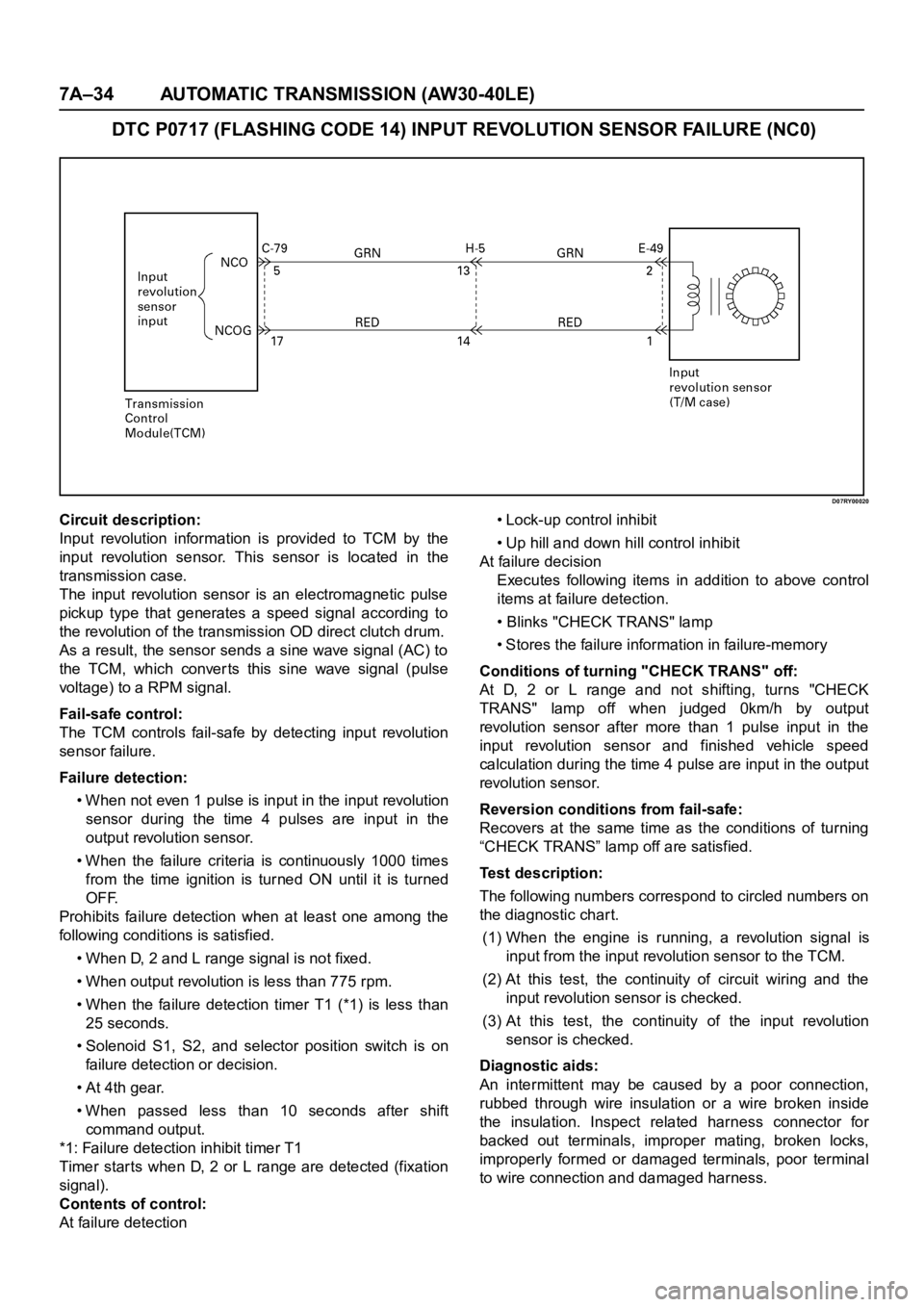
DTC P0717 (FLASHING CODE 14) INPUT REVOLUTION SENSOR FAILURE (NC0)
D07RY00020
Circuit description:
Input revolution information is provided to TCM by the
input revolution sensor. This sensor is located in the
transmission case.
The input revolution sensor is an electromagnetic pulse
pickup type that generates a speed signal according to
the revolution of the transmission OD direct clutch drum.
As a result, the sensor sends a sine wave signal (AC) to
the TCM, which conver ts this sine wave signal (pulse
voltage) to a RPM signal.
Fail-safe control:
The TCM controls fail-safe by detecting input revolution
sensor failure.
Failure detection:
• When not even 1 pulse is input in the input revolution
sensor during the time 4 pulses are input in the
output revolution sensor.
• When the failure criteria is continuously 1000 times
from the time ignition is turned ON until it is turned
OFF.
Prohibits failure detection when at least one among the
following conditions is satisfied.
• When D, 2 and L range signal is not fixed.
• When output revolution is less than 775 rpm.
• When the failure detection timer T1 (*1) is less than
25 seconds.
• Solenoid S1, S2, and selector position switch is on
failure detection or decision.
• At 4th gear.
• When passed less than 10 seconds after shift
command output.
*1: Failure detection inhibit timer T1
Timer star ts when D, 2 or L range are detected (fixation
signal).
Contents of control:
At failure detection• Lock-up control inhibit
• Up hill and down hill control inhibit
At failure decision
Executes following items in addition to above control
items at failure detection.
• Blinks "CHECK TRANS" lamp
• Stores the failure information in failure-memory
Conditions of turning "CHECK TRANS" off:
At D, 2 or L range and not shifting, turns "CHECK
TRANS" lamp off when judged 0km/h by output
revolution sensor after more than 1 pulse input in the
input revolution sensor and finished vehicle speed
calculation during the time 4 pulse are input in the output
revolution sensor.
Reversion conditions from fail-safe:
Recovers at the same time as the conditions of turning
“CHECK TRANS” lamp off are satisfied.
Test description:
The following numbers correspond to circled numbers on
the diagnostic char t.
(1) When the engine is running, a revolution signal is
input from the input revolution sensor to the TCM.
(2) At this test, the continuity of circuit wiring and the
input revolution sensor is checked.
(3) At this test, the continuity of the input revolution
sensor is checked.
Diagnostic aids:
An intermittent may be caused by a poor connection,
rubbed through wire insulation or a wire broken inside
the insulation. Inspect related harness connector for
backed out terminals, improper mating, broken locks,
improperly formed or damaged terminals, poor terminal
to wire connection and damaged harness.
Page 5816 of 6000
AUTOMATIC TRANSMISSION (AW30-40LE) 7A–35
DTC P0717 (FLASHING CODE 14) INPUT REVOLUTION SENSOR FAILURE (NC0)
DTCP0717
Page 5817 of 6000
7A–36 AUTOMATIC TRANSMISSION (AW30-40LE)
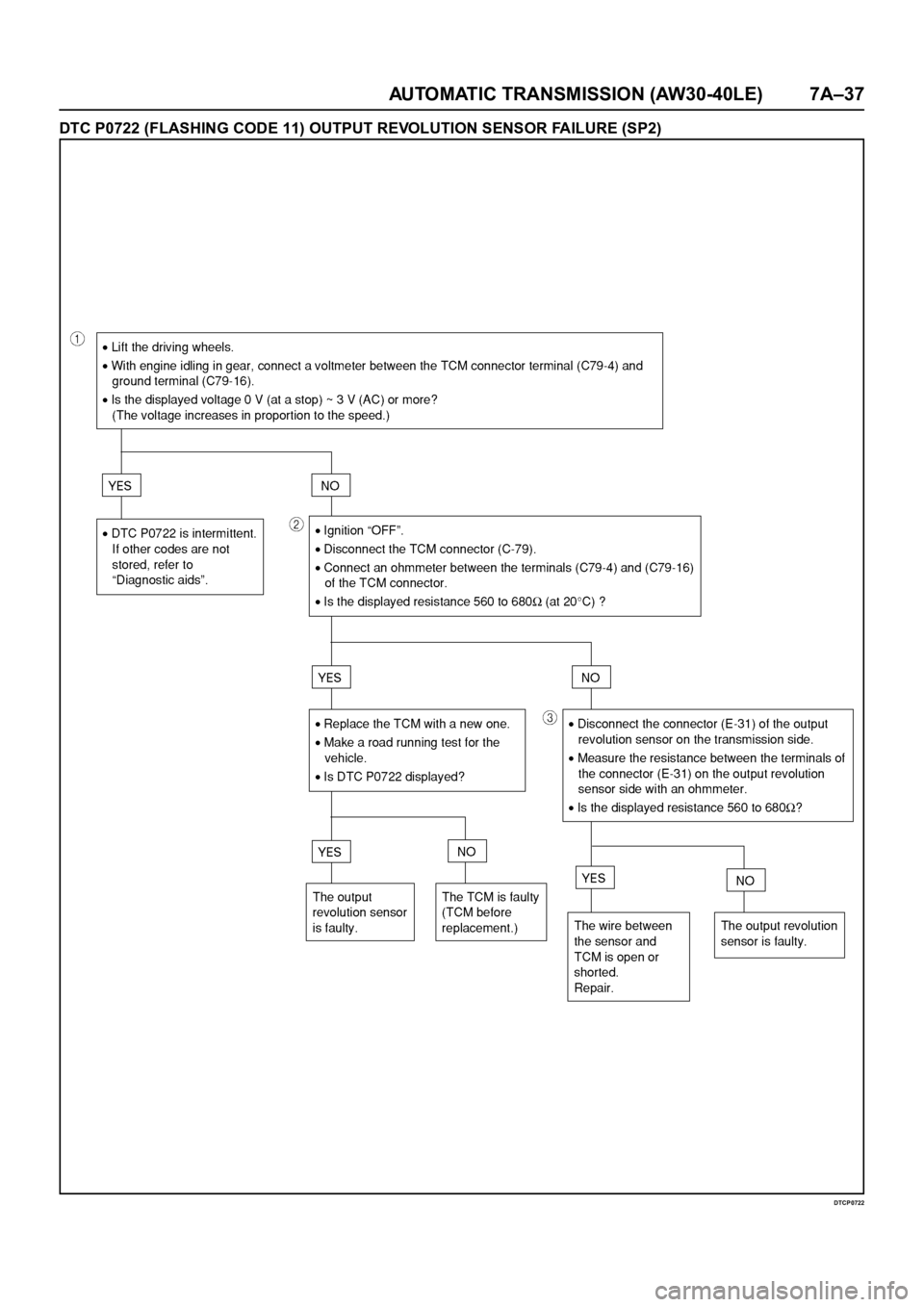
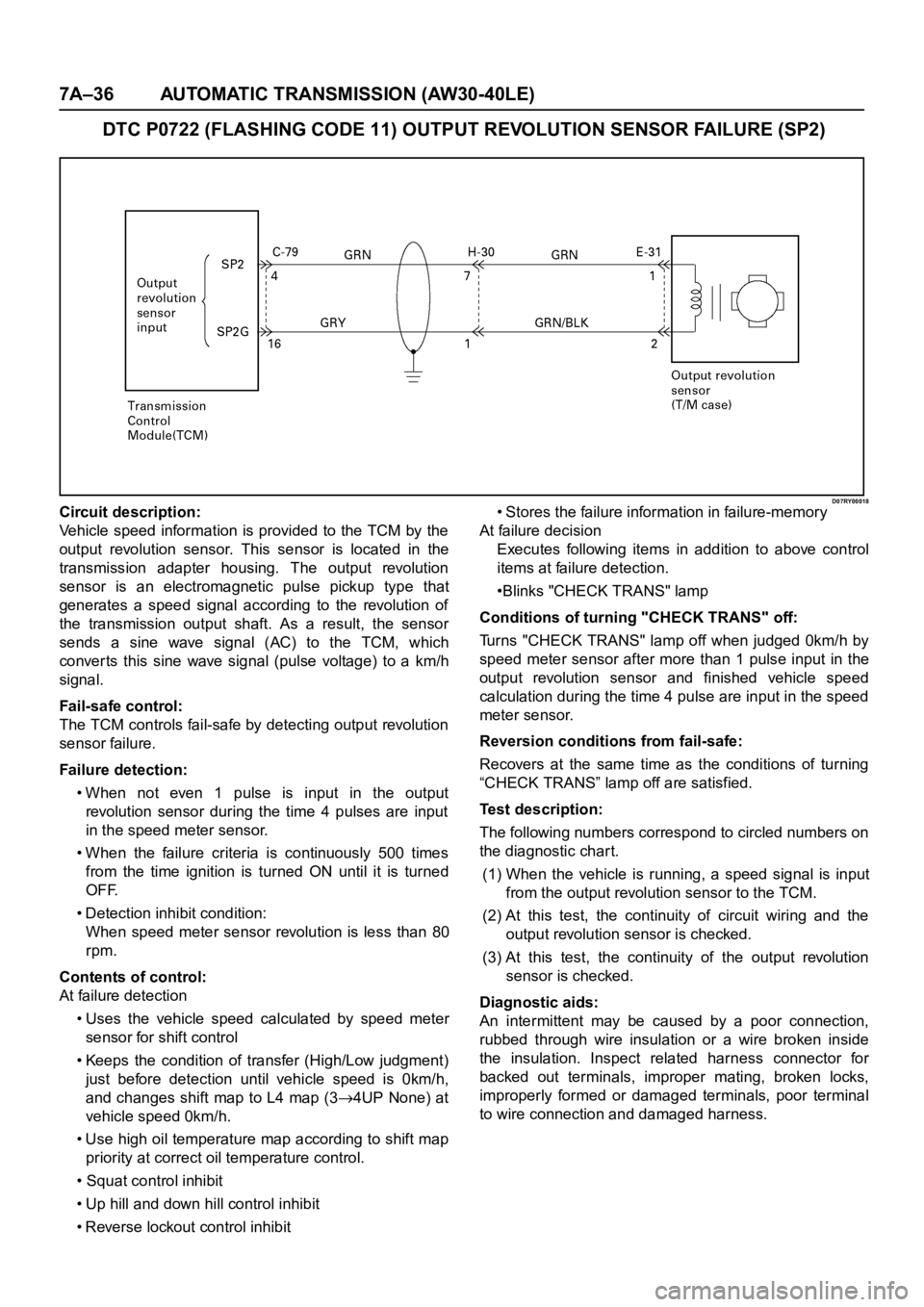
DTC P0722 (FLASHING CODE 11) OUTPUT REVOLUTION SENSOR FAILURE (SP2)
D07RY00018Circuit description:
Vehicle speed information is provided to the TCM by the
output revolution sensor. This sensor is located in the
transmission adapter housing. The output revolution
sensor is an electromagnetic pulse pickup type that
generates a speed signal according to the revolution of
the transmission output shaft. As a result, the sensor
sends a sine wave signal (AC) to the TCM, which
converts this sine wave signal (pulse voltage) to a km/h
signal.
Fail-safe control:
The TCM controls fail-safe by detecting output revolution
sensor failure.
Failure detection:
• When not even 1 pulse is input in the output
revolution sensor during the time 4 pulses are input
in the speed meter sensor.
• When the failure criteria is continuously 500 times
from the time ignition is turned ON until it is turned
OFF.
• Detection inhibit condition:
When speed meter sensor revolution is less than 80
rpm.
Contents of control:
At failure detection
• Uses the vehicle speed calculated by speed meter
sensor for shift control
• Keeps the condition of transfer (High/Low judgment)
just before detection until vehicle speed is 0km/h,
and changes shift map to L4 map (3
4UP None) at
vehicle speed 0km/h.
• Use high oil temperature map according to shift map
priority at correct oil temperature control.
• Squat control inhibit
• Up hill and down hill control inhibit
• Reverse lockout control inhibit• Stores the failure information in failure-memory
At failure decision
Executes following items in addition to above control
items at failure detection.
•Blinks "CHECK TRANS" lamp
Conditions of turning "CHECK TRANS" off:
Turns "CHECK TRANS" lamp off when judged 0km/h by
speed meter sensor after more than 1 pulse input in the
output revolution sensor and finished vehicle speed
calculation during the time 4 pulse are input in the speed
meter sensor.
Reversion conditions from fail-safe:
Recovers at the same time as the conditions of turning
“CHECK TRANS” lamp off are satisfied.
Test description:
The following numbers correspond to circled numbers on
the diagnostic char t.
(1) When the vehicle is running, a speed signal is input
from the output revolution sensor to the TCM.
(2) At this test, the continuity of circuit wiring and the
output revolution sensor is checked.
(3) At this test, the continuity of the output revolution
sensor is checked.
Diagnostic aids:
An intermittent may be caused by a poor connection,
rubbed through wire insulation or a wire broken inside
the insulation. Inspect related harness connector for
backed out terminals, improper mating, broken locks,
improperly formed or damaged terminals, poor terminal
to wire connection and damaged harness.
Page 5818 of 6000
AUTOMATIC TRANSMISSION (AW30-40LE) 7A–37
DTC P0722 (FLASHING CODE 11) OUTPUT REVOLUTION SENSOR FAILURE (SP2)
DTCP0722
Page 5819 of 6000
7A–38 AUTOMATIC TRANSMISSION (AW30-40LE)
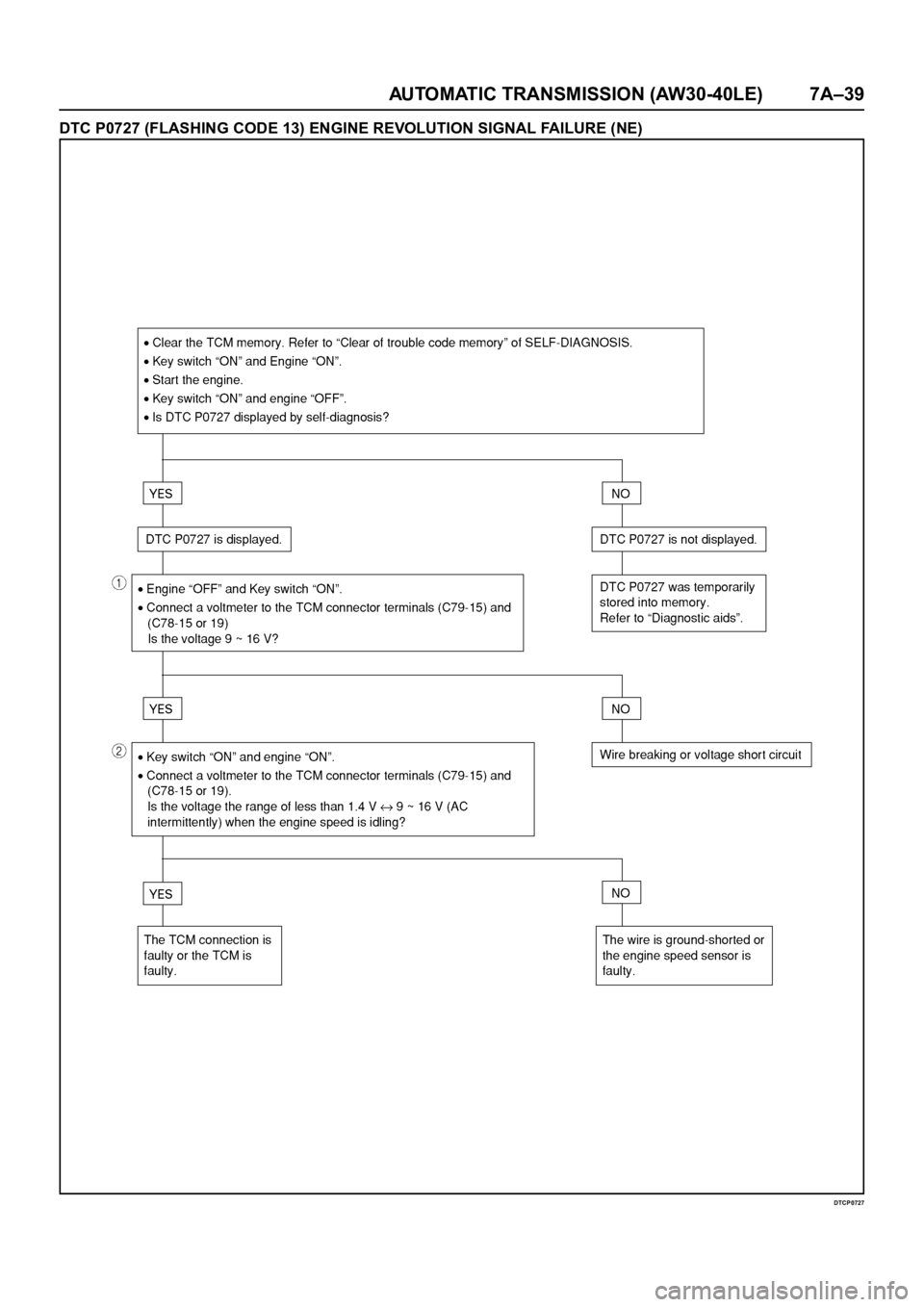
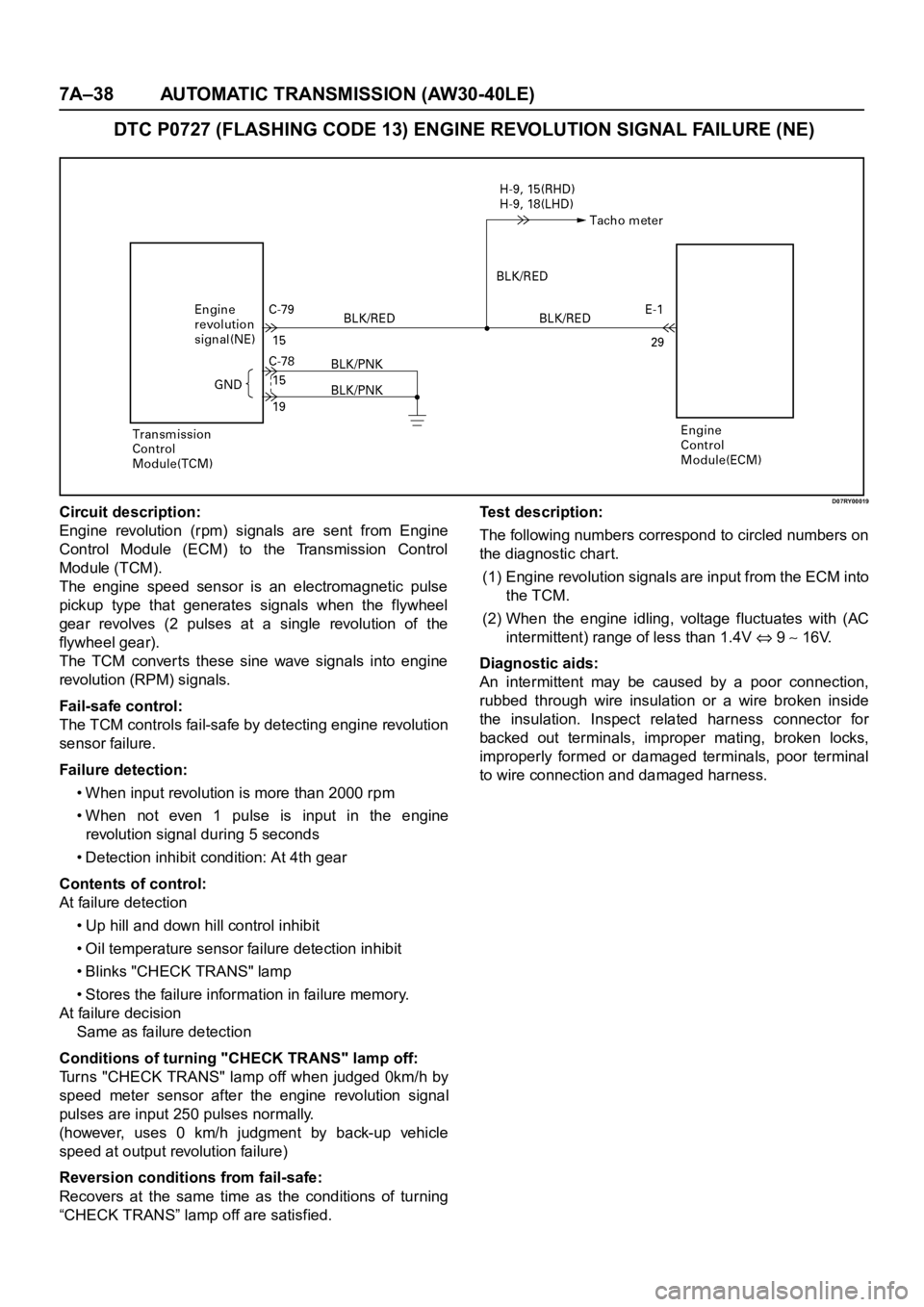
DTC P0727 (FLASHING CODE 13) ENGINE REVOLUTION SIGNAL FAILURE (NE)
D07RY00019Circuit description:
Engine revolution (rpm) signals are sent from Engine
Control Module (ECM) to the Transmission Control
Module (TCM).
The engine speed sensor is an electromagnetic pulse
pickup type that generates signals when the flywheel
gear revolves (2 pulses at a single revolution of the
flywheel gear).
The TCM converts these sine wave signals into engine
revolution (RPM) signals.
Fail-safe control:
The TCM controls fail-safe by detecting engine revolution
sensor failure.
Failure detection:
• When input revolution is more than 2000 rpm
• When not even 1 pulse is input in the engine
revolution signal during 5 seconds
• Detection inhibit condition: At 4th gear
Contents of control:
At failure detection
• Up hill and down hill control inhibit
• Oil temperature sensor failure detection inhibit
• Blinks "CHECK TRANS" lamp
• Stores the failure information in failure memory.
At failure decision
Same as failure detection
Conditions of turning "CHECK TRANS" lamp off:
Turns "CHECK TRANS" lamp off when judged 0km/h by
speed meter sensor after the engine revolution signal
pulses are input 250 pulses normally.
(however, uses 0 km/h judgment by back-up vehicle
speed at output revolution failure)
Reversion conditions from fail-safe:
Recovers at the same time as the conditions of turning
“CHECK TRANS” lamp off are satisfied.Test description:
The following numbers correspond to circled numbers on
the diagnostic char t.
(1) Engine revolution signals are input from the ECM into
the TCM.
(2) When the engine idling, voltage fluctuates with (AC
intermittent) range of less than 1.4V
9 16V.
Diagnostic aids:
An intermittent may be caused by a poor connection,
rubbed through wire insulation or a wire broken inside
the insulation. Inspect related harness connector for
backed out terminals, improper mating, broken locks,
improperly formed or damaged terminals, poor terminal
to wire connection and damaged harness.
Page 5820 of 6000
AUTOMATIC TRANSMISSION (AW30-40LE) 7A–39
DTC P0727 (FLASHING CODE 13) ENGINE REVOLUTION SIGNAL FAILURE (NE)
DTCP0727
Page 5821 of 6000
7A–40 AUTOMATIC TRANSMISSION (AW30-40LE)
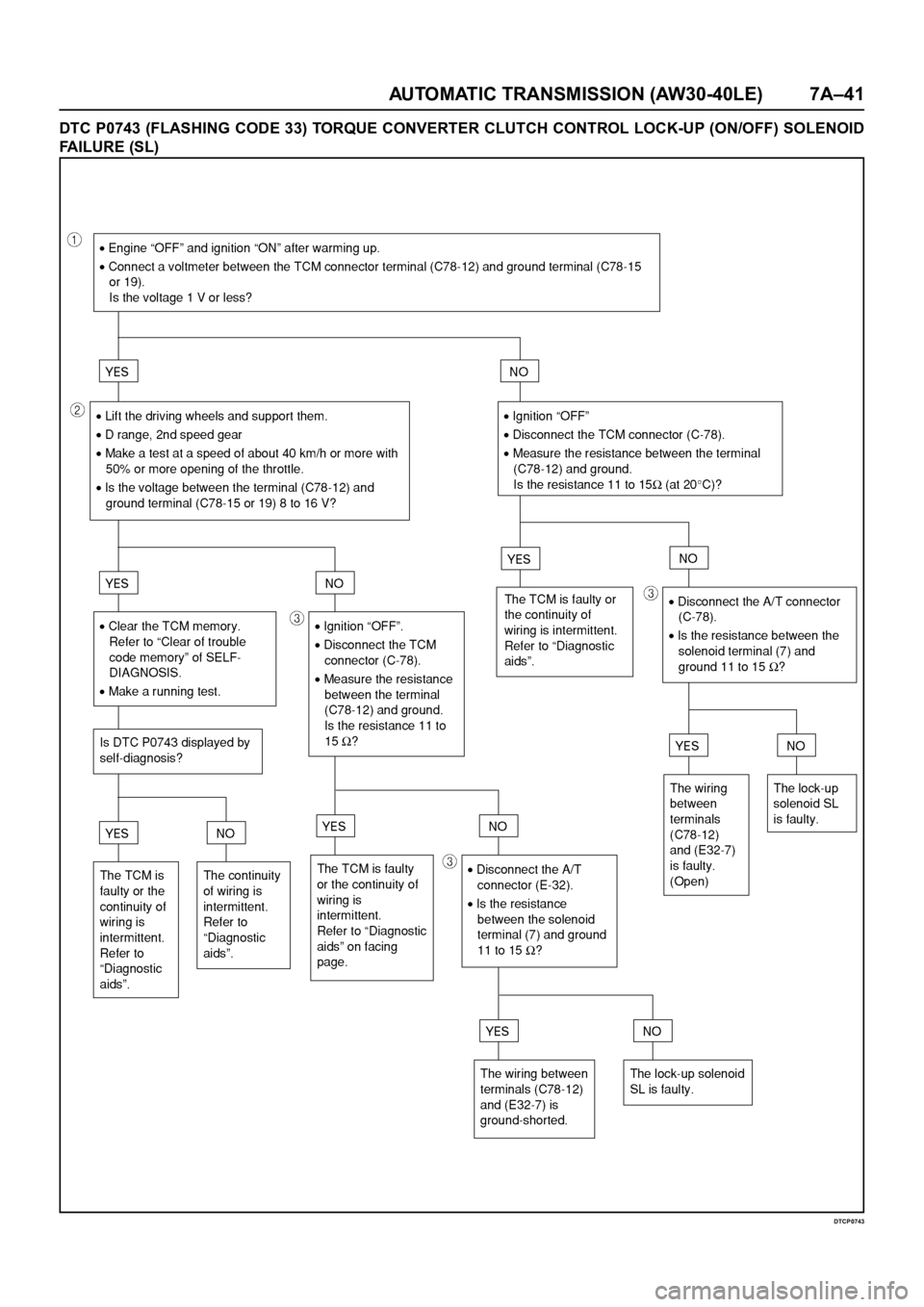
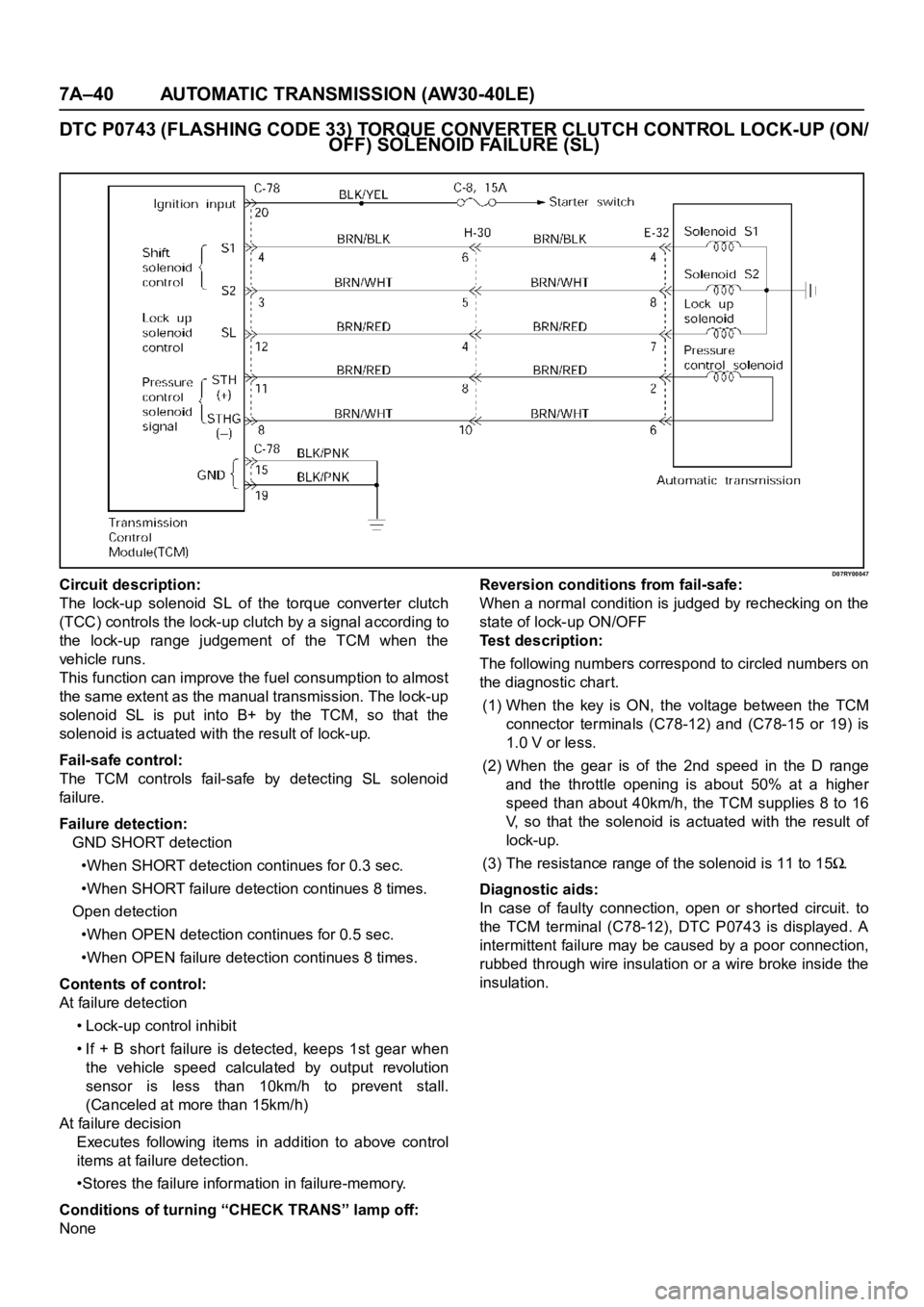
DTC P0743 (FLASHING CODE 33) TORQUE CONVERTER CLUTCH CONTROL LOCK-UP (ON/
OFF) SOLENOID FA I L U R E ( S L )
D07RY00047Circuit description:
The lock-up solenoid SL of the torque converter clutch
(TCC) controls the lock-up clutch by a signal according to
the lock-up range judgement of the TCM when the
vehicle runs.
This function can improve the fuel consumption to almost
the same extent as the manual transmission. The lock-up
solenoid SL is put into B+ by the TCM, so that the
solenoid is actuated with the result of lock-up.
Fail-safe control:
The TCM controls fail-safe by detecting SL solenoid
fai lu re.
Failure detection:
GND SHORT detection
•When SHORT detection continues for 0.3 sec.
•When SHORT failure detection continues 8 times.
Open detection
•When OPEN detection continues for 0.5 sec.
•When OPEN failure detection continues 8 times.
Contents of control:
At failure detection
• Lock-up control inhibit
• If + B short failure is detected, keeps 1st gear when
the vehicle speed calculated by output revolution
sensor is less than 10km/h to prevent stall.
(Canceled at more than 15km/h)
At failure decision
Executes following items in addition to above control
items at failure detection.
•Stores the failure information in failure-memory.
Conditions of turning “CHECK TRANS” lamp off:
NoneReversion conditions from fail-safe:
When a normal condition is judged by rechecking on the
state of lock-up ON/OFF
Test description:
The following numbers correspond to circled numbers on
the diagnostic char t.
(1) When the key is ON, the voltage between the TCM
connector terminals (C78-12) and (C78-15 or 19) is
1.0 V or less.
(2) When the gear is of the 2nd speed in the D range
and the throttle opening is about 50% at a higher
speed than about 40km/h, the TCM supplies 8 to 16
V, so that the solenoid is actuated with the result of
lock-up.
(3) The resistance range of the solenoid is 11 to 15
.
Diagnostic aids:
In case of faulty connection, open or shorted circuit. to
the TCM terminal (C78-12), DTC P0743 is displayed. A
intermittent failure may be caused by a poor connection,
rubbed through wire insulation or a wire broke inside the
insulation.
Page 5822 of 6000
AUTOMATIC TRANSMISSION (AW30-40LE) 7A–41
DTC P0743 (FLASHING CODE 33) TORQUE CONVERTER CLUTCH CONTROL LOCK-UP (ON/OFF) SOLENOID
FAILURE (SL)
DTCP0743