1998 NISSAN QUEST fuel type
[x] Cancel search: fuel typePage 123 of 260
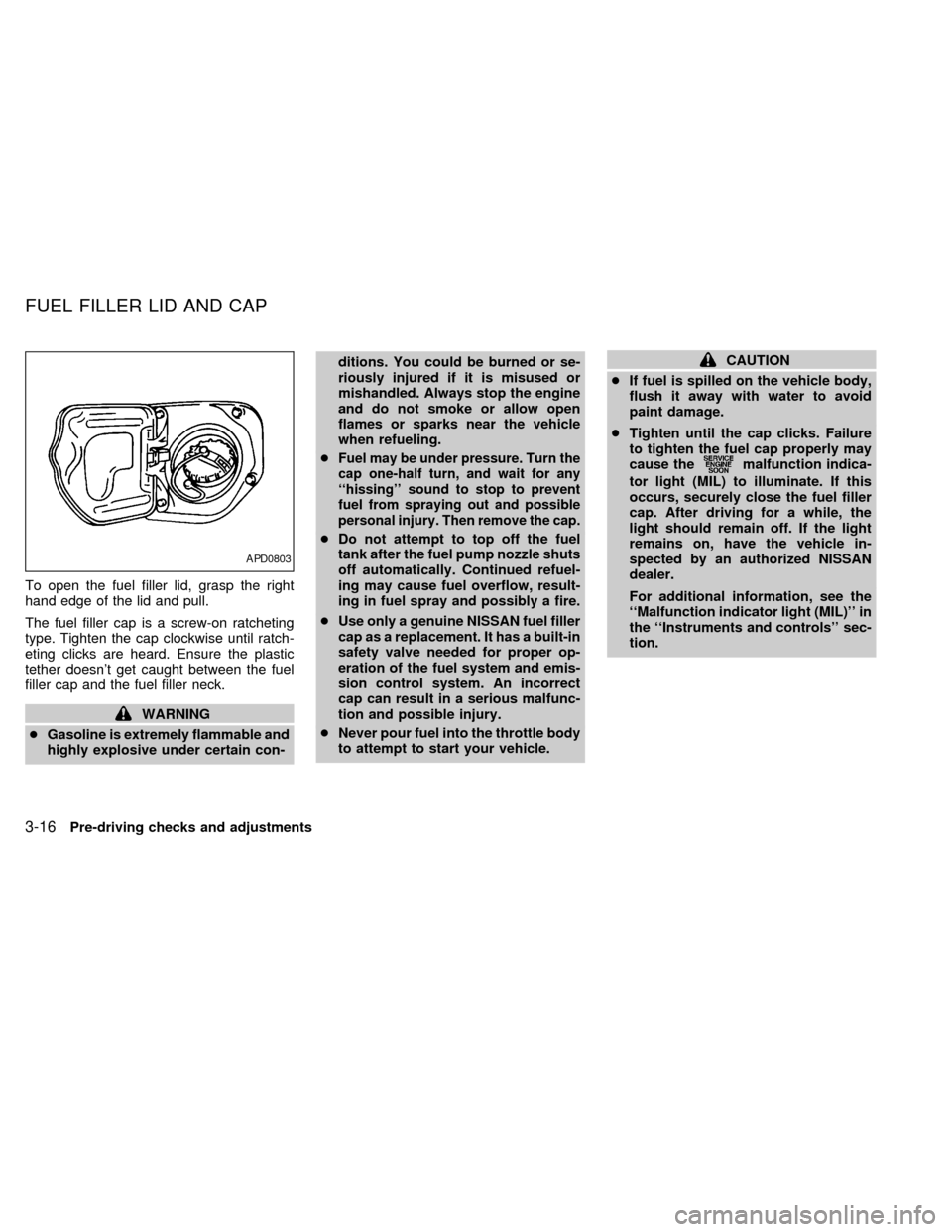
To open the fuel filler lid, grasp the right
hand edge of the lid and pull.
The fuel filler cap is a screw-on ratcheting
type. Tighten the cap clockwise until ratch-
eting clicks are heard. Ensure the plastic
tether doesn't get caught between the fuel
filler cap and the fuel filler neck.
WARNING
cGasoline is extremely flammable and
highly explosive under certain con-ditions. You could be burned or se-
riously injured if it is misused or
mishandled. Always stop the engine
and do not smoke or allow open
flames or sparks near the vehicle
when refueling.
c
Fuel may be under pressure. Turn the
cap one-half turn, and wait for any
``hissing'' sound to stop to prevent
fuel from spraying out and possible
personal injury. Then remove the cap.
cDo not attempt to top off the fuel
tank after the fuel pump nozzle shuts
off automatically. Continued refuel-
ing may cause fuel overflow, result-
ing in fuel spray and possibly a fire.
cUse only a genuine NISSAN fuel filler
cap as a replacement. It has a built-in
safety valve needed for proper op-
eration of the fuel system and emis-
sion control system. An incorrect
cap can result in a serious malfunc-
tion and possible injury.
cNever pour fuel into the throttle body
to attempt to start your vehicle.
CAUTION
cIf fuel is spilled on the vehicle body,
flush it away with water to avoid
paint damage.
cTighten until the cap clicks. Failure
to tighten the fuel cap properly may
cause the
malfunction indica-
tor light (MIL) to illuminate. If this
occurs, securely close the fuel filler
cap. After driving for a while, the
light should remain off. If the light
remains on, have the vehicle in-
spected by an authorized NISSAN
dealer.
For additional information, see the
``Malfunction indicator light (MIL)'' in
the ``Instruments and controls'' sec-
tion.
APD0803
FUEL FILLER LID AND CAP
3-16Pre-driving checks and adjustments
ZX
Page 227 of 260
![NISSAN QUEST 1998 V40 / 1.G Owners Manual Schedule One
Abbreviations: R = Replace I = Inspect. Correct or replace if necessary. [ ]: At the mileage intervals only
MAINTENANCE OPERATIONMAINTENANCE INTERVAL
Perform at number of miles,
kilometer](/manual-img/5/610/w960_610-226.png "NISSAN QUEST 1998 V40 / 1.G Owners Manual Schedule One
Abbreviations: R = Replace I = Inspect. Correct or replace if necessary. [ ]: At the mileage intervals only
MAINTENANCE OPERATIONMAINTENANCE INTERVAL
Perform at number of miles,
kilometer")
Schedule One
Abbreviations: R = Replace I = Inspect. Correct or replace if necessary. [ ]: At the mileage intervals only
MAINTENANCE OPERATIONMAINTENANCE INTERVAL
Perform at number of miles,
kilometers or months,
whichever comes first.Miles ý 1,000 3.75 7.5 11.25 15 18.75 22.526.25 30 33.75 37.541.25 45 48.75 52.556.25 60
(km ý 1,000) (6) (12) (18) (24) (30) (36) (42) (48) (54) (60) (66) (72) (78) (84) (90) (96)
Months 3 6 9 12 15 18 21 24 27 30 33 36 39 42 45 48
Emission control system maintenance
Drive belts See NOTE (1).I*
Air cleaner filter See NOTE (2). [R] [R]
EVAP vapor linesI* I*
Fuel linesI* I*
Fuel filter See NOTE (3)*.
Engine coolant Replace every 30,000 miles (48,000 km) or 36 months.*
Engine oilRRRRRRRRRRRRRRRR
Engine oil filter (Use NISSAN Premium type or equivalent.)RRRRRRRRRRRRRRRR
Spark plugs[R] [R]
Timing beltReplace every 105,000 miles (168,000 km).
NOTE: (1) After 60,000 miles (96,000 km) or 48 months, inspect every 15,000 miles (24,000 km) or 12 months.
(2) If operating mainly in dusty conditions, more frequent maintenance may be required.
(3) If vehicle is operated under extremely adverse weather conditions or in areas where ambient temperatures are either extremely low or
extremely high, the filters might become clogged. In such an event, replace them immediately.
* Maintenance items and intervals with an ``*'' are recommended by NISSAN for reliable vehicle operation. The owner need not perform
such maintenance in order to maintain the emission warranty or manufacturer recall liability. Other maintenance items and intervals
are required.
9-6Maintenance
ZX
Page 229 of 260
![NISSAN QUEST 1998 V40 / 1.G Owners Manual Schedule Two
Abbreviations: R = Replace I = Inspect. Correct or replace if necessary. [ ]: At the mileage intervals only
MAINTENANCE OPERATIONMAINTENANCE INTERVAL
Perform at number of miles,
kilometer](/manual-img/5/610/w960_610-228.png "NISSAN QUEST 1998 V40 / 1.G Owners Manual Schedule Two
Abbreviations: R = Replace I = Inspect. Correct or replace if necessary. [ ]: At the mileage intervals only
MAINTENANCE OPERATIONMAINTENANCE INTERVAL
Perform at number of miles,
kilometer")
Schedule Two
Abbreviations: R = Replace I = Inspect. Correct or replace if necessary. [ ]: At the mileage intervals only
MAINTENANCE OPERATIONMAINTENANCE INTERVAL
Perform at number of miles,
kilometers or months, whichever comes first.Miles ý 1,000 7.5 15 22.5 30 37.5 45 52.5 60
(km ý 1,000) (12) (24) (36) (48) (60) (72) (84) (96)
Months 6 12 18 24 30 36 42 48
Emission control system maintenance
Drive belts See NOTE (1).I*
Air cleaner housing filter[R] [R]
EVAP vapor linesI* I*
Fuel linesI* I*
Fuel filter See NOTE (2)*.
Engine coolant Replace every 30,000 miles (48,000 km) or 36 months.*
Engine oilRRRRRRRR
Engine oil filter (Use NISSAN Premium type, or equivalent.)RRRRRRRR
Spark plugs[R] [R]
Timing beltReplace every 105,000 miles (168,000 km).
NOTE: (1) After 60,000 miles (96,000 km) or 48 months, inspect every 15,000 miles (24,000 km) or 12 months.
(2) If vehicle is operated under extremely adverse weather conditions or in areas where ambient temperatures are either extremely low or
extremely high, the filters might become clogged. In such an event, replace them immediately.
* Maintenance items and intervals with an ``*'' are recommended by NISSAN for reliable vehicle operation. The owner need not perform
such maintenance in order to maintain the emission warranty or manufacturer recall liability. Other maintenance items and intervals
are required.
9-8Maintenance
ZX
Page 233 of 260
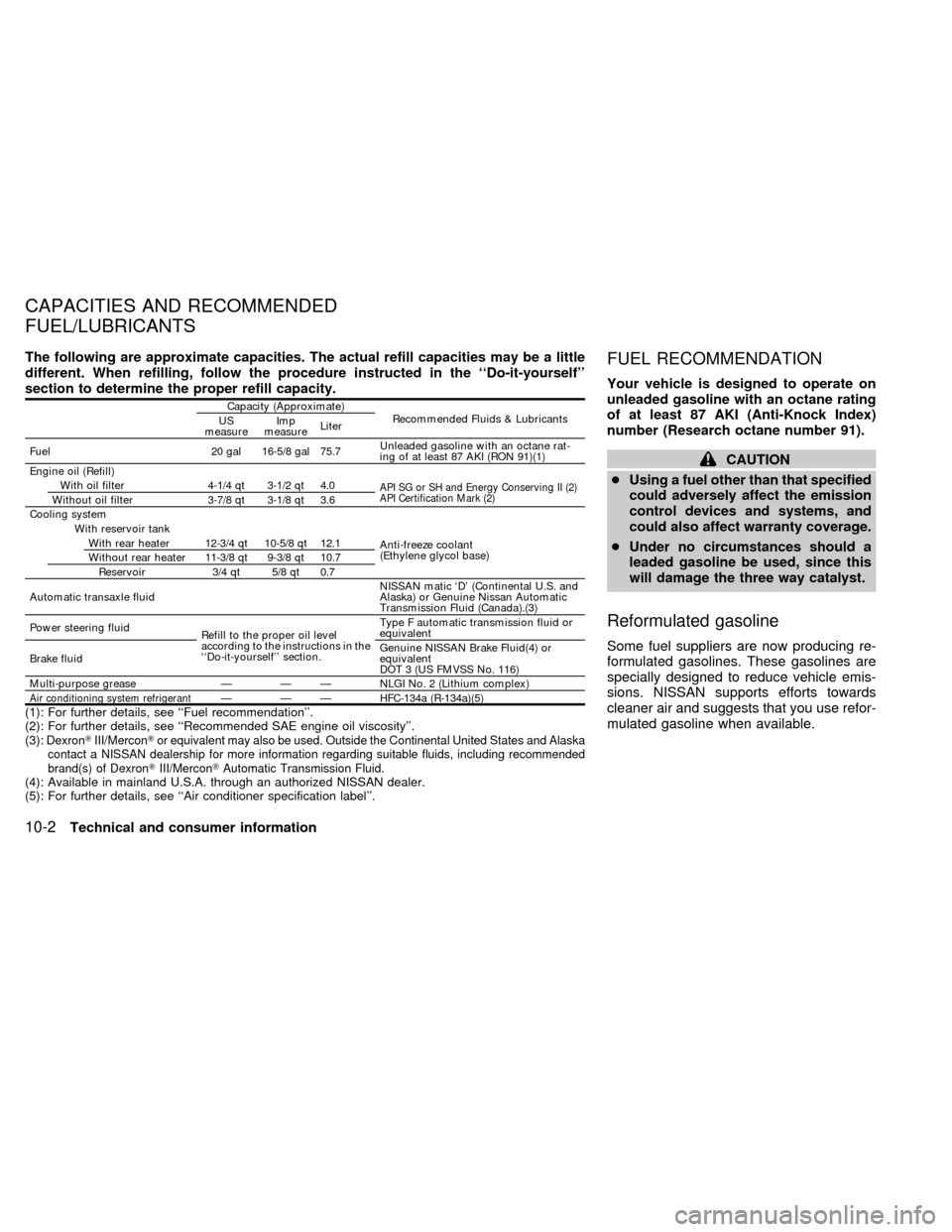
The following are approximate capacities. The actual refill capacities may be a little
different. When refilling, follow the procedure instructed in the ``Do-it-yourself''
section to determine the proper refill capacity.
Capacity (Approximate)
Recommended Fluids & Lubricants
US
measureImp
measureLiter
Fuel 20 gal 16-5/8 gal 75.7Unleaded gasoline with an octane rat-
ing of at least 87 AKI (RON 91)(1)
Engine oil (Refill)
With oil filter 4-1/4 qt 3-1/2 qt 4.0
API SG or SH and Energy Conserving II (2)
API Certification Mark (2)Without oil filter 3-7/8 qt 3-1/8 qt 3.6
Cooling system
With reservoir tank
With rear heater 12-3/4 qt 10-5/8 qt 12.1
Anti-freeze coolant
(Ethylene glycol base)
Without rear heater 11-3/8 qt 9-3/8 qt 10.7
Reservoir 3/4 qt 5/8 qt 0.7
Automatic transaxle fluidNISSAN matic `D' (Continental U.S. and
Alaska) or Genuine Nissan Automatic
Transmission Fluid (Canada).(3)
Power steering fluid
Refill to the proper oil level
according to the instructions in the
``Do-it-yourself'' section.Type F automatic transmission fluid or
equivalent
Brake fluidGenuine NISSAN Brake Fluid(4) or
equivalent
DOT 3 (US FMVSS No. 116)
Multi-purpose grease Ð Ð Ð NLGI No. 2 (Lithium complex)
Air conditioning system refrigerantÐ Ð Ð HFC-134a (R-134a)(5)(1): For further details, see ``Fuel recommendation''.
(2): For further details, see ``Recommended SAE engine oil viscosity''.
(3):
DexronTIII/MerconTor equivalent may also be used. Outside the Continental United States and Alaska
contact a NISSAN dealership for more information regarding suitable fluids, including recommended
brand(s) of DexronTIII/MerconTAutomatic Transmission Fluid.
(4): Available in mainland U.S.A. through an authorized NISSAN dealer.
(5): For further details, see ``Air conditioner specification label''.
FUEL RECOMMENDATION
Your vehicle is designed to operate on
unleaded gasoline with an octane rating
of at least 87 AKI (Anti-Knock Index)
number (Research octane number 91).
CAUTION
cUsing a fuel other than that specified
could adversely affect the emission
control devices and systems, and
could also affect warranty coverage.
cUnder no circumstances should a
leaded gasoline be used, since this
will damage the three way catalyst.
Reformulated gasoline
Some fuel suppliers are now producing re-
formulated gasolines. These gasolines are
specially designed to reduce vehicle emis-
sions. NISSAN supports efforts towards
cleaner air and suggests that you use refor-
mulated gasoline when available.
CAPACITIES AND RECOMMENDED
FUEL/LUBRICANTS
10-2Technical and consumer information
ZX
Page 235 of 260

of the vehicle, for which NISSAN is not
responsible.
Incorrect ignition timing may result in spark
knock, after-run, and/or overheating, which
may cause excessive fuel consumption or
engine damage. If any of the above symp-
toms are encountered, have your vehicle
checked at an authorized NISSAN dealer or
other competent service facility.
However, now and then you may notice
light spark knock for a short time while
accelerating or driving up hills. This is
no cause for concern, because you get
the greatest fuel benefit when there is
light spark knock for a short time under
heavy engine load.
ENGINE OIL AND OIL FILTER
RECOMMENDATION
Selecting the correct oil
It is essential to chose engine oil with the
correct quality and viscosity to ensure sat-
isfactory engine life and performance. NIS-
SAN recommends the use of a low friction
oil (energy conserving oil) in order to im-
prove fuel economy and conserve energy.
Oils which do not have the specified quality
label should not be used as they could
cause engine damage.Only those engine oils with the American
Petroleum Institute (API) CERTIFICATION
MARK on the front of the container should
be used. This type of oil supersedes the
existing API SG or SH and Energy Conserv-
ing II categories.
If you cannot find engine oil with the CER-
TIFICATION MARK, an API SG or SH, an
Energy Conserving II oil with the API Ser-
vice Symbol may be used. An oil with a
single designation SG or SH, or in combi-
nation with other categories (for example,
SG/CC or SG/CD) may also be used if one
ATI0507
10-4Technical and consumer information
ZX
Page 257 of 260

Multi-remote control system ........................ 3-8
O
Odometer ..................................................... 2-4
Oil
Capacities and recommended fuel/
lubricants .............................................. 10-2
Changing engine oil................................ 8-6
Changing engine oil filter........................ 8-7
Checking engine oil level ....................... 8-5
Engine oil ................................................ 8-5
Engine oil and oil filter
recommendation ................................... 10-4
Engine oil viscosity ............................... 10-5
Outside mirror control ................................ 3-17
Outside mirrors .......................................... 3-18
Overdrive switch .......................................... 5-7
Overheat
If your vehicle overheats ...................... 6-10
Owner's manual order form ..................... 10-21
P
Parking
Parking brake check ............................. 8-16
Parking brake operation ......................... 5-9
Parking/parking on hills ........................ 5-13
Periodic maintenance schedules ................. 9-5
Personal reading light ................................ 2-25Power
Power antenna ..................................... 4-20
Power door lock...................................... 3-6
Power rear windows ............................. 2-23
Power steering fluid ...................... 10-2, 8-9
Power support front seat ........................ 1-4
Power windows..................................... 2-20
Precautions
Maintenance precautions ....................... 8-2
Precautions on seat belt usage............ 1-25
Precautions when starting and driving ... 5-2
Push starting .............................................. 6-10
R
Radio
AM-FM radio with cassette player ........ 4-14
CB radio or car phone .......................... 4-25
Readiness for inspection maintenance
(I/M) test................................................... 10-20
Rear door ................................................... 3-12
Rear door lock ........................................... 3-12
Rear power point ....................................... 2-17
Rear seat heater and air conditioner......... 4-13
Rear window defogger switch ................... 2-13
Rear window wiper and washer switches . 2-12
Refrigerant recommendation ..................... 10-6
Registering your vehicle in another
country ....................................................... 10-9
Remote keyless entry system (See
multi-remote control system) ....................... 3-8Removing and installing the second row
bench seat ................................................... 1-8
Reporting safety defects (USA) ............... 10-19
S
Safety
Child safety sliding door lock ................. 3-5
Reporting safety defects (USA) .......... 10-19
Seat belt
2-point type without retractor................ 1-36
3-point type with retractor ........... 1-28, 1-31
Precautions on seat belt usage............ 1-25
Seat belt extenders .............................. 1-38
Seat belt maintenance.......................... 1-38
Seat belts.............................................. 1-25
Seat belt warning light ................................. 2-7
Seat positions ............................................ 1-69
Seating arrangements ............................... 1-64
Seats
Five passenger seating ........................ 1-66
Five passenger seating with cargo
room...................................................... 1-66
Flexible seating....................................... 1-8
Integrated child safety seats ................ 1-57
Manual front seat adjustment ................. 1-3
Power support front seat ........................ 1-4
Seat positions ....................................... 1-69
Second row bench seat........................ 1-69
Second row bucket seats ..................... 1-72
Seven passenger seating ..................... 1-65
Sliding three-passenger seat................ 1-14
11-4
ZX