Page 72 of 260
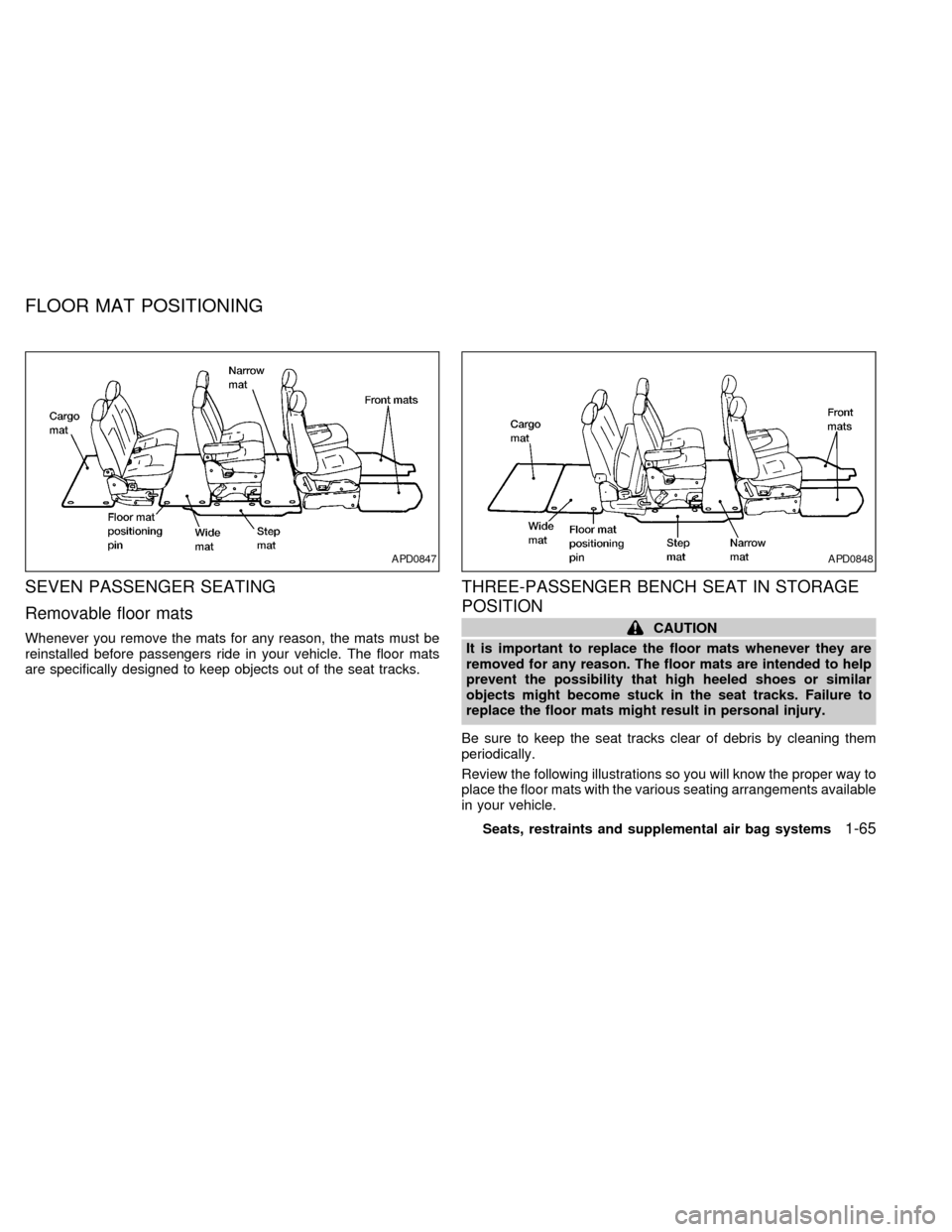
SEVEN PASSENGER SEATING
Removable floor mats
Whenever you remove the mats for any reason, the mats must be
reinstalled before passengers ride in your vehicle. The floor mats
are specifically designed to keep objects out of the seat tracks.
THREE-PASSENGER BENCH SEAT IN STORAGE
POSITION
CAUTION
It is important to replace the floor mats whenever they are
removed for any reason. The floor mats are intended to help
prevent the possibility that high heeled shoes or similar
objects might become stuck in the seat tracks. Failure to
replace the floor mats might result in personal injury.
Be sure to keep the seat tracks clear of debris by cleaning them
periodically.
Review the following illustrations so you will know the proper way to
place the floor mats with the various seating arrangements available
in your vehicle.
APD0847APD0848
FLOOR MAT POSITIONING
Seats, restraints and supplemental air bag systems1-65
ZX
Page 77 of 260
If a considerable amount of cargo area
room is needed, the seat cushion of the
three-passenger sliding bench seat can be
flipped up and the seat can be moved up to
storage position #2, just behind the second
row seat.When maximum cargo area is needed and
there are no rear seat passengers, the
second row seat can be removed and the
three-passenger sliding bench seat can be
moved up to storage position #1, just behind
the front seats.The second row bench seat can be folded
down to serve as a tabletop for passengers
sitting in the three-passenger bench seat.
APD0043APD0049APD0044
1-70Seats, restraints and supplemental air bag systems
ZX
Page 78 of 260
The second and third row bench seats can
be folded down to tabletops.To increase cargo area space, the second
row bench seat can be removed and the
three-passenger sliding seat can be moved
up to the second row position.The third seat can be folded down into a
tabletop.
APD0045APD0046APD0047
Seats, restraints and supplemental air bag systems1-71
ZX
Page 79 of 260
With the third seat folded down and the
second seat removed, cargo can be placed
in between the front seats and the third row
seat.People should not be allowed to
ride in areas meant for cargo. Passen-
gers should always be properly re-
strained in seat belts.The second row seat can be folded down
and the third row seat can be moved just
behind it in a storage position.WITH SECOND ROW BUCKET
SEATS
The normal seating arrangement for seven
passengers is with the three-passenger
bench seat in seating position #1. This
provides more leg room for the passengers
sitting in the third row.
APD0048APD0050APD0128
1-72Seats, restraints and supplemental air bag systems
ZX
Page 80 of 260
When one passenger in the three-
passenger bench seat would like more leg
room, one of the second row bucket seats
can be removed.When more cargo area room is necessary,
the three-passenger sliding bench seat can
be moved to seating position #2. This seat-
ing arrangement provides less leg room for
third row passengers, but more cargo area
room.If passengers in the three-passenger bench
seat would like more leg room, both second
row bucket seats can be removed.The
floor area should never be used by pas-
sengers. Passengers should always be
properly restrained by seat belts.
APD0127APD0052APD0053
Seats, restraints and supplemental air bag systems1-73
ZX
Page 188 of 260
you in choosing the proper product.
cWax your vehicle only after a thorough
washing. Follow the instructions supplied
with the wax.
cDo not use a wax containing any abra-
sives, cutting compounds or cleaners
that may damage the vehicle finish.
cIf the surface does not polish easily, use
a ``road tar'' remover and wax again.
Machine compounding or aggressive pol-
ishing on a base coat/clear coat paint finish
may dull the finish or leave swirl marks.
Removing spots
Remove tar and oil spots, industrial dust,
insects, and tree sap as quickly as possible
from the surface of the paint to avoid lasting
damage or staining. Special cleaning prod-
ucts are available at an authorized NISSAN
dealer or any automotive accessory store.
Underbody
In areas where road salt is used in winter,
the underbody must be cleaned regularly.
This prevents dirt and salt from building up
and causing underbody and suspension
corrosion. Before the winter period andagain in the spring, the underseal must be
checked and, if necessary, re-treated.
Cleaning glass
Use glass cleaner to remove smoke and
dust film from the glass surfaces. It is nor-
mal for glass to become coated with a film
after the vehicle is parked in the hot sun.
Glass cleaner and a soft cloth easily remove
this film.
CAUTION
When cleaning the inside of the win-
dow, do not use sharp-edged tools,
abrasive cleaners or chlorine-based
disinfectant cleaners. They could dam-
age the rear window defogger.
Cleaning aluminum alloy wheels
Wash regularly, especially during winter
months in areas where road salt is used.
Salt could discolor the wheel if not removed.
Chrome parts
Clean all chrome parts regularly with a
non-abrasive chrome polish to maintain the
finish.
Cleaning interior
Occasionally remove loose dust from the
interior trim, plastic parts and seats using a
vacuum cleaner or soft brush. Wipe the
vinyl and leather surfaces with a clean, soft
cloth dampened in mild soap solution, then
wipe clean with a dry, soft cloth. Before
using any fabric protector, read the manu-
facturer's recommendations. Some fabric
protectors contain chemicals that may stain
or bleach the seat material.
CAUTION
cNever use benzine, thinner, or any
similar material.
cLeather seats should be regularly
coated with a leather wax like saddle
soap. Never use car wax.
cNever use fabric protectors unless
recommended by the manufacturer.
Front floor mat positioning aid
This model includes a front floor mat
bracket to act as a floor mat positioning aid.
NISSAN floor mats, specially designed for
your vehicle, incorporate grommets. To in-
Appearance and care
7-3
ZX
Page 243 of 260
WARNING
cIt is extremely dangerous to ride in a
cargo area inside of a vehicle. In a
collision, people riding in these ar-
eas are more likely to be seriously
injured or killed.
cDo not allow people to ride in any
area of your vehicle that is not
equipped with seats and seat belts.
c
Be sure everyone in your vehicle is in
a seat and using a seat belt properly.
Terms
It is important to familiarize yourself with the
following terms before loading your vehicle:
cCurb Weight (actual weight of your ve-
hicle) - vehicle weight including: standard
and optional equipment, fluids, emer-
gency tools, and spare tire assembly.
This weightdoes notinclude passen-
gers and cargo.
cGVW (Gross Vehicle Weight) - curb
weight plus the combined weight of pas-
sengers and cargo.
cGVWR (Gross Vehicle Weight Rating) -maximum total weight (load) limit speci-
fied for the vehicle.
cGAWR (Gross Axle Weight Rating) -
maximum weight (load) limit specified for
the front or rear axle.
cGross combined weight - GVW plus the
total weight of the trailer and all its cargo.
Determining Vehicle Load Capacity
The load capacity of this vehicle is deter-
mined by weight, not by available cargo
space. For example, a luggage rack, bike
carrier, cartop carrier or similar equipment
does not increase load carrying capacity of
your vehicle.
To determine vehicle load capacity:
Vehicle weight can be determined by using
a commercial-grade scale, found at places
such as a truck stop, gravel quarry, grain
elevator, or a scrap metal recycling facility.
1)
Determine the curb weight of your vehicle.
2) Compare the curb weight amount to the
GVWR specified for your vehicle to de-
termine how much more weight your
vehicle can carry.
3) After loading (cargo & passengers), re-weigh your vehicle to determine if either
GVWR or GAWR for your vehicle is
exceeded. If GVWR is exceeded, re-
move cargo as necessary. If either the
front or rear GAWR is exceeded, shift
the load or remove cargo as necessary.
Loading Tips
cThe GVW must not exceed GVWR or
GAWR specified on the F.M.V.S.S. Cer-
tification Label.
cDo not load the front and rear axle to the
GAWR. Doing so will exceed the GVWR.
WARNING
c
Properly secure all cargo to help pre-
vent it from sliding or shifting. Do not
place cargo higher than the seat-
backs. In a sudden stop or collision,
unsecured cargo could cause per-
sonal injury.
cDo not load your vehicle any heavier
than the GVWR or the maximum
front and rear GAWRs. If you do,
parts on your vehicle can break, or it
can change the way your vehicle
handles. This could result in loss of
control and cause personal injury.
VEHICLE LOADING
INFORMATION
10-12Technical and consumer information
ZX
Page:
< prev 1-8 9-16 17-24