Page 378 of 2490
In
stallation
11
. R
emove brake dust from calipers, and from area of parking
brake shoes, see WARNING above.
12. Repeat above procedure to remo ve opposite side brake disc.
13. Thoroughly clean the area of both hubs where they mate
against the br ake discs.
1. Inst al
l brake disc to wheel studs.
Make su
re hu
b and brake disc
access holes are aligned.
2. Set the parking brake, refer to operation 70.35.37.
3. Check brake disc run-out. Refer to General Procedures section
206-04.
4. Instal
l caliper carri
er to hub carrier.
Position carrier.
Install and tigh ten bolts to 6
0 Nm.
5. CAUTION: Retracting the caliper piston may cause the
fluid reservoir to over-flow. Remove brake fluid spillage
immediately from paint work, with clean water.
Slowly retract piston into caliper housing.
Page 382 of 2490
In
stallation
10
. R
emove brake dust from calipers, and from area of parking
brake shoes, see WARNING above.
11. Repeat above procedure to remo ve opposite side brake disc.
12. Thoroughly clean the area of both hubs where they mate
against the br ake discs.
1. Inst al
l brake disc to wheel studs.
Make su
re hu
b and brake disc
access holes are aligned.
2. Set the parking brake, refer to operation 70.35.37.
3. Check brake disc run-out. Refer to General Procedures section
206-04.
4. Inst al
l caliper to hub carrier.
Install and tigh
ten bolts to 6
0 Nm.
5. CAUTIONS:
Always install new brake pads, irrespective of the condition
of the original pads, when renewing brake discs.
Retracting the caliper piston may cause the fluid reservoir
to over-flow. Remove brake flui d spillage immediately from paint
work with clean water.
Page 388 of 2490

In
stallation
6.
Clean all mating surfaces and remove brake du
st, see
WARNING above.
7. Repeat above procedure to remo ve opposite side brake pads.
1. CAUTIO
N: Make sure grease does not contact brake-pad
friction surface or brake disc.
To prevent brake squeal apply grease to the shoulders of the
brake-pad backplate.
For additional information, refer to: Specifications
(206-0
4 Rear
Disc Brake, Specifications).
Apply a un iform
layer of grea
se to backplate shoulders,
making sure the whole sh oulder is covered.
2. CAUTIO
N: Make sure the brake pads are fitted with the
direction arrow following the direction of wheel rotation.
Make sure the brake pads are fi tted with the direction arrow
following the direction of wheel rotation.
3. CAUTI O
NS:
Retracting the caliper piston may cause the fluid reservoir
to over-flow. Remove brake flui d spillage immediately from paint
work with clean water.
Make sure the brake pads are installed to the correct
orientation.
Make sure the brake pads ar e fitted with the direction
arrow following the direction of wheel rotation.
Note the condition of pins and replace if necessary.
• NOTE: Slowly retract caliper pistons.
Page 392 of 2490
means of a manual adjustment
mechanism
at each set of shoes. Refer to General Procedur es in section 206-05.
If the vehicle is driven above 5 km/h with the parking brake applied, a warning lamp and text message will appear on the
message center. The message clears when the brake is released or the speed drops below 3 km/h.
Parking Brake Shoe Arrangement
The adjuster mech
anism enables manual
adjustment of the brake shoes.
Retai
ning pins keep the shoes in contact with the dust shield.
The brake
shoes locate into the expander lever and the adjuster mechanism.
R
e
turn springs retr
act the brake shoes when the parking brake is released.
Th
e expander lever mechanism moves the brake shoes outwar
ds, in contact with the brake drum when the parking
brake is applied.
It e
m
Par
t
Number
De
scr
iption
1—Adjust
er Me
chanism
2—R
e
taining Pins
3—Brake Sh
oe
s
4—Upper
Return
Spring
5—Lower Return Spring
6—Expander
Lever Mechanism
Page 406 of 2490
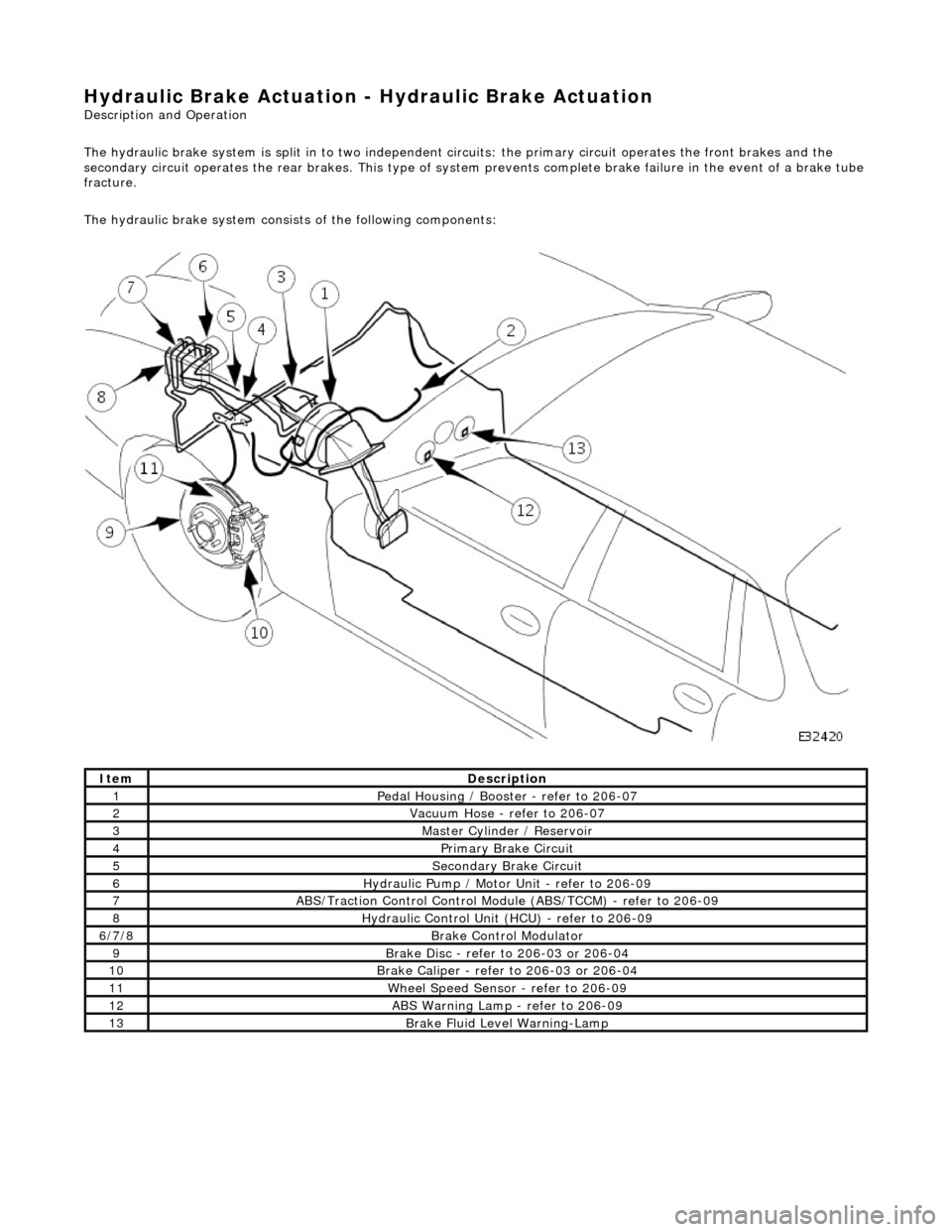
Hydraulic Br
ake Actuation -
Hydraulic Brake Actuation
Description and Operation
The hydraulic brake system is split in to two independent circuits: the primary ci rcuit operates the front brakes and the
secondary circuit operates the re ar brakes. This type of system prevents comple te brake failure in the event of a brake tube
fracture.
The hydraulic brake system consists of the following components:
Ite
m
Descr
iption
1Pedal Housi
ng / Booster - refer to 206-07
2Vacu
um Hose - refer to 206-07
3Mast
er Cyl
inder / Reservoir
4Primary Brake Circu
i
t
5Secon
dary Brake Circuit
6Hydrauli c
Pump / Motor Unit - refer to 206-09
7ABS/Traction
Control Control Modu
le (ABS/TCCM) - refer to 206-09
8Hydraulic Cont
rol Unit (HCU) - refer to 206-09
6/
7/
8
Br
ak
e Control Modulator
9Brake
Di
sc - refer to 206-03 or 206-04
10Brake
Cali
per - refer to 206-03 or 206-04
11W
h
eel Speed Sensor - refer to 206-09
12ABS Warning Lamp -
refer to 206
-09
13Brake F
l
uid Level Warning-Lamp
Page 419 of 2490
Install peda
l housing to vehicle.
Make sure ped
al housing apertu
re is positioned correctly.
Inst
all and tighten nuts to 15-20 Nm.
3. Position cloth underneath master cylinder to collect brake fluid
spillage.
4. Inst
all brake tubes to master cylinder.
Re
move plugs.
Connect
and tighten brake tubes. Refer to Specification
section 206-06 for torque setting.
R
emove cloth from underneath master cylinder.
5. Con
nect throttle cabl
e to pedal housing.
Inst
all cable to grommet.
Inst
all cable to
pedal housing.
6. Conne
ct throttle inner ca
ble to pedal grommet.
7. Connect vacuum pipe elbow to brake booster.
1. Install new seal.
2. Connect pipe.
Page 422 of 2490
Power Brake Actuation - Brake Booster
Description and Operation
The brake b
ooster provides assi
stance by reinforcing the driver's effort when brakin g. The reinforced assistance
provided by the booster is proportional to the driver's effort applied to the brake pedal.
The brake force applied by
the driver is incr
eased by the booster in a ratio of 6.5:1.
Th
e vacuum used to operate the booster
is formed in the engine's intake manifold. The booster is connected to the
intake manifold by a hose.
The boost
er is fail-safe therefore, if a fault develops in
the vacuum unit, the braking system will still function.
However, the driver will have to apply a greater fo rce to the brake pedal to slow down the vehicle.
It e
m
Par
t
Number
De
scr
iption
1—Mas
t
er Cylinder / Reservoir - refer to 206-06
2—Booster
3—Pedal Box
- refer to 206-06
4—Vacuu
m
Hose
5—No
n
-Return Valve
Page 430 of 2490

Anti-Lock Control - Anti-Lock Control
Description and Operation
Wheel Spe
ed Sensors
Each
wheel is monitored by a wheel speed se n
sor, to detect the speed of movement of
a toothed gear that is driven by the
wheel. Signal's generate d by the toothed gear passing th e sensor are sent to the ABS/TCCM to communicate the speed of
wheel rotation and any rapid change of wheel speed.
The frequency of the sinusoidal output voltag e signal from the sensor, is proportional to road wheel rotational speed and the
number of teeth on the toothed gear. The amplitude of the volt age is dependent upon the 'air gap' between the sensor and
toothed wheel, therefore it is important that this preset gap remains clear and undisturbed.
Ite
m
De
scr
iption
1Pe
dal Housi
ng / Booster - refer to 206-07
2Vac
u
um Hose - refer to 206-07
3Mas
t
er Cylinder / Reservoir - refer to 206-06
4Pri
m
ary Brake Circuit - refer to 206-06
5Sec
ondary Brake Circuit - refer to 206-06
6Hydraulic
Pump / Motor Unit
7ABS/Traction
Control Control Module (ABS/TCCM)
8Hydraulic Cont
rol Unit (HCU)
6/
7/
8
Br
ak
e Control Modulator
9Brake
Di
sc - refer to 206-03 or 206-04
10Brake
Cali
per - refer to 206-03/206-04
11Wh
ee
l Speed Sensor
12ABS Warning Lamp
13Brake
Fl
uid Level Warning-Lamp - refer to 206-06