1998 ISUZU TROOPER UBS
[x] Cancel search: UBSPage 1 of 3573
W O R K S H O P M A N U A L
US VERSION
RIGHT HAND MODEL
EXP UBS
PubNo. RV99_02-01.E
Page 2 of 3573
W O R K S H O P M A N U A L
1998/1999
U B S
2000
UBS
2002
UBS
Page 17 of 3573
GENERAL INFORMATION 0AÐ3
HOW TO USE THIS MANUAL
1. Find the applicable section by referring to the
table of contents on the introduction page of
each manual.
2. In ÒService InformationÓ, an opening section of
each manual, the troubleshooting, maintenance
servicing, service data and/or information on
special tools required for the service operations
described in the next subsequent sections are
arranged and compiled so concisely that you
can see at a first glance.
3. Each section except the Service Information
section is basically arranged in the following
order of headings:
General description
On-vehicle service
Unit repair4. The service operations are in two groups: one is
the ÒOn-vehicle serviceÓ where operations can
be directly performed on the vehicle, and the
other is the ÒUnit repairÓ where the operations
are done on the work bench after removing the
unit from the vehicle.
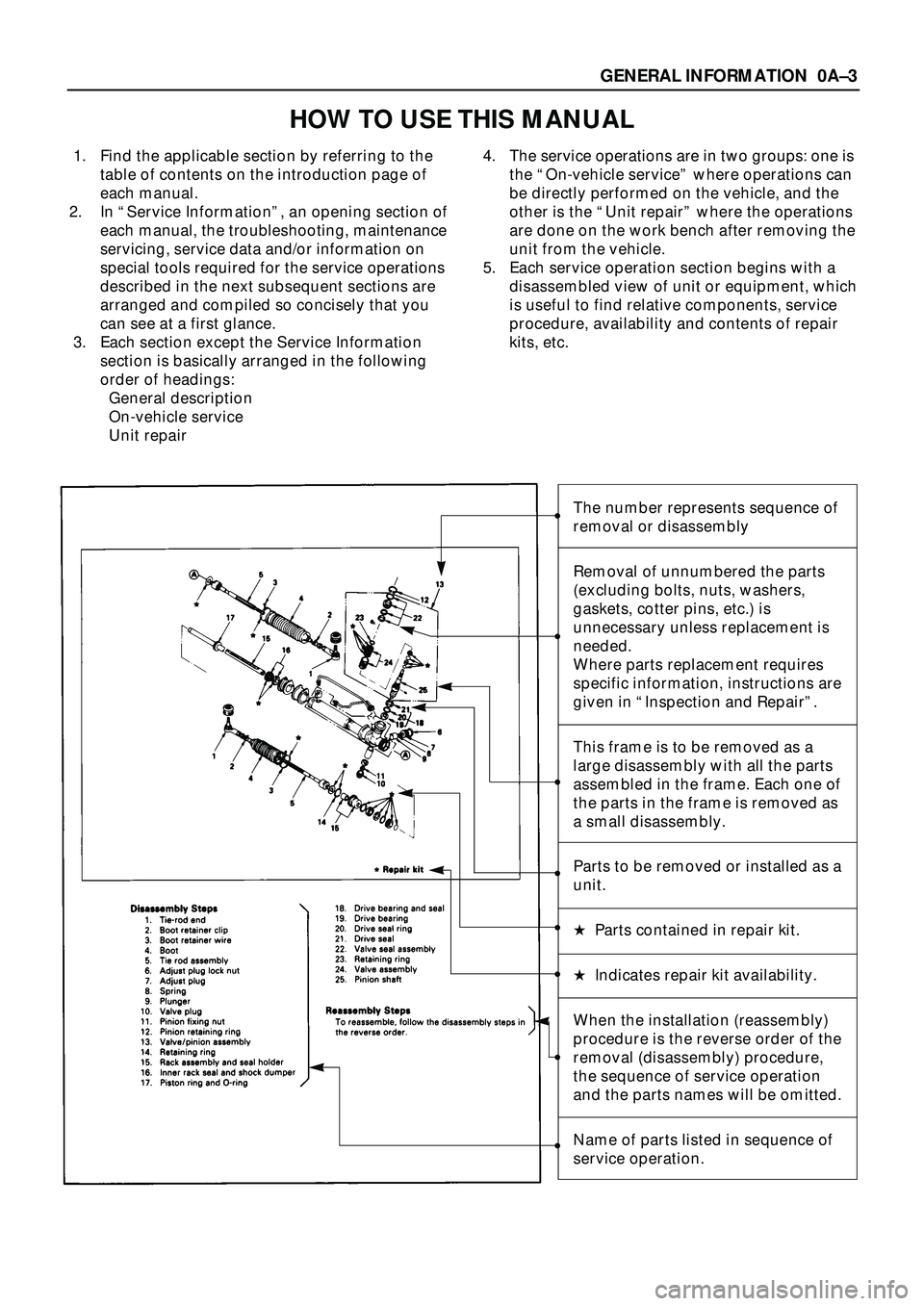
5. Each service operation section begins with a
disassembled view of unit or equipment, which
is useful to find relative components, service
procedure, availability and contents of repair
kits, etc.
The number represents sequence of
removal or disassembly
Removal of unnumbered the parts
(excluding bolts, nuts, washers,
gaskets, cotter pins, etc.) is
unnecessary unless replacement is
needed.
Where parts replacement requires
specific information, instructions are
given in ÒInspection and RepairÓ.
This frame is to be removed as a
large disassembly with all the parts
assembled in the frame. Each one of
the parts in the frame is removed as
a small disassembly.
Parts to be removed or installed as a
unit.
H Parts contained in repair kit.
H Indicates repair kit availability.
When the installation (reassembly)
procedure is the reverse order of the
removal (disassembly) procedure,
the sequence of service operation
and the parts names will be omitted.
Name of parts listed in sequence of
service operation.
Page 20 of 3573
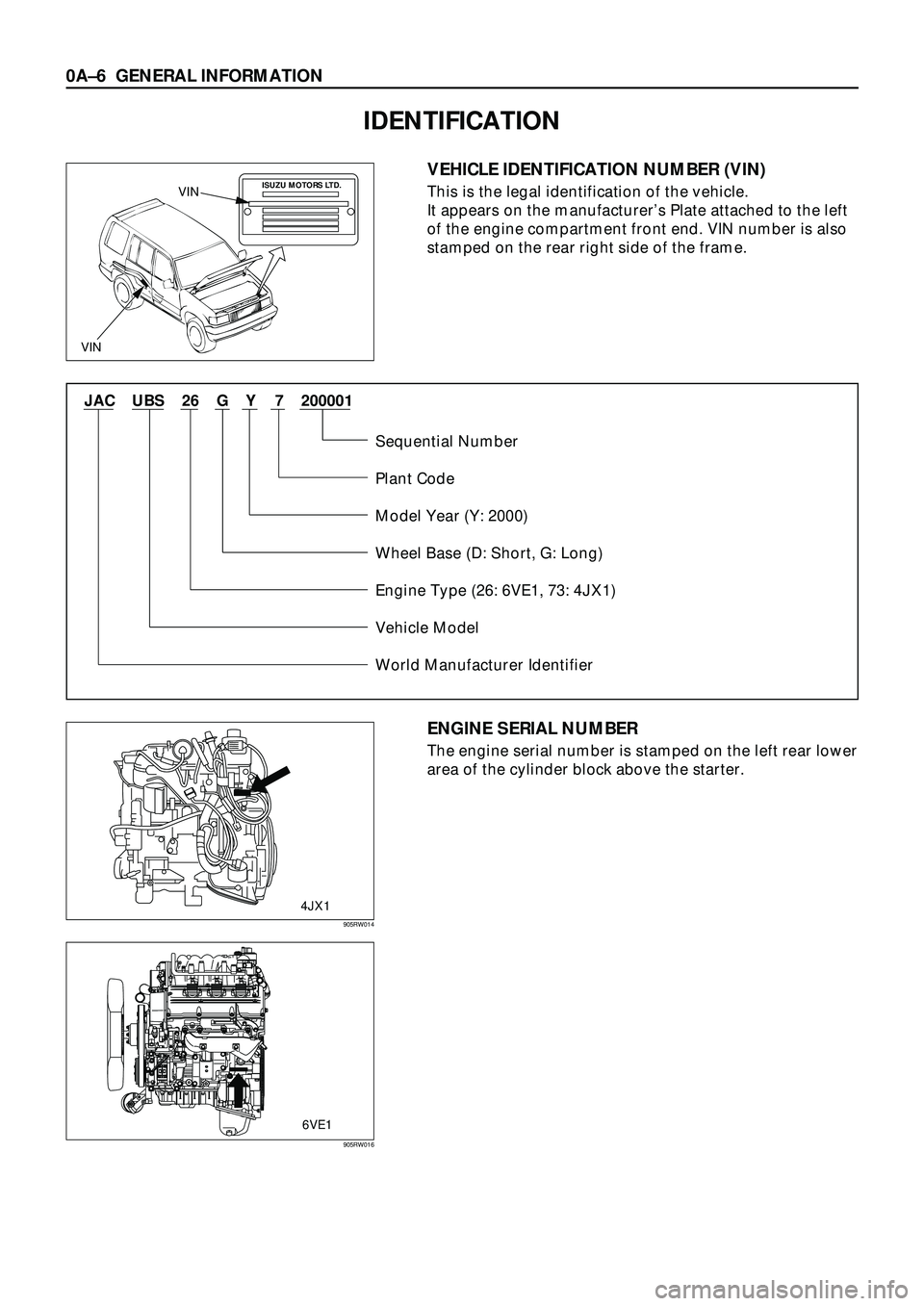
VEHICLE IDENTIFICATION NUMBER (VIN)
This is the legal identification of the vehicle.
It appears on the manufacturerÕs Plate attached to the left
of the engine compartment front end. VIN number is also
stamped on the rear right side of the frame.VIN
VINISUZU MOTORS LTD.
JAC UBS 26 G Y 7 200001
Sequential Number
Plant Code
Model Year (Y: 2000)
Wheel Base (D: Short, G: Long)
Engine Type (26: 6VE1, 73: 4JX1)
Vehicle Model
World Manufacturer Identifier
ENGINE SERIAL NUMBER
The engine serial number is stamped on the left rear lower
area of the cylinder block above the starter.
4JX1
6VE1
0AÐ6 GENERAL INFORMATION
IDENTIFICATION
905RW014
905RW016
Page 30 of 3573
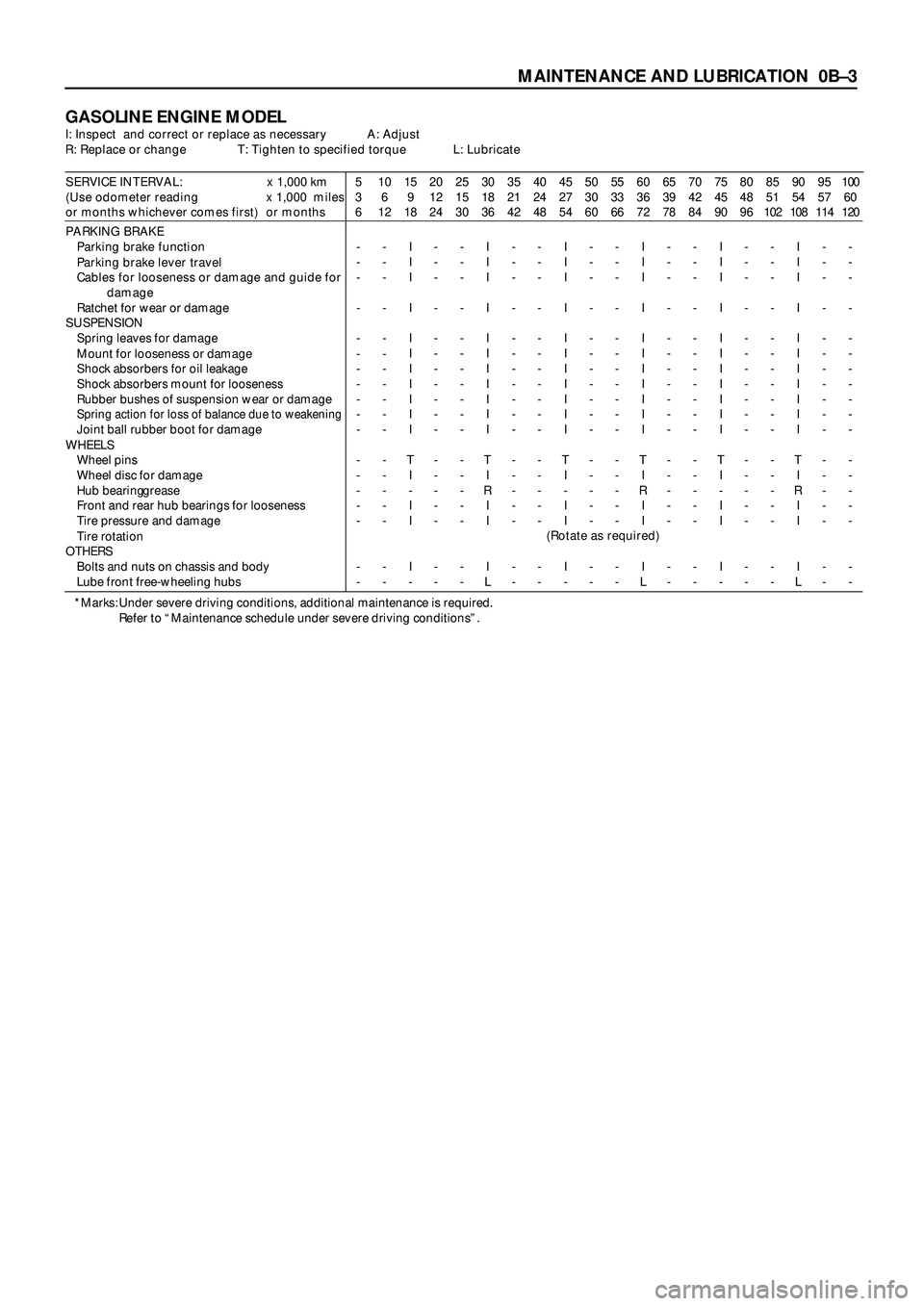
MAINTENANCE AND LUBRICATION 0BÐ3
GASOLINE ENGINE MODELI: Inspect and correct or replace as necessary A: Adjust
R: Replace or change T: Tighten to specified torque L: Lubricate
SERVICE INTERVAL: x 1,000 km
(Use odometer reading x 1,000 miles
or months whichever comes first) or months5
3
610
6
1215
9
1820
12
2425
15
3030
18
3635
21
4240
24
4845
27
5450
30
6055
33
6660
36
7265
39
7870
42
8475
45
9080
48
9685
51
10290
54
10895
57
114100
60
120
PARKING BRAKE
Parking brake function
Parking brake lever travel
Cables for looseness or damage and guide for
damage
Ratchet for wear or damage
SUSPENSION
Spring leaves for damage
Mount for looseness or damage
Shock absorbers for oil leakage
Shock absorbers mount for looseness
Rubber bushes of suspension wear or damage
Spring action for loss of balance due to weakeningJoint ball rubber boot for damage
WHEELS
Wheel pins
Wheel disc for damage
Hub bearing grease
Front and rear hub bearings for looseness
Tire pressure and damage
Tire rotation
OTHERS
Bolts and nuts on chassis and body
Lube front free-wheeling hubs-
-
-
-
-
-
-
-
-
-
-
-
-
-
-
-
-
--
-
-
-
-
-
-
-
-
-
-
-
-
-
-
-
-
-I
I
I
I
I
I
I
I
I
I
I
T
I
-
I
I
I
--
-
-
-
-
-
-
-
-
-
-
-
-
-
-
-
-
--
-
-
-
-
-
-
-
-
-
-
-
-
-
-
-
-
-I
I
I
I
I
I
I
I
I
I
I
T
I
R
I
I
I
L-
-
-
-
-
-
-
-
-
-
-
-
-
-
-
-
-
--
-
-
-
-
-
-
-
-
-
-
-
-
-
-
-
-
-I
I
I
I
I
I
I
I
I
I
I
T
I
-
I
I
I
--
-
-
-
-
-
-
-
-
-
-
-
-
-
-
-
-
--
-
-
-
-
-
-
-
-
-
-
-
-
-
-
-
-
-I
I
I
I
I
I
I
I
I
I
I
T
I
R
I
I
I
L-
-
-
-
-
-
-
-
-
-
-
-
-
-
-
-
-
--
-
-
-
-
-
-
-
-
-
-
-
-
-
-
-
-
-I
I
I
I
I
I
I
I
I
I
I
T
I
-
I
I
I
--
-
-
-
-
-
-
-
-
-
-
-
-
-
-
-
-
--
-
-
-
-
-
-
-
-
-
-
-
-
-
-
-
-
-I
I
I
I
I
I
I
I
I
I
I
T
I
R
I
I
I
L-
-
-
-
-
-
-
-
-
-
-
-
-
-
-
-
-
--
-
-
-
-
-
-
-
-
-
-
-
-
-
-
-
-
-
(Rotate as required)
*Marks: Under severe driving conditions, additional maintenance is required.
Refer to “Maintenance schedule under severe driving conditions”.
Page 32 of 3573
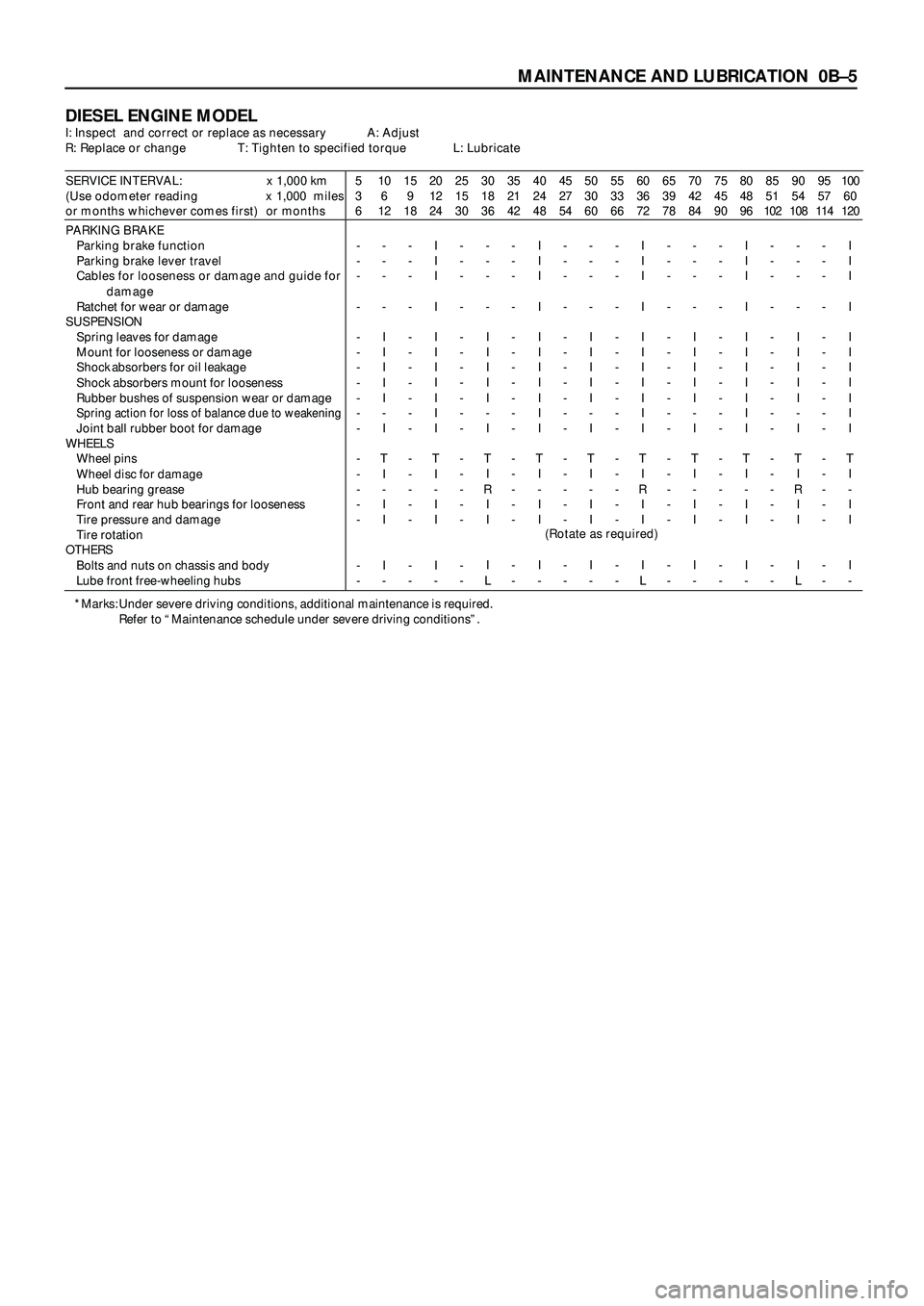
MAINTENANCE AND LUBRICATION 0BÐ5
DIESEL ENGINE MODELI: Inspect and correct or replace as necessary A: Adjust
R: Replace or change T: Tighten to specified torque L: Lubricate
SERVICE INTERVAL: x 1,000 km
(Use odometer reading x 1,000 miles
or months whichever comes first) or months5
3
610
6
1215
9
1820
12
2425
15
3030
18
3635
21
4240
24
4845
27
5450
30
6055
33
6660
36
7265
39
7870
42
8475
45
9080
48
9685
51
10290
54
10895
57
114100
60
120
PARKING BRAKE
Parking brake function
Parking brake lever travel
Cables for looseness or damage and guide for
damage
Ratchet for wear or damage
SUSPENSION
Spring leaves for damage
Mount for looseness or damage
Shock absorbers for oil leakage
Shock absorbers mount for looseness
Rubber bushes of suspension wear or damage
Spring action for loss of balance due to weakeningJoint ball rubber boot for damage
WHEELS
Wheel pins
Wheel disc for damage
Hub bearing grease
Front and rear hub bearings for looseness
Tire pressure and damage
Tire rotation
OTHERS
Bolts and nuts on chassis and body
Lube front free-wheeling hubs-
-
-
-
-
-
-
-
-
-
-
-
-
-
-
-
-
--
-
-
-
I
I
I
I
I
-
I
T
I
-
I
I
I
--
-
-
-
-
-
-
-
-
-
-
-
-
-
-
-
-
-I
I
I
I
I
I
I
I
I
I
I
T
I
-
I
I
I
--
-
-
-
-
-
-
-
-
-
-
-
-
-
-
-
-
--
-
-
-
I
I
I
I
I
-
I
T
I
R
I
I
I
L-
-
-
-
-
-
-
-
-
-
-
-
-
-
-
-
-
-I
I
I
I
I
I
I
I
I
I
I
T
I
-
I
I
I
--
-
-
-
-
-
-
-
-
-
-
-
-
-
-
-
-
--
-
-
-
I
I
I
I
I
-
I
T
I
-
I
I
I
--
-
-
-
-
-
-
-
-
-
-
-
-
-
-
-
-
-I
I
I
I
I
I
I
I
I
I
I
T
I
R
I
I
I
L-
-
-
-
-
-
-
-
-
-
-
-
-
-
-
-
-
--
-
-
-
I
I
I
I
I
-
I
T
I
-
I
I
I
--
-
-
-
-
-
-
-
-
-
-
-
-
-
-
-
-
-I
I
I
I
I
I
I
I
I
I
I
T
I
-
I
I
I
--
-
-
-
-
-
-
-
-
-
-
-
-
-
-
-
-
--
-
-
-
I
I
I
I
I
-
I
T
I
R
I
I
I
L-
-
-
-
-
-
-
-
-
-
-
-
-
-
-
-
-
-I
I
I
I
I
I
I
I
I
I
I
T
I
-
I
I
I
-
(Rotate as required)
*Marks: Under severe driving conditions, additional maintenance is required.
Refer to “Maintenance schedule under severe driving conditions”.
Page 62 of 3573
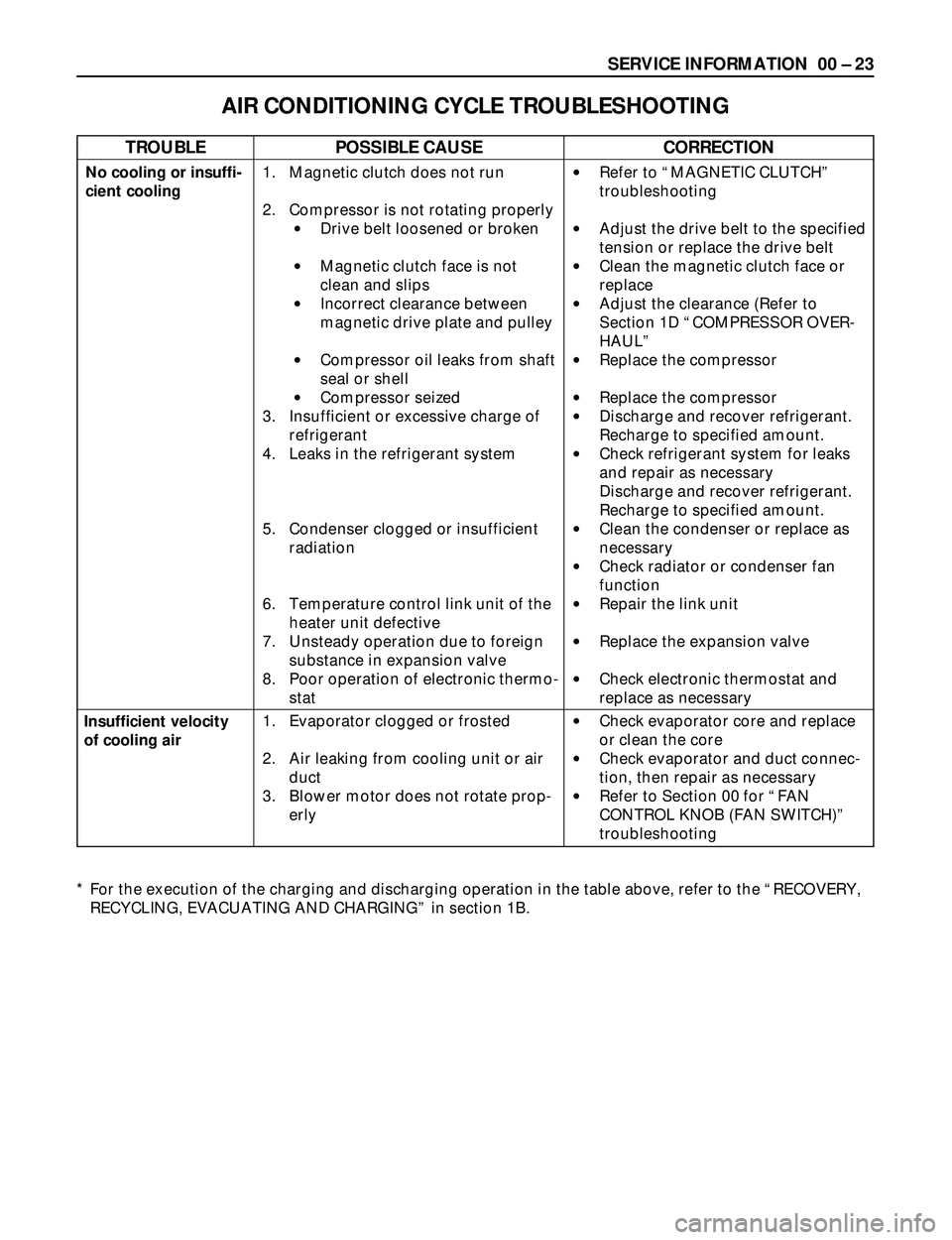
SERVICE INFORMATION 00 Ð 23
AIR CONDITIONING CYCLE TROUBLESHOOTING
No cooling or insuffi-
cient cooling
Insufficient velocity
of cooling air1. Magnetic clutch does not run
2. Compressor is not rotating properly
·Drive belt loosened or broken
·Magnetic clutch face is not
clean and slips
·Incorrect clearance between
magnetic drive plate and pulley
·Compressor oil leaks from shaft
seal or shell
·Compressor seized
3. Insufficient or excessive charge of
refrigerant
4. Leaks in the refrigerant system
5. Condenser clogged or insufficient
radiation
6. Temperature control link unit of the
heater unit defective
7. Unsteady operation due to foreign
substance in expansion valve
8. Poor operation of electronic thermo-
stat
1. Evaporator clogged or frosted
2. Air leaking from cooling unit or air
duct
3. Blower motor does not rotate prop-
erly·Refer to ÒMAGNETIC CLUTCHÓ
troubleshooting
·Adjust the drive belt to the specified
tension or replace the drive belt
·Clean the magnetic clutch face or
replace
·Adjust the clearance (Refer to
Section 1D ÒCOMPRESSOR OVER-
HAULÓ
·Replace the compressor
·Replace the compressor
·Discharge and recover refrigerant.
Recharge to specified amount.
·Check refrigerant system for leaks
and repair as necessary
Discharge and recover refrigerant.
Recharge to specified amount.
·Clean the condenser or replace as
necessary
·Check radiator or condenser fan
function
·Repair the link unit
·Replace the expansion valve
·Check electronic thermostat and
replace as necessary
·Check evaporator core and replace
or clean the core
·Check evaporator and duct connec-
tion, then repair as necessary
·Refer to Section 00 for ÒFAN
CONTROL KNOB (FAN SWITCH)Ó
troubleshooting
* For the execution of the charging and discharging operation in the table above, refer to the ÒRECOVERY,
RECYCLING, EVACUATING AND CHARGINGÓ in section 1B.
TROUBLEPOSSIBLE CAUSECORRECTION
Page 261 of 3573
COMPRESSOR OVERHAUL 1D Ð 5
Checking and Adjusting for Compressor
Replacement
150cc (4.2 Imp fl oz) of oil is charged in compressor
(service parts). So it is necessary to drain the proper
amount of oil from the new compressor.
1) Perform oil return operation.
2) Discharge refrigerant and remove the
compressor.
3) Drain the compressor oil and measure the
extracted oil.
4) Check the compressor oil for contamination.
5) Adjust oil level as required.
Amount of oil drained Draining amount of oil
from used compressor from new compressor
less than Same as drained
90cc (2.5 Imp fl oz) amount
more than
90cc (2.5 Imp fl oz)
90cc (2.5 Imp fl oz)
6) Evacuate, charge and perform oil return
operation.
7) Check system operation.
CONTAMINATION OF COMPRESSOR OIL
Unlike engine oil, no cleaning agent is added to the
compressor oil. Even if the compressor runs for a
long period of time (approximately 1 season), the
oil never becomes contaminated as long as there is
nothing wrong with the compressor or its method
of use.
Inspect the extracted oil for any of the following
conditions:
·The capacity of the oil has increased.
·The oil has changed color to red.
·Foreign substances, metal powder, etc., are
present in the oil.
If any of these conditions exists, compressor oil is
contaminated. Whenever contaminated
compressor oil is discovered, the receiver/drier
must be replaced.
OIL RETURN OPERATION
There is close affinity between the oil and the
refrigerant. During normal operation, part of the oil
recirculates with the refrigerant in the system.
When checking the amount of oil in the system, or
replacing any component of the system, the
compressor must be run in advance for oil return
operation. The procedure is as follows:
1) Open the all doors and engine hood.
2) Start the engine and A/C switch is ÒONÓ and
Set the fan control knob at its highest position.
3) Run the compressor for more than 20 minutes
between 800 and 1,000 rpm in order to operate
the system.
4) Stop the engine.
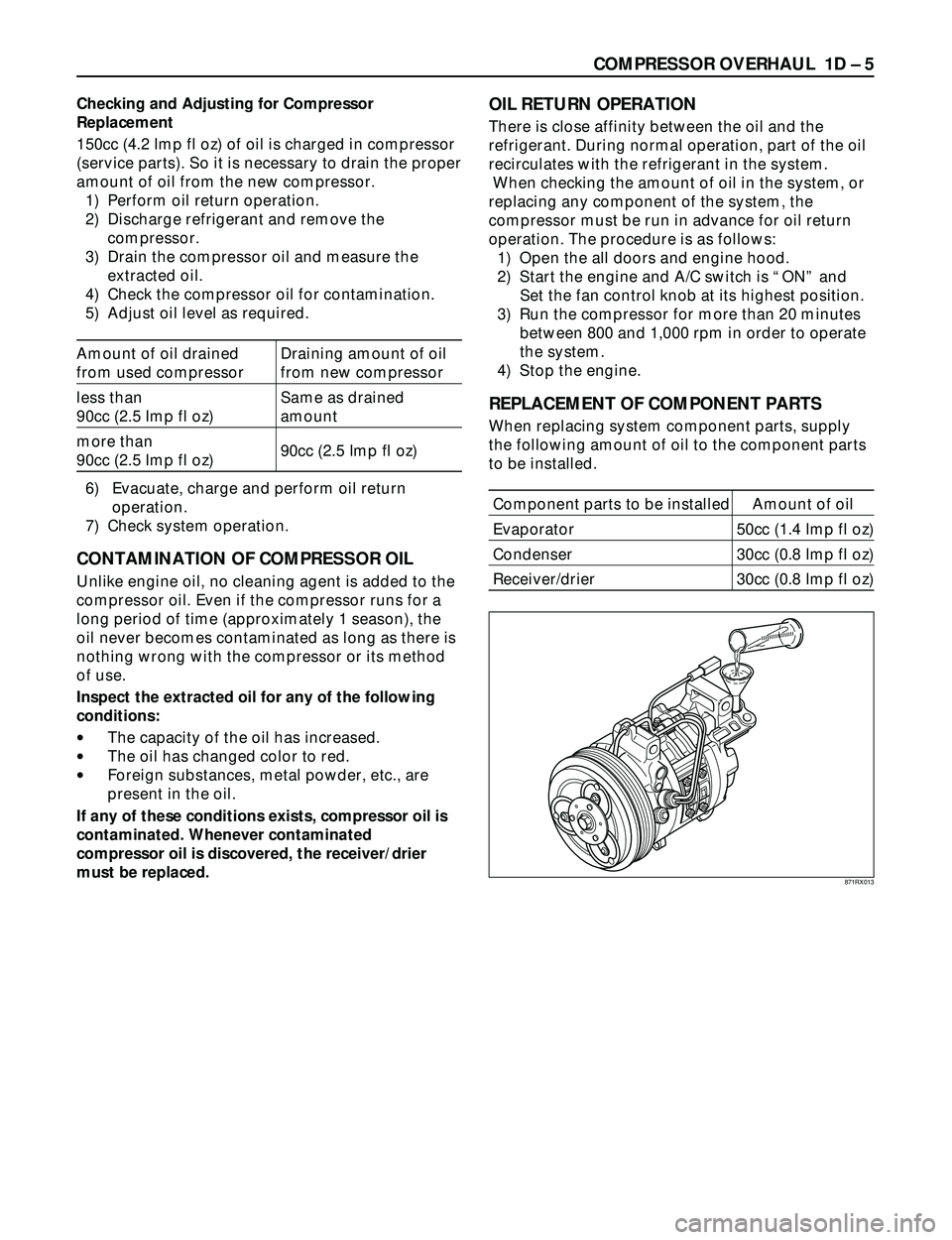
REPLACEMENT OF COMPONENT PARTS
When replacing system component parts, supply
the following amount of oil to the component parts
to be installed.
Component parts to be installed Amount of oil
Evaporator 50cc (1.4 Imp fl oz)
Condenser 30cc (0.8 Imp fl oz)
Receiver/drier 30cc (0.8 Imp fl oz)
871RX013