1998 ISUZU TROOPER charging
[x] Cancel search: chargingPage 142 of 3573

1B Ð 16 AIR CONDITIONING
WARNING
·SHOULD HFC-134a CONTACT YOUR EYE(S),
CONSULT A DOCTOR IMMEDIATELY.
·DO NOT RUB THE AFFECTED EYE(S). INSTEAD,
SPLASH QUANTITIES OF FRESH COLD WATER
OVER THE AFFECTED AREA TO GRADUALLY
RAISE THE TEMPERATURE OF THE
REFRIGERANT ABOVE THE FREEZING POINT.
·OBTAIN PROPER MEDICAL TREATMENT AS
SOON AS POSSIBLE. SHOULD THE HFC-134a
TOUCH THE SKIN, THE INJURY MUST BE
TREATED THE SAME AS SKIN WHICH HAS
BEEN FROSTBITTEN OR FROZEN.
REFRIGERANT RECOVERY
The refrigerant must be discharged and recovered by
using ACR4(HFC-134a Refrigerant Recovery/ Recycling/
Recharging/ System) or equivalent before removing or
mounting air conditioning parts.
ACR
4(115V 60Hz) : 5-8840-0629-0 (J-39500-A)
ACR4(220-240V 50/60Hz)
: 5-8840-0630-0 (J-39500-220A)
ACR
4(220-240V 50/60Hz Australian model)
: 5-8840-0631-0 (J-39500-220ANZ)
1) Connect the high and low charging hoses of the ACR
4
(or equivalent) as shown
2) Recover the refrigerant by following the ACR4
ManufactureÕs Instructions.
3) When a part is removed, put a cap or a plug on the
connecting portion so that dust, dirt or moisture
cannot get into it.
ACR4
(Low side) (High side)
HFC 134a
REFRIGERANT RECYCLING
Recycle the refrigerant recovered by ACR4or equivalent.
For the details of the actual operation, follow the steps in
the ACR
4ManufactureÕs Instructions.
ACR
4(115V 60Hz) : 5-8840-0629-0 (J-39500-A)
ACR4(220-240V 50/60Hz)
: 5-8840-0630-0 (J-39500-220A)
ACR
4(220-240V 50/60Hz Australian model)
: 5-8840-0631-0 (J-39500-220ANZ)
Page 143 of 3573
AIR CONDITIONING 1B Ð 17
7) Check to ensure that the pressure does not change
after 10 minutes or more.
·If the pressure changes, check the system for leaks.
·If leaks occur, retighten the refrigerant line
connections and repeat the evacuation steps.
8) If no leaks are found, again operate the vacuum
pump for 20 minutes or more, After confirming that
the gauge manifold pressure is at 750 mmHg(30
inHg), close both hand valves.
9) Close positive shutoff valve.
Stop the vacuum pump and disconnect the center
hose from the vacuum pump. Air and moisture in the refrigerant will cause problems in
the air conditioning system.
Therefore, before charging the refrigerant, be sure to
evacuate air and moisture thoroughly from the system.
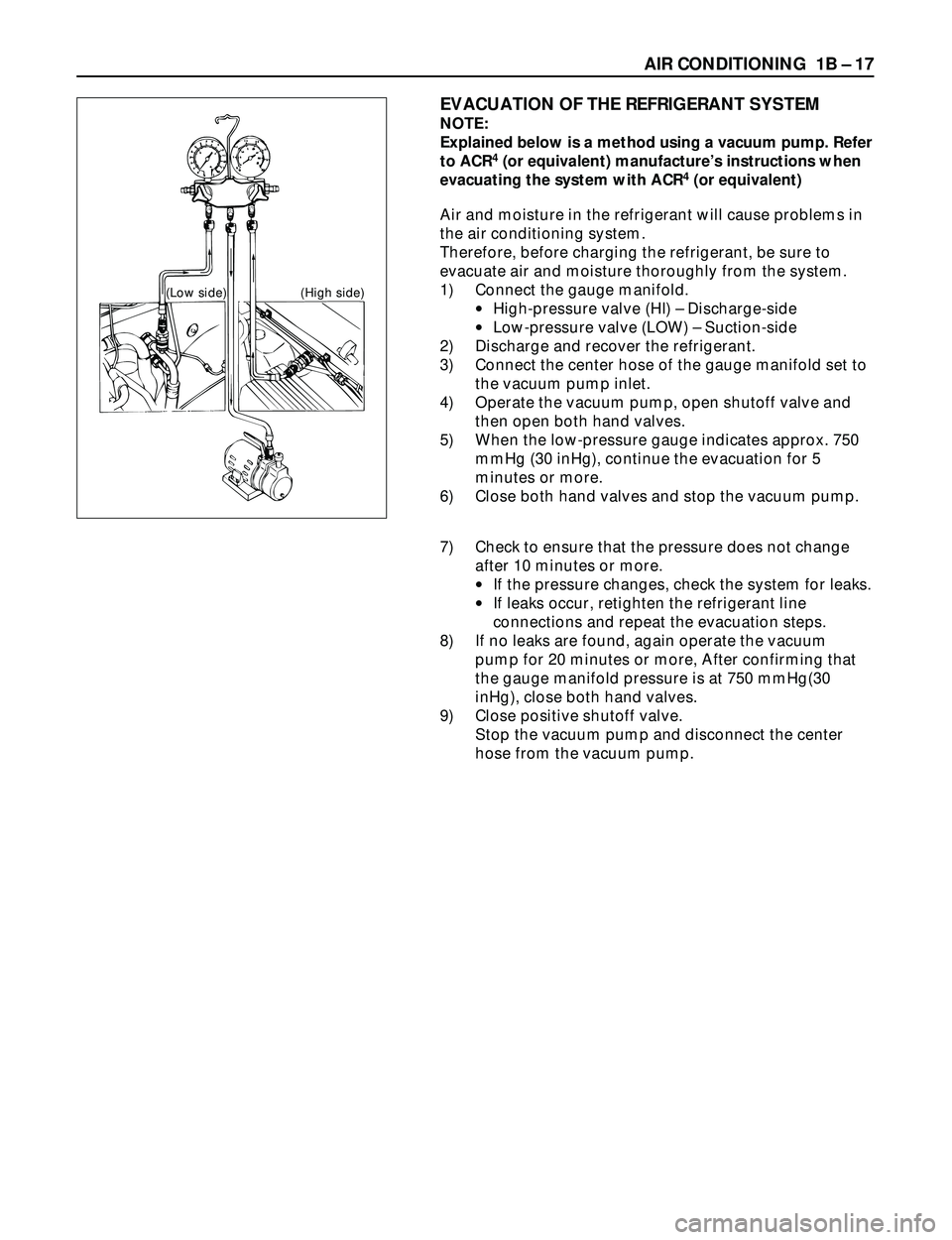
1) Connect the gauge manifold.
·High-pressure valve (HI) Ð Discharge-side
·Low-pressure valve (LOW) Ð Suction-side
2) Discharge and recover the refrigerant.
3) Connect the center hose of the gauge manifold set to
the vacuum pump inlet.
4) Operate the vacuum pump, open shutoff valve and
then open both hand valves.
5) When the low-pressure gauge indicates approx. 750
mmHg (30 inHg), continue the evacuation for 5
minutes or more.
6) Close both hand valves and stop the vacuum pump.
EVACUATION OF THE REFRIGERANT SYSTEM
NOTE:
Explained below is a method using a vacuum pump. Refer
to ACR
4(or equivalent) manufactureÕs instructions when
evacuating the system with ACR4(or equivalent)
(Low side) (High side)
Page 144 of 3573
1B Ð 18 AIR CONDITIONING
CHARGING THE REFRIGERANT SYSTEM
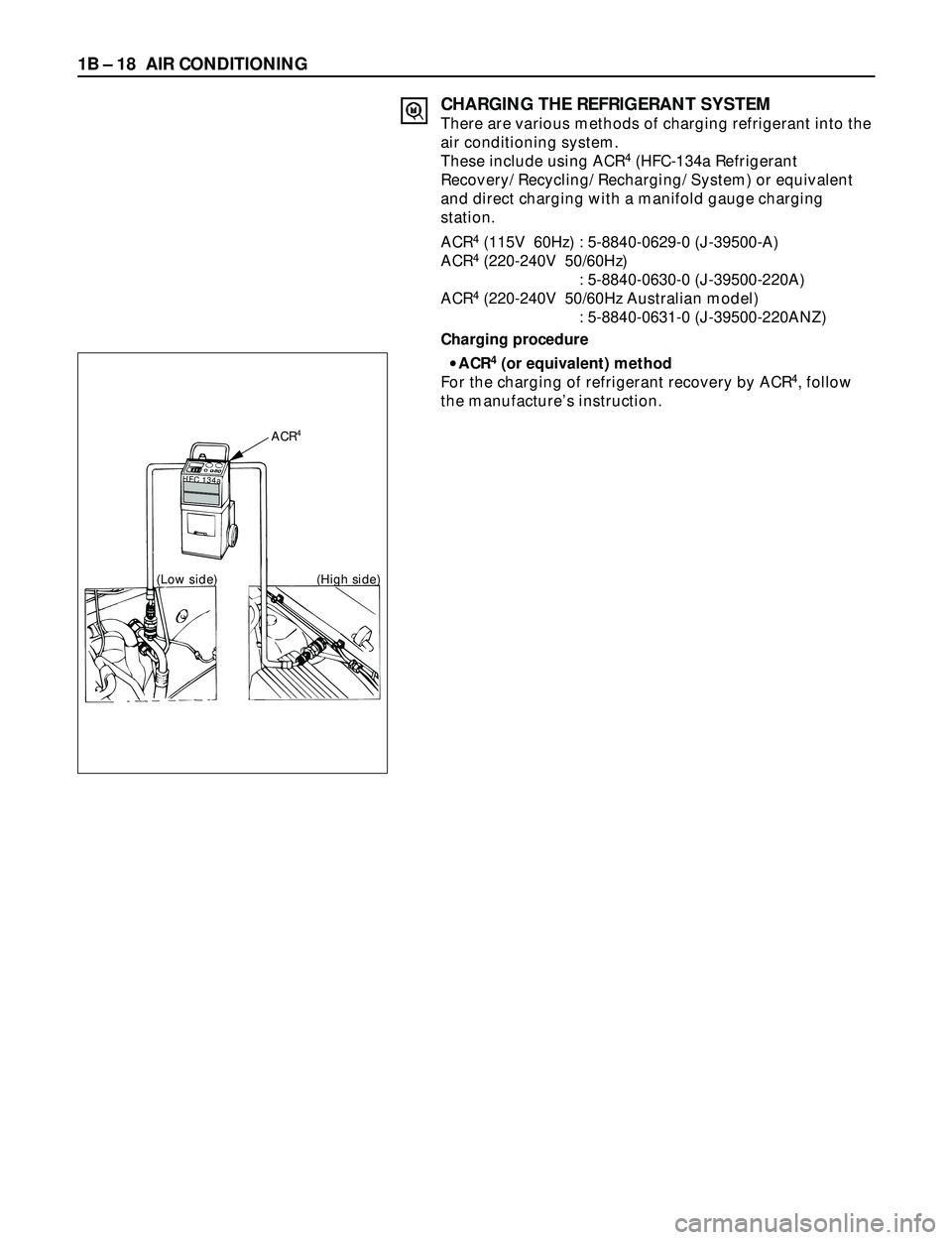
There are various methods of charging refrigerant into the
air conditioning system.
These include using ACR
4(HFC-134a Refrigerant
Recovery/ Recycling/ Recharging/ System) or equivalent
and direct charging with a manifold gauge charging
station.
ACR
4(115V 60Hz) : 5-8840-0629-0 (J-39500-A)
ACR4(220-240V 50/60Hz)
: 5-8840-0630-0 (J-39500-220A)
ACR
4(220-240V 50/60Hz Australian model)
: 5-8840-0631-0 (J-39500-220ANZ)
Charging procedure
·ACR4(or equivalent) method
For the charging of refrigerant recovery by ACR4, follow
the manufactureÕs instruction.
ACR4
(Low side) (High side)
HFC 134a
Page 145 of 3573
AIR CONDITIONING 1B Ð 19
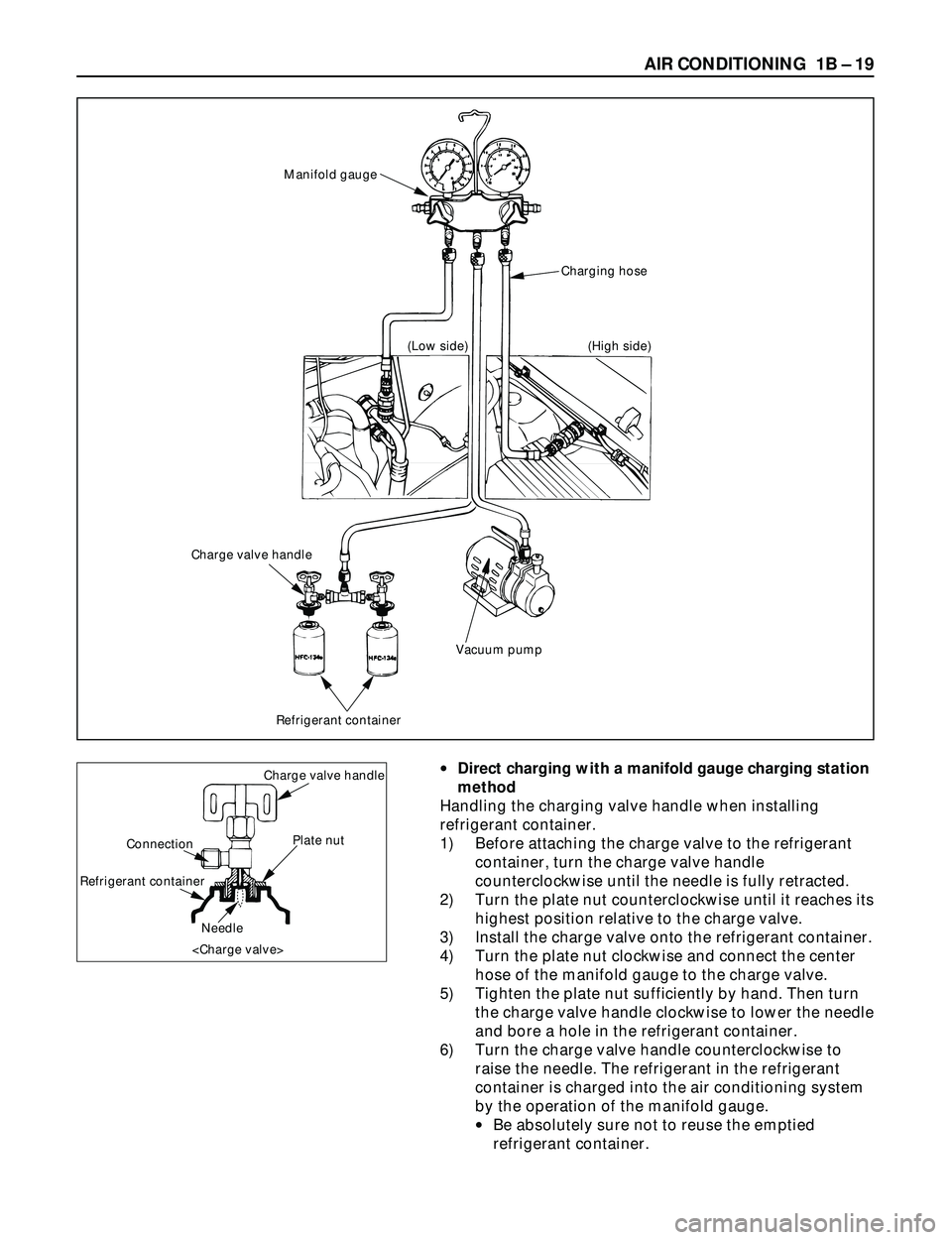
·Direct charging with a manifold gauge charging station
method
Handling the charging valve handle when installing
refrigerant container.
1) Before attaching the charge valve to the refrigerant
container, turn the charge valve handle
counterclockwise until the needle is fully retracted.
2) Turn the plate nut counterclockwise until it reaches its
highest position relative to the charge valve.
3) Install the charge valve onto the refrigerant container.
4) Turn the plate nut clockwise and connect the center
hose of the manifold gauge to the charge valve.
5) Tighten the plate nut sufficiently by hand. Then turn
the charge valve handle clockwise to lower the needle
and bore a hole in the refrigerant container.
6) Turn the charge valve handle counterclockwise to
raise the needle. The refrigerant in the refrigerant
container is charged into the air conditioning system
by the operation of the manifold gauge.
·Be absolutely sure not to reuse the emptied
refrigerant container.Charge valve handle
Plate nut
Needle Connection
Refrigerant container
Charging hose Manifold gauge
Vacuum pump
Refrigerant container
Charge valve handle
(Low side) (High side)
Page 146 of 3573

1B Ð 20 AIR CONDITIONING
1) Make sure the evacuation process is correctly
completed.
2) Connect the center-hose of the manifold gauge to the
refrigerant container.
·Turn the charge valve handle counterclockwise to
purge the charging line and purge any air existing
in the center-hose of the manifold gauge.
3) Open the low-pressure hand valve and charge the
refrigerant about 200 g(0.44 lbs.).
·Make sure the high-pressure hand valve is closed.
·Avoid charging the refrigerant by turning the
refrigerant container upside down.
4) Close the low-pressure hand valve of the manifold
gauge.
·Check to ensure that the degree of pressure does
not charge.
5) Check the refrigerant leaks by using a HFC-134a leak
detector.
·If a leak occurs, repair the leak connection, and
start all over again from the first step of
evacuation.
6) If no leaks are found, open the low-pressure hand
valve of the manifold gauge.Then continue charging
refrigerant to the system.
·When charging the system becomes difficult:
(1) Run the engine at Idling and close the all
vehicle doors.
(2) A/C switch is ÒONÓ.
(3) Set the fan control knob (fan switch) to its
highest position.
WARNING
BE ABSOLUTELY SURE NOT TO OPEN THE HIGH-
PRESSURE HAND VALVE. SHOULD THE HIGH-
PRESSURE HAND VALVE BE OPENED, THE HIGH-
PRESSURE REFRIGERANT GAS WOULD FLOW
BACKWARD, AND THIS MAY CAUSE THE
REFRIGERANT CONTAINER TO BURST.
7) When the refrigerant container is emptied, use the
following procedure to replace it with a new
refrigerant container.
(1) Close the low pressure hand valve.
(2) Raise the needle upward and remove the charge
valve.
(3) Reinstall the charge valve to the new refrigerant
container.
(4) Purge any air existing in the center hose of the
manifold gauge.
Page 147 of 3573

AIR CONDITIONING 1B Ð 21
8) Charge the system to the specified amount and then
close the low-pressure hand valve.
Refrigerant Amount g(lbs.)
750 (1.65)
DELPH1HD6/HT6 g(lbs.)
600 (1.32)
·A fully charged system is indicated by the sight
glass on the receiver/driver being free of any.
bubbles(Refer to ÒReading Sight GlassÓ).
·Check the high and low pressure value of the
manifold gauge.
·Check for refrigerant leaks by using a HFC-134a
leak detector.
Immediately after charging refrigerant, both high and low
pressures are slightly high and to the left of the gauge, but
they settle down to the guide pressure valves as shown
below:
·Ambient temperature; 25 ~30¡C (77 ~86¡F)
·Guide pressure
High-pressure side;
Approx. 1373 Ð 1863 kPa (14 Ð 19 kgácm
2/ 199 Ð 270 PSI)
Low-pressure side;
Approx. 147 Ð 294 kPa (1.4 Ð 3.0 kgácm
2/ 21 Ð 43 PSI)
9) Close the low pressure hand valve and charge valve
of the refrigerant container.
10) Stop the air conditioning and the engine.
11) Disconnect the high and low pressure hoses from the
manifold gauge fittings.
Page 260 of 3573
1D Ð 4 COMPRESSOR OVERHAUL
COMPRESSOR OIL
OIL SPECIFICATION
·The HFC-134a system requires a synthetic
(PAG) compressor oil.
·Compressor (PAG) oil varies according to
compressor model. Be sure to use oil specified
for the model of compressor.
DKV-14D : ZXL-200PG
(ISUZU PART NO.
8-97101-336-0)
DKS-15CH : ZXL-100PG
(ISUZU PART NO.
8-97101-338-0)
HANDLING OF OIL
·The oil should be free from moisture, dust,
metal powder, etc.
·Do not mix with other oil
·The water content in the oil increases when
exposed to the air. After use, seal oil from air
immediately.
·The compressor oil must be stored in steel
containers, not in plastic containers.
COMPRESSOR OIL CHECK
The oil used to lubricate the compressor is
circulating with the refrigerant.
Whenever replacing any component of the system
or a large amount of gas leakage occurs, add oil to
maintain the original amount of oil.
Oil Capacity
Capacity total in system 150cc (4.2 Imp fl oz)
Compressor (Service
150cc (4.2 Imp fl oz)
parts) charging amount
Checking and Adjusting for Used Compressor
1) Perform Oil return operation.
(Refer to ÒOil Return OperationÓ in this section.)
2) Discharge refrigerant and remove the
compressor.
3) Drain the compressor oil and measure the
extracted oil with a measuring cylinder.
4) If the amount of oil drained is much less than
90cc (2.5 Imp fl oz), some refrigerant may have
leaked out. Conduct leak tests on connections
of each system, and if necessary, repair or
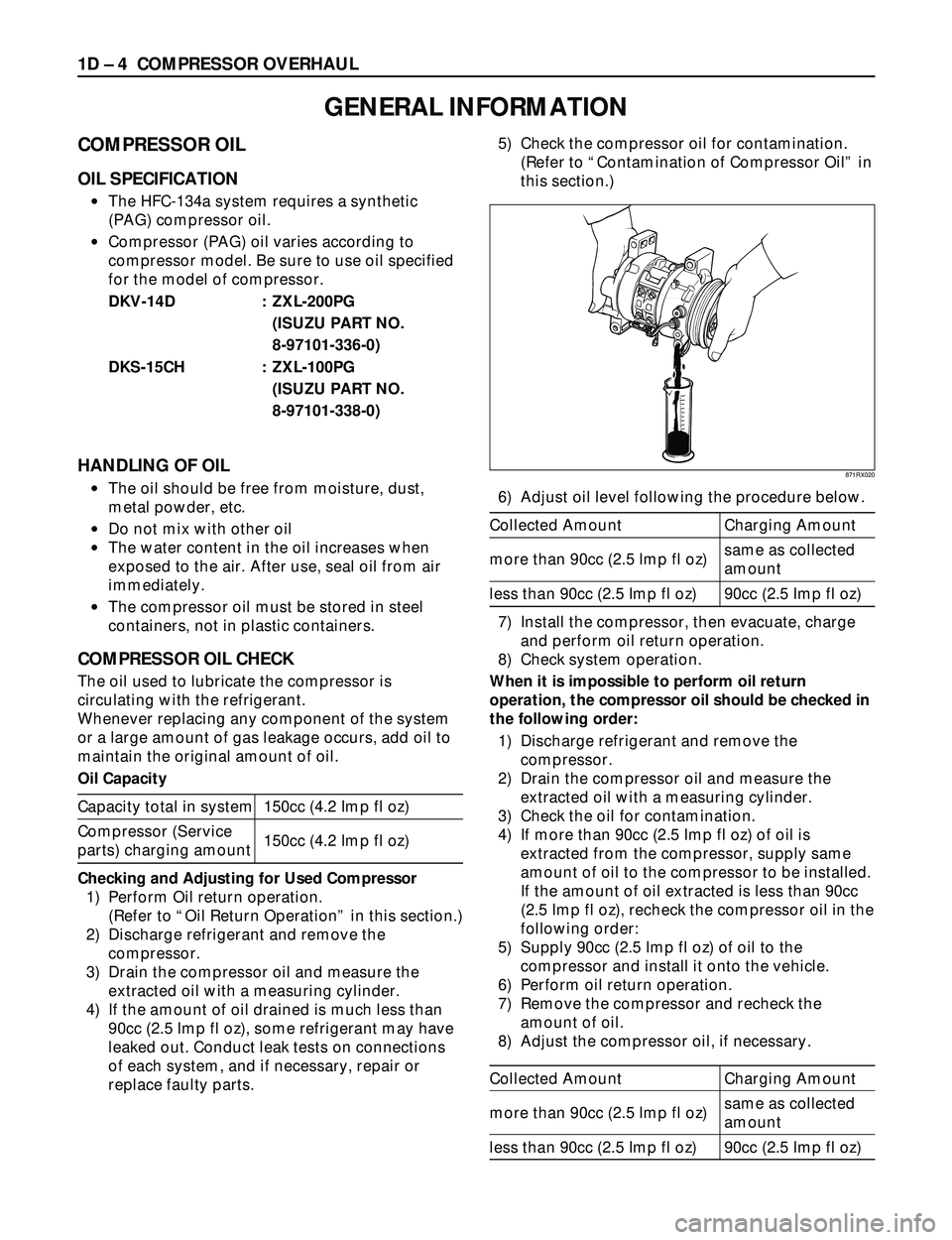
replace faulty parts.5) Check the compressor oil for contamination.
(Refer to ÒContamination of Compressor OilÓ in
this section.)
6) Adjust oil level following the procedure below.
Collected Amount Charging Amount
same as collected
more than 90cc (2.5 Imp fl oz)
amount
less than 90cc (2.5 Imp fl oz) 90cc (2.5 Imp fl oz)
7) Install the compressor, then evacuate, charge
and perform oil return operation.
8) Check system operation.
When it is impossible to perform oil return
operation, the compressor oil should be checked in
the following order:
1) Discharge refrigerant and remove the
compressor.
2) Drain the compressor oil and measure the
extracted oil with a measuring cylinder.
3) Check the oil for contamination.
4) If more than 90cc (2.5 Imp fl oz) of oil is
extracted from the compressor, supply same
amount of oil to the compressor to be installed.
If the amount of oil extracted is less than 90cc
(2.5 Imp fl oz), recheck the compressor oil in the
following order:
5) Supply 90cc (2.5 Imp fl oz) of oil to the
compressor and install it onto the vehicle.
6) Perform oil return operation.
7) Remove the compressor and recheck the
amount of oil.
8) Adjust the compressor oil, if necessary.
Collected Amount Charging Amount
same as collected
more than 90cc (2.5 Imp fl oz)
amount
less than 90cc (2.5 Imp fl oz) 90cc (2.5 Imp fl oz)
GENERAL INFORMATION
871RX020
Page 279 of 3573
COMPRESSOR OVERHAUL 1D Ð 23
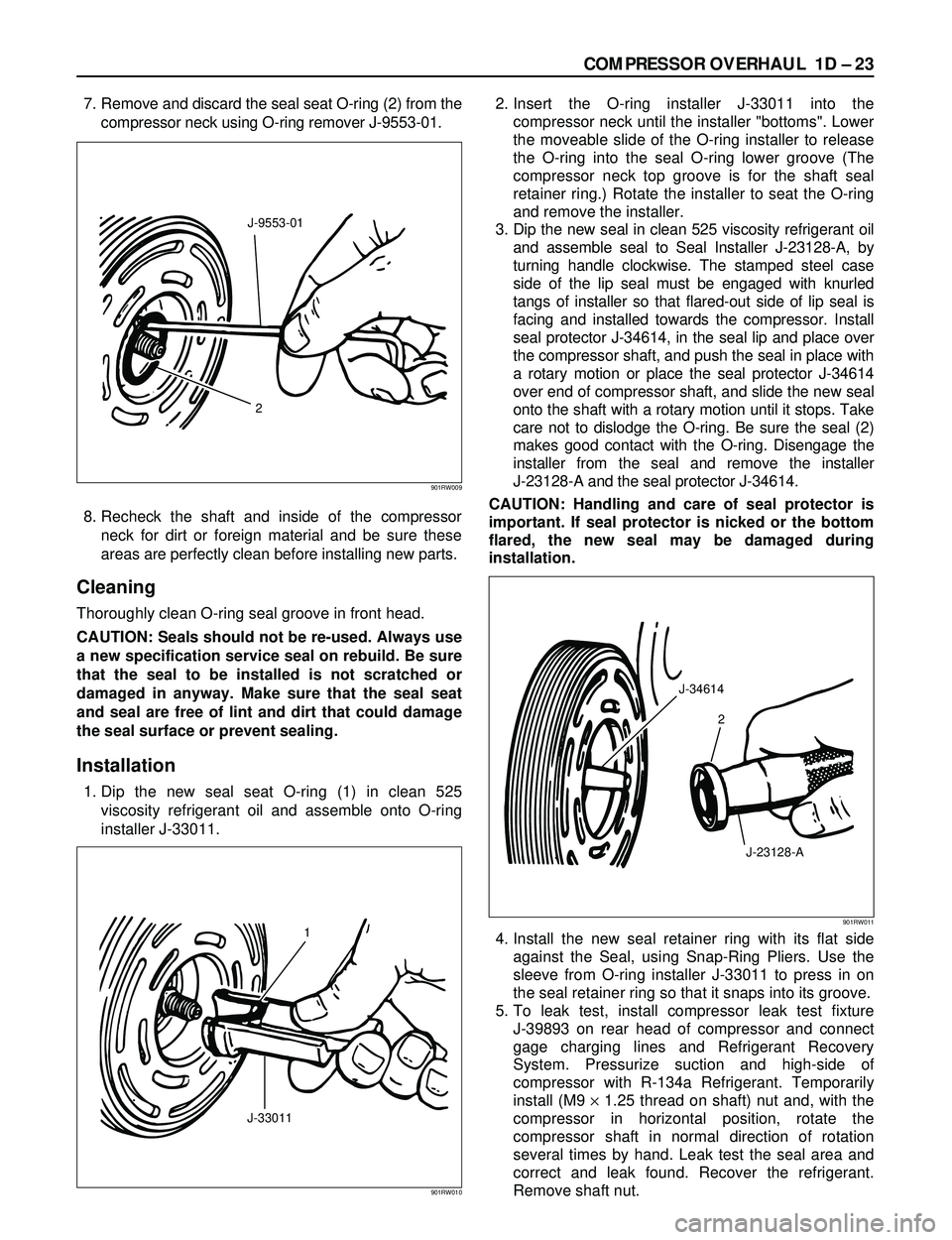
7. Remove and discard the seal seat O-ring (2) from the
compressor neck using O-ring remover J-9553-01.
8. Recheck the shaft and inside of the compressor
neck for dirt or foreign material and be sure these
areas are perfectly clean before installing new parts.
Cleaning
Thoroughly clean O-ring seal groove in front head.
CAUTION: Seals should not be re-used. Always use
a new specification service seal on rebuild. Be sure
that the seal to be installed is not scratched or
damaged in anyway. Make sure that the seal seat
and seal are free of lint and dirt that could damage
the seal surface or prevent sealing.
Installation
1. Dip the new seal seat O-ring (1) in clean 525
viscosity refrigerant oil and assemble onto O-ring
installer J-33011.2. Insert the O-ring installer J-33011 into the
compressor neck until the installer "bottoms". Lower
the moveable slide of the O-ring installer to release
the O-ring into the seal O-ring lower groove (The
compressor neck top groove is for the shaft seal
retainer ring.) Rotate the installer to seat the O-ring
and remove the installer.
3. Dip the new seal in clean 525 viscosity refrigerant oil
and assemble seal to Seal Installer J-23128-A, by
turning handle clockwise. The stamped steel case
side of the lip seal must be engaged with knurled
tangs of installer so that flared-out side of lip seal is
facing and installed towards the compressor. Install
seal protector J-34614, in the seal lip and place over
the compressor shaft, and push the seal in place with
a rotary motion or place the seal protector J-34614
over end of compressor shaft, and slide the new seal
onto the shaft with a rotary motion until it stops. Take
care not to dislodge the O-ring. Be sure the seal (2)
makes good contact with the O-ring. Disengage the
installer from the seal and remove the installer
J-23128-A and the seal protector J-34614.
CAUTION: Handling and care of seal protector is
important. If seal protector is nicked or the bottom
flared, the new seal may be damaged during
installation.
4. Install the new seal retainer ring with its flat side
against the Seal, using Snap-Ring Pliers. Use the
sleeve from O-ring installer J-33011 to press in on
the seal retainer ring so that it snaps into its groove.
5. To leak test, install compressor leak test fixture
J-39893 on rear head of compressor and connect
gage charging lines and Refrigerant Recovery
System. Pressurize suction and high-side of
compressor with R-134a Refrigerant. Temporarily
install (M9 ´1.25 thread on shaft) nut and, with the
compressor in horizontal position, rotate the
compressor shaft in normal direction of rotation
several times by hand. Leak test the seal area and
correct and leak found. Recover the refrigerant.
Remove shaft nut.
2 J-9553-01
901RW009
1
J-33011
901RW010
J-34614
2
J-23128-A
901RW011