Page 90 of 251
Heating and Cooling
Vent Controls
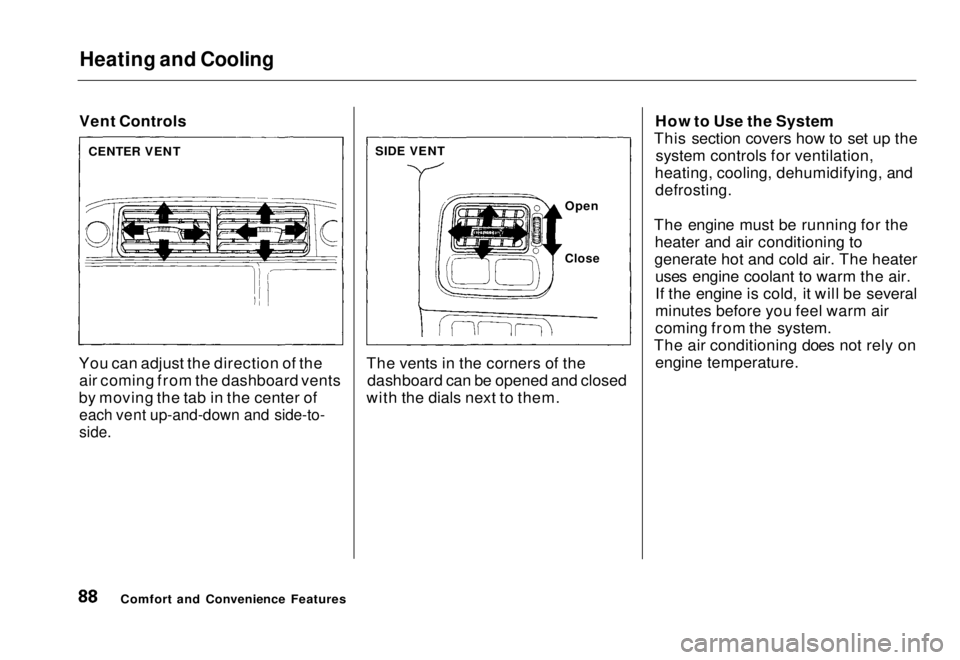
You can adjust the direction of the air coming from the dashboard vents
by moving the tab in the center of
each vent up-and-down and side-to-
side.
The vents in the corners of the
dashboard can be opened and closed
with the dials next to them. How to Use the System
This section covers how to set up the system controls for ventilation,
heating, cooling, dehumidifying, and defrosting.
The engine must be running for the heater and air conditioning to
generate hot and cold air. The heater uses engine coolant to warm the air.
If the engine is cold, it will be several
minutes before you feel warm air
coming from the system.
The air conditioning does not rely on engine temperature.
Comfort and Convenience Features
CENTER VENT
SIDE VENT
Open
CloseMain Menu Table of Contents s t
Page 112 of 251
Service Station Procedures
Opening the Hood
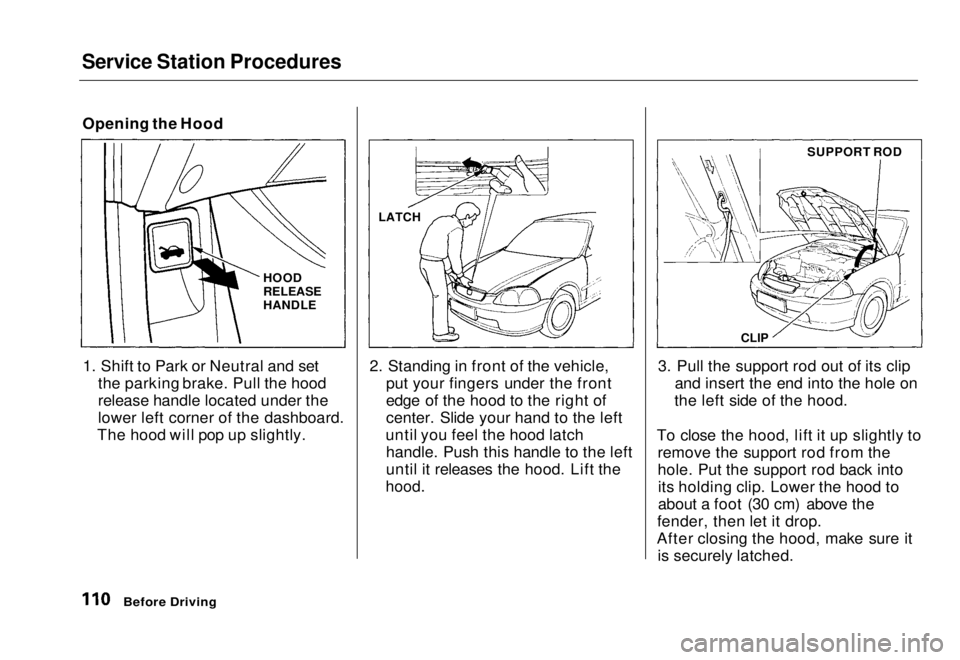
1. Shift to Park or Neutral and set the parking brake. Pull the hood
release handle located under the
lower left corner of the dashboard.
The hood will pop up slightly. 2. Standing in front of the vehicle,
put your fingers under the front
edge of the hood to the right of
center. Slide your hand to the left
until you feel the hood latch handle. Push this handle to the left
until it releases the hood. Lift the
hood.
3. Pull the support rod out of its clip
and insert the end into the hole on
the left side of the hood.
To close the hood, lift it up slightly to remove the support rod from the
hole. Put the support rod back intoits holding clip. Lower the hood to
about a foot (30 cm) above the
fender, then let it drop.
After closing the hood, make sure it is securely latched.
Before Driving
LATCH
HOOD
RELEASE
HANDLE
CLIP
SUPPORT RODMain Menu Table of Contents s t
Page 117 of 251

Accessories and Modifications
Modifications Do not remove any original
equipment or modify your vehicle in
any way that would alter its design or
operation. This could make your
vehicle unsafe and illegal to drive.
For example, do not make any
modifications that would change the
ride height of your vehicle, or install
wheels and tires with a different overall diameter.
Such modifications can adversely
affect handling, and interfere with
the operation of the vehicle's anti-
lock brakes and other systems. In addition, any modifications that
decrease ground clearance increase
the chance of undercarriage parts striking a curb, speed bump, or other
raised object, which could cause
your airbags to deploy.
Do not modify your steering wheelor any other part of your
Supplemental Restraint System.
Modifications could make the system ineffective. Additional Safety Precaution
Do not attach or place objects on theairbag covers. Any object attached to
or placed on the covers marked "SRS,"
in the center of the steering wheel and on top of the dashboard, could
interfere with the proper operation of the airbags. Or, if the airbags
inflate, the objects could be
propelled inside the vehicle and hurt
someone.
Before DrivingMain Menu Table of Contents s t
Page 222 of 251
Fuses
All the electrical circuits in your vehicle have fuses to protect them
from a short circuit or overload.
These fuses are located in two or three fuse boxes.
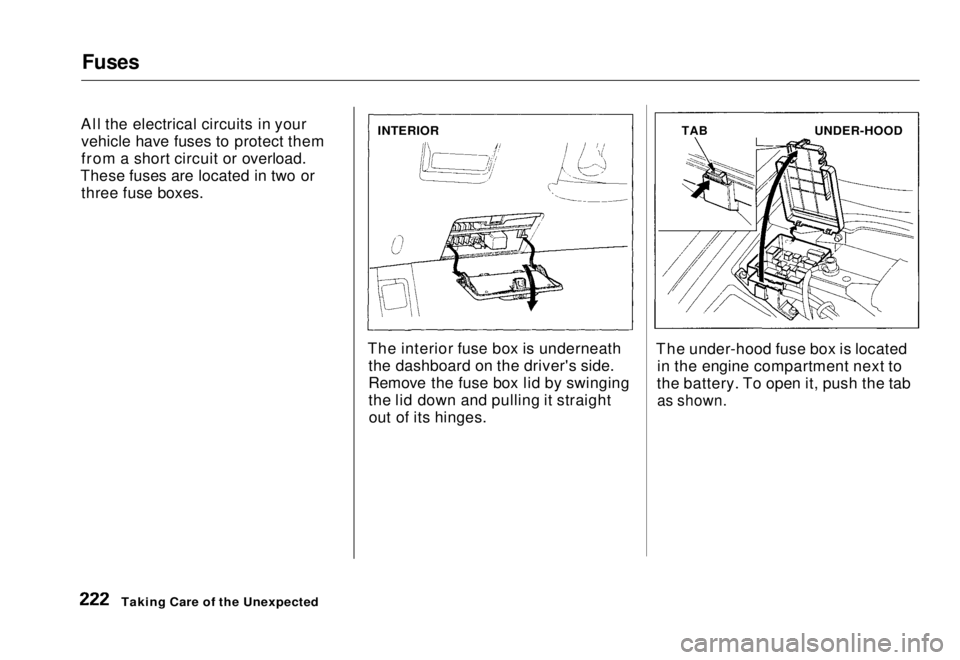
The interior fuse box is underneaththe dashboard on the driver's side.
Remove the fuse box lid by swinging
the lid down and pulling it straightout of its hinges. The under-hood fuse box is located
in the engine compartment next to
the battery. To open it, push the tab
as shown.
Taking Care of the Unexpected
INTERIOR
TAB
UNDER-HOODMain Menu Table of Contents s t
Page 230 of 251
Identification Numbers
Your vehicle has several identifying numbers located in various places.
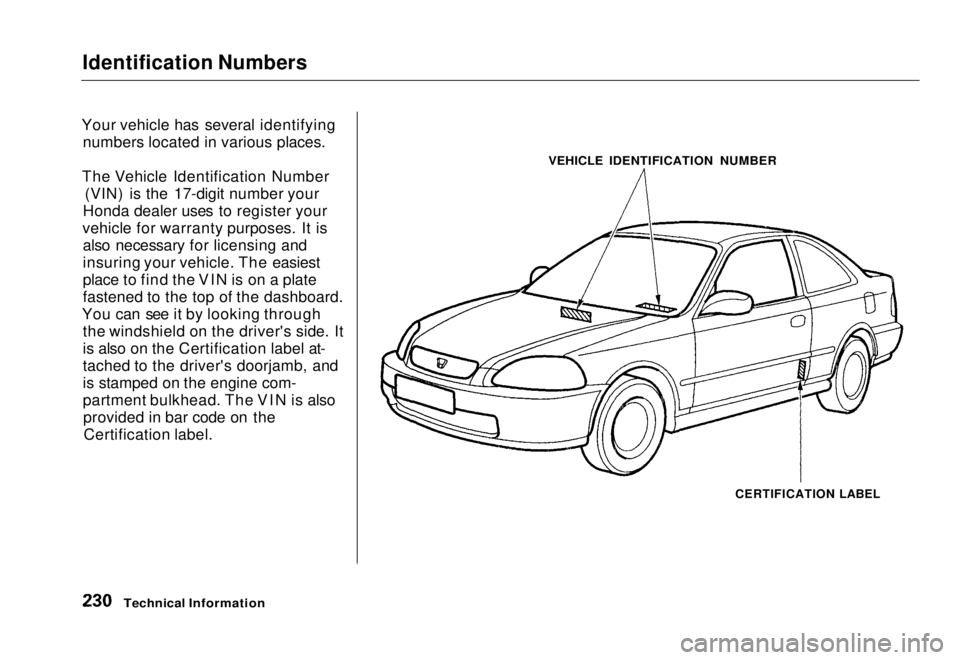
The Vehicle Identification Number (VIN) is the 17-digit number your
Honda dealer uses to register your
vehicle for warranty purposes. It is also necessary for licensing and
insuring your vehicle. The easiest
place to find the VIN is on a plate
fastened to the top of the dashboard.
You can see it by looking through the windshield on the driver's side. It
is also on the Certification label at-
tached to the driver's doorjamb, and
is stamped on the engine com-
partment bulkhead. The VIN is alsoprovided in bar code on theCertification label.
Technical Information
VEHICLE IDENTIFICATION NUMBER
CERTIFICATION LABELMain Menu Table of Contents s t
Page 249 of 251
Index
Compact Spare............................... 206
Consumer Information*................ 244
Controls, Instruments and.............. 49
Coolant
Adding......................................... 155
Checking..................................... 112
Proper Solution.......................... 159
Replacing.................................... 161
Temperature Gauge.................... 56
Corrosion Protection..................... 203
Crankcase Emissions Control
System......................................... 240
Cruise Control Operation............... 64
Customer Relations Office........... 244
DANGER, Explanation of................. ii
Dashboard........................................ 50
Daytime Running Lights................. 59
Dead Battery, What to Do............ 213
Defects, Reporting Safety............. 248
Defog and Defrost........................... 91
Defogger, Rear Window................. 62
Defrosting the Windows................. 91
DEXRON
®
III Automatic
Transmission Fluid.................... 165
Dimensions..................................... 232
Dimming the Headlights................ 59
Dipstick Automatic Transmission........... 165
Engine Oil................................... 112
Directional Signals........................... 60
Disabled, Towing Your Car If...... 227
Disc Brake Wear Indicators......... 134
Disposal of Used Oil...................... 158
Doors
Locking and Unlocking............... 68
Power Door Locks....................... 69
DOT Tire Quality Grading........... 236
Downshifting, 5-speed Manual Transmission.............................. 122
Driver and Passeneer Safety............ 3
Drive Belts.................................... 178
Driving............................................ 119
Economy..................................... 113
In Bad Weather.......................... 138
In Foreign Countries................. 239
Economy, Fuel............................... 113
Emergencies on the Road............. 205
Battery, Jump Starting.............. 213
Brake System Indicator............ 220Changing a Flat Tire................. 207
Charging System Indicator ...... 218
Checking the Fuses................... 223
Low Oil Pressure Indicator...... 217
Malfunction Indicator Lamp .... 219
Manually Closing Moonroof.... 219Overheated Engine................... 211
Emergency Brake............................ 80 Emergency Flashers....................... 62
Emissions Controls........................ 240
Engine
Coolant Temperature Gauge ..... 56
Malfunction Indicator
Lamp.................................
54, 219
Oil Pressur e
Indicator......... 53,
217
Oil, Wha
t
Kind to Use............... 155
Overheating................................ 215
Specifications............................. 232
CONTINUEDMain Menu s t
Page:
< prev 1-8 9-16 17-24