1998 HONDA CIVIC COUPE warning
[x] Cancel search: warningPage 4 of 251
A Few Words About Safety
Your safety, and the safety of others, is very important. And operating this
vehicle safely is an important responsibility.
To help you make informed decisions about safety, we have
provided operating procedures and other information on labels and in
this manual. This information alerts
you to potential hazards that could hurt you or others.
Of course, it is not practical or
possible to warn you about all the
hazards associated with operating or maintaining your vehicle. You must
use your own good judgement. You will find this important safety information in a variety of forms,
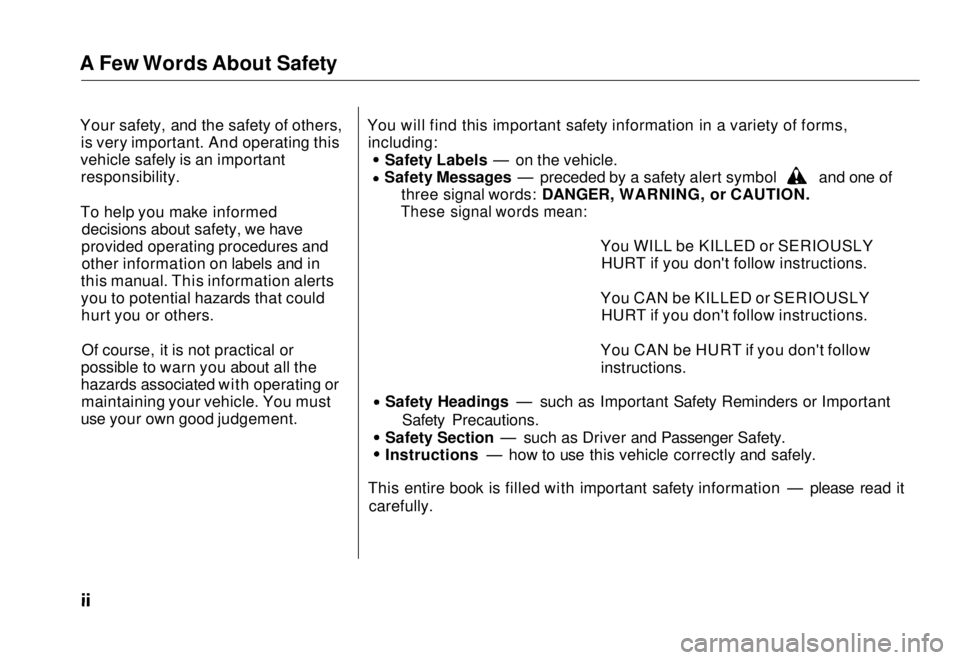
including: Safety Labels — on the vehicle.
Safety Messages — preceded by a safety alert symbol and one of
three signal words: DANGER, WARNING, or CAUTION.
These signal words mean:
You WILL be KILLED or SERIOUSLYHURT if you don't follow instructions.
You CAN be KILLED or SERIOUSLY HURT if you don't follow instructions.
You CAN be HURT if you don't follow instructions. Safety Headings — such as Important Safety Reminders or Important
Safety Precautions. Safety Section — such as Driver and Passenger Safety.
Instructions — how to use this vehicle correctly and safely.
This entire book is filled with important safety information — please read it carefully.Main Menu s t
Page 6 of 251
Important Safety Precautions
You'll find many safety recommendations throughout thissection, and throughout this manual.
Following are a few
recommendations we consider most important.
Always Wear Your Seat Belt
A seat belt is your best protection in all types of collisions. Airbags
supplement seat belts, but airbags
are designed to inflate only in a
severe frontal collision. So even with
airbags, make sure you and your
passengers always wear your seat
belts, and wear them properly. (See
page 13.)
Restrain All Children Children are safest when they are
properly restrained in the back seat,
not the front seat. A child who is too small for a seat belt must be properly
restrained in a child safety seat. (See
page 19.) Be Aware of Airbag Hazards
While airbags save lives, they can cause serious or fatal injuries to
occupants who sit too close to them,or are not properly restrained.
Infants, young children, and short
adults are at the greatest risk. Besure to follow all instructions and
warnings in this manual. (See page 5.)
Don't Drink and Drive
Alcohol and driving don't mix. Even one drink can reduce your ability to
respond to changing conditions. Reaction time gets worse with every
additional drink. So don't drink and
drive, and don't let your friends drink
and drive, either. Control Your Speed
Excessive speed is a major factor in
crash injuries and deaths, Generally,
the higher the speed the greater the
risk, but serious accidents can also occur at lower speeds. Never drive
faster than is safe for current conditions, regardless of the
maximum speed posted.
Keep Your Vehicle in Safe
Condition
Having a
tire blowout or a
mechanical failure can be extremely
hazardous. To reduce the possibility of such problems, check your tire
pressures and condition frequently, and perform all regularly scheduled
maintenance. (See page 146.)
Driver and Passenger SafetyMain Menu Table of Contents s t
Page 23 of 251
Protecting Children
U.S. Models
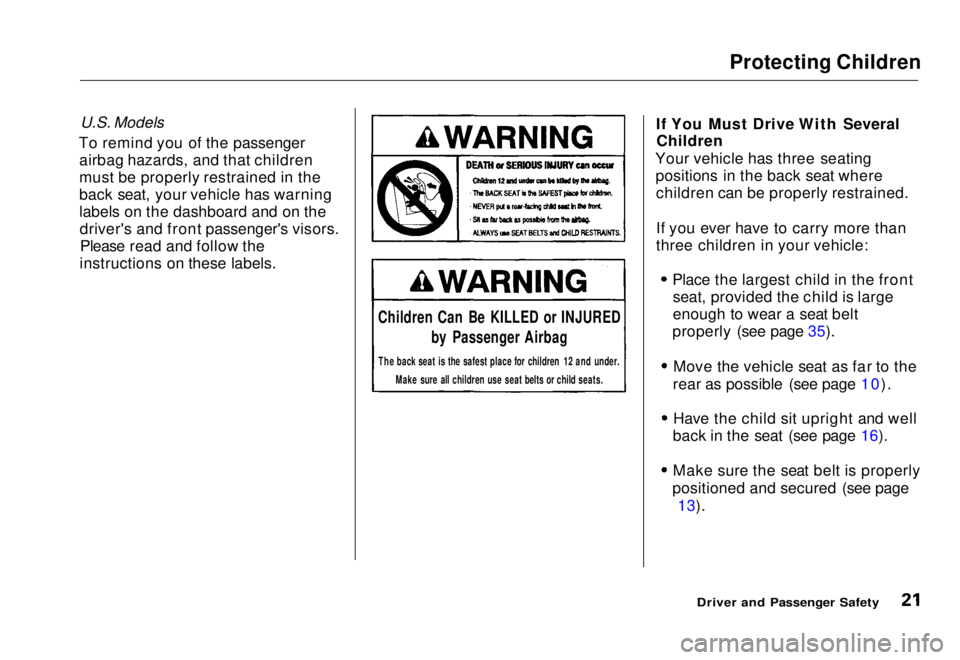
To remind you of the passenger airbag hazards, and that children
must be properly restrained in the
back seat, your vehicle has warning
labels on the dashboard and on thedriver's and front passenger's visors.Please read and follow the
instructions on these labels. If You Must Drive With Several
Children
Your vehicle has three seating positions in the back seat wherechildren can be properly restrained.
If you ever have to carry more than
three children in your vehicle:
Place the largest child in the frontseat, provided the child is large
enough to wear a seat belt
properly (see page 35).
Move the vehicle seat as far to the
rear as possible (see page 10).
Have the child sit upright and well
back in the seat (see page 16). Make sure the seat belt is properly
positioned and secured (see page 13).
Driver and Passenger Safety
Children Can Be KILLED or INJURED
by Passenger Airbag
The back seat is the safest place for children 12 and under. Make sure all children use seat belts or child seats.Main Menu Table of Contents s t
Page 51 of 251
Instruments and Controls
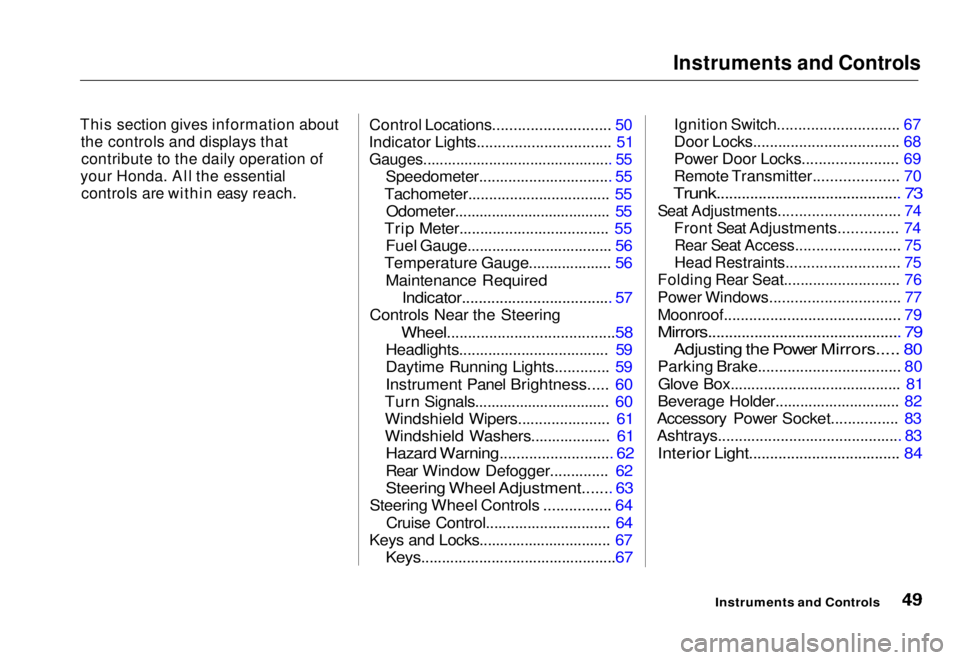
This section gives information about the controls and displays that
contribute to the daily operation of
your Honda. All the essential
controls are within easy reach.
Control Locations............................ 50
Indicator Lights................................ 51
Gauges.............................................. 55
Speedometer................................ 55
Tachometer.................................. 55 Odometer...................................... 55
Trip Meter.................................... 55 Fuel Gauge................................... 56
Temperature Gauge.................... 56
Maintenance Required
Indicator.................................... 57
Controls Near the Steering
Wheel........................................58
Headlights.................................... 59
Daytime Running Lights............. 59
Instrument Panel Brightness..... 60
Turn Signals................................. 60
Windshield Wipers...................... 61
Windshield Washers................... 61
Hazard Warning........................... 62
Rear Window Defogger.............. 62
Steering Wheel Adjustment....... 63
Steering Wheel Controls ................ 64
Cruise Control.............................. 64
Keys and Locks................................ 67
Keys...............................................67
Ignition Switch............................. 67
Door Locks................................... 68
Power Door Locks....................... 69
Remote Transmitter.................... 70
Trunk............................................ 73
Seat Adjustments............................. 74
Front Seat Adjustments.............. 74
Rear Seat Access......................... 75
Head Restraints........................... 75
Folding Rear Seat............................ 76
Power Windows............................... 77
Moonroof.......................................... 79
Mirrors.............................................. 79
Adjusting the Power Mirrors..... 80
Parking Brake.................................. 80
Glove Box......................................... 81
Beverage Holder.............................. 82
Accessory Power Socket................ 83
Ashtrays............................................ 83
Interior Light.................................... 84
Instruments and ControlsMain Menu s t
Page 56 of 251
Indicator Lights
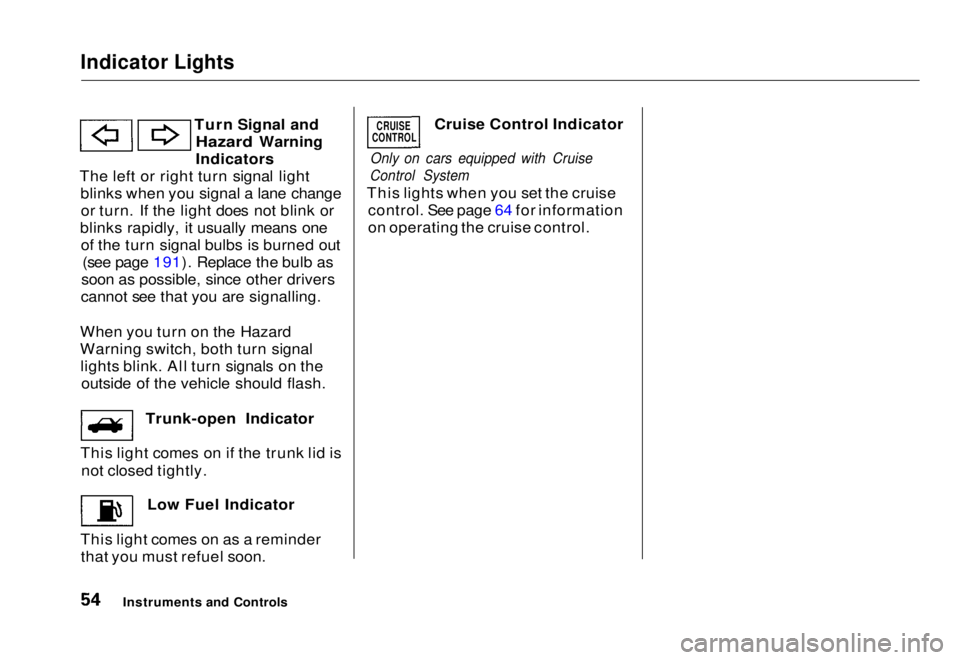
Turn Signal and
Hazard Warning
Indicators
The left or right turn signal light blinks when you signal a lane changeor turn. If the light does not blink or
blinks rapidly, it usually means one of the turn signal bulbs is burned out (see page 191). Replace the bulb as
soon as possible, since other drivers
cannot see that you are signalling.
When you turn on the Hazard
Warning switch, both turn signal lights blink. All turn signals on the outside of the vehicle should flash. Trunk-open Indicator
This light comes on if the trunk lid is not closed tightly. Low Fuel Indicator
This light comes on as a reminder that you must refuel soon. Cruise Control Indicator
Only on cars equipped with Cruise
Control System
This lights when you set the cruise control. See page 64 for information
on operating the cruise control.
Instruments and Controls
CRUISE
CONTROLMain Menu Table of Contents s t
Page 60 of 251
Controls Near the Steering Wheel
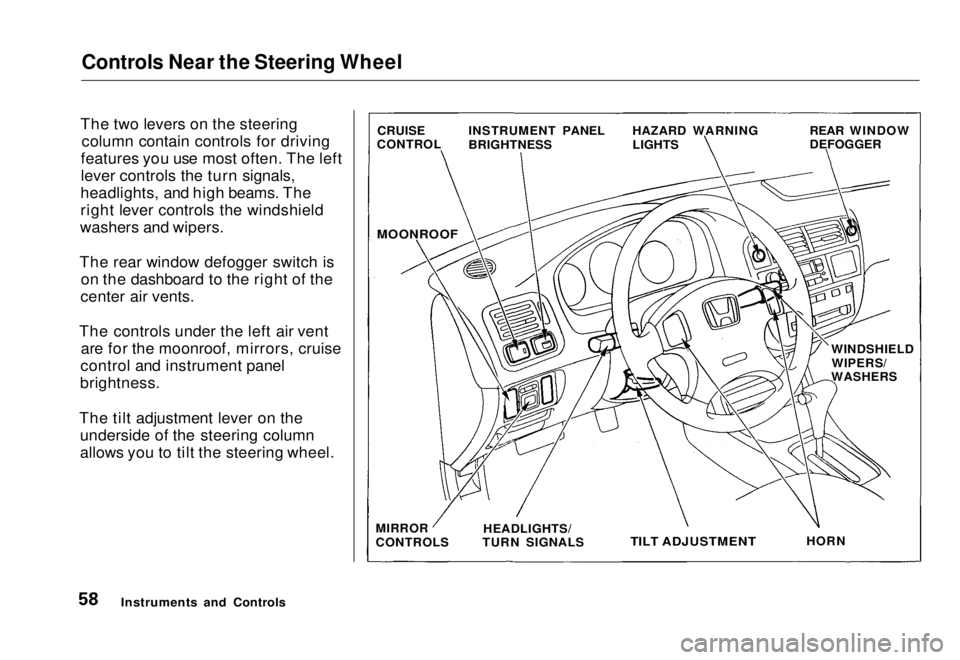
The two levers on the steering column contain controls for driving
features you use most often. The left
lever controls the turn signals,
headlights, and high beams. The
right lever controls the windshield
washers and wipers.
The rear window defogger switch is on the dashboard to the right of the
center air vents.
The controls under the left air vent are for the moonroof, mirrors, cruise
control and instrument panel
brightness.
The tilt adjustment lever on the underside of the steering column
allows you to tilt the steering wheel.
Instruments and Controls CRUISE
CONTROL INSTRUMENT PANEL
BRIGHTNESS HAZARD WARNING
LIGHTS REAR WINDOW
DEFOGGER
MOONROOF
WINDSHIELDWIPERS/
WASHERS
MIRROR
CONTROLS HEADLIGHTS/
TURN SIGNALS
TILT ADJUSTMENT
HORNMain Menu Table of Contents s t
Page 64 of 251
Controls Near the Steering Wheel
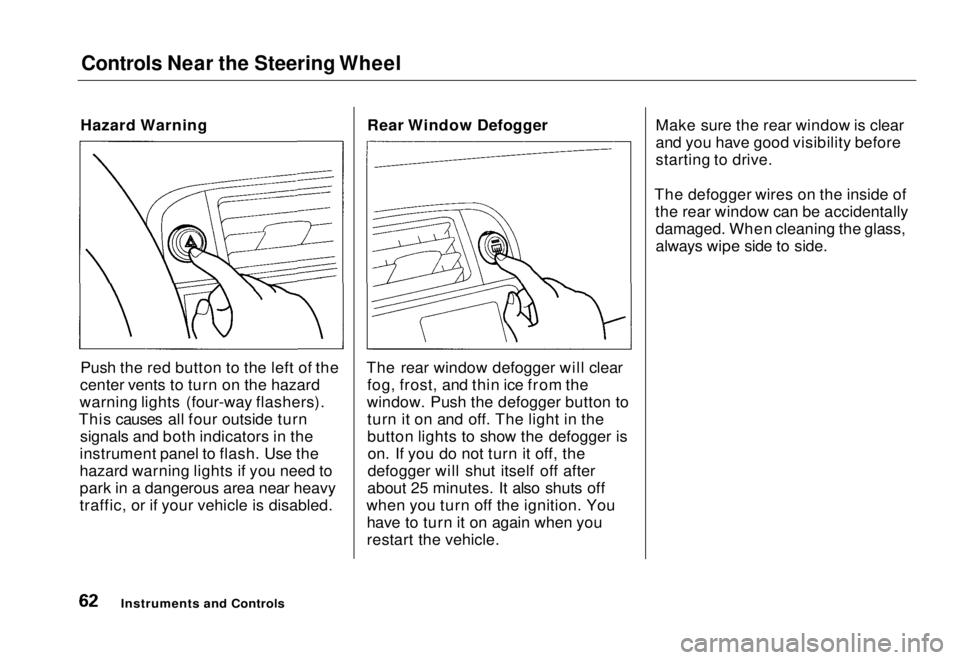
Hazard Warning
Push the red button to the left of the
center vents to turn on the hazard
warning lights (four-way flashers).
This causes all four outside turn signals and both indicators in the
instrument panel to flash. Use the
hazard warning lights if you need to
park in a dangerous area near heavy
traffic, or if your vehicle is disabled. Rear Window Defogger
The rear window defogger will clear fog, frost, and thin ice from the
window. Push the defogger button to turn it on and off. The light in the
button lights to show the defogger ison. If you do not turn it off, the
defogger will shut itself off after
about 25 minutes. It also shuts off
when you turn off the ignition. You have to turn it on again when you
restart the vehicle. Make sure the rear window is clear
and you have good visibility before
starting to drive.
The defogger wires on the inside of the rear window can be accidentallydamaged. When cleaning the glass,
always wipe side to side.
Instruments and ControlsMain Menu Table of Contents s t
Page 76 of 251
Seat Adjustments
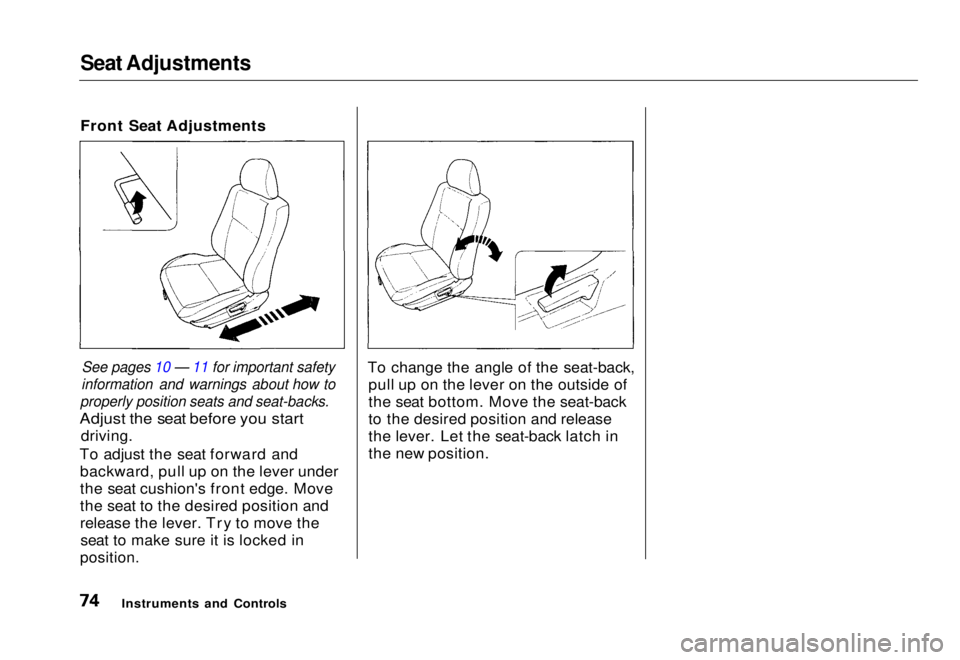
Front Seat Adjustments
See pages 10 — 11 for important safety
information and warnings about how to
properly position seats and seat-backs.
Adjust the seat before you start
driving.
To adjust the seat forward and backward, pull up on the lever under
the seat cushion's front edge. Move
the seat to the desired position and
release the lever. Try to move theseat to make sure it is locked in
position.
To change the angle of the seat-back,
pull up on the lever on the outside of
the seat bottom. Move the seat-back
to the desired position and release
the lever. Let the seat-back latch in
the new position.
Instruments and ControlsMain Menu Table of Contents s t