Page 33 of 251
Protecting Children
Additional Precautions for Infants
Never hold a baby on your lap. If
you are not wearing a seat belt in a crash, you could be thrown
forward into the dashboard and crush the child.
If you are wearing a seat belt, the
baby can be torn from your arms.
For example, if the vehicle crashes
into a parked vehicle at 30 mph (48 km/h), a 20 Ib (9 kg) baby will
become a 600-lb (275-kg) force,
and you will not be able to hold it.
Never put a seat belt over yourself
and a baby. During a crash, the
belt could press deep into the child
and cause very serious injuries.
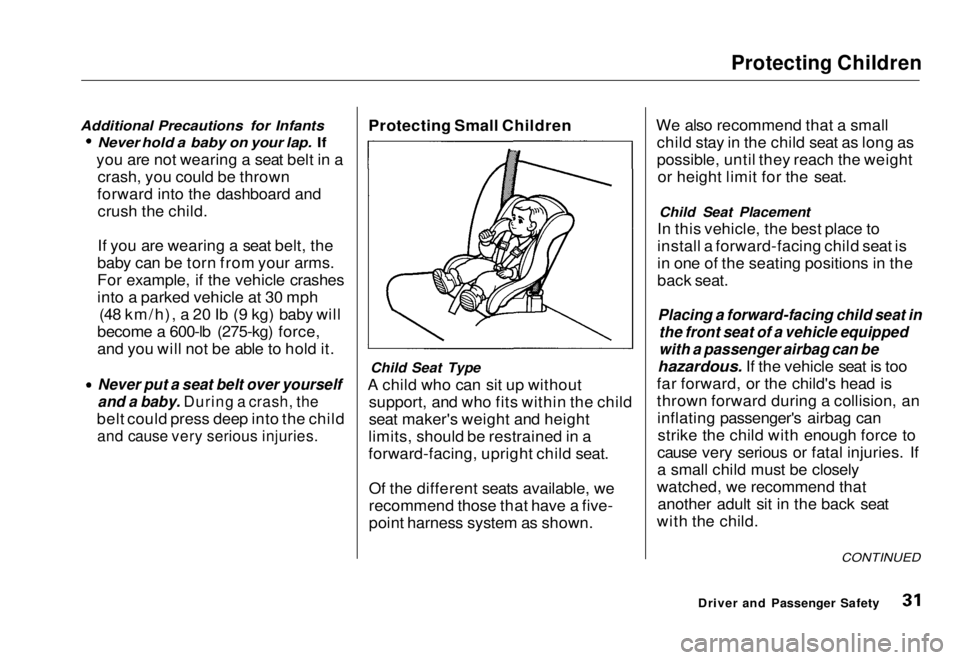
Protecting Small Children
Child Seat Type
A child who can sit up without support, and who fits within the child
seat maker's weight and height
limits, should be restrained in a
forward-facing, upright child seat.
Of the different seats available, we
recommend those that have a five-
point harness system as shown. We also recommend that a small
child stay in the child seat as long as
possible, until they reach the weightor height limit for the seat.
Child Seat Placement
In this vehicle, the best place to
install a forward-facing child seat is
in one of the seating positions in the
back seat.
Placing a forward-facing child seat in the front seat of a vehicle equipped
with a passenger airbag can be
hazardous. If the vehicle seat is too
far forward, or the child's head is
thrown forward during a collision, an inflating passenger's airbag canstrike the child with enough force to
cause very serious or fatal injuries. If
a small child must be closely
watched, we recommend that another adult sit in the back seat
with the child.
Driver and Passenger Safety
CONTINUEDMain Menu Table of Contents s t
Page 36 of 251
Protecting Children
To deactivate the locking mechanism in order to remove a
child seat, unlatch the buckle,
unroute the seat belt, and let the belt
fully retract.
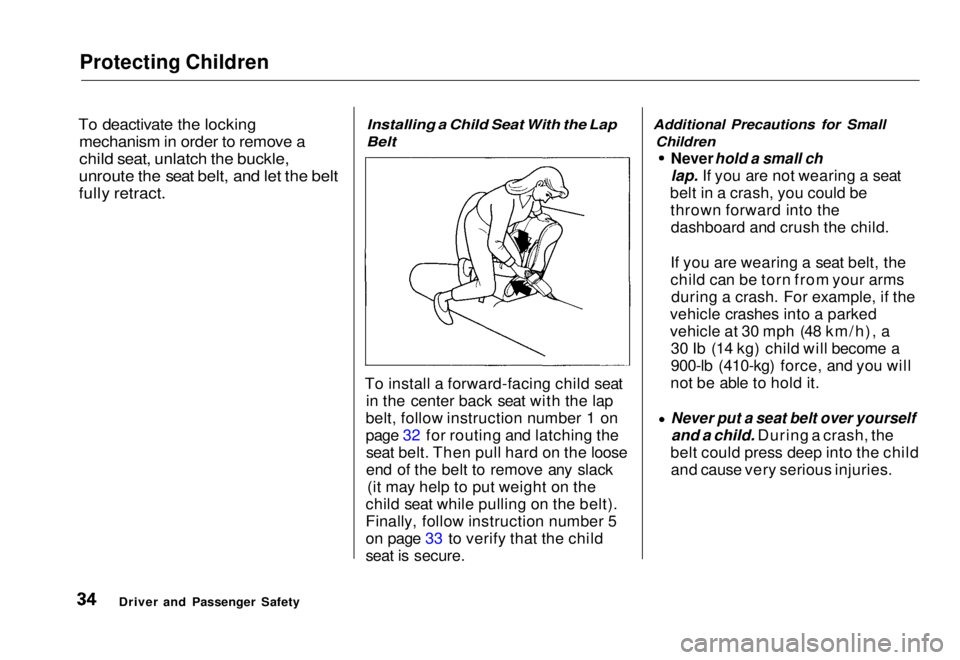
Installing a Child Seat With the Lap
Belt
To install a forward-facing child seat in the center back seat with the lap
belt, follow instruction number 1 on
page 32 for routing and latching the seat belt. Then pull hard on the loose
end of the belt to remove any slack (it may help to put weight on the
child seat while pulling on the belt).
Finally, follow instruction number 5
on page 33 to verify that the child
seat is secure.
Additional Precautions for Small
Children
Never
hold a small ch \
ild on your
lap. If you are not wearing a seat
belt in a crash, you could be thrown forward into thedashboard and crush the child.
If you are wearing a seat belt, the
child can be torn from your arms during a crash. For example, if the
vehicle crashes into a parked
vehicle at 30 mph (48 km/h), a 30 Ib (14 kg) child will become a
900-lb (410-kg) force, and you will
not be able to hold it.
Never put a seat belt over yourself
and a child. During a crash, the
belt could press deep into the child and cause very serious injuries.
Driver and Passenger SafetyMain Menu Table of Contents s t
Page 45 of 251
Additional Information About Your SRS
SRS Components
Your Supplemental Restraint System (SRS) includes:
Two frontal airbags. The driver'sairbag is stored in the center of
the steering wheel; the front
passenger's airbag is stored in thedashboard. Both are marked
"SRS".
Sensors that can detect a severe
frontal collision. A sophisticated electronic system
that continually monitors thesensors, control unit, the airbag
activators, and all related wiring
when the ignition is ON (II). An indicator light on the
instrument panel to alert you to a
possible problem with the system (see page 45). Emergency backup power in case
your vehicle's electrical system is disconnected in a crash.
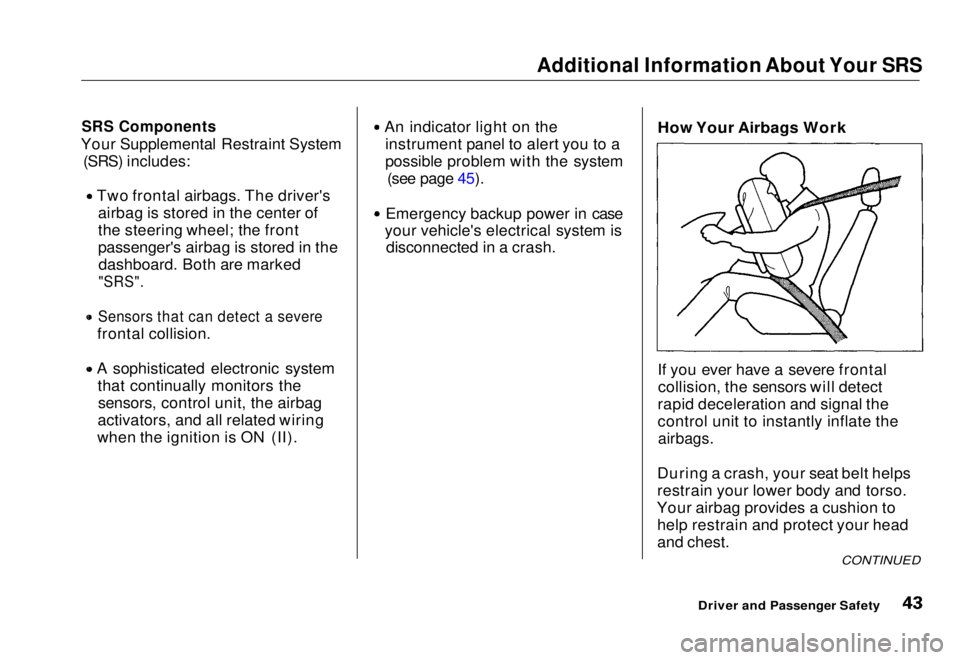
How Your Airbags Work
If you ever have a severe frontal
collision, the sensors will detect
rapid deceleration and signal the
control unit to instantly inflate the
airbags.
During a crash, your seat belt helps
restrain your lower body and torso.
Your airbag provides a cushion to help restrain and protect your head
and chest.
CONTINUED
Driver and Passenger SafetyMain Menu Table of Contents s t
Page 60 of 251
Controls Near the Steering Wheel
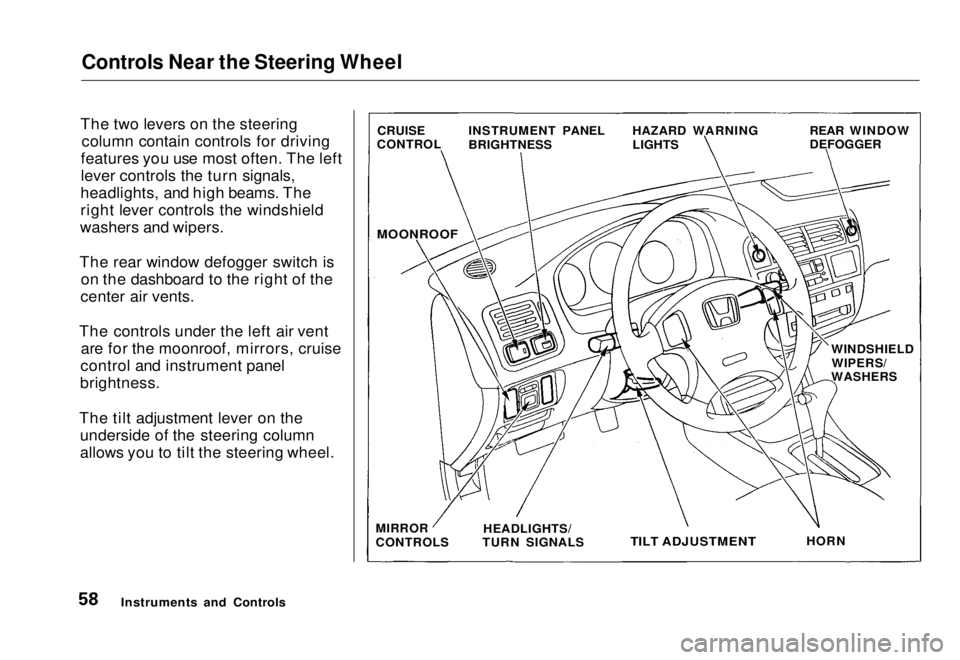
The two levers on the steering column contain controls for driving
features you use most often. The left
lever controls the turn signals,
headlights, and high beams. The
right lever controls the windshield
washers and wipers.
The rear window defogger switch is on the dashboard to the right of the
center air vents.
The controls under the left air vent are for the moonroof, mirrors, cruise
control and instrument panel
brightness.
The tilt adjustment lever on the underside of the steering column
allows you to tilt the steering wheel.
Instruments and Controls CRUISE
CONTROL INSTRUMENT PANEL
BRIGHTNESS HAZARD WARNING
LIGHTS REAR WINDOW
DEFOGGER
MOONROOF
WINDSHIELDWIPERS/
WASHERS
MIRROR
CONTROLS HEADLIGHTS/
TURN SIGNALS
TILT ADJUSTMENT
HORNMain Menu Table of Contents s t
Page 62 of 251
Controls Near the Steering Wheel
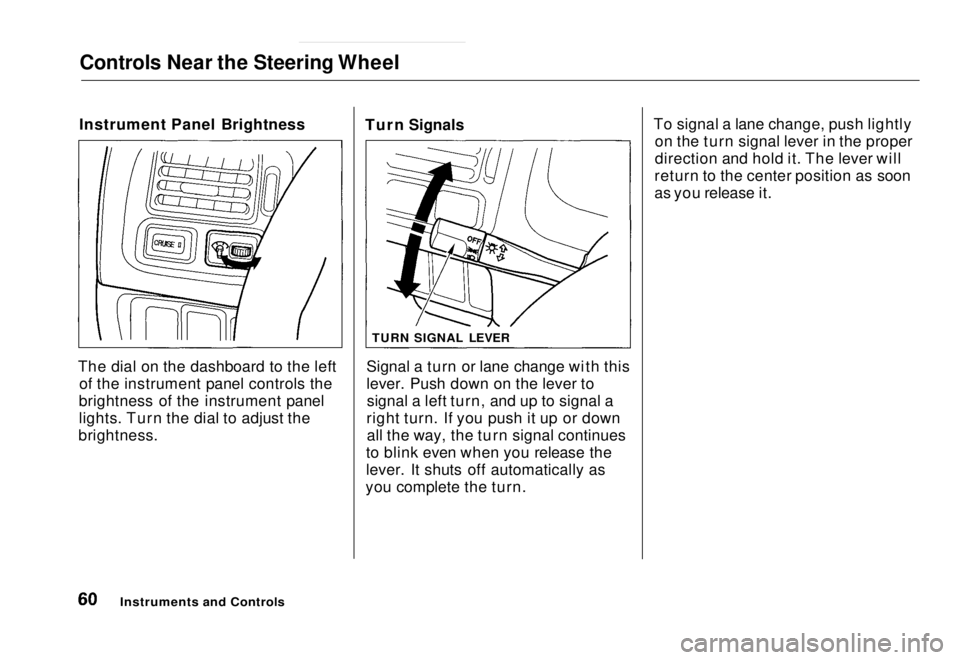
Instrument Panel Brightness
The dial on the dashboard to the left of the instrument panel controls the
brightness of the instrument panel
lights. Turn the dial to adjust the
brightness. Turn Signals
Signal a turn or lane change with this
lever. Push down on the lever tosignal a left turn, and up to signal a
right turn. If you push it up or down all the way, the turn signal continues
to blink even when you release the
lever. It shuts off automatically as
you complete the turn. To signal a lane change, push lightly
on the turn signal lever in the proper
direction and hold it. The lever will
return to the center position as soon
as you release it.
Instruments and Controls
TURN SIGNAL LEVERMain Menu Table of Contents s t
Page 81 of 251
Moonroof, Mirrors
Moonroof
On EX model in the U.S., and Si model
in Canada
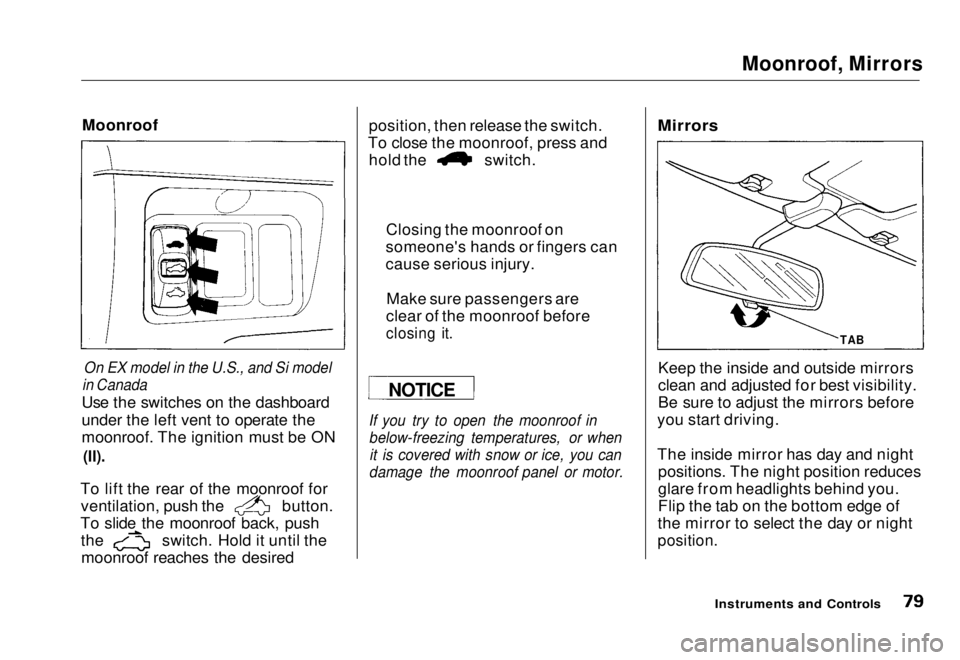
Use the switches on the dashboard
under the left vent to operate the
moonroof. The ignition must be ON
(II).
To lift the rear of the moonroof for ventilation, push the button.
To slide the moonroof back, push the switch. Hold it until the
moonroof reaches the desired position, then release the switch.
To close the moonroof, press and hold the switch.
If you try to open the moonroof in below-freezing temperatures, or whenit is covered with snow or ice, you can
damage the moonroof panel or motor.
Mirrors
Keep the inside and outside mirrors
clean and adjusted for best visibility.
Be sure to adjust the mirrors before
you start driving.
The inside mirror has day and night positions. The night position reduces
glare from headlights behind you.
Flip the tab on the bottom edge of
the mirror to select the day or night
position.
Instruments and Controls
NOTICE
Closing the moonroof on
someone's hands or fingers can
cause serious injury.
Make sure passengers are
clear of the moonroof before
closing it.
TABMain Menu Table of Contents s t
Page 82 of 251
Mirrors, Parking Brake
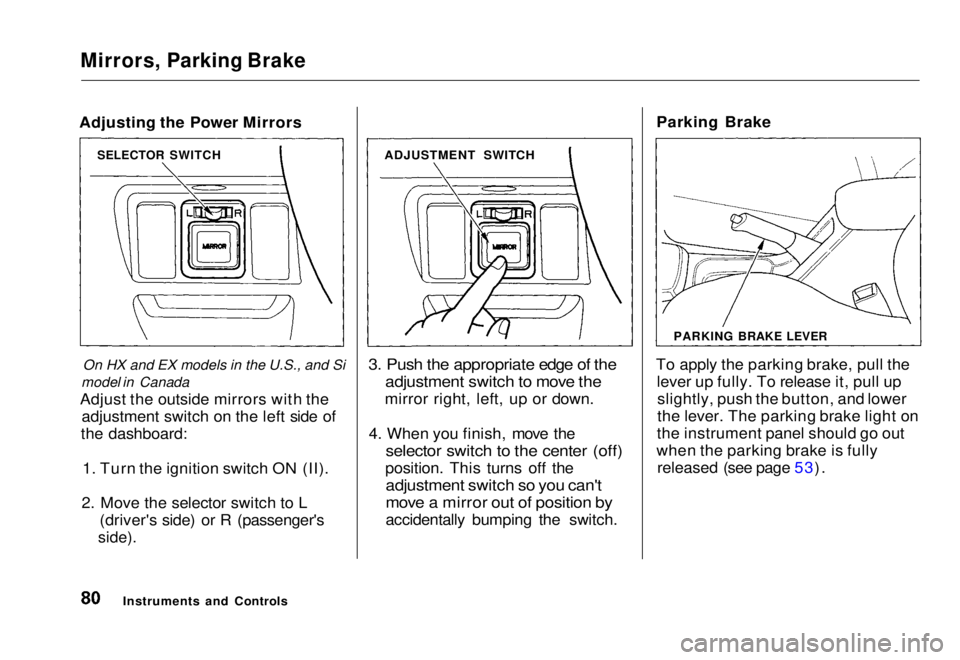
Adjusting the Power Mirrors
On HX and EX models in the U.S., and Si
model in Canada
Adjust the outside mirrors with the adjustment switch on the left side of
the dashboard:
1. Turn the ignition switch ON (II).
2. Move the selector switch to L (driver's side) or R (passenger's
side).
3. Push the appropriate edge of the
adjustment switch to move the
mirror right, left, up or down.
4. When you finish, move the
selector switch to the center (off)
position. This turns off the
adjustment switch so you can't
move a mirror out of position by
accidentally bumping the switch. Parking Brake
To apply the parking brake, pull the lever up fully. To release it, pull upslightly, push the button, and lower
the lever. The parking brake light on
the instrument panel should go out
when the parking brake is fully released (see page 53).
Instruments and Controls
SELECTOR SWITCH
ADJUSTMENT SWITCH
PARKING BRAKE LEVERMain Menu Table of Contents s t
Page 89 of 251
Heating and Cooling
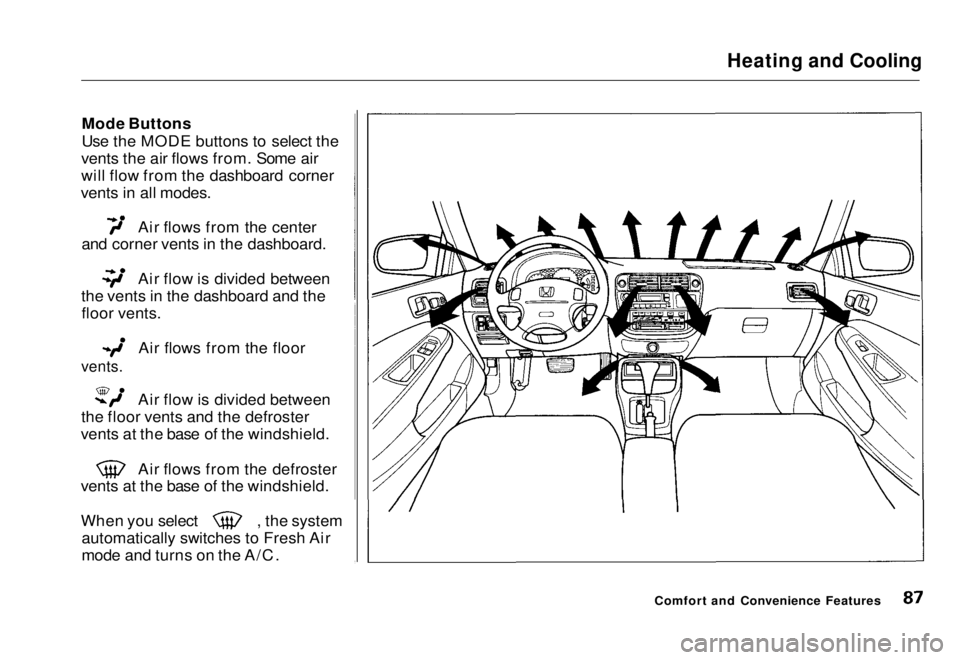
Mode Buttons
Use the MODE buttons to select the
vents the air flows from. Some air
will flow from the dashboard corner
vents in all modes. Air flows from the center
and corner vents in the dashboard. Air flow is divided between
the vents in the dashboard and the floor vents.
Air flows from the floor
vents.
Air flow is divided between
the floor vents and the defroster
vents at the base of the windshield. Air flows from the defroster
vents at the base of the windshield. When you select , the system
automatically switches to Fresh Air
mode and turns on the A/C.
Comfort and Convenience FeaturesMain Menu Table of Contents s t