Page 9 of 251
Your Vehicle's Safety Features
Airbags
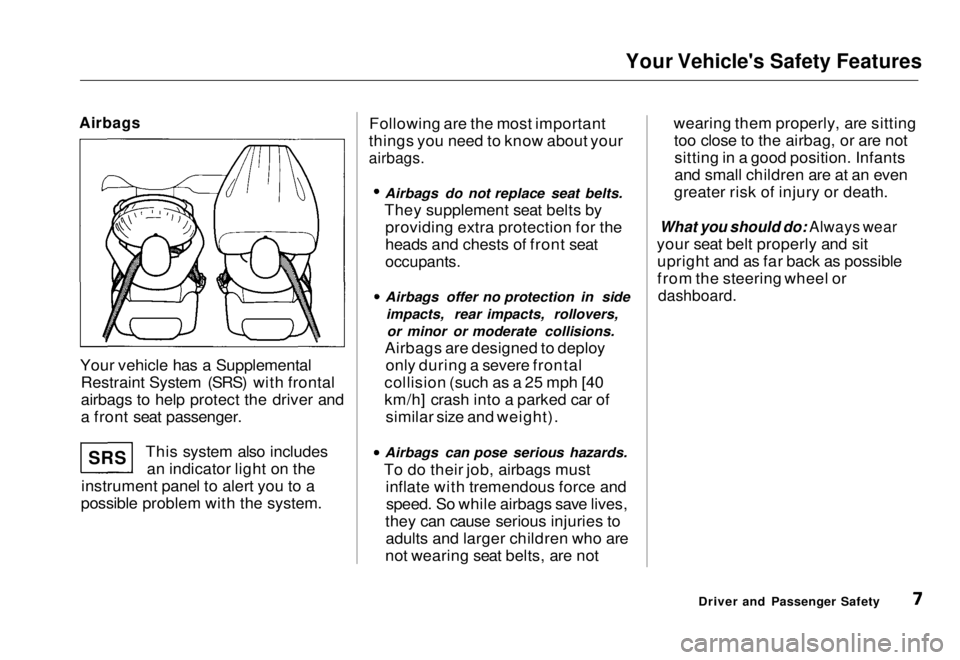
Your vehicle has a SupplementalRestraint System (SRS) with frontal
airbags to help protect the driver and
a front seat passenger.
This system also includesan indicator light on the
instrument panel to alert you to a
possible problem with the system. Following are the most important
things you need to know about your
airbags.
Airbags do not replace seat belts.
They supplement seat belts by providing extra protection for the
heads and chests of front seat
occupants.
Airbags offer no protection in side
impacts, rear impacts, rollovers,or minor or moderate collisions.
Airbags are designed to deploy only during a severe frontal
collision (such as a 25 mph [40
km/h] crash into a parked car of similar size and weight). Airbags can pose serious hazards.
To do their job, airbags must inflate with tremendous force andspeed. So while airbags save lives,
they can cause serious injuries to adults and larger children who are
not wearing seat belts, are not wearing them properly, are sitting
too close to the airbag, or are notsitting in a good position. Infants
and small children are at an even
greater risk of injury or death.
What you should do: Always wear
your seat belt properly and sit upright and as far back as possible
from the steering wheel or
dashboard.
Driver and Passenger Safety
SRSMain Menu Table of Contents s t
Page 10 of 251

Your Vehicle's Safety Features
Seats & Seat-Backs
Your vehicle seats are designed to
keep you in a comfortable, upright
position so you can take full advantage of the protection offered
by seat belts and the seats' energy
absorbing materials.
How you adjust your seats and seat-
backs can also affect your safety. For example, sitting too close to the
steering wheel or dashboard
increases your risk of being injured
by striking the inside of the vehicle or being injured by an inflating
airbag.
Reclining a seat-back too far makes
your seat belt less effective and increases your chance of sliding
under the seat belt and being seriously injured in a crash. What you should do: Move the front
seats as far back as practical, and
keep adjustable seat-backs in an upright position whenever the
vehicle is moving.
Head Restraints
Head restraints can help protect you
from whiplash and other injuries. Formaximum protection, the back of
your head should rest against the center of the head restraint.
Driver and Passenger SafetyMain Menu Table of Contents s t
Page 18 of 251
Protecting Adults
6.Adjust the Steering Wheel
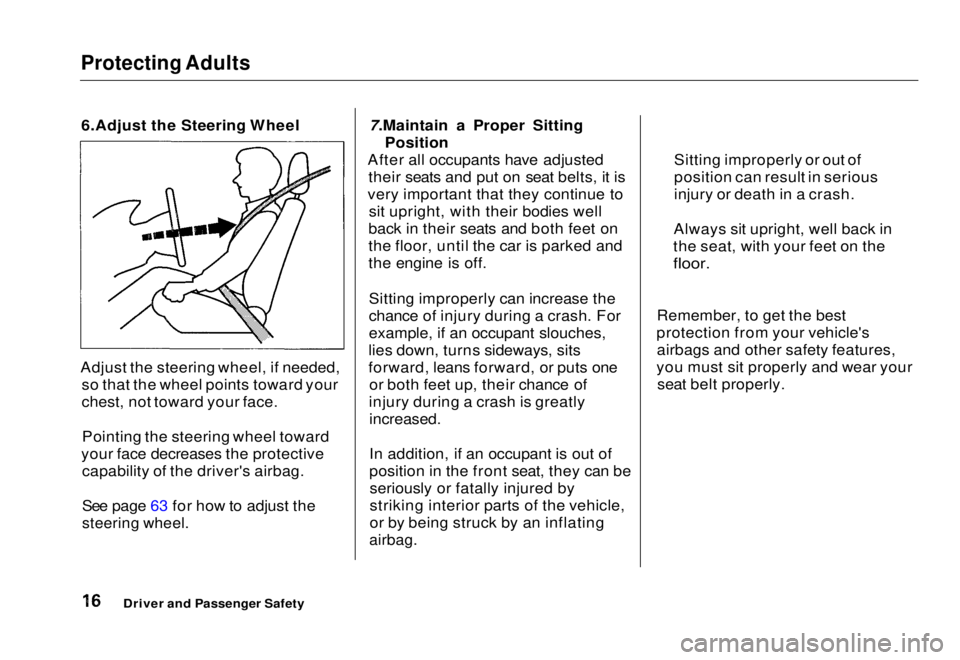
Adjust the steering wheel, if needed, so that the wheel points toward your
chest, not toward your face.
Pointing the steering wheel toward
your face decreases the protective capability of the driver's airbag.
See page 63 for how to adjust the
steering wheel.
7.Maintain a Proper Sitting
Position
After all occupants have adjusted their seats and put on seat belts, it is
very important that they continue to sit upright, with their bodies well
back in their seats and both feet on
the floor, until the car is parked and
the engine is off.
Sitting improperly can increase the
chance of injury during a crash. For
example, if an occupant slouches,
lies down, turns sideways, sits
forward, leans forward, or puts one or both feet up, their chance of
injury during a crash is greatly
increased.
In addition, if an occupant is out of
position in the front seat, they can beseriously or fatally injured by
striking interior parts of the vehicle,
or by being struck by an inflating
airbag.
Remember, to get the best
protection from your vehicle's airbags and other safety features,
you must sit properly and wear your seat belt properly.
Driver and Passenger Safety Sitting improperly or out of
position can result in serious
injury or death in a crash.
Always sit upright, well back in
the seat, with your feet on the
floor.Main Menu Table of Contents s t
Page 46 of 251
Additional Information About Your SRS
Since both airbags use the samesensors, both airbags normally
inflate at the same time. However, it
is possible for only one airbag to
inflate.
This can occur when the severity of a collision is at the margin, or
threshold, that determines whetheror not the airbags will deploy. In
such cases, the seat belt will provide
sufficient protection, and the
supplemental protection offered by
the airbag would be minimal.
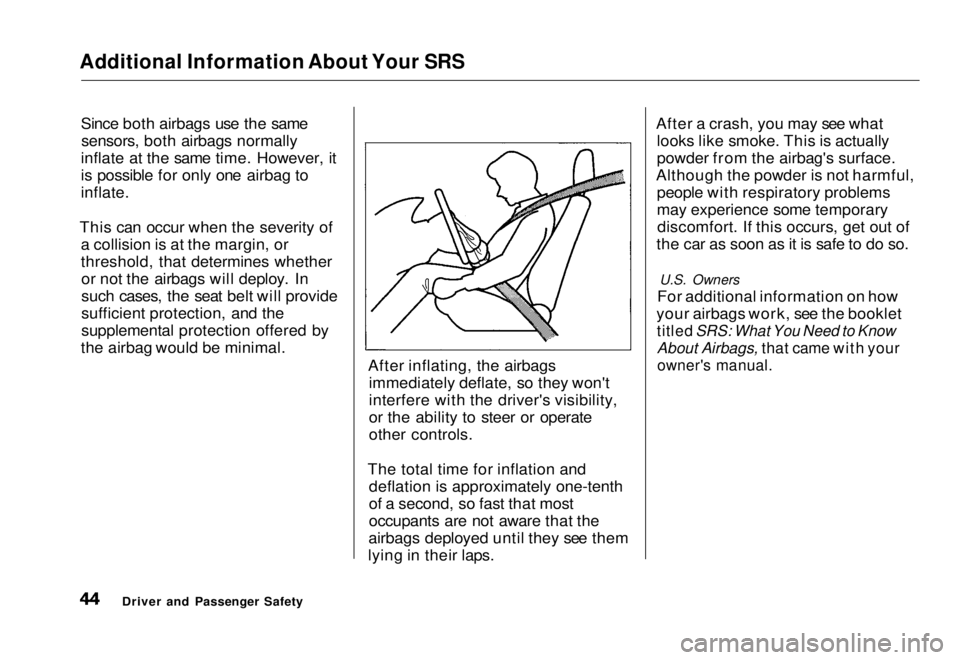
After inflating, the airbagsimmediately deflate, so they won't
interfere with the driver's visibility,
or the ability to steer or operate
other controls.
The total time for inflation and deflation is approximately one-tenth
of a second, so fast that most
occupants are not aware that the
airbags deployed until they see them
lying in their laps. After a crash, you may see what
looks like smoke. This is actually
powder from the airbag's surface.
Although the powder is not harmful, people with respiratory problems
may experience some temporarydiscomfort. If this occurs, get out of
the car as soon as it is safe to do so.
U.S. Owners
For additional information on how
your airbags work, see the booklet
titled SRS: What You Need to Know
About Airbags, that came with your
owner's manual.
Driver and Passenger SafetyMain Menu Table of Contents s t
Page 47 of 251
Additional Information About Your SRS
How Your SRS Indicator Light
Works The purpose of the SRSindicator light is to alert
you to a potential problem with your Supplemental Restraint System.
When you turn the ignition ON (II), this indicator will light up briefly
then go out. This tells you that thesystem is working properly.
However, if the light comes on at any
other time, you should have yoursystem checked by your dealer. For
example:
If the SRS indicator light does not
come on after you turn the ignition
ON (II). If the light stays on after the
engine starts. If the light comes on or flashes on
and off while you drive.
If you see any of these indications,
your airbags may not deploy when you need them. See your Honda dealer as soon as possible. SRS Service
Your Supplemental Restraint System is virtually maintenance-free, and
there are no parts you can safelyservice. However, you must have
your vehicle serviced if:
Your airbags ever inflate. The
airbags and
the control unit must
be replaced. Do not try to remove or replace the airbags yourself.
This must be done by a Honda dealer or a knowledgeable body
shop.
The SRS indicator light alerts you
to a problem. Take your vehicle to
an authorized Honda dealer as soon as possible. If you ignore this
indication, the airbags might not
inflate when you need them.
Driver and Passenger Safety
SRS
Ignoring the SRS indicator light
can result in serious injury or death if the airbags do notinflate when needed.
Have your vehicle checked by a
dealer as soon as possible if
the SRS light alerts you to a potential problem.Main Menu Table of Contents s t