Page 34 of 251
Protecting Children
If it is necessary to put a forward-
facing child seat in the front, move
the vehicle seat as far to the rear as possible, be sure the child seat is
firmly secured to the car, and that
the child is properly strapped in the
seat.
Installing a Child Seat With a Lap/
Shoulder Belt
The lap/shoulder belts in the back
and front passenger seating positions
have a locking mechanism that must be activated to secure a child seat.
The following pages provide instructions on how to secure a
forward-facing child seat with this
type of seat belt.
See page 34 for how to secure a
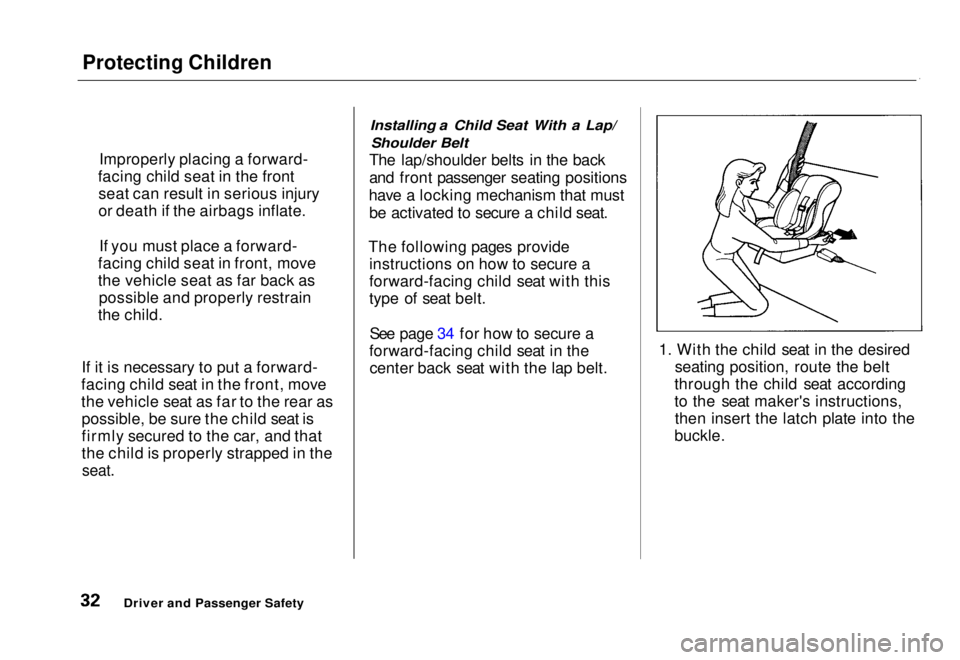
forward-facing child seat in the center back seat with the lap belt. 1. With the child seat in the desired
seating position, route the belt
through the child seat according
to the seat maker's instructions, then insert the latch plate into the
buckle.
Driver and Passenger Safety
Improperly placing a forward-
facing child seat in the front seat can result in serious injury
or death if the airbags inflate.
If you must place a forward-
facing child seat in front, move
the vehicle seat as far back as possible and properly restrain
the child.Main Menu Table of Contents s t
Page 35 of 251
Protecting Children
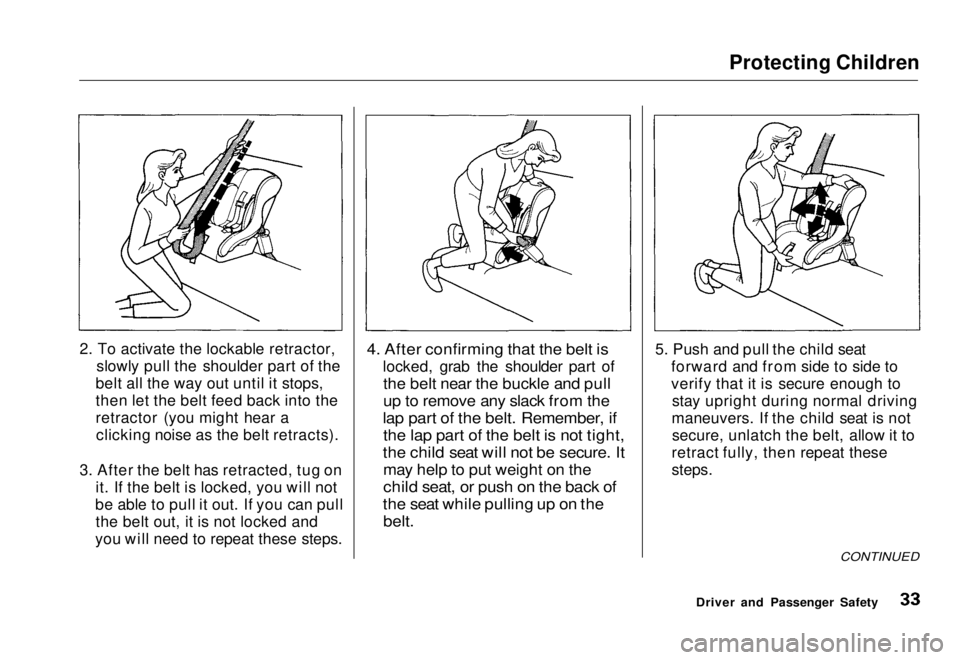
2. To activate the lockable retractor, slowly pull the shoulder part of the
belt all the way out until it stops,
then let the belt feed back into the
retractor (you might hear a clicking noise as the belt retracts).
3. After the belt has retracted, tug on it. If the belt is locked, you will not
be able to pull it out. If you can pull the belt out, it is not locked and
you will need to repeat these steps.
4. After confirming that the belt is
locked, grab the shoulder part of
the belt near the buckle and pull
up to remove any slack from the
lap part of the belt. Remember, if
the lap part of the belt is not tight,
the child seat will not be secure. It
may help to put weight on the
child seat, or push on the back of
the seat while pulling up on the
belt.
5. Push and pull the child seat
forward and from side to side to
verify that it is secure enough tostay upright during normal driving
maneuvers. If the child seat is not secure, unlatch the belt, allow it to
retract fully, then repeat these
steps.
CONTINUED
Driver and Passenger SafetyMain Menu Table of Contents s t
Page 36 of 251
Protecting Children
To deactivate the locking mechanism in order to remove a
child seat, unlatch the buckle,
unroute the seat belt, and let the belt
fully retract.
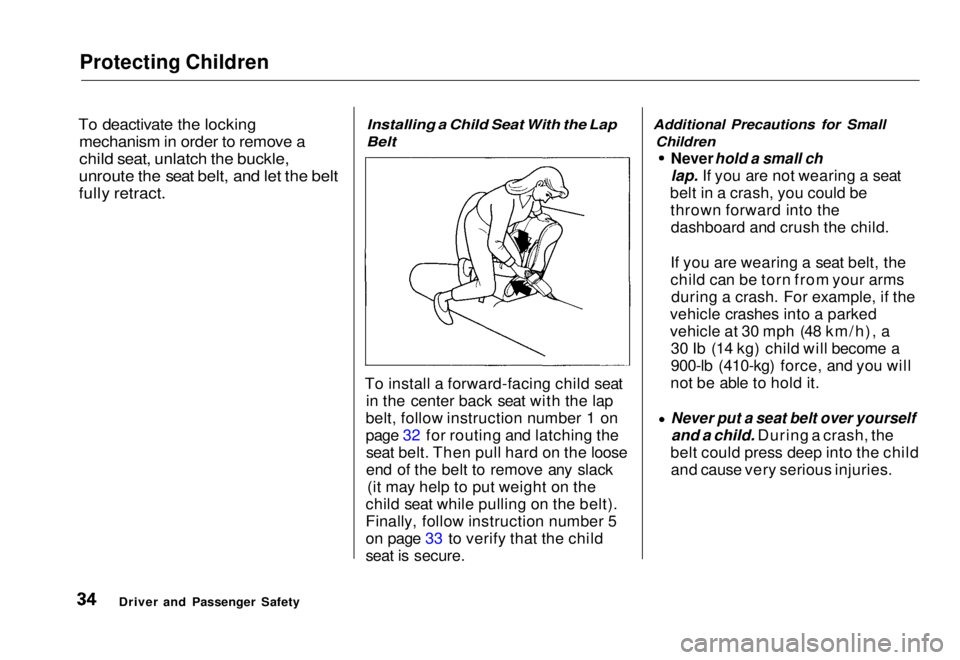
Installing a Child Seat With the Lap
Belt
To install a forward-facing child seat in the center back seat with the lap
belt, follow instruction number 1 on
page 32 for routing and latching the seat belt. Then pull hard on the loose
end of the belt to remove any slack (it may help to put weight on the
child seat while pulling on the belt).
Finally, follow instruction number 5
on page 33 to verify that the child
seat is secure.
Additional Precautions for Small
Children
Never
hold a small ch \
ild on your
lap. If you are not wearing a seat
belt in a crash, you could be thrown forward into thedashboard and crush the child.
If you are wearing a seat belt, the
child can be torn from your arms during a crash. For example, if the
vehicle crashes into a parked
vehicle at 30 mph (48 km/h), a 30 Ib (14 kg) child will become a
900-lb (410-kg) force, and you will
not be able to hold it.
Never put a seat belt over yourself
and a child. During a crash, the
belt could press deep into the child and cause very serious injuries.
Driver and Passenger SafetyMain Menu Table of Contents s t
Page 42 of 251
Additional Information About Your Seat Belts
Seat Belt System Components
Your seat belt system includes lap/ shoulder belts in the front seats and
the outer back seats, and a lap belt in
the center back seat.
The system also includes alight on the instrument
panel to remind you and your passengers to fasten your belts. If
the driver's seat belt is not fastened
before the ignition is turned ON (II),
the light will come on and a beeper
will also sound. The beeper will stop after a few seconds, but the light willstay on until the driver's seat belt is
fastened.
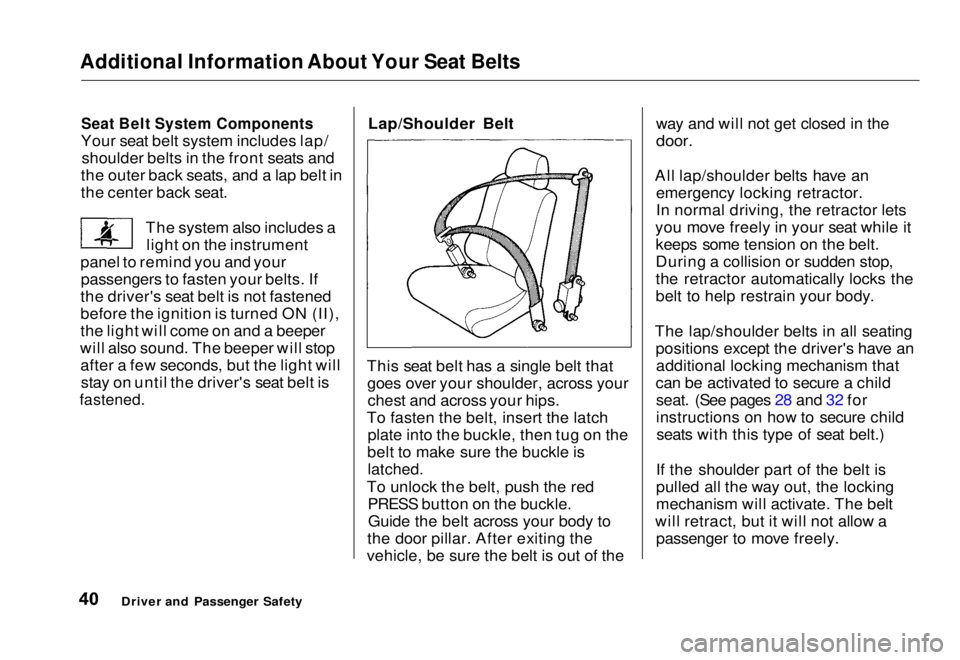
Lap/Shoulder Belt
This seat belt has a single belt that goes over your shoulder, across yourchest and across your hips.
To fasten the belt, insert the latch plate into the buckle, then tug on the
belt to make sure the buckle is
latched.
To unlock the belt, push the red PRESS button on the buckle.Guide the belt across your body to
the door pillar. After exiting the
vehicle, be sure the belt is out of the way and will not get closed in the
door.
All lap/shoulder belts have an emergency locking retractor.
In normal driving, the retractor lets
you move freely in your seat while it keeps some tension on the belt.
During a collision or sudden stop,
the retractor automatically locks the
belt to help restrain your body.
The lap/shoulder belts in all seating positions except the driver's have anadditional locking mechanism that
can be activated to secure a child seat. (See pages 28 and 32 for
instructions on how to secure childseats with this type of seat belt.)
If the shoulder part of the belt is
pulled all the way out, the locking
mechanism will activate. The belt
will retract, but it will not allow a passenger to move freely.
Driver and Passenger SafetyMain Menu Table of Contents s t
Page 43 of 251
Additional Information About Your Seat Belts
To deactivate the locking mechanism, unlatch the buckle and
let the seat belt fully retract. To
refasten the belt, pull it out only as
far as needed.
See page 13 for instructions on how
to wear the lap/shoulder belt
properly. Lap Belt
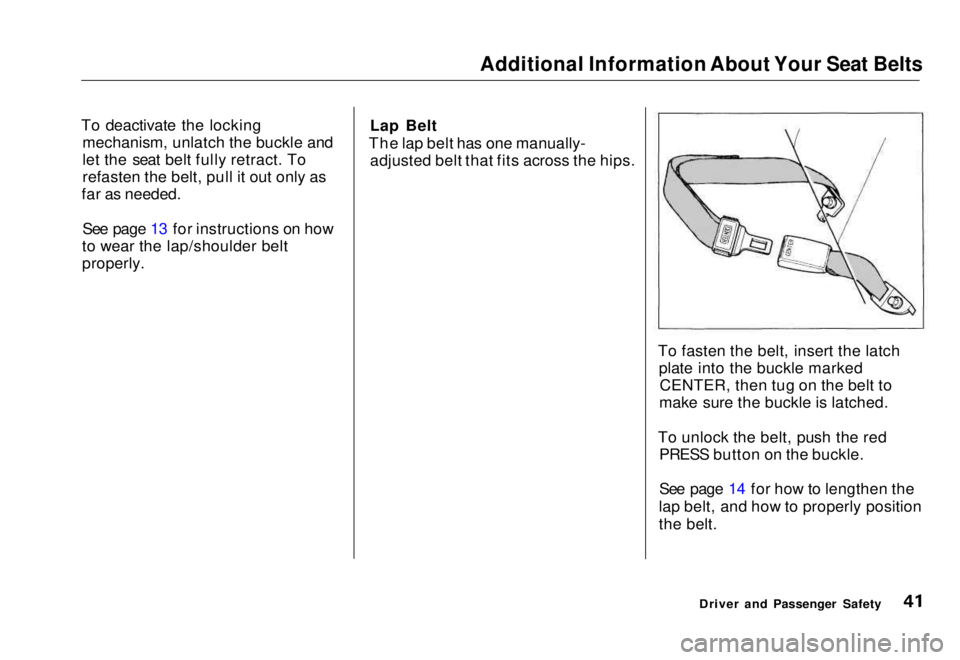
The lap belt has one manually- adjusted belt that fits across the hips.
To fasten the belt, insert the latchplate into the buckle markedCENTER, then tug on the belt to
make sure the buckle is latched.
To unlock the belt, push the red PRESS button on the buckle.
See page 14 for how to lengthen the
lap belt, and how to properly position
the belt.
Driver and Passenger SafetyMain Menu Table of Contents s t
Page 51 of 251
Instruments and Controls
This section gives information about the controls and displays that
contribute to the daily operation of
your Honda. All the essential
controls are within easy reach.
Control Locations............................ 50
Indicator Lights................................ 51
Gauges.............................................. 55
Speedometer................................ 55
Tachometer.................................. 55 Odometer...................................... 55
Trip Meter.................................... 55 Fuel Gauge................................... 56
Temperature Gauge.................... 56
Maintenance Required
Indicator.................................... 57
Controls Near the Steering
Wheel........................................58
Headlights.................................... 59
Daytime Running Lights............. 59
Instrument Panel Brightness..... 60
Turn Signals................................. 60
Windshield Wipers...................... 61
Windshield Washers................... 61
Hazard Warning........................... 62
Rear Window Defogger.............. 62
Steering Wheel Adjustment....... 63
Steering Wheel Controls ................ 64
Cruise Control.............................. 64
Keys and Locks................................ 67
Keys...............................................67
Ignition Switch............................. 67
Door Locks................................... 68
Power Door Locks....................... 69
Remote Transmitter.................... 70
Trunk............................................ 73
Seat Adjustments............................. 74
Front Seat Adjustments.............. 74
Rear Seat Access......................... 75
Head Restraints........................... 75
Folding Rear Seat............................ 76
Power Windows............................... 77
Moonroof.......................................... 79
Mirrors.............................................. 79
Adjusting the Power Mirrors..... 80
Parking Brake.................................. 80
Glove Box......................................... 81
Beverage Holder.............................. 82
Accessory Power Socket................ 83
Ashtrays............................................ 83
Interior Light.................................... 84
Instruments and ControlsMain Menu s t
Page 52 of 251
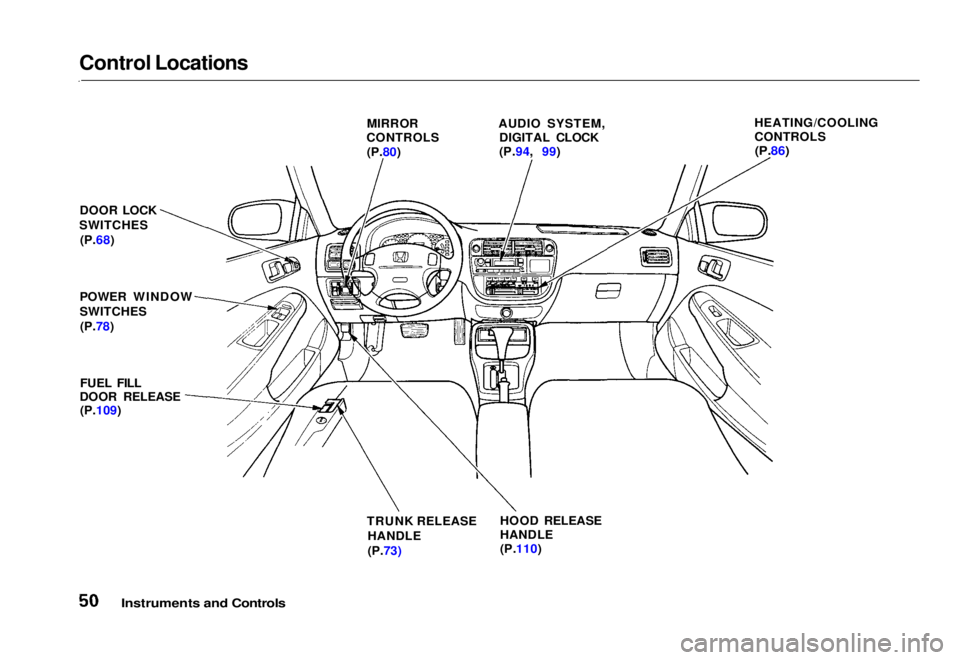
Control Locations
Instruments and Controls
MIRROR
CONTROLS
(P.80) AUDIO SYSTEM,
DIGITAL CLOCK
(P.94, 99) HEATING/COOLING
CONTROLS
(P.86)
DOOR LOCK
SWITCHES (P.68)
POWER WINDOW
SWITCHES (P.78)
FUEL FILL
DOOR RELEASE (P.109)
TRUNK RELEASE
HANDLE
(P.73) HOOD RELEASE
HANDLE
(P.110)Main Menu Table of Contents s t
Page 53 of 251
Indicator Lights
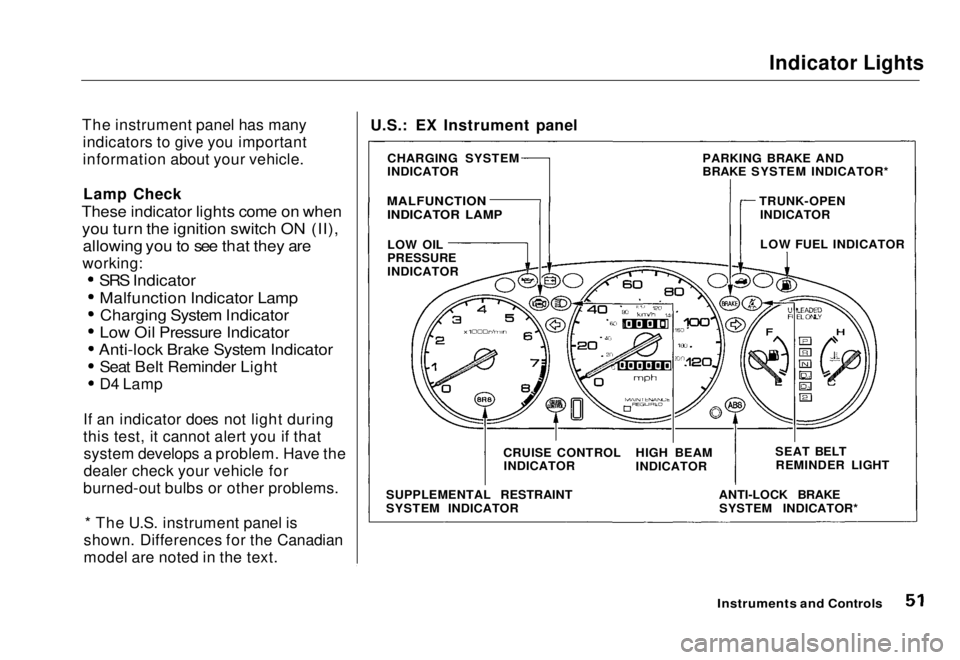
The instrument panel has many indicators to give you important
information about your vehicle.
Lamp Check
These indicator lights come on when
you turn the ignition switch ON (II), allowing you to see that they are
working:
SRS Indicator
Malfunction Indicator LampCharging System Indicator
Low Oil Pressure Indicator
Anti-lock Brake System Indicator
Seat Belt Reminder Light
D4 Lamp
If an indicator does not light during
this test, it cannot alert you if that system develops a problem. Have the
dealer check your vehicle for
burned-out bulbs or other problems.
* The U.S. instrument panel is
shown. Differences for the Canadian
model are noted in the text.
Instruments and Controls
U.S.: EX Instrument panel
CHARGING SYSTEM
INDICATOR
MALFUNCTION
INDICATOR LAMP
LOW OIL
PRESSURE
INDICATOR
SUPPLEMENTAL RESTRAINT
SYSTEM INDICATOR CRUISE CONTROL
INDICATOR HIGH BEAM
INDICATOR
ANTI-LOCK BRAKESYSTEM INDICATOR* SEAT BELT
REMINDER LIGHT
LOW FUEL INDICATOR
PARKING BRAKE AND
BRAKE SYSTEM INDICATOR*
TRUNK-OPENINDICATORMain Menu Table of Contents s t