1998 GMC ENVOY instrument panel
[x] Cancel search: instrument panelPage 121 of 386
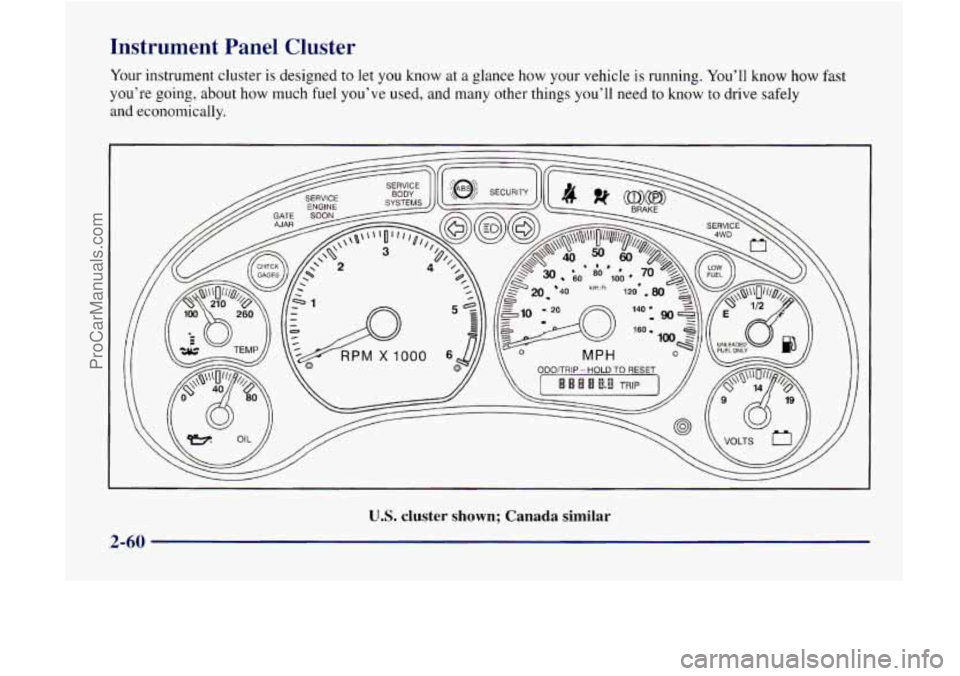
Instrument Panel Cluster
U.S. cluster shown; Canada similar
2-60
ProCarManuals.com
Page 124 of 386

Air Bag Readiness Light
There is an air bag readiness light on the instrument
panel, which shows
the air bag symbol. The system
checks the air bag’s electrical system for malfunctions.
The light tells you
if there is an electrical problem. The
system check includes
the air bag sensors, the air bag
module, the wiring and the diagnostic module. For more
information
on the air bag system, see “Air Bag” in
the Index.
This light will come on
when you start your engine,
and
it will flash for a few
seconds. Then the light
should go out. This means
the system is ready.
If the air bag readiness light stays on after you start the
engine or comes on when you are driving, your air bag
system may
not work properly. Have your vehicle
serviced right away.
The air bag readiness light should flash for a few
seconds when
you turn the ignition key to RUN. If the
light doesn’t come
on then, have it fixed so it will be
ready to warn
you if there is a problem.
Charging System Indicator Light
The charging system light
will come on briefly when
you turn on the ignition, but
’ the engine is not running,
as a check to show you it
is working.
It should go out once the engine
is running. If it stays
on, or comes on while you are driving, you may have a
problem with the charging system.
It could indicate that
you have problems with
a generator drive belt, or
another electrical problem. Have
it checked right away.
Driving while this light
is on could drain your battery.
If you must drive a short distance with the light on, be
certain to turn off all your accessories, such as the radio
and air conditioner.
2-63
I
ProCarManuals.com
Page 136 of 386

Mode Knob - Automatic Operation
The right knob on the control panel allows you to
choose the direction of air delivery. When the system is
set for automatic operation, sensors will control the air
delivery mode.
Air will come primarily from the floor or
instrument panel outlets, with some air directed to the
windshield to prevent fogging.
When the system is in AUTO mode, the air conditioning
light will turn on, and the recirculation and outside air
lights turn
off. With the system in full auto control
(both the fan and mode knobs
in AUTO), you still have
the ability to override any function. However,
continually overriding the outside air or the
A/C
compressor will limit the ability of the system to cool
the vehicle quickly.
If you push a button for a function which is nor
available, the light next to that button will flash three
times to alert you that it’s not available.
To find your comfort zone, start with the
74°F (23 O C)
setting and allow about 20 minutes for the system to
adjust the temperature if necessary.
With the automatic setting, the
air conditioning compressor
automatically cycles when needed to cool the
air. In cold
weather, when the system senses the need for heat, the
airflow
will be directed out the floor outlets. As the interior temperature approaches the desired setting, the
blower speed will decrease. To maintain interior comfort,
the &ow will adjust between the instrument panel
air
outlets and floor outlets. On bright sunny days in cool
weather, the alrflow may come out
of the air conditioning
and floor outlets (bi-level mode) to maintain comfort and
prevent stuffiiess.
To avoid blowing cold
air in cold weather, the system will
delay turning on the fan until warm
air is available. The
length of delay depends on the outside
air temperature,
engine coolant temperature or the time since the engine was last started.
As the coolant warms up, the blower fan
speed will gradually increase and
air will flow from the
heater outlets, with some airflow to
the windshield to
prevent fogging under most normal conditions.
If your vehicle is sitting out on a warm day and you
have the fan set on AUTO, the air will first flow out of
the floor air outlets
for a few seconds. That is normal.
This is to expel hot air from the air outlets.
As the air is
cooled, the airflow will move through the
air
conditioning outlets.
Be careful not to put anything over the solar sensor
located around the center of the instrument panel.
This sensor is used by the automatic system to
regulate temperature.
3-3
I
ProCarManuals.com
Page 137 of 386
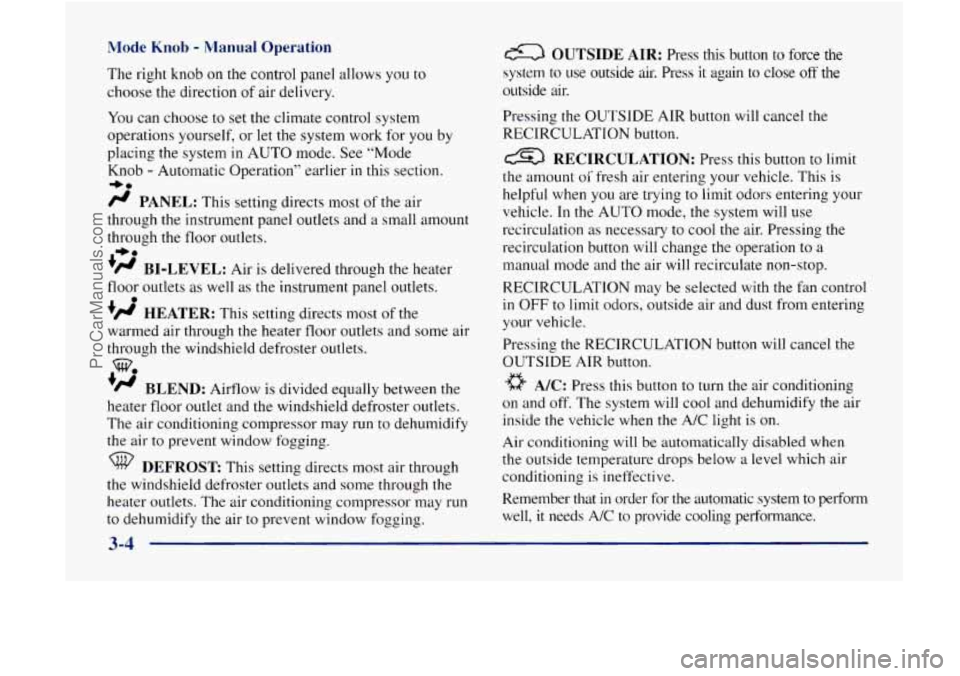
Mode Knob - Manual Operation
The right knob on the control panel allows you to
choose the direction
of air delivery.
You can choose to set the climate control system
operations yourself, or let the system work for you by
placing the system
in AUTO mode. See “Mode
Knob
- Automatic Operation” earlier in this section.
/J PANEL: This setting directs most of the air
through the instrument panel outlets and a small amount
through the floor outlets.
’@ BI-LEVEL: Air is delivered through the heater
floor outlets as well as the instrument panel outlets.
+# HEATER: This setting directs most of the
warmed air through the heater floor outlets and some air
through the windshield defroster outlets.
‘/J BLEND: Airflow is divided equally between the
heater floor outlet and the windshield defroster outlets.
The air conditioning compressor may run
to dehumidify
the air to prevent window fogging.
+0
-bo
0
WO
DEFROST This setting directs most air through
the windshield defroster outlets and some through the
heater outlets. The air conditioning compressor may
run
to dehumidify the air to prevent window fogging.
a OUTSIDE AIR: Press this button to force the
system to
use outside air. Press it again to close off the
outside air.
Pressing the
OUTSIDE AIR button will cancel the
RECIRCULATION button.
RECIRCULATION: Press this button to limit
the amount
oi’ fresh air entering your vehicle. This is
helpful when
you are trying to limit odors entering your
vehicle. In the AUTO mode, the system will use
recirculation as necessary to cool
the air. Pressing the
recirculation button will change the operation to
a
manual mode and the air will recirculate non-stop.
RECIRCULATION may be selected
with the fan control
in OFF to limit odors, outside air and dust from entering
your vehicle.
Pressing the RECIRCULATlON button will cancel the
OUTSIDE AIR button.
a A/C: Press this button to turn the air conditioning
on and off. The system will cool and dehumidify the air
inside the vehicle
when the A/C light is on.
Air conditioning will be automatically disabled when
the outside temperature drops below a level which air
conditioning is ineffective.
Remember that
in order for the automatic system to perform
well,
it needs A/C to provide cooling performance.
3-4
ProCarManuals.com
Page 138 of 386

Air Conditioning
On hot days, open the windows long enough to let hot
inside air escape. This reduces the time
it takes for your
vehicle to cool down. Then keep your windows closed
for the air conditioner to work its best.
Heating
For quick cool-down on very hot days, A/C should be
enabled with the temperature knob turned
to the left and
the OUTSIDE
AIR button should not be active. This
setting should be used to keep odors and/or dust from
entering the vehicle. For normal cooling on hot days,
use
A/C with the temperature knob turned to the left.
On cool but sunny days, use BI-LEVEL
A/C to deliver
warm air to the floor and cooler air to the instrument
panel outlets.
When the air conditioner is on, you may sometimes
notice slight changes
in your vehicle’s engine speed
and power.
This is normal because the system is
designed to cycle the compressor on and off to keep the
desired temperature. The heater
works best
if you keep your windows closed
while using it.
On cold days, use HEATER with the
temperature knob turned
to the right. BLEND is useful
in cool weather when
you have fog or ice on the
windshield
or side windows.
If you use the optional engine coolant heater before
starting your engine, your heating system will produce
warmer air faster to heat the passenger compartment in
cold weather. See “Engine Coolant Heater”
in the Index.
Ventilation System
For mild outside temperatures when little heating or
cooling is needed, use PANEL with the OUTSIDE
AIR
button enabled to direct outside air through your vehicle.
Airflow is through the instrument panel outlets.
Your vehicle’s ventilation system supplies outside air to
the inside
of your vehicle when it is moving. When the
vehicle is not moving, you can get outside air to flow
through by selecting
any mode and any fan speed.
3-5
!
ProCarManuals.com
Page 139 of 386
Ventilation Tips
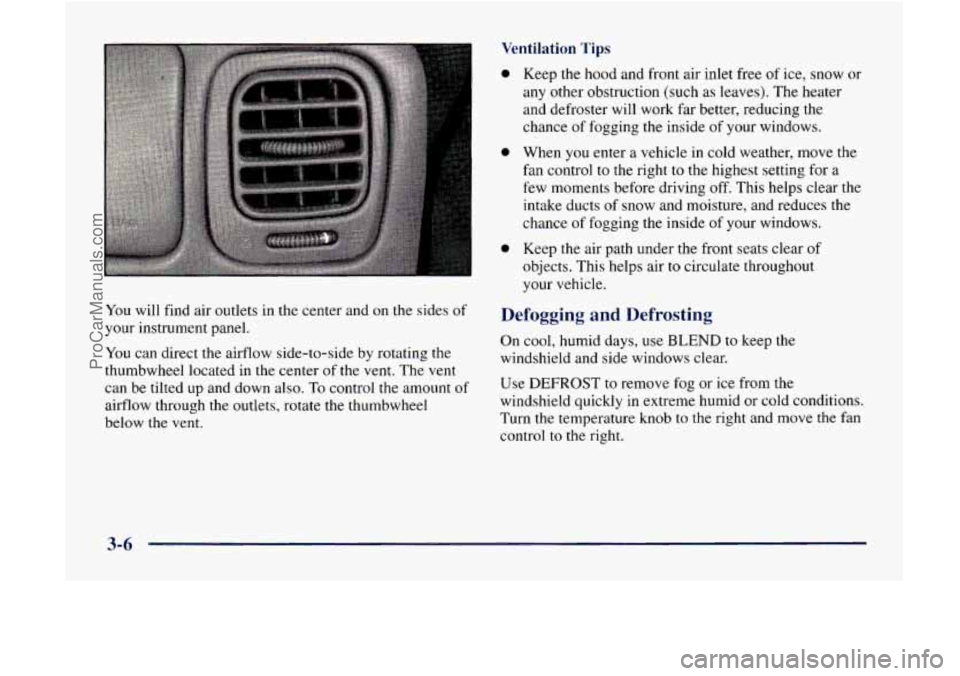
You will find air outlets in the center and on the sides of
your instrument panel.
You can direct the airflow side-to-side by rotating the
thumbwheel located in the center of the vent. The vent
can be tilted up and down also.
To control the amount of
airflow through the outlets, rotate the thumbwheel
below the vent.
0
e
0
Keep the hood and front air inlet free of ice, snow or
any other obstruction (such as leaves). The heater
and defroster will work far better, reducing the
chance
of fogging the inside of your windows.
When
you enter a vehicle in cold weather, move the
fan control to the right
to the highest setting for a
few moments before driving off. This helps clear the
intake ducts
of snow and moisture, and reduces the
chance of fogging the inside of your windows.
Keep the air path under the front seats clear
of
objects. This helps air to circulate throughout
your vehicle.
Defogging and Defrosting
On cool, humid days, use BLEND to keep the
windshield and side windows clear.
Use DEFROST
to remove fog or ice from the
windshield quickly in extreme humid or cold conditions.
Turn the temperature knob to the right and move the fan
control
to the right.
3-6
ProCarManuals.com
Page 208 of 386
Passing
You’ll need more passing distance up ahead when
you’re towing a trailer. And, because you’re
a good deal
longer,
you’ll need to go much farther beyond the
passed vehicle before you can return to your lane.
Backing Up
Hold the bottom of the steering wheel with one hand.
Then,
to move the trailer to the left, just move that hand
to the left. To move the trailer to the right, move your
hand to the right. Always back up slowly and,
if
possible, have someone guide you.
Making Turns
NOTICE:
~~
Making very sharp turns while trailering could
cause the trailer to come in contact with the
vehicle. Your vehicle could be damaged. Avoid
making very sharp turns while trailering.
When you’re turning with a trailer, make wider turns than
normal.
Do this so your trailer won’t strike soft shoulders,
curbs, road signs, trees or other objects.
Avoid jerky or
sudden maneuvers. Signal well
in advance.
Turn Signals When Towing a Trailer
When you tow a trailer, your vehicle has to have extra
wiring and a heavy-duty turn signal flasher.
The arrows on your instrument panel will flash
whenever you signal a
turn or lane change. Properly
hooked up,
the trailer lamps will also flash, telling other
drivers you’re about to
turn, change lanes or stop.
When towing a trailer, the arrows
on your instrument
panel will flash for turns even
if the bulbs on the trailer
are burned out. Thus, you may think drivers behind you
are seeing your signal when
they are not. It’s important
to check occasionally
to be sure the trailer bulbs are
still working.
4-49
I
ProCarManuals.com
Page 222 of 386

Engine Overheating
You will find a coolant temperature gage on your
vehicle's instrument panel. See "Gages" in the Index.
If Steam Is Coming From Your Engine
A CAUTION:
Steam from an overheated engine can burn you
badly, even if you ,just open the hood. Stay
away
from the engine if you see or hear steam coming
from
it. Just turn it off and get everyone away
from the vehicle until it cools down. Wait until
there is no sign of steam or coolant before you
open the hood.
If you keep driving when your engine is
overheated, the liquids in it can catch fire. You or
others could be badly burned. Stop your engine if
it overheats, and get out of the vehicle until the
engine is
cool.
NOTICE:
If your engine catches fire because you keep
driving with no coolant, your vehicle can be
badly damaged.
The costly repairs would not be
covered
by your warranty.
5-11
ProCarManuals.com