1998 GMC ENVOY oil temperature
[x] Cancel search: oil temperaturePage 78 of 386

To Use the Engine Coolant Heater
1. Turn off the engine.
2. Open the hood and unwrap the electrical cord. The
cord is located on the driver’s side of the engine
compartment, behind the underhood fuse block.
3. Plug it into a normal, grounded 110-volt AC outlet.
% CAUTION:
Plugging the cord into an ungrounded outlet
could cause an electrical shock. Also, the wrong
kind
of extension cord could overheat and cause
a fire. You could be seriously injured. Plug the
cord into
a properly grounded three-prong
110-volt
AC outlet. If the cord won’t reach, use a
heavy-duty three-prong extension cord rated for
at least
15 amps.
4. Before starting the engine, be sure to unplug and
store the cord as it was before to keep it away from
moving engine parts. If you don’t, it could
be damaged.
How long should you keep the coolant heater plugged
in? The answer depends on the outside temperature, the
kind
of oil you have, and some other things. Instead of
trying to list everything here, we ask that you contact
your dealer in the area where you’ll be parking your
vehicle. The dealer can give you the best advice for that
particular area.
2-17
ProCarManuals.com
Page 130 of 386

Have you recently changed brands of fuel?
If so, be sure to fuel your vehicle with quality fuel (see
"Fuel"
in the Index). Poor fuel quality will cause your
engine not to run as efficiently
as designed. You may
notice this as stalling after start-up, stalling when you
put the vehicle into gar, misfiring, hesitation on
acceleration or stumbling on acceleration. (These
conditions may go away once the engine
is warmed up.)
This will be detected by the system and cause the light
to turn on.
If you experience one or more of these conditions,
change the
fuel brand you use. It will require at least one
full tank of the proper fuel to turn the light off.
If none of the above steps have made the light turn off,
have your dealer or qualified service center check the
vehicle. Your dealer has the proper test equipment and
diagnostic tools to
fix any mechanical or electrical
problems that may have developed.
Engine Oil Pressure Gage
The oil pressure gage shows
the engine
oil pressure in
psi (pounds per square inch)
when the engine is running.
Canadian vehicles indicate pressure
in kPa (kilopascals).
Oil pressure may vary with engine speed, outside
temperature and oil viscosity, but readings above the
low pressure zone indicate the normal operating range.
A reading in the low pressure zone may be caused by a
dangerously low
oil level or other problems causing low
oil pressure.
2-69
I
ProCarManuals.com
Page 132 of 386

Service 4WD Light
SERVICE
4WD
This light should come on
briefly when you turn on the
ignition, as a check to show
you it is working.
The
SERVICE 4WD light comes on to indicate that
there may be a problem with the drive system and
service is required. Malfunctions can be indicated by the
system before any problem is apparent, which may
prevent serious damage
to the vehicle. This system is
also designed to assist your service technician in
correctly diagnosing a malfunction.
Check Gages Light
The CHECK GAGES light
CHECK
GAGES
will come on briefly when
you are starting the engine.
If the light comes on and stays on while you are driving,
check your coolant temperature and engine oil pressure
gages
to see if they are in the warning zones.
Gate Ajar Light
GATE
AJAR
This light will come on
briefly when
you are
starting the engine.
If it stays on, your liftgate
is ajar. Try closing the liftgate
again. Never drive with the liftgate even partially open.
2-71
ProCarManuals.com
Page 209 of 386

Driving On Grades
Reduce speed and shift to a 1owe.r gear Iwfow you start
down a long or steep downgrade.
If you don’t shift
down. you might have to use your brakes
so much that
they would get hot and no longer work well.
On
a long uphill grade, shift down and reduce your
speed to around
45 mph (70 km/h) to reduce the
possibility of engine and transmission overheating.
You should use DRIVE
(D) when towing a trailer.
Operating your vehicle
in DRIVE (D) when towing a
trailer
will minimize heat buildup and extend the life of
your transmission.
When towing at high altitude
on steep uphill grades,
consider the following: Engine coolant
will boil at a lower
temperature than at normal altitudes.
If you twn your
engine off imnlediately after towing at high altitude on
steep uphill grades, your vehicle may show signs similar to
engine overheating.
To avoid this, let the engine run while
parked (preferably on level ground)
with the automatic
transmission
in PARK (PI for a few minutes before turning
the engine off.
If you do get the overheat warning. see
”Engine Overheating”
in the Index.
Parking on Hills
You really should not park your vehicle, with a trailer
attached.
on a hill. If‘ something goes wrong, your rig
could start
to move. People can be injured, and both
your vehicle and the trailer can be damaged.
But
if you ever have to park your rig on a hill, here‘s
how
to do it:
1.
-. 3
3.
4.
5.
Apply your regular brakes, but don’t shift into
PARK
(P) yet. Then turn your wheels into the curb
if facing downhill or into traffic if facing uphill.
Have someone place chocks under the trailer wheels.
When the wheel chocks are
in place, release the
regular brakes
until the chocks absorb the load.
Reapply the regular brakes. Then apply your parking
brake, and then shift into PARK
(P).
Release the regular brakes.
4-50
ProCarManuals.com
Page 259 of 386

What Kind of Eng 3il to Use
Oils recommended for your vehicle can be identified by
looking for the “Starburst” symbol. This symbol
indicates that the oil has been certified by the American
Petroleum Institute (API).
Do not use any oil which
does not carry this Starburst symbol.
If you change your own oil,
be sure you use oil that has
the Starburst symbol on the
front of the
oil container. If
you have your oil changed
for you, be sure the oil
put
into your engine is
American Petroleum
Institute certified
for
gasoline engines.
You should also use the proper viscosity oil for your
vehicle, as shown in the following chart:
I RECOMMENDED SA€ VISCOSITY GRADE ENGINE OILS
FOR BEST FUEL ECONOMY AND COLD STARTING, SELECT THE LOWEST
I SAL VISCOSITY GRADE OIL FOR THE EXPECTED TEMPERATURE RANGE.
L
HOT
WEATHER
+ 20 7
SAE SW-30 PREFERRED
LOOK
FOR MIS
SYMBOL
00 NOT USE SAE 2OW-50 OR ANY OTHER
GRADE OIL NOT RECOMMENDED
6-12
ProCarManuals.com
Page 260 of 386

As shown in the chart, SAE SW-30 is best for your
vehicle. However, you can use
SAE low-30 if it’s going
to be 0°F (- 18°C) or above. These numbers on an oil
container show its viscosity, or thickness. Do
not use
other viscosity oils, such
as SAE 20W-SO.
NOTICE:
Use only engine oil with the American Petroleum
Institute Certified For Gasoline Engines
“Starburst”
symbol. Failure to use the
recommended oil can result in engine damage not
covered by your warranty.
GM Goodwrench@ oil meets all the requirements for
your vehicle.
If you are in an area where the temperature falls below
-20°F (-29”C), consider using either an SAE 5W-30
synthetic oil or an SAE OW-30 oil. Both will provide
easier cold starting and better protection for your engine
at extremely low temperatures.
Engine Oil Additives
Don’t add anything to your oil. Your dealer is ready to
advise if you think something should be added.
When to Change Engine Oil
If any one of these is true for you, use the short tripkity
maintenance schedule:
0 Most trips are less than 5 to 10 miles (8 to 16 km).
This is particularly important when outside
temperatures are below freezing.
driving
in stop-and-go traffic).
off-road frequently. your vehicle.
or other commercial application.
0 Most trips include extensive idling (such as frequent
0 You operate your vehicle in dusty areas or
0 You frequently tow a trailer or use a carrier on top of
0 The vehicle is used for delivery service, police, taxi
Driving under these conditions causes engine oil
to
break down sooner. If any one of these is true for your
vehicle, then you need to change your
oil and filter
every
3,000 miles (5 000 km) or 3 months -- whichever
occurs first.
If none of them is true, use the long trip/highway
maintenance schedule. Change the oil and filter every
7,500 miles (12 500 km) or 12 months -- whichever
occurs first. Driving
a vehicle with a fully warmed
engine under highway conditions causes engine oil
to
break down slower.
6-13
ProCarManuals.com
Page 262 of 386

A CAUTION:
Operating the engine with the air cleaner off can
cause you or others to be burned. The air cleaner
not only cleans the air, it stops flame
if the engine
backfires.
If it isn’t there, and the engine
backfires, you could be burned. Don’t drive with
it
off, and be careful working on the engine with
the
air cleaner off.
NOTICE:
If the air cleaner is off, a backfire can cause a
damaging engine fire. And, dirt can easily get
into your engine, which will damage it. Always
have the air cleaner in place when you’re driving.
Automatic Transmission Fluid
When to Check and Change
A good time to check your automatic transmission fluid
level
is when the engine oil is changed.
Change both the fluid and filter every
15,000 miles
(25 000 km) if the vehicle is mainly driven under one
or more of these conditions:
In heavy city traffic where the outside temperature
regularly reaches
90°F (32°C) or higher.
In hilly or mountainous terrain.
When doing frequent trailer towing.
Uses such as found in taxi, police or delivery service.
If you do not use your vehicle under any of these
conditions, change the fluid and filter every
50,000 miles (83 000 km).
See “Scheduled Maintenance Services’’ in the Index.
ProCarManuals.com
Page 269 of 386
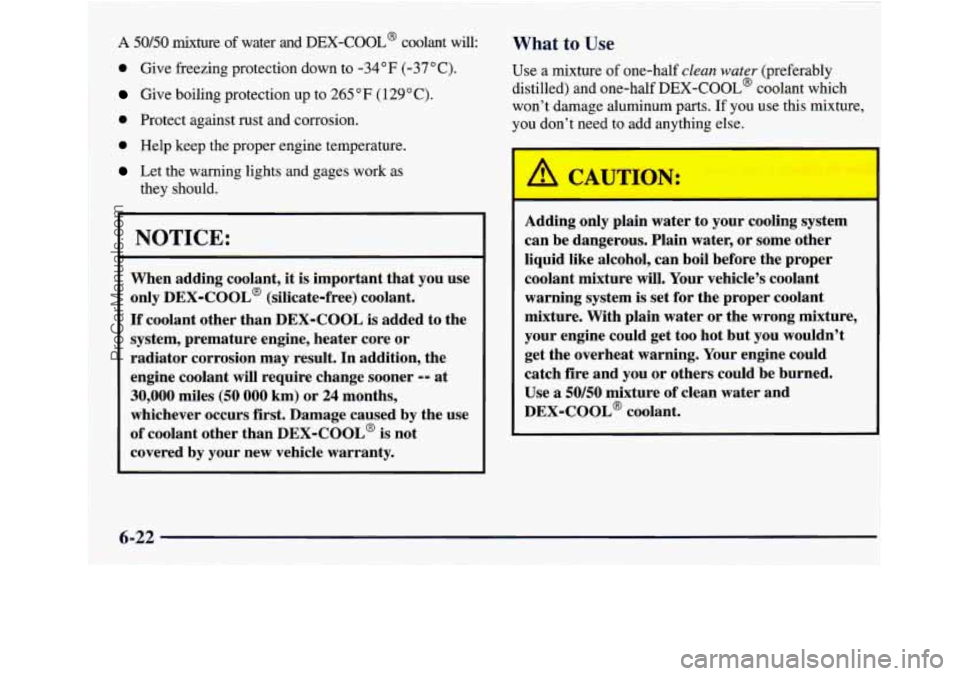
A 50/50 mixture of water and DEX-COOL@ coolant will:
0 Give freezing protection down to -34°F (-37°C).
Give boiling protection up to 265 “F ( 129°C).
0 Protect against rust and corrosion.
0 Help keep the proper engine temperature.
Let the warning lights and gages work as
they should.
NOTICE:
When adding coolant, it is important that you use
only
DEX-COOL@ (silicate-free) coolant.
If coolant other than DEX-COOL is added to the
system, premature engine, heater core or
radiator corrosion may result. In addition, the
engine coolant will require change sooner
0- at
30,000 miles (50 000 km) or 24 months,
whichever occurs
first. Damage caused by the use
of coolant other than DEX-COOL@ is not
covered by your new vehicle warranty.
What to Use
Use a mixture of one-half clean water (preferably
distilled) and one-half
DEX-COOL@ coolant which
won’t damage aluminum
parts. If you use this mixture,
you don’t need to add anything else.
Adding only plain water to your cooling system
can be dangerous. Plain water, or some other
liquid like alcohol, can boil before the proper
coolant mixture will. Your vehicle’s coolant
warning system is set for the proper coolant
mixture. With plain water or the wrong mixture,
your engine could get too hot but you wouldn’t
get the overheat warning. Your engine could
catch fire and you or others could be burned.
Use
a 50/50 mixture of clean water and
DEX-COOL@ coolant.
ProCarManuals.com