Page 117 of 216

Do not exceed the GVWR
or the GAWR specified on
the Safety Compliance
Certification Label.
Do not use replacement tires with
lower weight capacities than the
originals because they may lower
the vehicle's GVWR and GAWR
limitations. Replacement tires with
a higher weight limit than the
originals do not increase the
GVWR and GAWR limitations.
Calculating the load your
vehicle can carry/tow
1. Use the Safety Compliance
Certification Label to find the axle
code number and engine type for
your vehicle.
2. Use the appropriate maximum
gross combined weight rating
(GCWR) chart to find the
maximum GCWR for your type
engine and rear axle ratio.
3. Weigh your vehicle as you
customarily operate the vehicle
without cargo. To obtain correct
weights, try taking your vehicle to
a shipping company or an
inspection station for trucks.
4. Subtract your loaded vehicle
weight from the maximum GCWR
on the following charts. This is the
maximum trailer weight your
vehicle can tow and must fall
below the maximum shown under
maximum trailer weight on the
chart.
Driving
117
Page 118 of 216
Trailer towing with your vehicle
may require the use of a trailer
tow option package.
Trailer towing puts additional loads
on your vehicle's engine,
transmission, axle, brakes, tires,
and suspension. For your safety
and to maximize vehicle
performance, be sure to use the
proper equipment while towing.
Follow these guidelines to ensure
safe towing procedure:
²Stay within your vehicle's load
limits. If exceeded, cargo should
be removed from the trailer
and/or the vehicle until all
weights are within specified
limits.
²Thoroughly prepare your vehicle
for towing. Refer toPreparing
to towin this chapter.
²Use extra caution when driving
while trailer towing. Refer to
Driving while you towin this
chapter.
²Service your vehicle more
frequently if you tow a trailer.
Refer to the severe duty
schedule in the ªService Guideº.
²Do not tow a trailer until your
vehicle has been driven at least
800 km (500 miles).
²Refer to the instructions
included with towing accessories
for the proper installation and
adjustment specifications.
Driving
118
Page 119 of 216

If your vehicle is equipped with
the optional heavy duty trailer tow
wiring, it is pre-wired for trailer
towing. An electrical connector is
provided under the instrument
panel for installing a
customer-supplied electric brake
controller. Another electrical
connector is provided at the hitch.
This connector provides power to
the trailer for taillamps, stop and
turn lamps, back up lamps, battery
charge, electric brakes (when a
customer provided controller is
installed) and ground. The kit
included with your vehicle
provides you with adaptors to
attach the brake controller and
convert the hitch connector for
Class I trailer usage.
Trailer towing table (with heavy
duty trailer tow option)
GCWR (Gross Combined Weight
Rating)/trailer weights
EngineRear
axle
ratioTire sizeMaximum
GCWRTrailer weight
range
(0 - maximum)
4x2
4.6L 3.3140.6 cm
(16 in)4 990 kg
(11 000 lbs.)0-2676 kg
(0-5 900 lbs.)
5.4L 3.3140.6 cm
(16 in)5 443 kg
(12 000 lbs.)0-3 039 kg
(0-6 700 lbs.)
5.4L 3.7340.6 cm
(16 in)6 123 kg
(13 500 lbs.)0-3 628 kg
(0-8 000 lbs.)
Driving
119
Page 120 of 216
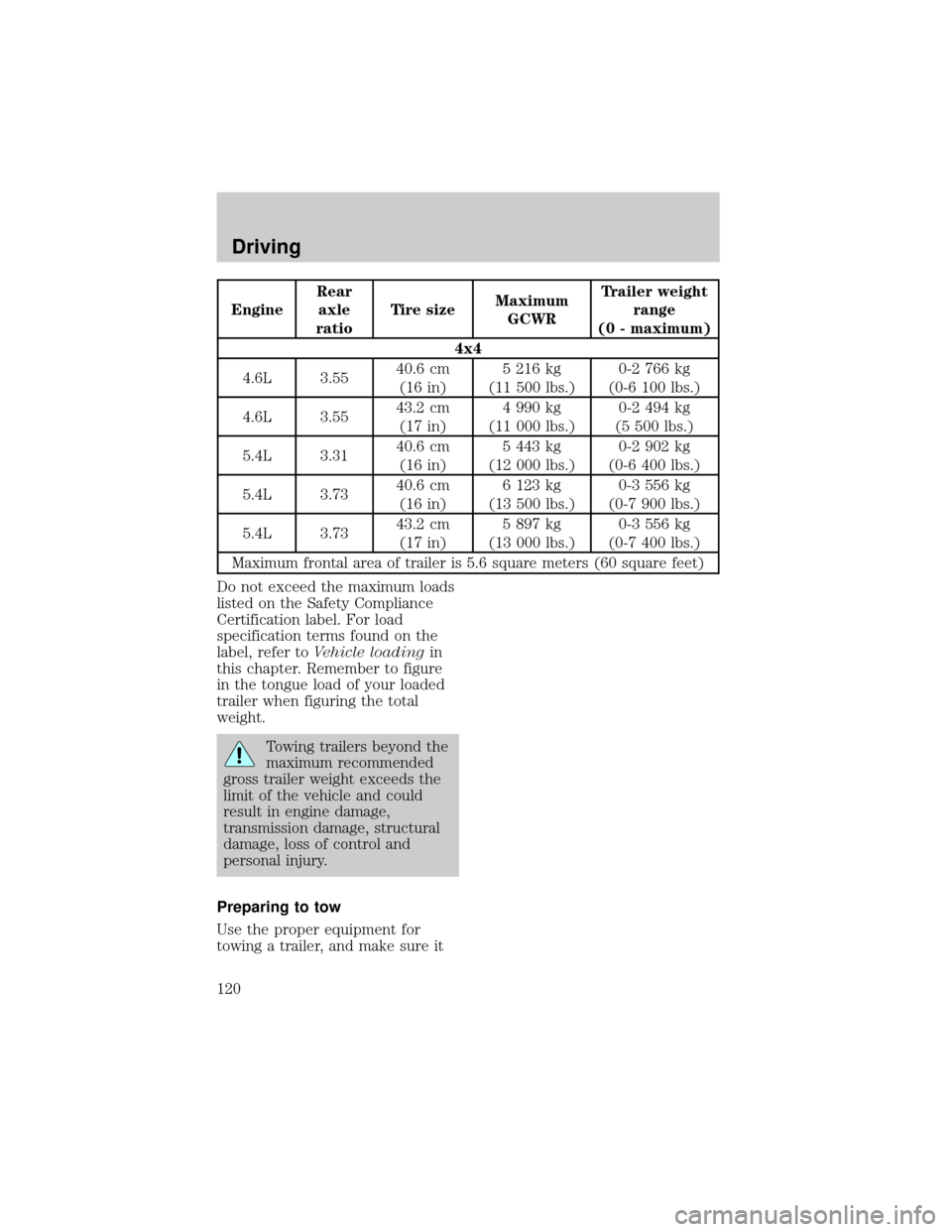
EngineRear
axle
ratioTire sizeMaximum
GCWRTrailer weight
range
(0 - maximum)
4x4
4.6L 3.5540.6 cm
(16 in)5 216 kg
(11 500 lbs.)0-2 766 kg
(0-6 100 lbs.)
4.6L 3.5543.2 cm
(17 in)4 990 kg
(11 000 lbs.)0-2 494 kg
(5 500 lbs.)
5.4L 3.3140.6 cm
(16 in)5 443 kg
(12 000 lbs.)0-2 902 kg
(0-6 400 lbs.)
5.4L 3.7340.6 cm
(16 in)6 123 kg
(13 500 lbs.)0-3 556 kg
(0-7 900 lbs.)
5.4L 3.7343.2 cm
(17 in)5 897 kg
(13 000 lbs.)0-3 556 kg
(0-7 400 lbs.)
Maximum frontal area of trailer is 5.6 square meters (60 square feet)
Do not exceed the maximum loads
listed on the Safety Compliance
Certification label. For load
specification terms found on the
label, refer toVehicle loadingin
this chapter. Remember to figure
in the tongue load of your loaded
trailer when figuring the total
weight.
Towing trailers beyond the
maximum recommended
gross trailer weight exceeds the
limit of the vehicle and could
result in engine damage,
transmission damage, structural
damage, loss of control and
personal injury.
Preparing to tow
Use the proper equipment for
towing a trailer, and make sure it
Driving
120
Page 121 of 216

is properly attached to your
vehicle. See your dealer or a
reliable trailer dealer if you require
assistance.
If your vehicle is not equipped
with the factory heavy duty trailer
tow option, auxiliary coolers are
recommended for the automatic
transmission system if you are
planning on:
²traveling farther than 80 km
(50 miles)
²towing in hilly terrain
²towing frequently
Hitches
Do not use hitches that clamp onto
the vehicle's bumper or attach to
the axle. You must distribute the
load in your trailer so that 10 to
15% of the total weight of the
trailer is on the tongue.
Load equalizing hitch
When hooking up a trailer using a
load equalizing hitch, always use
the following procedure:
1. Park the unloaded vehicle on a
level surface. With the ignition on
and all doors closed, allow the
vehicle to stand for several
minutes so that it can level.
2. Turn the air suspension (if
equipped) control to OFF.
3. Measure the height of a
reference point on the front and
rear bumpers at the center of the
vehicle.
Driving
121
Page 123 of 216
Do not connect a trailer's
hydraulic brake system
directly to your vehicle's brake
system. Your vehicle may not
have enough braking power and
your chances of having a
collision greatly increase.
Trailer lamps
Trailer lamps are required on most
towed vehicles. Make sure your
trailer lamps conform to local and
Federal regulations. See your
dealer or trailer rental agency for
proper instructions and equipment
for hooking up trailer lamps.
Using a step bumper
The rear bumper is equipped with
an integral hitch and requires only
a ball with a 25.4 mm (one inch)
shank diameter. The bumper has a
1 814 kg (4 000 lb.) trailer weight
and 181 kg (400 lb.) tongue weight
capability.
Use a frame-mounted weight
distributing hitch for trailers over
1814 kg (4 000 lb).
Driving while you tow
Do not drive faster than 88 km/h
(55 mph) when towing a trailer.
Speed control may shut off if you
are towing on long, steep grades.
When towing a trailer:
²Use D (Drive) or a lower gear
when towing up or down steep
hills. This will eliminate
excessive downshifting and
Driving
123
Page 124 of 216
upshifting for optimum fuel
economy and transmission
cooling.
²Anticipate stops and brake
gradually.
Servicing after towing
If you tow a trailer for long
distances, your vehicle will require
more frequent service intervals.
Refer to the Severe Duty Schedule
in your ªService Guideº for more
information.
Towing behind another vehicle
Do not tow your vehicle behind
another vehicle, such as an RV.
Your vehicle cannot be flat towed
with all wheels on the ground.
Trailer towing tips
²Practice turning, stopping and
backing up in an area before
starting on a trip to get the feel
of the vehicle trailer
combination. When turning,
make wider turns so the trailer
wheels will clear curbs and
other obstacles.
²Allow more distance for
stopping with a trailer attached.
²The trailer tongue weight should
be 10±15% of the loaded trailer
weight.
²After you have traveled 80 km
(50 miles), thoroughly check
your hitch, electrical
connections and trailer wheel
lug nuts.
Driving
124
Page 126 of 216
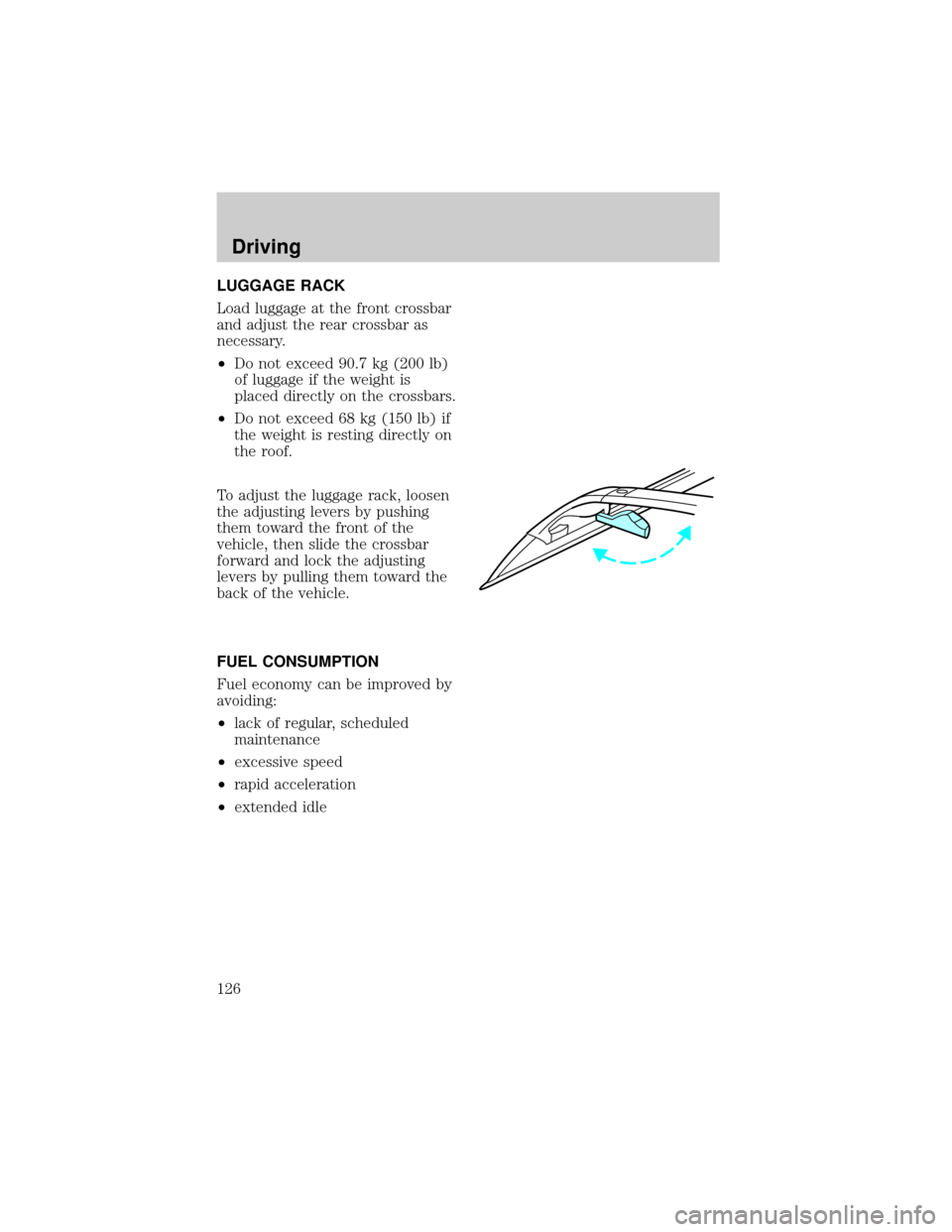
LUGGAGE RACK
Load luggage at the front crossbar
and adjust the rear crossbar as
necessary.
²Do not exceed 90.7 kg (200 lb)
of luggage if the weight is
placed directly on the crossbars.
²Do not exceed 68 kg (150 lb) if
the weight is resting directly on
the roof.
To adjust the luggage rack, loosen
the adjusting levers by pushing
them toward the front of the
vehicle, then slide the crossbar
forward and lock the adjusting
levers by pulling them toward the
back of the vehicle.
FUEL CONSUMPTION
Fuel economy can be improved by
avoiding:
²lack of regular, scheduled
maintenance
²excessive speed
²rapid acceleration
²extended idle
Driving
126