Page 97 of 216
If you ever smell exhaust
fumes of any kind inside
your vehicle, have your dealer
inspect and fix your vehicle
immediately. Do not drive if you
smell exhaust fumes. These
fumes are harmful and could kill
you.
Have the exhaust and body
ventilation systems checked
whenever:
²the vehicle is raised for service
²the sound of the exhaust system
changes
²the vehicle has been damaged in
a collision
Important ventilating
information
If the engine is idling while the
vehicle is stopped in an open area
for long periods of time, open the
windows at least 2.5 cm (one
inch).
Adjust the heating or air
conditioning (if equipped) to bring
in fresh air.
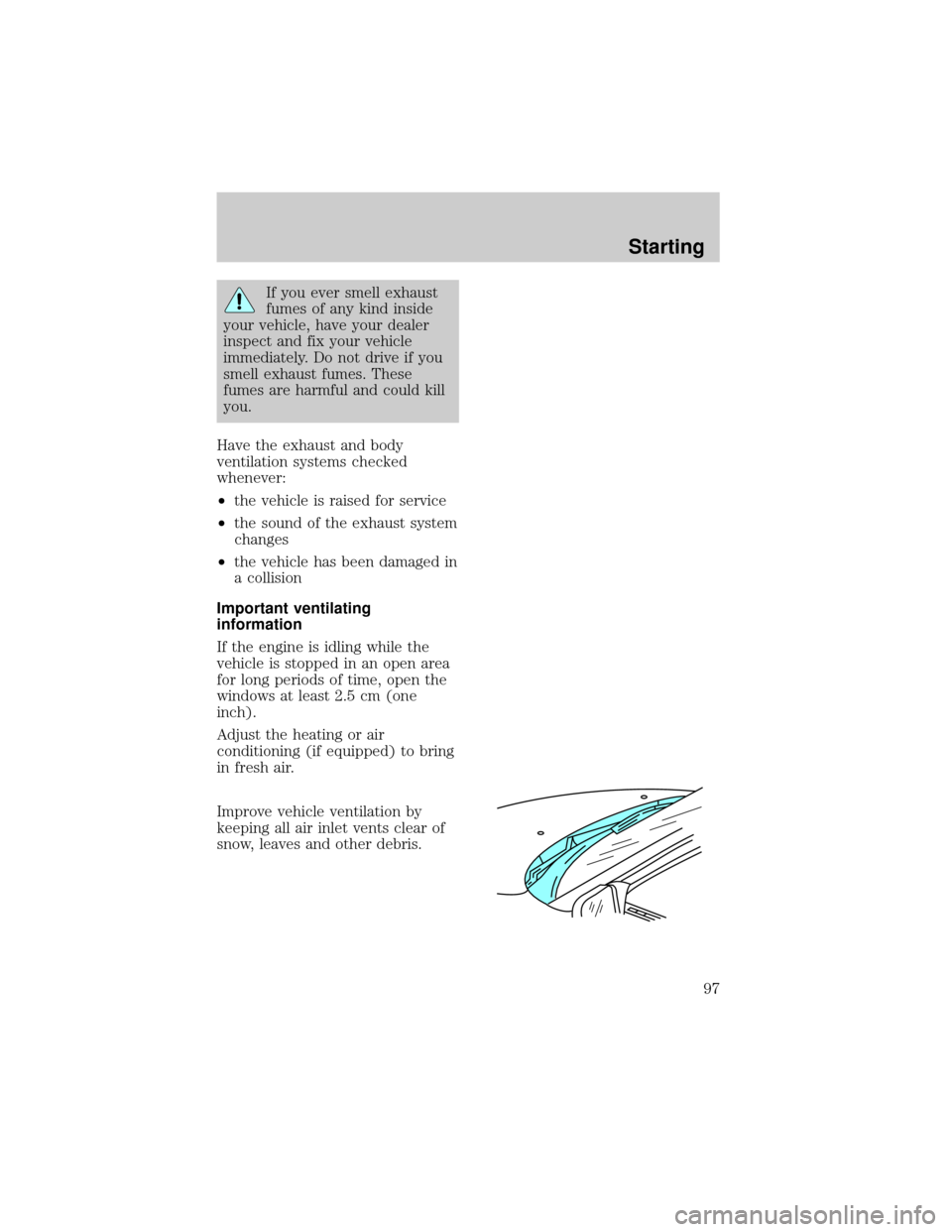
Improve vehicle ventilation by
keeping all air inlet vents clear of
snow, leaves and other debris.
Starting
97
Page 98 of 216

BRAKES
Your brakes are self-adjusting.
Refer to the ªService Guideº for
scheduled maintenance.
Occasional brake noise is normal
and often does not indicate a
performance concern with the
vehicle's brake system. In normal
operation, automotive brake
systems may emit occasional or
intermittent squeal or groan noises
when the brakes are applied. Such
noises are usually heard during the
first few brake applications in the
morning; however, they may be
heard at any time while braking
and can be aggravated by
environmental conditions such as
cold, heat, moisture, road dust, salt
or mud. If a ªmetal-to-metal,º
ªcontinuous grindingº or
ªcontinuous squealº sound is
present while braking, the brake
linings may be worn-out and
should be inspected by a qualified
service technician.
Anti-lock brake system (ABS)
On vehicles equipped with an
anti-lock braking system (ABS), a
noise from the hydraulic pump
motor and pulsation in the pedal
may be observed during ABS
braking events. Pedal pulsation
coupled with noise while braking
under panic conditions or on loose
gravel, bumps, wet or snowy roads
is normal and indicates proper
functioning of the vehicle's
anti-lock brake system. If the
vehicle has continuous vibration or
Driving
98
Page 99 of 216

shudder while braking, felt mainly
in the steering wheel, the vehicle
most likely needs service.
The ABS operates by detecting the
onset of wheel lock up during
brake applications and
compensating for this tendency.
The front wheels are prevented
from locking even when the brakes
are firmly applied. The
accompanying illustration depicts
the advantage of an ABS equipped
vehicle (on bottom) to a non-ABS
equipped vehicle (on top) during
hard braking.
ABS warning lamp
The
ABSwarning lamp in the
instrument cluster illuminates for
about five seconds when starting
the vehicle. If an ABS fault is
detected, the light will remain on
and your vehicle should be
serviced as soon as possible.
Normal braking is still effective
unless the BRAKE warning lamp is
also illuminated.
Using ABS
²In an emergency or when
maximum efficiency from the
ABS is required, apply
continuous full force on the
brake. The ABS will be activated
immediately, thus allowing you
to retain full steering control of
your vehicle and, providing
!
BRAKE
Driving
99
Page 102 of 216
steering assist will decrease to
improve steering feel. At lower
speeds, maneuverability will be
increased.
If the amount of effort required to
steer your vehicle changes at a
constant vehicle speed, have the
power steering system checked by
your dealer or a qualified service
technician.
AIR SUSPENSION SYSTEM
(IF EQUIPPED)
The air suspension system is
designed to improve ride, handling
and general vehicle performance
for static, on and off-road driving
conditions.
²The load leveling feature of the
air suspension automatically
keeps the vehicle at a constant
level if a load is added or
removed from the vehicle.
²The height adjustment feature
automatically controls the
vehicle height over a range of
approximately 5 cm (2 inches)
based on vehicle speed, ignition
position and selection of two or
four-wheel drive modes.
Driving
102
Page 118 of 216
Trailer towing with your vehicle
may require the use of a trailer
tow option package.
Trailer towing puts additional loads
on your vehicle's engine,
transmission, axle, brakes, tires,
and suspension. For your safety
and to maximize vehicle
performance, be sure to use the
proper equipment while towing.
Follow these guidelines to ensure
safe towing procedure:
²Stay within your vehicle's load
limits. If exceeded, cargo should
be removed from the trailer
and/or the vehicle until all
weights are within specified
limits.
²Thoroughly prepare your vehicle
for towing. Refer toPreparing
to towin this chapter.
²Use extra caution when driving
while trailer towing. Refer to
Driving while you towin this
chapter.
²Service your vehicle more
frequently if you tow a trailer.
Refer to the severe duty
schedule in the ªService Guideº.
²Do not tow a trailer until your
vehicle has been driven at least
800 km (500 miles).
²Refer to the instructions
included with towing accessories
for the proper installation and
adjustment specifications.
Driving
118
Page 124 of 216
upshifting for optimum fuel
economy and transmission
cooling.
²Anticipate stops and brake
gradually.
Servicing after towing
If you tow a trailer for long
distances, your vehicle will require
more frequent service intervals.
Refer to the Severe Duty Schedule
in your ªService Guideº for more
information.
Towing behind another vehicle
Do not tow your vehicle behind
another vehicle, such as an RV.
Your vehicle cannot be flat towed
with all wheels on the ground.
Trailer towing tips
²Practice turning, stopping and
backing up in an area before
starting on a trip to get the feel
of the vehicle trailer
combination. When turning,
make wider turns so the trailer
wheels will clear curbs and
other obstacles.
²Allow more distance for
stopping with a trailer attached.
²The trailer tongue weight should
be 10±15% of the loaded trailer
weight.
²After you have traveled 80 km
(50 miles), thoroughly check
your hitch, electrical
connections and trailer wheel
lug nuts.
Driving
124
Page 134 of 216
The high-current fuses are coded
as follows.
Fuse/Relay
LocationFuse Amp
RatingDescription
1 20A* Trailer Tow Running Lamp Relay,
Trailer Tow Backup Lamp Relay
2 10A* Air Bag Diagnostic Monitor
3 30A* All Unlock Relay, All Lock Relay,
Driver's Unlock Relay
4 15A* Air Suspension Service Switch
5 20A* Horn Relay
6 30A* Radio, Premium Sound Amplifier,
CD Changer, Rear Integrated
Control Panel, Sub-Woofer Power
(Fuse 3 & Fuse 5)
19 29
18 28EEC
POWER
RELAY
FUEL
PUMP
RELAY
FRONT
WASHER
PUMP HORN
RELAY 17 27
16 26
15 25
14 24
13
11 12
910
78
56
34
1223
22
21
20
W/S/W
RUN/
PARKW/S/W
HI/LO
Roadside emergencies
134
Page 137 of 216
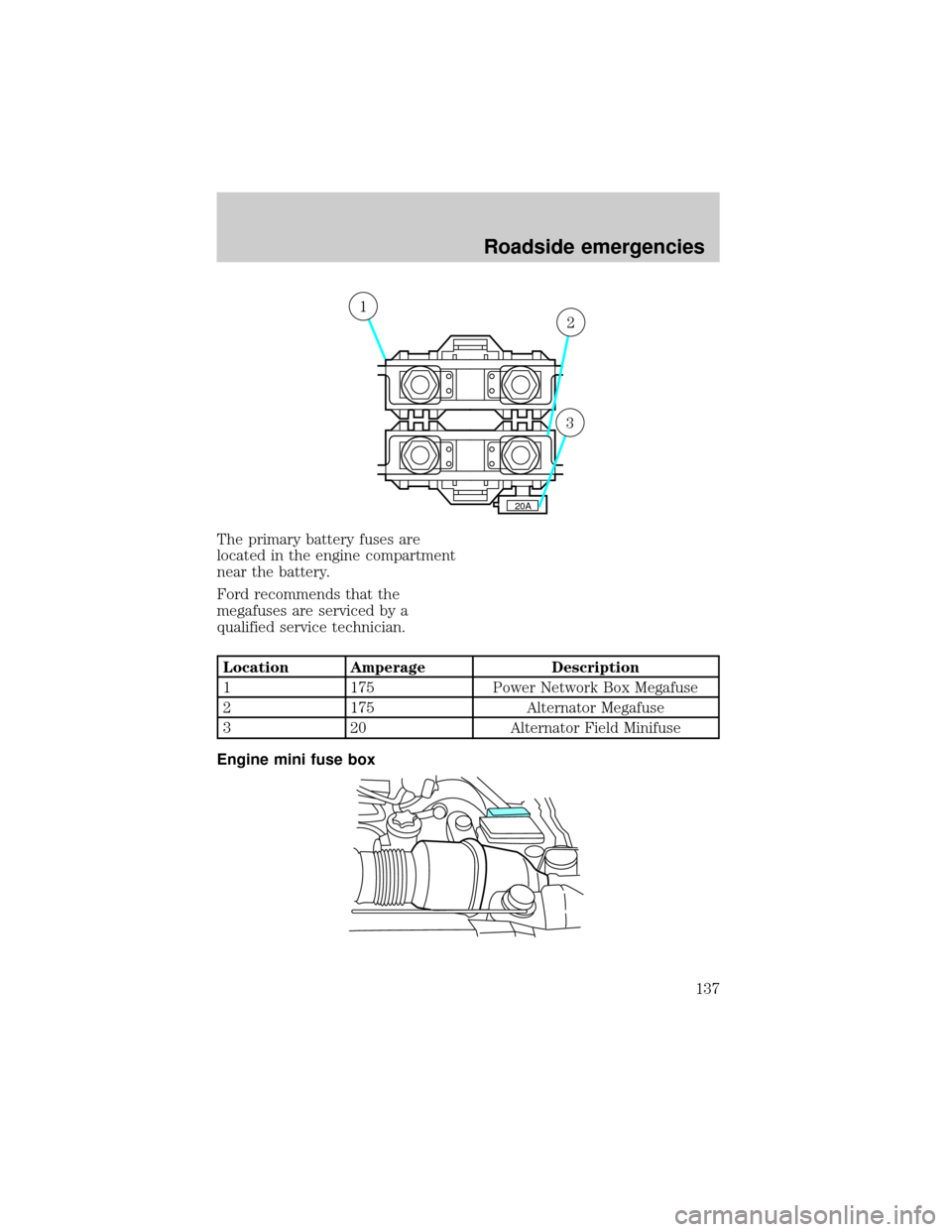
The primary battery fuses are
located in the engine compartment
near the battery.
Ford recommends that the
megafuses are serviced by a
qualified service technician.
Location Amperage Description
1 175 Power Network Box Megafuse
2 175 Alternator Megafuse
3 20 Alternator Field Minifuse
Engine mini fuse box
20A
1
2
3
Roadside emergencies
137