Page 148 of 216
WRECKER TOWING
If you need to have your vehicle
towed, contact a professional
towing service or, if you are a
member, your roadside assistance
center.
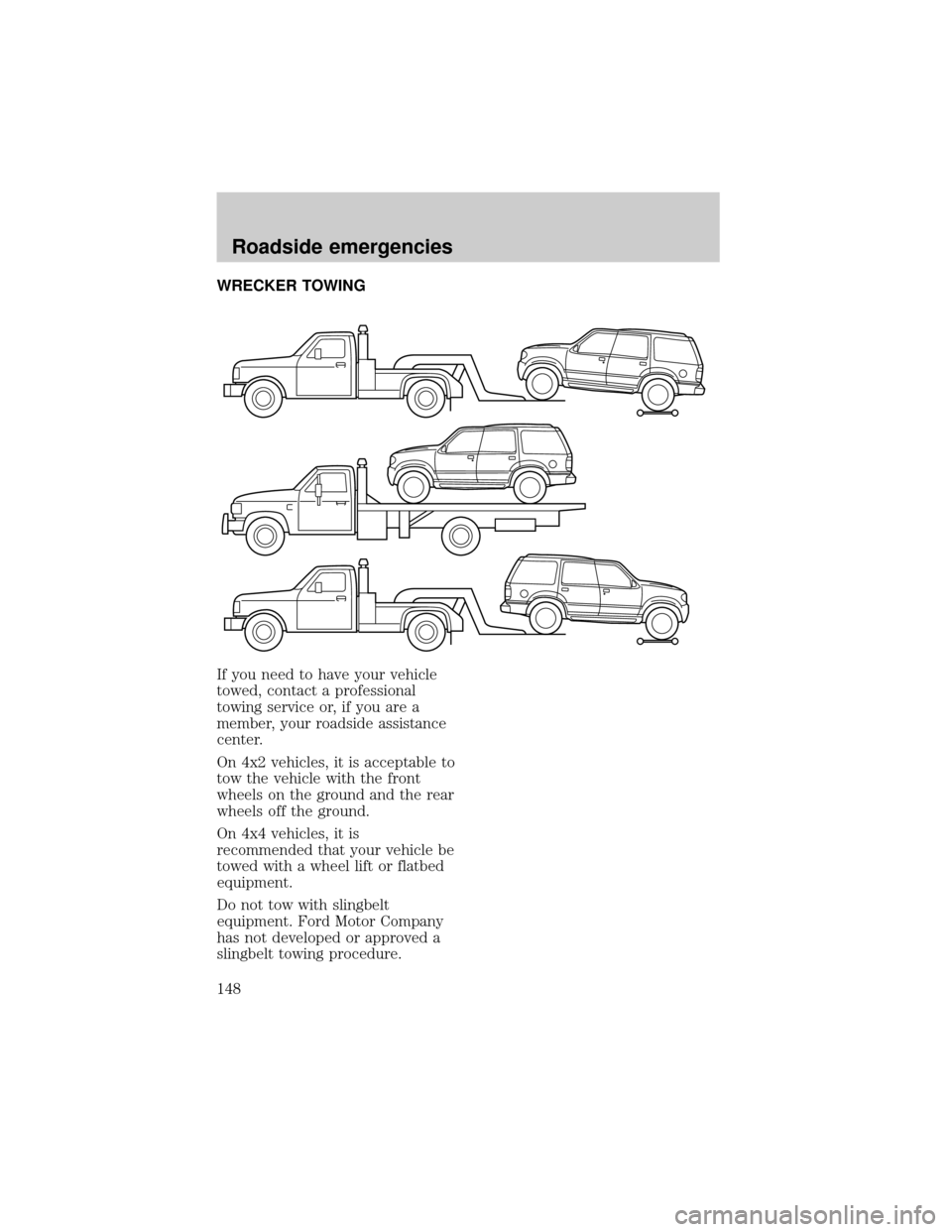
On 4x2 vehicles, it is acceptable to
tow the vehicle with the front
wheels on the ground and the rear
wheels off the ground.
On 4x4 vehicles, it is
recommended that your vehicle be
towed with a wheel lift or flatbed
equipment.
Do not tow with slingbelt
equipment. Ford Motor Company
has not developed or approved a
slingbelt towing procedure.
Roadside emergencies
148
Page 150 of 216
SERVICE RECOMMENDATIONS
To help you service your vehicle:
²We highlight do-it-yourself items
in the engine compartment for
easy location.
²We provide a ªService Guideº
which makes tracking routine
service easy.
If your vehicle requires
professional service, your
dealership can provide necessary
parts and service. Check your
ªWarranty Guideº to find out which
parts and services are covered.
Use only recommended fuels,
lubricants, fluids and service parts
conforming to specifications.
Motorcraft parts are designed and
built to provide the best
performance in your vehicle.
PRECAUTIONS WHEN
SERVICING YOUR VEHICLE
Be especially careful when
inspecting or servicing your
vehicle.
²Do not work on a hot engine.
²When the engine is running,
make sure that loose clothing,
jewelry or long hair does not get
caught up in moving parts.
²Do not work on a vehicle with
the engine running in an
enclosed space, unless you are
sure you have enough
ventilation.
Maintenance and care
150
Page 155 of 216
²Oil levels above the MAX mark
may cause engine damage. Some
oil must be removed from the
engine by a service technician.
7. Put the indicator back in and
ensure it is fully seated.
Adding engine oil
1. Check the engine oil. For
instructions, refer toChecking the
engine oilin this chapter.
2. If the fluid level is not within
the normal range, add only
certified engine oil of the preferred
viscosity. Add engine oil through
the oil filler cap. Remove the filler
cap and use a funnel to pour oil in
the opening.
3. Recheck the oil level. Make sure
the oil level is not above the MAX
mark on the dipstick.
Engine oil recommendations
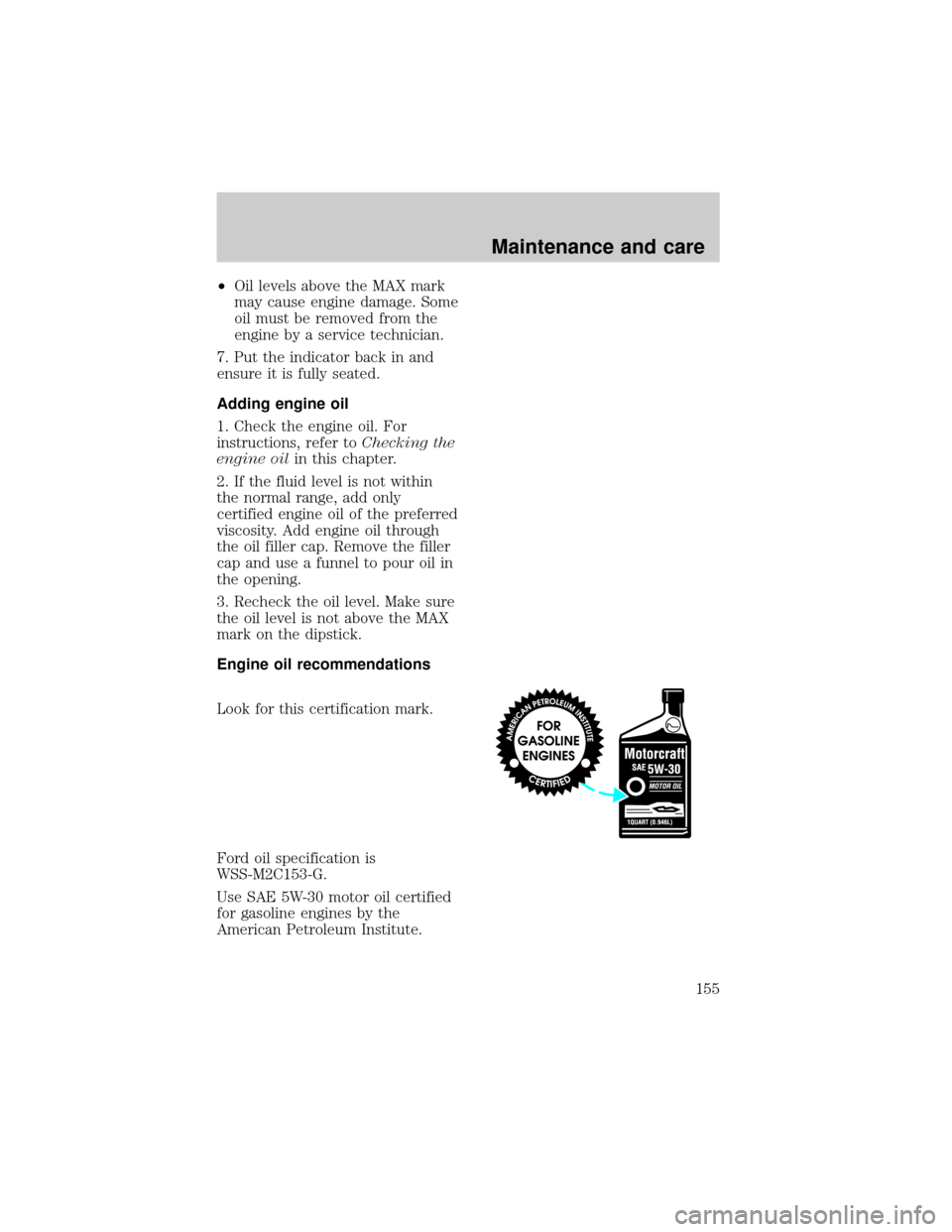
Look for this certification mark.
Ford oil specification is
WSS-M2C153-G.
Use SAE 5W-30 motor oil certified
for gasoline engines by the
American Petroleum Institute.
Maintenance and care
155
Page 156 of 216
Do not use supplemental engine oil
additives, oil treatments or engine
treatments. They are unnecessary
and could, under certain
conditions, lead to engine damage
which is not covered by your
warranty.
Changing the engine oil and
filter
Change your engine oil and filter
according to the following mileage
and time requirements, whichever
occurs first:
²Normal Schedule ± 8,000 km
(5,000 miles) or six months.
²Severe Duty Schedule - 5,000
km (3,000 miles) or three
months. Severe duty operation
would include extensive idling,
trailer towing, driving in severe
dust and police, taxi or delivery
service.
Ford production and aftermarket
(Motorcraft) oil filters are designed
for added engine protection and
long life. If a replacement oil filter
is used that does not meet Ford
material and design specifications,
startup engine noises or knock
may be experienced.
It is recommended you use the
appropriate Motorcraft oil filter (or
another brand meeting Ford
specifications) for your engine
application.
Maintenance and care
156
Page 162 of 216
container to ensure the coolant
concentration in your vehicle is
such that the coolant will not
freeze at the temperature level in
which you drive during winter
months. Never increase the engine
coolant concentration above 60%.
Leave a 50/50 mixture of engine
coolant and water in your vehicle
year-round in non-extreme
climates.
What you should know about
fail-safe cooling
If the engine coolant supply is
depleted, this feature allows the
vehicle to be driven temporarily
before incremental component
damage is incurred. The ªfail safeº
distance depends on ambient
temperatures, vehicle load and
terrain.
How fail-safe cooling works
If the engine overheats, the engine
will automatically switch from
eight to alternating four cylinder
operation. Each disabled cylinder
acts as an air pump and cools the
engine.
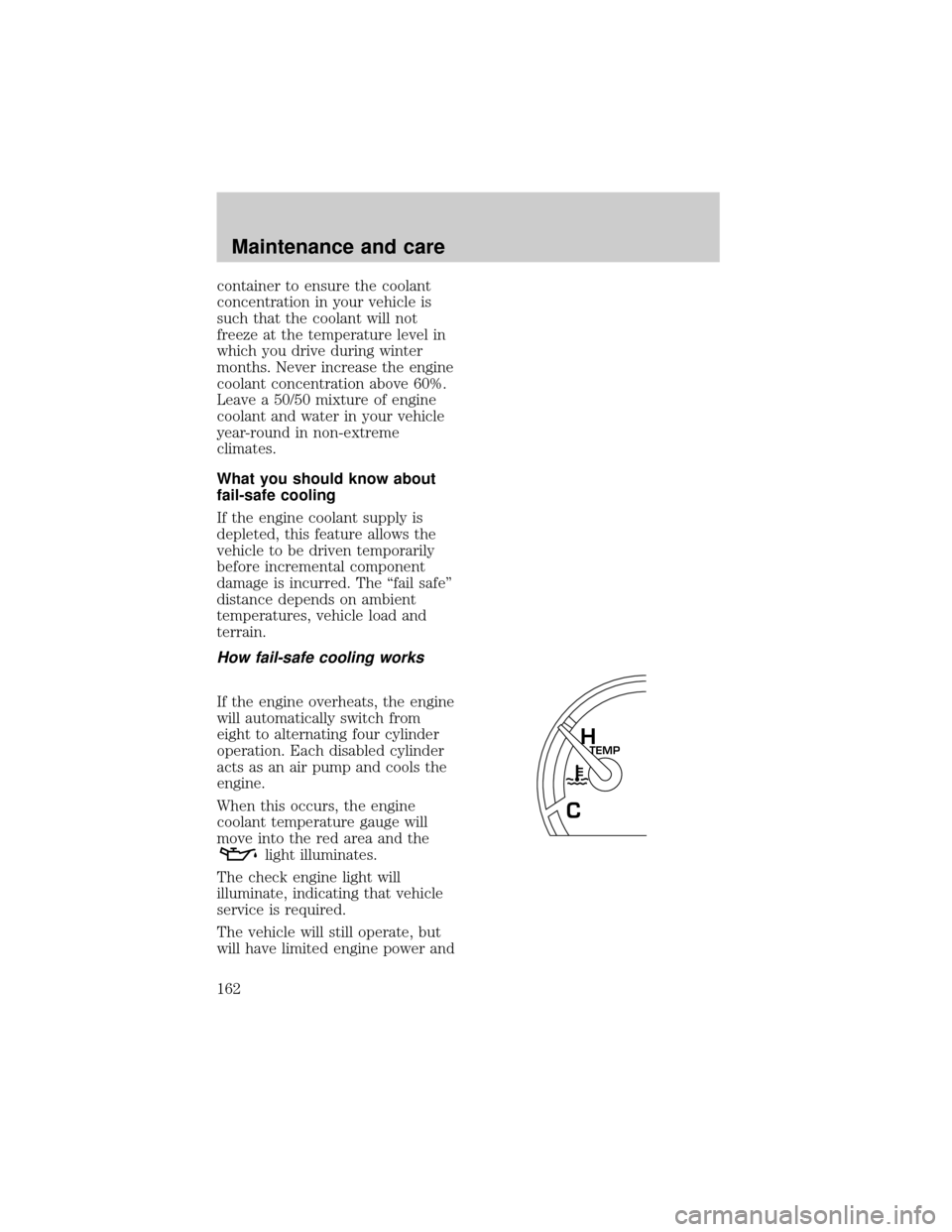
When this occurs, the engine
coolant temperature gauge will
move into the red area and the
light illuminates.
The check engine light will
illuminate, indicating that vehicle
service is required.
The vehicle will still operate, but
will have limited engine power and
TEMPH
C
Maintenance and care
162
Page 163 of 216
no air conditioning capability.
Continued operation will increase
engine temperature and cause the
engine to completely shut down.
The vehicle will coast to a stop.
As the engine temperature cools,
the engine may be re-started. Take
your vehicle to a service facility as
soon as possible to minimize
engine damage.
When fail-safe mode is
activated
²Pull off the road as soon as
possible.
²Immediately turn the engine off
to prevent severe engine
damage.
²Wait for the engine to cool.
²Check the coolant level.
CHECKING AND ADDING
POWER STEERING FLUID
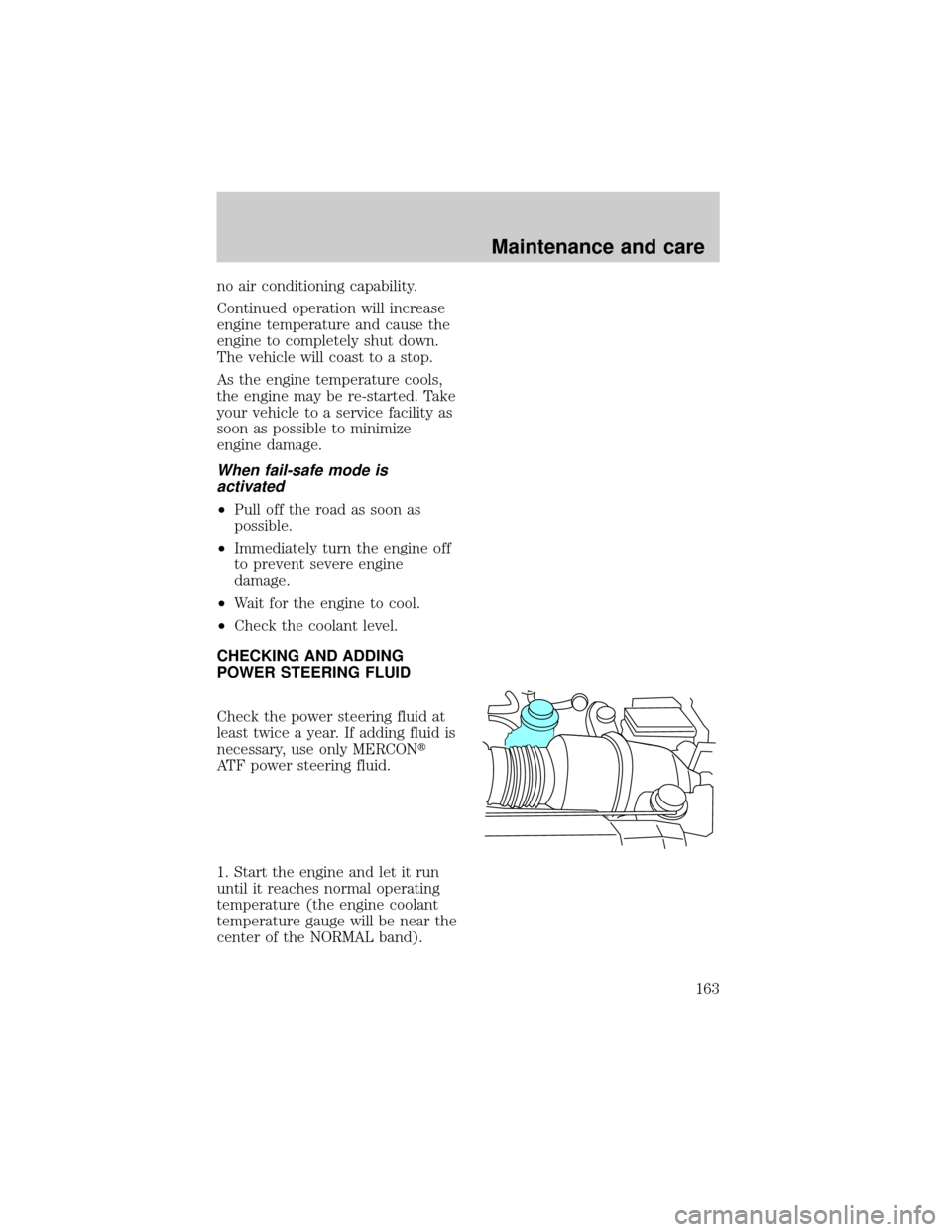
Check the power steering fluid at
least twice a year. If adding fluid is
necessary, use only MERCONt
ATF power steering fluid.
1. Start the engine and let it run
until it reaches normal operating
temperature (the engine coolant
temperature gauge will be near the
center of the NORMAL band).
Maintenance and care
163
Page 164 of 216
2. While the engine idles, turn the
steering wheel left and right
several times.
3. Turn the engine off.
4. Check the fluid level in the
reservoir. It should be between the
MIN and MAX lines. Do not add
fluid if the level is in this range.
5. If the fluid is low, add fluid in
small amounts, continuously
checking the level until it reaches
the range between the MIN and
MAX lines. Be sure to put the cap
back on the reservoir.
TRANSMISSION FLUID
Checking and adding automatic
transmission fluid
Follow the scheduled service
intervals outlined in the ªService
Guide.º
Before adding any fluid, make sure
the correct type is used. The type
of fluid used is normally indicated
on the dipstick and/or dipstick
handle and also in theLubricant
specificationssection in the
MAX
MIN
MAX
MIN
Maintenance and care
164
Page 168 of 216
BATTERY
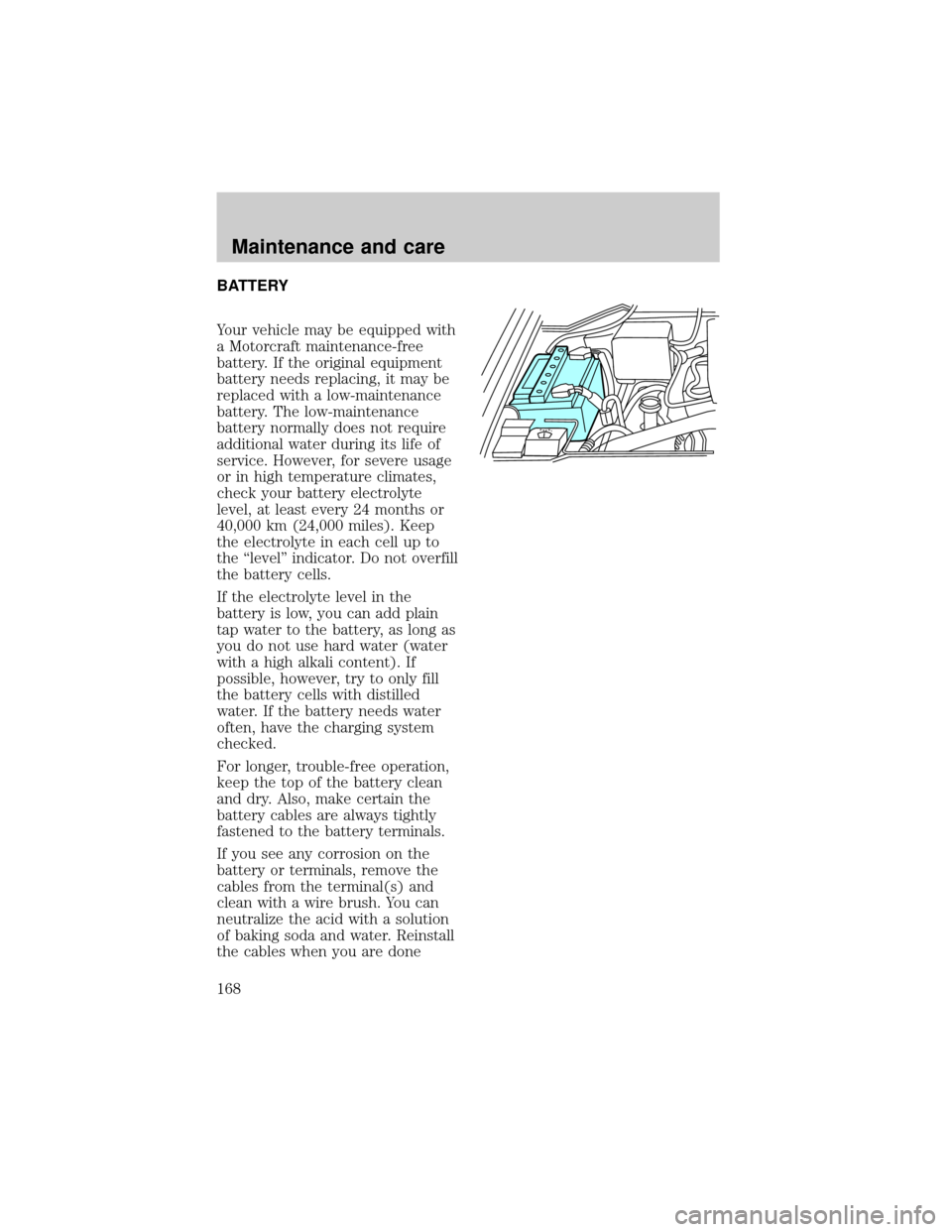
Your vehicle may be equipped with
a Motorcraft maintenance-free
battery. If the original equipment
battery needs replacing, it may be
replaced with a low-maintenance
battery. The low-maintenance
battery normally does not require
additional water during its life of
service. However, for severe usage
or in high temperature climates,
check your battery electrolyte
level, at least every 24 months or
40,000 km (24,000 miles). Keep
the electrolyte in each cell up to
the ªlevelº indicator. Do not overfill
the battery cells.
If the electrolyte level in the
battery is low, you can add plain
tap water to the battery, as long as
you do not use hard water (water
with a high alkali content). If
possible, however, try to only fill
the battery cells with distilled
water. If the battery needs water
often, have the charging system
checked.
For longer, trouble-free operation,
keep the top of the battery clean
and dry. Also, make certain the
battery cables are always tightly
fastened to the battery terminals.
If you see any corrosion on the
battery or terminals, remove the
cables from the terminal(s) and
clean with a wire brush. You can
neutralize the acid with a solution
of baking soda and water. Reinstall
the cables when you are done
Maintenance and care
168