Page 170 of 216
²Always dispose of automotive
batteries in a responsible
manner. Follow your
communities standards for
disposal. Call your local
recycling center to find out
more about recycling automotive
batteries.
AIR CLEANER FILTER
MAINTENANCE
Refer to the ªService Guideº for
the appropriate intervals for
changing the air cleaner filter.
Do not start your engine
with the air cleaner
removed and do not remove it
while the engine is running.
CHANGING THE AIR FILTER
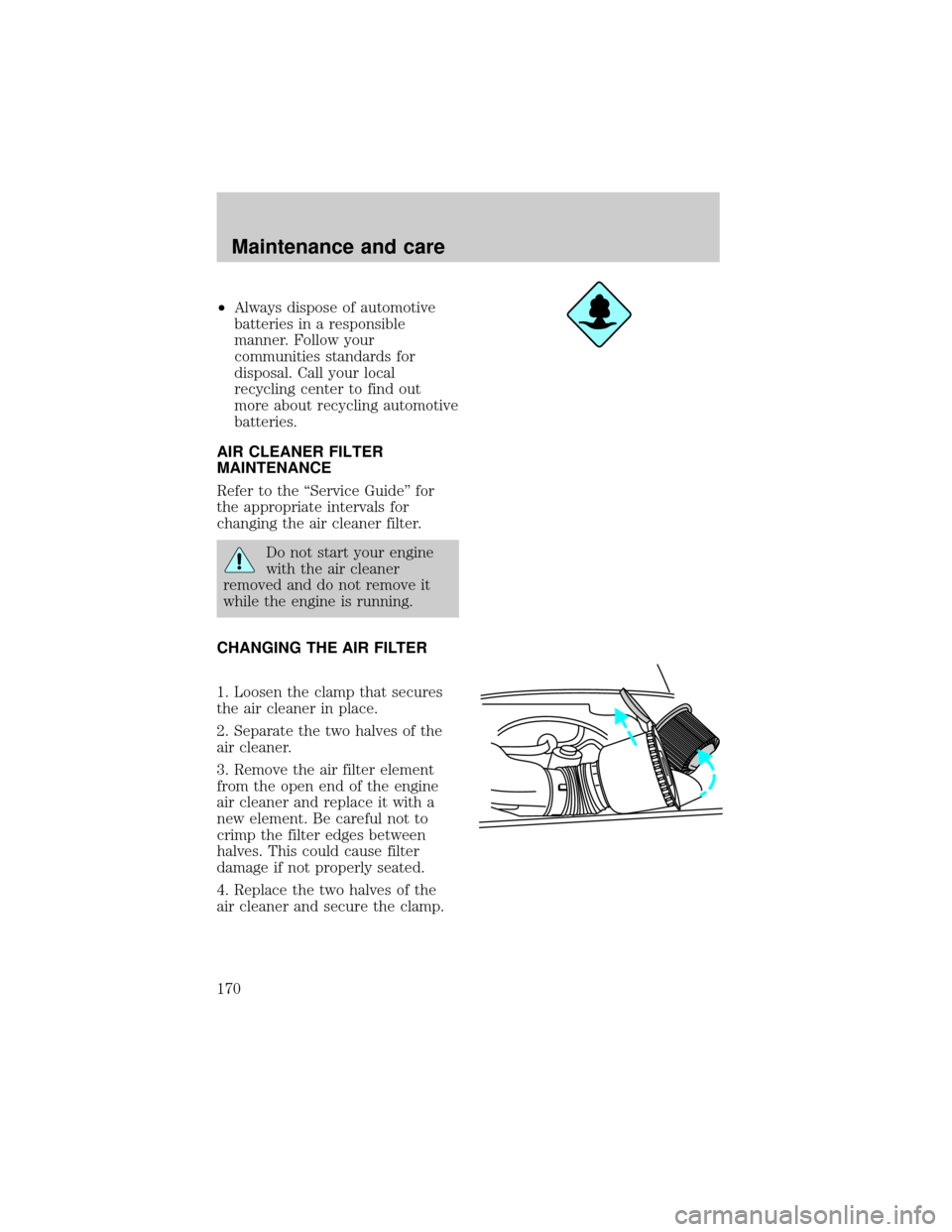
1. Loosen the clamp that secures
the air cleaner in place.
2. Separate the two halves of the
air cleaner.
3. Remove the air filter element
from the open end of the engine
air cleaner and replace it with a
new element. Be careful not to
crimp the filter edges between
halves. This could cause filter
damage if not properly seated.
4. Replace the two halves of the
air cleaner and secure the clamp.
Maintenance and care
170
Page 172 of 216
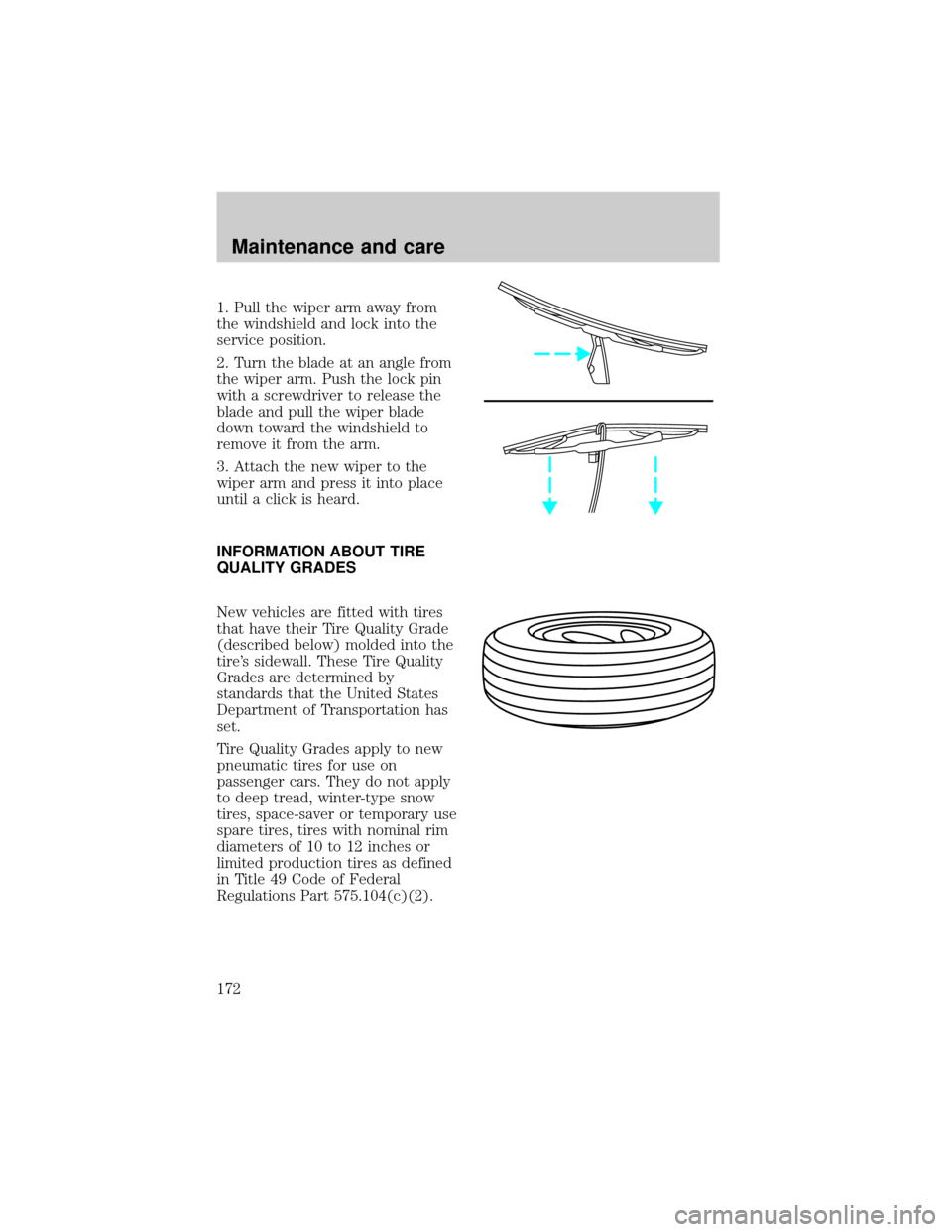
1. Pull the wiper arm away from
the windshield and lock into the
service position.
2. Turn the blade at an angle from
the wiper arm. Push the lock pin
with a screwdriver to release the
blade and pull the wiper blade
down toward the windshield to
remove it from the arm.
3. Attach the new wiper to the
wiper arm and press it into place
until a click is heard.
INFORMATION ABOUT TIRE
QUALITY GRADES
New vehicles are fitted with tires
that have their Tire Quality Grade
(described below) molded into the
tire's sidewall. These Tire Quality
Grades are determined by
standards that the United States
Department of Transportation has
set.
Tire Quality Grades apply to new
pneumatic tires for use on
passenger cars. They do not apply
to deep tread, winter-type snow
tires, space-saver or temporary use
spare tires, tires with nominal rim
diameters of 10 to 12 inches or
limited production tires as defined
in Title 49 Code of Federal
Regulations Part 575.104(c)(2).
Maintenance and care
172
Page 173 of 216
U.S. Department of
Transportation-Tire quality
grades:The U.S. Department of
Transportation requires Ford to
give you the following information
about tire grades exactly as the
government has written it.
Treadwear
The treadwear grade is a
comparative rating based on the
wear rate of the tire when tested
under controlled conditions on a
specified government test course.
For example, a tire grade 150
would wear one and one-half
(1 1/2) times as well on the
government course as a tire grade
100. The relative performance of
tires depends upon the actual
conditions of their use, however,
and may depart significantly from
the norm due to variations in
driving habits, service practices,
and differences in road
characteristics and climate.
Traction A B C
The traction grades, from highest
to lowest are A, B, and C, and they
represent the tire's ability to stop
on wet pavement as measured
under test surfaces of asphalt and
concrete. A tire marked C may
have poor traction performance.
The traction grade
assigned to this tire is
based on braking (straight
ahead) traction tests and does
not include cornering (turning)
traction.
Maintenance and care
173
Page 175 of 216
has been parked for at least one
hour or has been driven less
than 5 km (3 miles).
²Adjust tire pressure to
recommended specifications
found on the Safety Compliance
Certification Label.
Improperly inflated tires
can affect vehicle handling
and can fail suddenly, possibly
resulting in loss of vehicle
control.
Tire rotation
Because your vehicle's tires
perform different jobs, they often
wear differently. To make sure
your tires wear evenly and last
longer, rotate them as indicated in
the ªService Guide.º If you notice
that the tires wear unevenly, have
them checked.
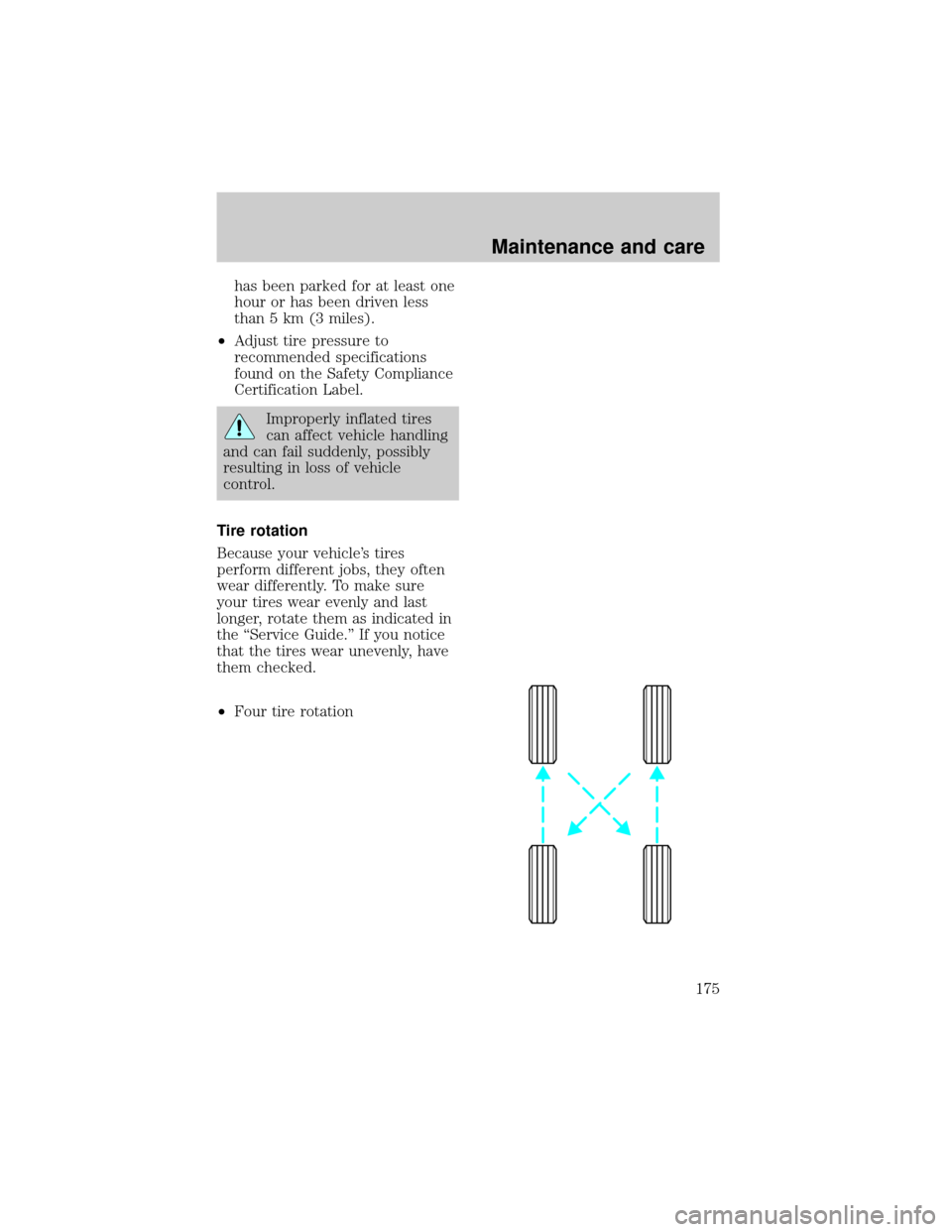
²Four tire rotation
Maintenance and care
175
Page 180 of 216
control devices and systems may
be adversely affected.
Repair of damage caused by using
a fuel that your vehicle was not
designed for may not be covered
by your warranty.
Octane recommendations
Your vehicle is designed to use
regular unleaded with an (R+M)/2
octane rating of 87. We do not
recommend gasolines labeled as
ªregularº in high altitude areas that
are sold with octane ratings of 86
or even less.
Do not be concerned if your
vehicle sometimes knocks lightly.
However, if it knocks heavily under
most driving conditions on fuel
with the recommended octane, see
your dealer or a qualified service
technician to prevent any engine
damage.
Fuel quality
If you are experiencing starting,
rough idle or hesitation problems
try a different brand of fuel. If the
condition persists, see your dealer
or a qualified service technician.
The American Automobile
Manufacturers Association (AAMA)
issued a gasoline specification to
provide information on high quality
fuels that optimize the
performance of your vehicle. We
87
Maintenance and care
180
Page 183 of 216

3. After at least three to five fuel
tank fill-ups, fill the fuel tank and
record the current mileage
reading.
4. Use one of the following
equations to calculate fuel
economy.
Liters used x 1004Total
kilometers traveled
Total miles traveled4Total
gallons used
Keep a record for at least one
month. This will provide an
accurate estimate of the vehicle's
fuel economy.
EMISSION CONTROL SYSTEM
Your vehicle is equipped with
various emission control
components and a catalytic
converter which will enable your
vehicle to comply with applicable
exhaust emission standards. To
make sure that the catalytic
converter and other emission
control components continue to
work properly:
²Use only unleaded fuel.
²Avoid running out of fuel.
²Do not turn off the ignition
while your vehicle is moving,
especially at high speeds.
²Have the services listed in your
ªService Guideº performed
according to the specified
schedule.
The Scheduled Maintenance
Services listed in the ªService
Maintenance and care
183
Page 184 of 216
Guideº are required because they
are considered essential to the life
and performance of your vehicle
and to its emissions system.
If other than Ford, Motorcraft or
Ford authorized parts are used for
maintenance replacements or for
service of components affecting
emission control such non-Ford
parts should be equivalent to
genuine Ford Motor Company
parts in performance and
durability.
Do not park, idle, or drive
your vehicle in dry grass
or other dry ground cover. The
emission system heats up the
engine compartment and exhaust
system, which can start a fire.
Watch for fluid leaks, strange
odors, smoke, loss of oil pressure,
the charging system warning light,
the ªCheck Engineº light or the
temperature warning light. These
events could indicate that the
emission control system is not
working properly.
If you smell exhaust fumes
of any kind inside your
vehicle, have the dealer inspect
and fix your vehicle immediately.
Do not drive if you smell exhaust
fumes. These fumes are harmful
and could kill you.
Do not make any unauthorized
changes to your vehicle or engine.
By law, vehicle owners and anyone
Maintenance and care
184
Page 185 of 216

who manufactures, repairs,
services, sells, leases, trades
vehicles, or supervises a fleet of
vehicles are not permitted to
intentionally remove an emission
control device or prevent it from
working. Information about your
vehicle's emission system is on the
Vehicle Emission Control
Information Decal located on or
near the engine. This decal
identifies engine displacement and
gives some tune up specifications.
Please consult your ªWarranty
Guideº for complete emission
warranty information.
Readiness for
inspection/maintenance (I/M)
testing
In some localities, it may be a legal
requirement to pass an I/M test of
the on-board diagnostic (OBD-II)
system. If your ªcheck
engine/service engine soonº light is
on, reference the applicable light
description in theWarning Lights
and Chimessection of your
owners guide. Your vehicle may
not pass the I/M test with the
ªcheck engine/service engine soonº
light on.
If the vehicle's powertrain system
or its battery has just been
serviced, the OBD-II system is
reset to a ªnot ready for I/M testº
condition. To ready the OBD-II
system for I/M testing, a minimum
of 30 minutes of city and highway
driving is necessary as described
below:
Maintenance and care
185