1998 CHEVROLET VENTURE service
[x] Cancel search: servicePage 144 of 474
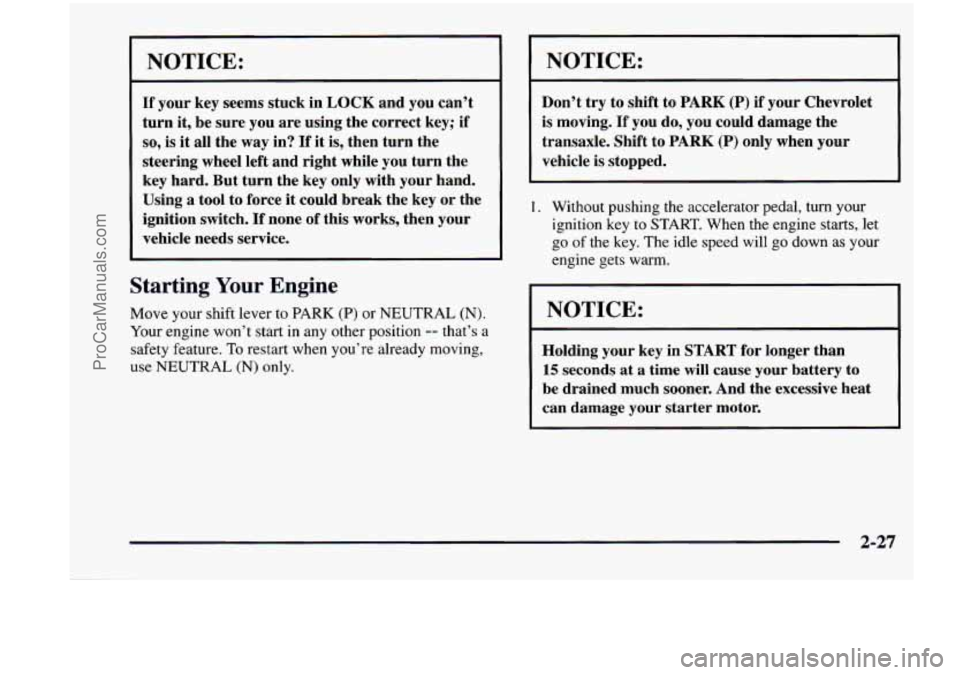
NOTICE:
If your key seems stuck in LOCK and you can’t
turn it, be sure you are using the correct key;
if
so, is it all the way in? If it is, then turn the
steering wheel left and right while you turn the
key hard. But turn
the key only with your hand.
NOTICE:
Don’t try to shift to PARK (P) if your Chevrolet
is moving.
If you do, you could damage the
transaxle. Shift to
PARK (P) only when your
vehicle is stopped.
Using a tool to force
it could break the key or the
ignition switch.
If none of this works, then your ignition key to START. When the engine starts, let
vehicle needs service.
go of the key. The idle speed will go down as your
1.
Without pushing the accelerator pedal, turn your
I engine gets warm.
Starting Your Engine
Move your shift lever to PARK (P) or NEUTRAL (N).
Your engine won’t start in any other position -- that’s a
safety feature.
To restart when you’re already moving,
use
NEUTRAL (N) only.
NOTICE:
Holding your key in START for longer than
15 seconds at a time will cause your battery to
be drained much sooner. And the excessive heat
can damage your starter motor.
2-27
ProCarManuals.com
Page 150 of 474

NOTICE:
If your vehicle seems to start up rather slowly,
or
if it seems not to shift gears as you go faster,
something may be wrong with a transaxle system
sensor.
If you drive very far that way, your
vehicle can be damaged.
So, if this happens,
have your vehicle serviced right away. Until then,
you can use
SECOND (2) when you are driving
less than
35 mph (55 km/h) and THIRD (3) for
higher speeds. FIRST
(1): This position gives
you even more power
(but lower fuel economy) than
SECOND (2). You can
use it on very steep hills, or in deep snow or mud.
If
the selector lever is put in FIRST (l), the transaxle
won’t downshift into fist gear until the vehicle
is
going slow enough.
NOTICE:
If your front wheels can’t rotate, don’t try to
drive. This might happen
if you were stuck in
very deep sand or mud or were up against
a
solid object. You could damage your transaxle.
Also, if you stop when going uphill, don’t hold
your vehicle there with only the accelerator
pedal. This could overheat and damage the
transaxle. Use your brakes or shift into
PARK (P)
to hold your vehicle in position on a hill.
2-33
ProCarManuals.com
Page 197 of 474

has the pressure gage, Then attach that end of the hose
to the object you wish to inflate. Remove the protective
cap covering the outlet. Attach the other end of the hose
to the outlet. Press the ON switch. The ON switch will
work even with the ignition off.
If the air inflator system does not turn on, the fuse may
be blown
or installed incorrectly. See “Fuses and Circuit
Breakers” in the Index or see your dealer for service.
Your air inflator will automatically shut off after about
10 minutes.
To reset, press the ON switch again.
Don’t run your air inflator for longer than
30 minutes at
one time. If you do, you may damage the system. After
30 minutes, wait at least 10 minutes before restarting the
air inflator.
To turn off the inflator, press OFF and detach the hose,
first from the inflated object, then from the outlet.
Replace the protective cap. Place the inflator kit tools
in the pouch, and store in the glove box.
To replace the cover, line up the tabs at the back of the
cover and put it in place. Push down the tab to secure
the cover.
Accessory Power Outlet
The rear power outlet is located in the rear compartment
on the driver’s side. To remove the cover, pull the tab
on
the cover and pull it off.
The front power outlet
is located next to the ashtray and
lighter. Pull the cover down to
use the power outlet.
2-80
ProCarManuals.com
Page 204 of 474

Air Bag Readiness Light
There is an air bag readiness light on the instrument
panel, which shows
a deployed air bag. The system
checks the air bag’s electrical system for malfunctions.
The light tells you if there is an electrical problem.
The system check includes the air bag sensors, the air
bag module, the wiring and the diagnostic module. For
more information on
the air bag system, see “Air Bag”
in the Index.
This light will come on
when you start your engine,
and
it will flash for a few
seconds. Then the light
should go out. This means
the system is ready.
If the air bag readiness light stays on after you start the
engine or comes on when you are driving, your air bag
system may not work properly. Have your vehicle
serviced right away.
The air bag readiness light should flash for
a few
seconds when you turn the ignition key to
RUN. If the
light doesn’t come on then, have it fixed
so it will be
ready to warn you
if there is a problem.
Charging System Indicator Light
1+1
The charging system light
will come on when you turn
on the ignition as a check to
show you it is working. It
will remain on as long as
the engine is not running.
It should go out once the engine is running. If
it stays
on, or comes on while you are driving, you may have a
problem with the charging system. It could indicate that
you have problems with a generator
drive belt, or
another electrical problem. Have
it checked right away.
Driving while this light
is on could drain your battery.
If you must drive a short distance with the light
on, be
certain to turn off all your accessories, such as the radio
and air conditioner.
Brake System Warning Light
When the ignition is on, the brake system warning light
will come on when you set your parking brake. The light
will stay on if your parking brake doesn’t release fully.
If it stays on after your parking brake is fully released, it
means you have a brake problem.
2-87
ProCarManuals.com
Page 205 of 474
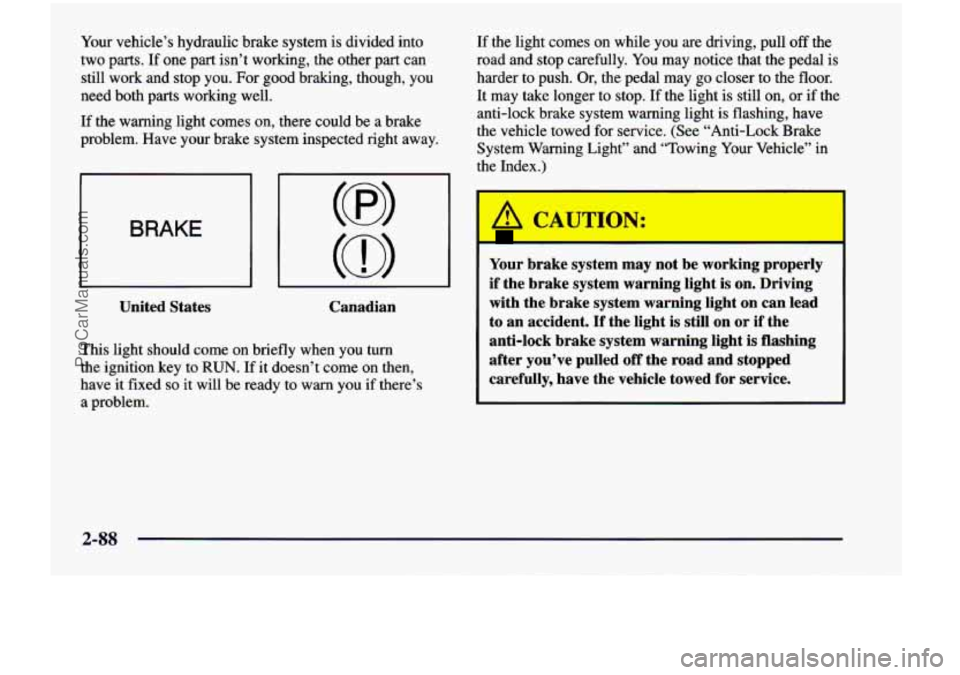
Your vehicle’s hydraulic brake system is divided into
two
parts. If one part isn’t working, the other part can
still work and stop you. For good braking, though, you
need both
parts working well.
If
the warning light comes on, there could be a brake
problem. Have your brake system inspected right away.
If the light comes on while you are driving, pull off the
road and stop carefully. You may notice that the pedal is
harder to push. Or, the pedal may go closer to the floor.
It may take longer to stop. If the light is still on, or if the
anti-lock brake system warning light is flashing, have
the vehicle towed for service. (See “Anti-Lock Brake
System Warning Light” and “Towing Your Vehicle” in
the Index.)
BRAKE A CAUTION:
United States Canadian
This light should come on briefly when you turn
the ignition key to
RUN. If it doesn’t come on then,
have it fixed
so it will be ready to warn you if there’s
a problem.
Your brake system may not be working properly
if the brake system warning light is on. Driving
with the brake system warning light on can lead
to an accident.
If the light is still on or if the
anti-lock brake system warning light
is flashing
after you’ve pulled
off the road and stopped
carefully, have the vehicle towed for service.
2-88
ProCarManuals.com
Page 206 of 474
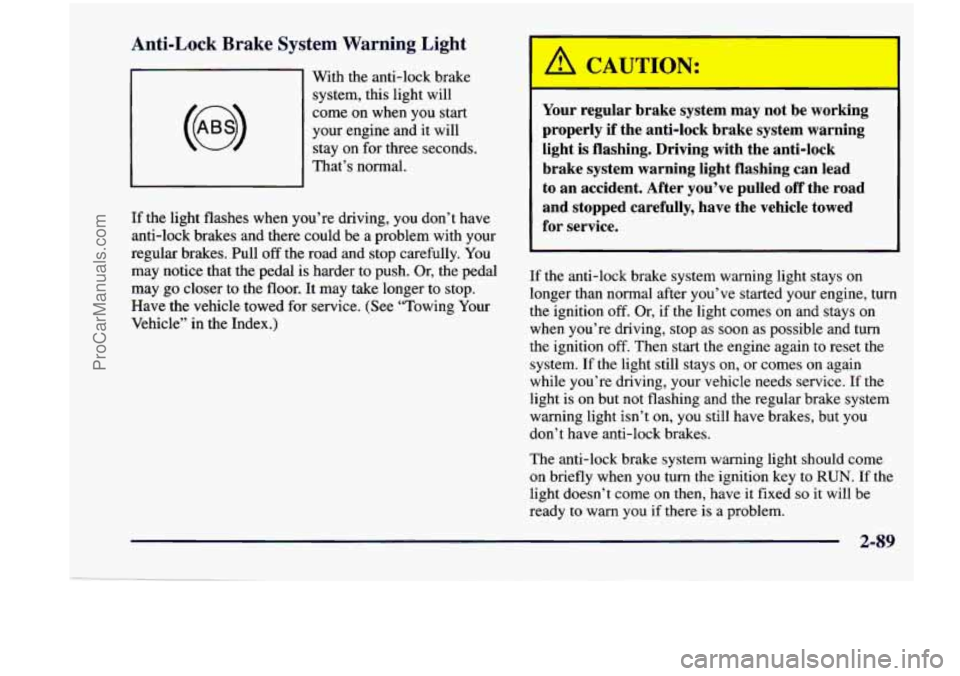
Ani- ?ck Brake System Warning Light
With the anti-lock brake
system, this light will
come on when you start
your engine and it will
stay on for three seconds.
That’s normal.
If the light flashes when you’re driving, you don’t have
anti-lock brakes and there could be a problem with your
regular brakes. Pull
off the road and stop carefully. You
may notice that the pedal is harder to push. Or, the pedal
may
go closer to the floor. It may take longer to stop.
Have the vehicle towed for service. (See “Towing Your
Vehicle” in the Index.)
A CAUTION:
Your regular brake system may not be working
properly if the anti-lock brake system warning
light is flashing. Driving with the anti-lock
brake system warning light flashing can lead
to an accident. After you’ve pulled off the road
and stopped carefully, have the vehicle towed
for service.
If the anti-lock brake system warning light stays on
longer than normal after you’ve started your engine, turn
the ignition off. Or, if the light comes on and stays on
when you’re driving, stop as soon as possible and turn
the ignition
off. Then start the engine again to reset the
system. If the light still stays on, or comes on again
while you’re driving, your vehicle needs service. If the
light is on but not flashing and the regular brake system
warning light isn’t on,
you still have brakes, but you
don’t have anti-lock brakes.
The anti-lock brake system warning light should come
on briefly when you turn the ignition key to
RUN. If the
light doesn’t
come on then, have it fixed so it will be
ready to warn you if there is a problem.
2-89
ProCarManuals.com
Page 207 of 474
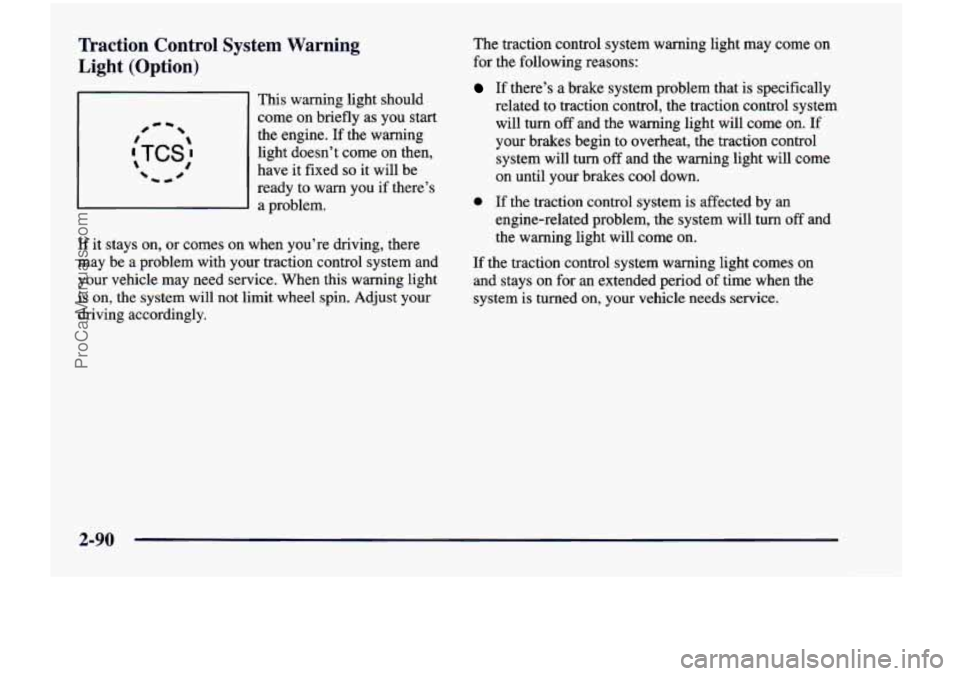
Traction Control System Warning
Light (Option)
This warning light should
come on briefly as you
start
the engine. If the warning
light doesn’t come on then,
have
it fixed so it will be
ready to warn you if there’s a problem.
If it stays on, or comes on when you’re driving, there
may be a problem with your traction control system and
your vehicle may need service. When this warning light
is on, the system will not limit wheel spin. Adjust your
driving accordingly. The
traction control system warning light may come on
for the following reasons:
If there’s a brake system problem that is specifically
related to traction control, the traction control system will turn
off and the warning light will come on. If
your brakes begin
to overheat, the traction control
system will
turn off and the warning light will come
on until your brakes cool down.
0 If the traction control system is affected by an
engine-related problem, the system will
turn off and
the warning light will come
on.
If the traction control system warning light comes on
and stays on for an extended period
of time when the
system
is turned on, your vehicle needs service.
2-90
ProCarManuals.com
Page 209 of 474
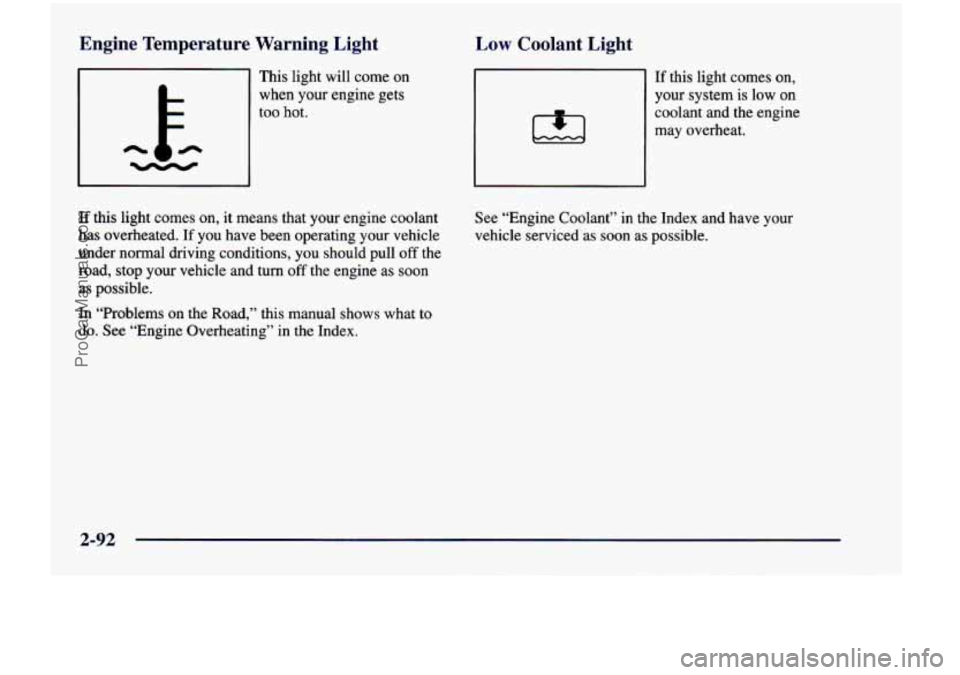
Engine Temperature Warning Light
This light will come on
when your engine gets
too hot.
Low Coolant Light
If this light comes on,
your system is low on
coolant and the engine
may overheat.
If this light comes on, it means that your engine coolant
has overheated. If you have been operating your vehicle
under normal driving conditions, you should pull
off the
road, stop your vehicle and turn off the engine as soon
as possible. See
“Engine Coolant” in the Index and have your
vehicle serviced as soon as possible.
In “Problems on the Road,” this manual shows what to
do. See “Engine Overheating” in the Index.
2-92
ProCarManuals.com