1998 CHEVROLET PRIZM lock
[x] Cancel search: lockPage 186 of 364

Downloaded from www.Manualslib.com manuals search engine Safety Chains
You should always attach chains between your vehicle
and your trailer. Cross the safety chains under the tongue
of the trailer so that the tongue will not drop to the road
if it becomes separated from the hitch. Instructions
about safety chains may be provided by the hitch
manufacturer or by the trailer manufacturer. Follow the
manufacturer’s recommendation for attaching safety
chains and do not attach them to the bumper. Always
leave just enough slack
so you can turn with your rig.
And, never allow safety chains to drag
on the ground.
Trailer Brakes
Does your trailer have its own brakes? Be sure to read
and follow the instructions for the trailer brakes
so
you’ll be able to install, adjust and maintain them
properly. If your vehicle has anti-lock brakes, don’t try
to tap into your vehicle’s brake system. If you do, both
brake systems won’t work well or at all.
Even
if your vehicle doesn’t have anti-lock brakes,
don’t tap into your vehicle’s brake system if the trailer’s
brake system will use more than
0.02 cubic inch (0.3 cc)
of fluid from your vehicle’s master cylinder. If it does,
both braking systems won’t work well. You could even
lose your brakes.
Will the trailer brake parts take 3,000 psi
(20 650 kPa) of pressure? If not, the trailer brake
system must not be used with your vehicle.
If everything checks out this far, then make the brake
fluid tap at the upper rear master cylinder port. But
don’t use copper tubing for this. If you do, it will
bend and finally break
off. Use steel brake tubing.
Driving with a Trailer
Towing a trailer requires a certain amount of experience.
Before setting out for the open road, you’ll want to
get to know your rig. Acquaint yourself with the feel
of handling and braking with the added weight
of the
trailer. And always keep in mind that the vehicle you
are driving is now a good deal longer and not nearly as
responsive as your vehicle is by itself.
Before you start, check the trailer hitch and platform
(and attachments), safety chains, electrical connector,
lamps, tires and mirror adjustment. If the trailer has
electric brakes, start your vehicle and trailer moving
and then apply the trailer brake controller by hand to be
sure
the brakes are working. This lets you check your
electrical connection at the same time.
During your trip, check occasionally to be sure that the
load is secure, and that the lamps and any trailer brakes
are still working.
4-34
Page 199 of 364
Downloaded from www.Manualslib.com manuals search engine A vehicle can fall from a car carrier if it isn’t
adequately secured, This can cause a collision,
serious personal injury and vehicle damage. The
vehicle should be tightly secured with chains
or
steel cables before it is transported.
Don’t use substitutes (ropes, leather straps,
canvas webbing, etc.) that can be cut by sharp
edges underneath the towed vehicle. Always use
T-hooks inserted in the T-hook slots, Never use
J-hooks. They
will damage drivetrain and
suspension components.
When your vehicle is being towed, have the ignition
key turned to
OFF. The steering wheel should
be clamped in a straight-ahead position, with a
clamping device designed for towing service. Do not
use the vehicle’s steering column lock for this. The
transaxle should be in
NEUTRAL (N) and the
parking brake released.
Don’t have your vehicle towed with the front wheels in
contact with the ground if it has
an automatic transaxle.
If
a vehicle with an automatic transaxle must be towed
from the rear with wheel-lift equipment, the front
wheels must be supported on a dolly.
If your vehicle has a manual transaxle, don’t have it
towed on the front wheels unless you must. If a vehicle
with a manual transaxle must be towed on the front
wheels, it is recommended that the front wheels be
supported on a dolly. If you have a manual transaxle
and dollies won’t be used, turn the ignition key to
ACC
and put the transaxle in NEUTRAL (N).
5-9
Page 210 of 364
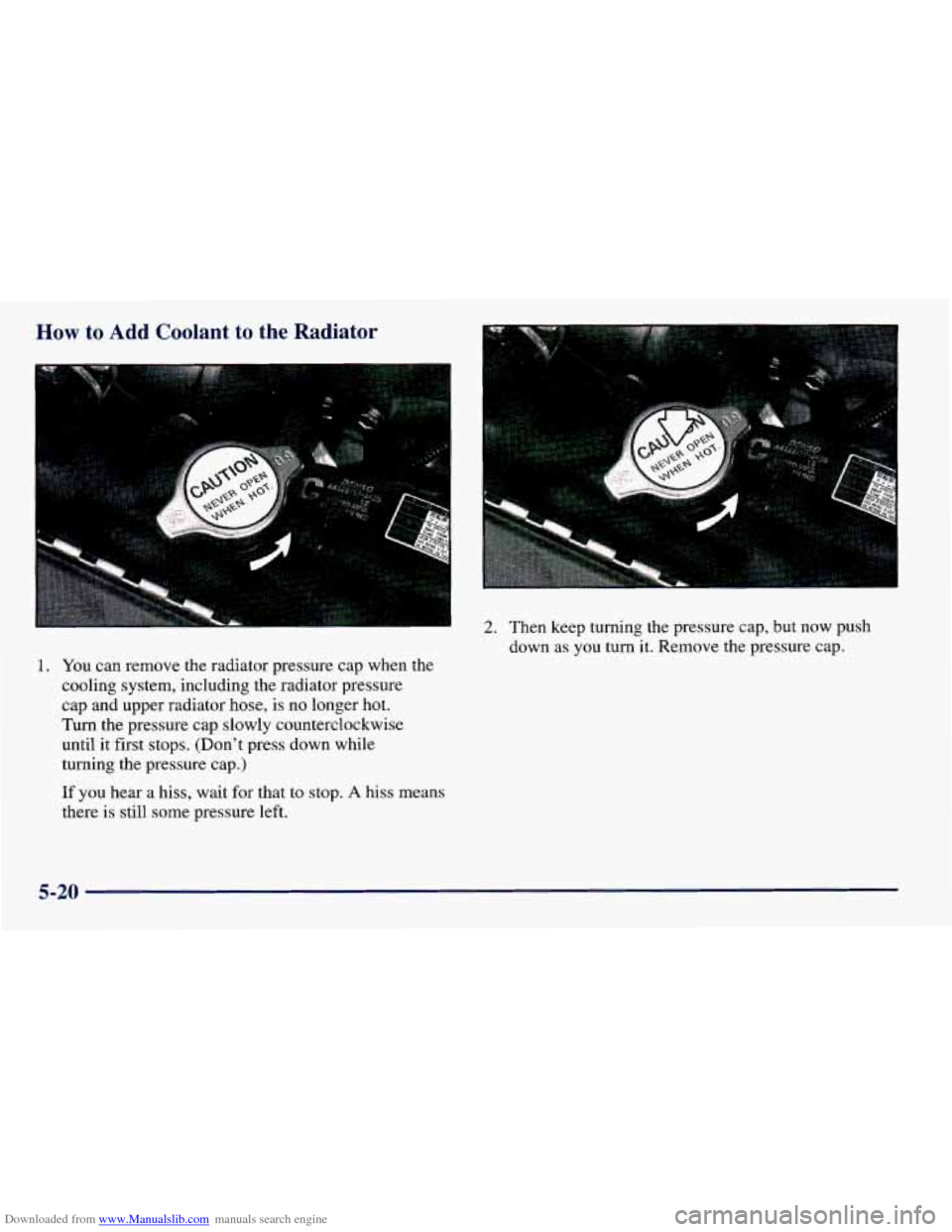
Downloaded from www.Manualslib.com manuals search engine How to Add Coolant to the Radiator
1. You can remove the radiator pressure cap when the
cooling system, including the radiator pressure
cap and upper radiator hose, is no longer
hot.
Turn the pressure cap slowly counterclockwise
until it first stops. (Don’t press down while
turning the pressure cap.)
If you hear a hiss, wait for that to stop. A hiss means
there
is still some pressure left.
2. Then keep turning the pressure cap, but now push
down as you
turn it. Remove the pressure cap.
5-20
Page 213 of 364
Downloaded from www.Manualslib.com manuals search engine If a Tire Goes Flat
It’s unusual for a tire to “blow out” while you’re driving,
especially if you maintain your tires properly. If air goes
out
of a tire, it’s much more likely to leak out slowly.
But if you should ever have a “blowout,” here are a
few tips about what to expect and what to do:
If a front tire fails, the flat tire will create a drag that
pulls the vehicle toward that side. Take your foot off
the accelerator pedal and grip the steering wheel firmly.
Steer to maintain lane position, and then gently brake
to
a stop well out of the traffic lane.
A rear blowout, particularly on a curve, acts much like
a
skid and may require the same correction you’d use
in a skid. In any rear blowout, remove your foot from
the accelerator pedal. Get the vehicle under control by steering the way you want the vehicle to
go. It may be
very bumpy and noisy, but you can still steer. Gently
brake to a stop
-- well off the road if possible.
If a tire goes flat, the next part shows how to use your
jacking equipment to change a flat tire safely.
Changing a Flat Tire
If a tire goes flat, avoid further tire and wheel damage
by driving slowly to a level place. Turn on your hazard
warning flashers.
Changing a tire can cause an injury. The vehicle
can slip
off the jack and roll over you or other
people. You and they could be badly injured.
Find a level place to change your tire. To help
prevent the vehicle from moving:
1. Set the parking brake firmly.
2. Put an automatic transaxle shift lever in
PARK
(P), or shift a manual transaxle to
FIRST
(1) or REVERSE (R).
3. lbrn off the engine.
To be even more certain the vehicle won’t move,
you can put blocks at the front and rear of the
tire farthest away from the one being changed.
That would be the tire on the other side of the
vehicle, at the opposite end.
5-23
Page 233 of 364
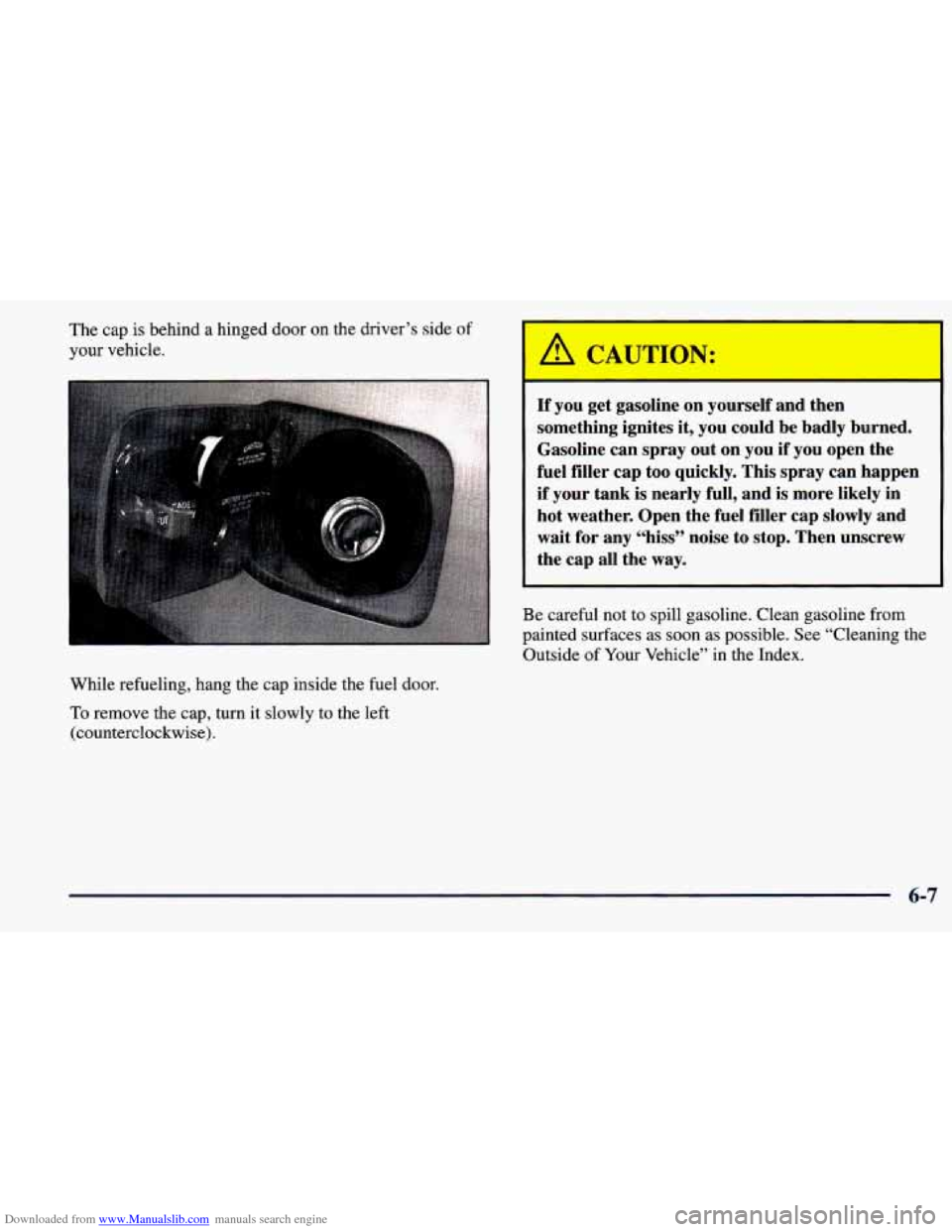
Downloaded from www.Manualslib.com manuals search engine The cap is behind a hinged door on the driver’s side of
your vehicle.
While refueling, hang the cap inside the fuel door.
To remove the cap, turn it slowly to the left
(counterclockwise).
A ,CAUTION
If you get gasoline on yourself and then
something ignites it, you could be badly burned.
Gasoline can spray out on you if you open the
fuel filler cap too quickly. This spray can happen
if your tank is nearly full, and is more likely in
hot weather. Open the fuel filler cap slowly and
wait for any “hiss” noise to stop. Then unscrew
the cap all the way.
Be careful not to spill gasoline. Clean gasoline from
painted surfaces as soon as possible.
See “Cleaning the
Outside of Your Vehicle” in the Index.
6-7
Page 234 of 364
Downloaded from www.Manualslib.com manuals search engine When you put the cap back on, turn it to the right
(clockwise) until you hear a clicking sound. Make
sure you fully install the cap. The diagnostic system
can determine
if the fuel cap has been left off or
improperly installed. This would allow fuel to
evaporate into the atmosphere. See “Malfunction
Indicator Lamp” in the Index.
NOTICE:
If you need a new cap, be sure to get the right
type. Your dealer can get one for you.
If you get
the wrong type, it may not fit properly. This may
cause your malfunction indicator lamp to light
and your fuel tank and emissions system may be
damaged. See “Malfunction Indicator Lamp” in
the Index.
Filling a Portable Fuel Container
Never fill a portable fuel container while it is in
your vehicle. Static electricity discharge from the
container can ignite the gasoline vapor.
You can
be badly burned and your vehicle damaged if this
occurs. To help avoid injury to you and others:
Dispense gasoline only into approved
containers.
Do not fill a container while it is inside a
vehicle, in a vehicle’s trunk, pickup bed or
on any surface other than the ground.
inside
of the fill opening before operating
the nozzle. Contact should be maintained
until the filling
is complete.
0 Bring the fill nozzle in contact with the
Don’t smoke while pumping gasoline.
Page 237 of 364
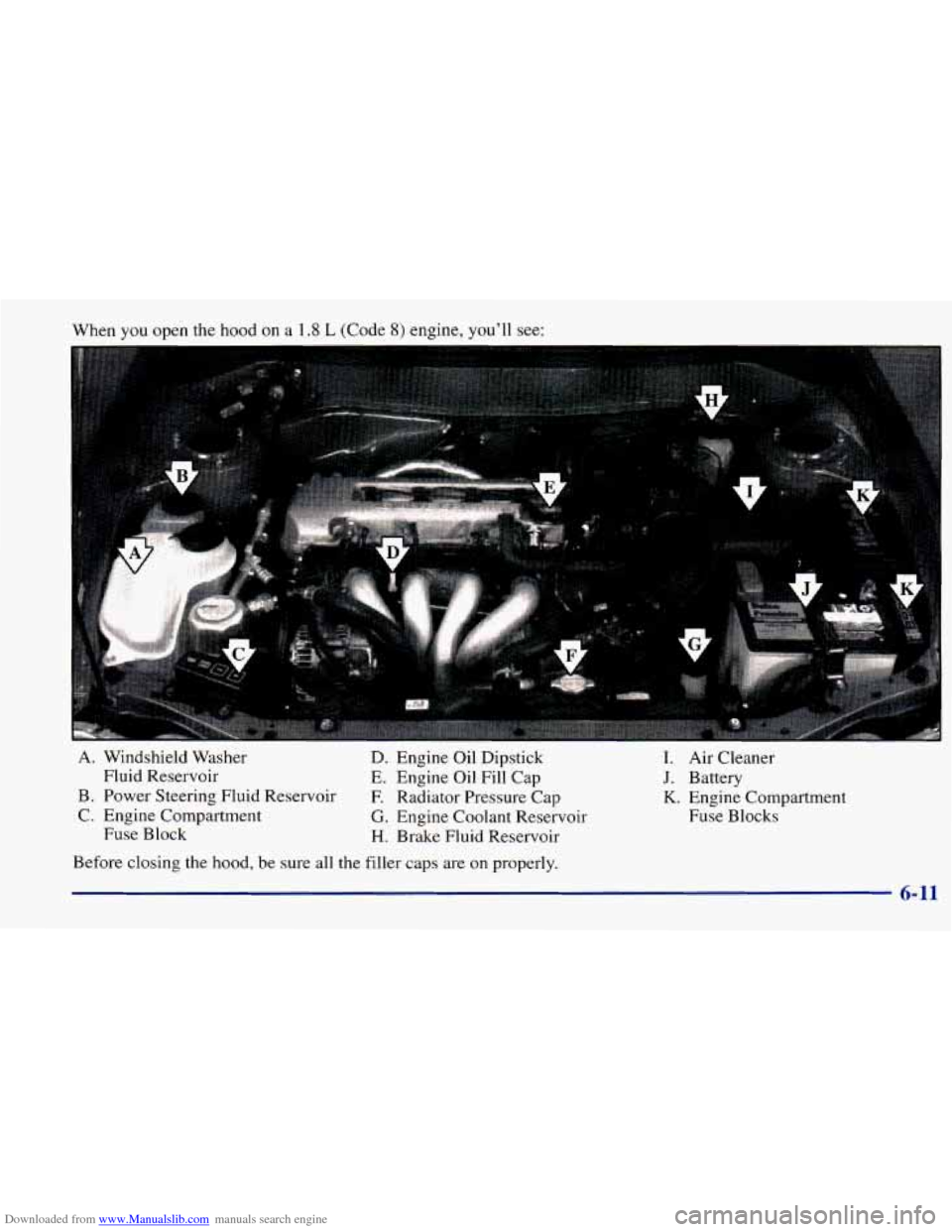
Downloaded from www.Manualslib.com manuals search engine When you open the hood on a 1.8 L (Code 8) engine, you'll see:
A. Windshield Washer
D. Engine Oil Dipstick I. Air Cleaner
Fluid Reservoir
E. Engine Oil Fill Cap
J. Battery
B. Power Steering Fluid Reservoir
F. Radiator Pressure Cap K. Engine Compartment
C. Engine Compartment
G. Engine Coolant Reservoir Fuse Blocks
Fuse Block
H. Brake Fluid Reservoir
Before closing the hood, be sure all the filler caps are on properly.
6-11
Page 246 of 364
Downloaded from www.Manualslib.com manuals search engine 3,
4.
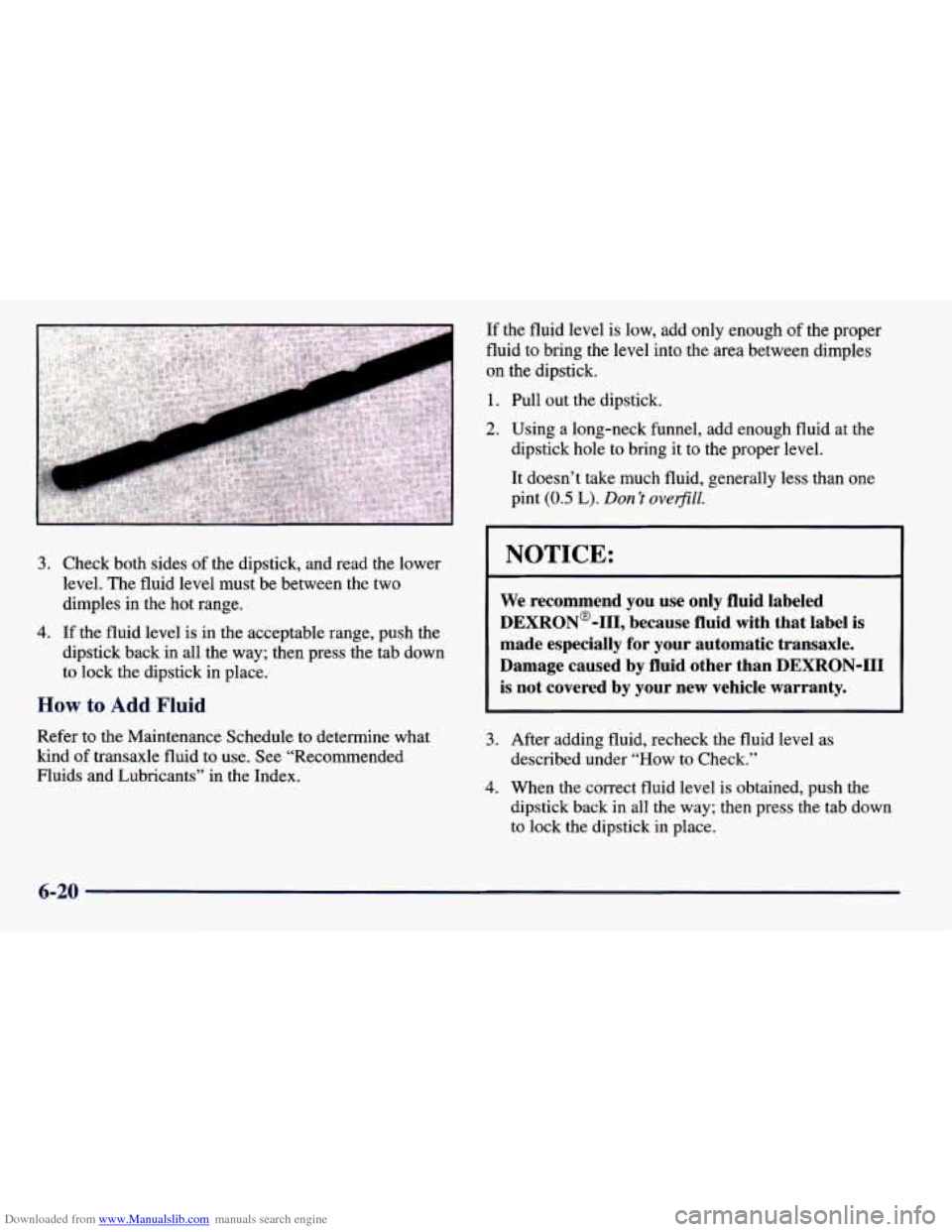
Check both sides of the dipstick, and read the lower
level.
The fluid level must be between the two
dimples
in the hot range.
If the fluid level is in the acceptable range, push the
dipstick back in all the way; then press the tab down
to lock the dipstick in place.
How to Add Fluid
Refer to the Maintenance Schedule to determine what
kind
of transaxle fluid to use. See “Recommended
Fluids
and Lubricants” in the Index. If
the fluid level is low, add only enough
of the proper
fluid to bring the level into the area between dimples
on the dipstick.
1. Pull out the dipstick.
2. Using a long-neck funnel, add enough fluid at the
dipstick hole to bring it to the proper level.
It doesn’t take much fluid, generally less than one
pint
(0.5 L). Don’t overfill.
NOTICE:
We recommend you use only fluid labeled
DEXRON@-111, because fluid with that label is
made especially for your automatic transaxle. Damage caused by fluid other than
DEXRON-111
~ is not covered by your new vehicle warranty.
3. After adding fluid, recheck the fluid level as
described under “How to Check.”
4. When the correct fluid level is obtained, push the
dipstick back
in all the way; then press the tab down
to lock the dipstick
in place.
6-20