Page 191 of 364
Downloaded from www.Manualslib.com manuals search engine a Section 5 Problems on the Road
Here you’ll find what to do about some problems that can occur on the road.
5-2
5-2
5-3
5-8
5-14
Hazard Warning Flashers
Other Warning Devices
Jump Starting
Towing Your Vehicle
Engine Overheating 5- 16
5-23
5-23
5-33
5-34
Cooling System
If a Tire Goes Flat
Changing
a Flat Tire
Compact Spare Tire
If You’re Stuck: In Sand, Mud, Ice or Snow
5-1
Page 214 of 364
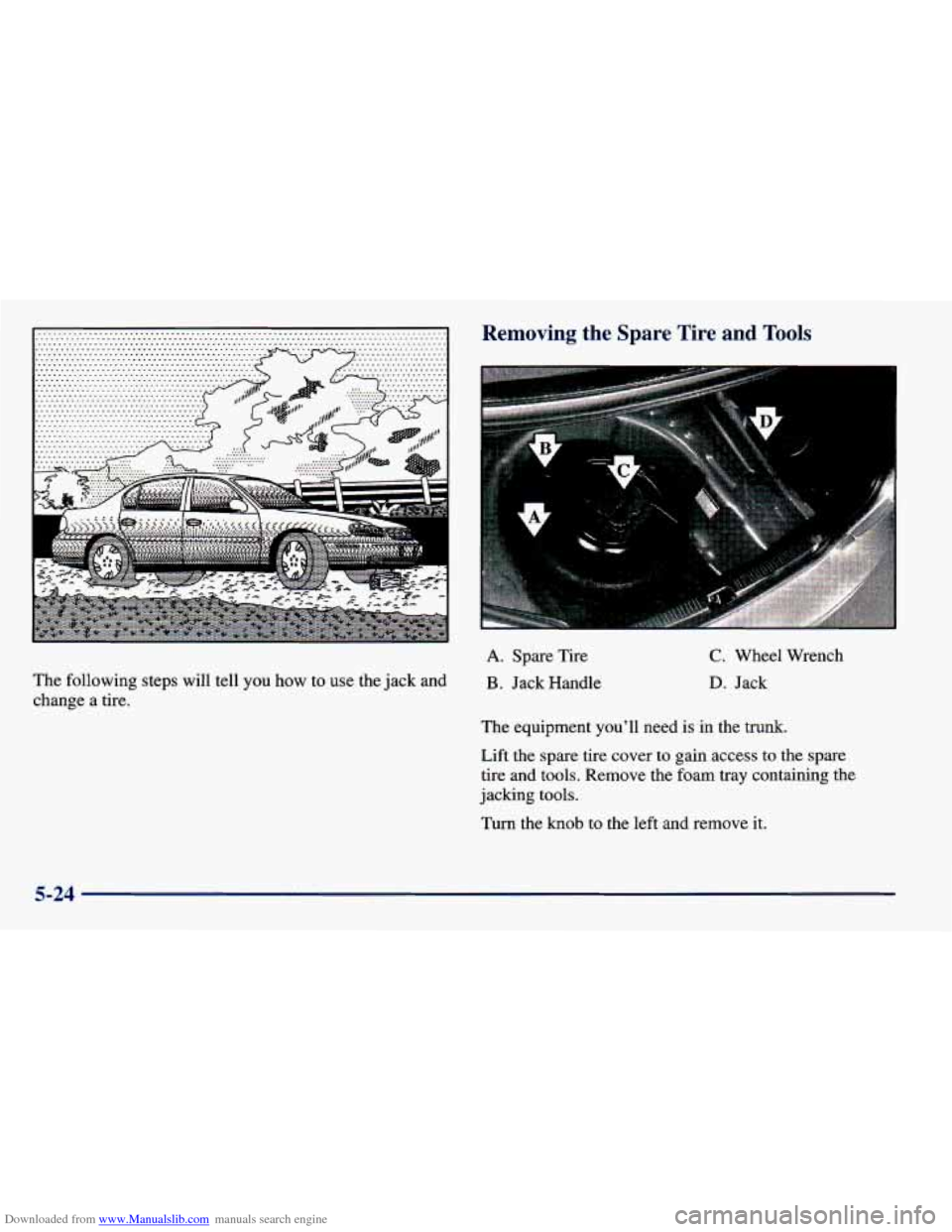
Downloaded from www.Manualslib.com manuals search engine The following steps will tell you how to use the jack and
change a tire.
Removine the Spare Tire and Tools
A. Spare Tire
B . Jack Handle
C. Wheel Wrench
D. Jack
The equipment you’ll need is in the trunk.
Lift the spare tire cover to gain access to
the spare
tire
and tools. Remove the foam tray containing the
jacking tools.
Turn the knob to the left and remove it.
5-24
Page 215 of 364
Downloaded from www.Manualslib.com manuals search engine Pull out the spare tire. See “Compact Spare Tire”
later in this section for more information about the
compact spare.
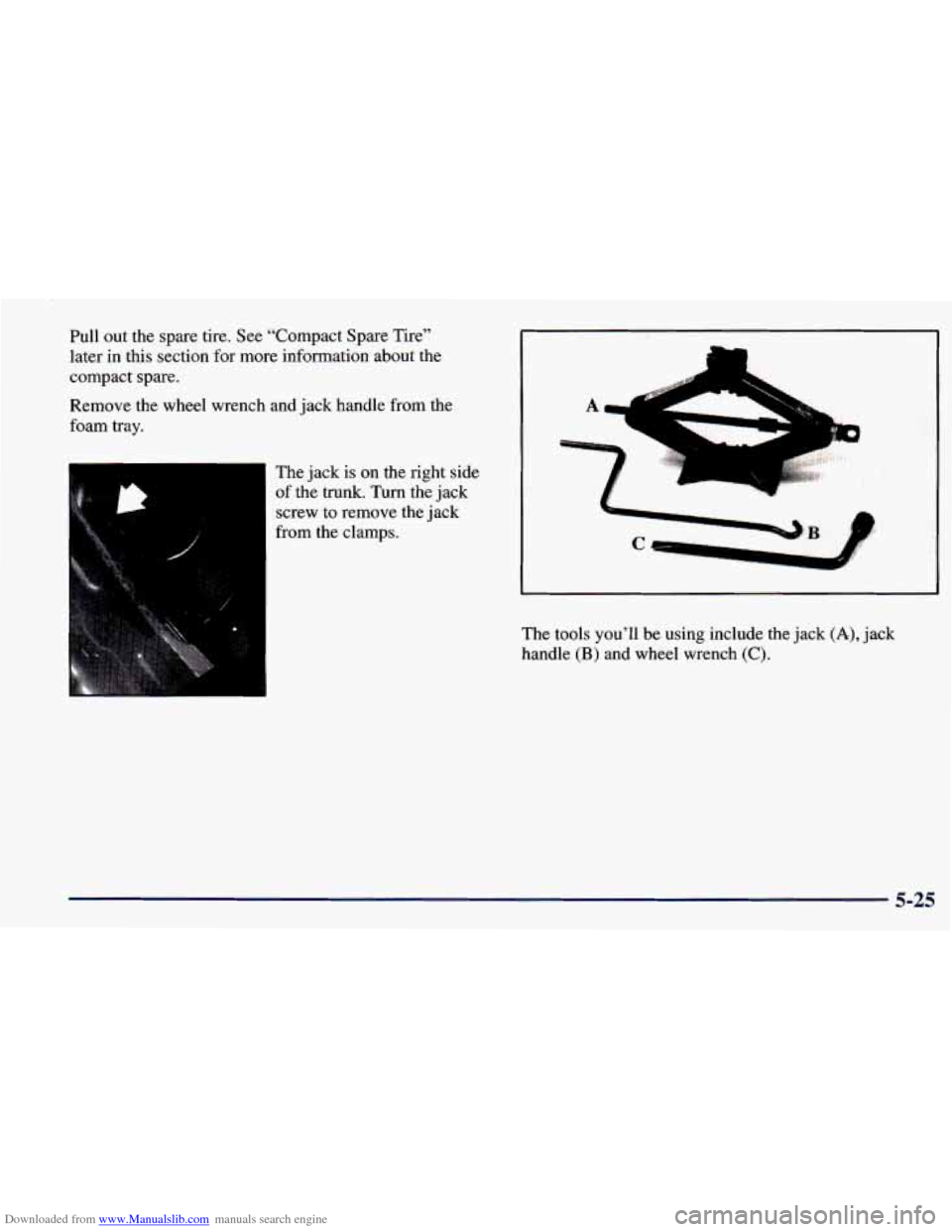
Remove the wheel wrench and jack handle from the
foam tray.
The jack is
on the right side
of the trunk. Turn the jack
screw
to remove the jack
from the clamps.
The tools you’ll be using include the jack
(A), jack
handle
(B) and wheel wrench (C).
5-25
Page 217 of 364
Downloaded from www.Manualslib.com manuals search engine Removing the Flat Tire and Installing the
Spare Tire
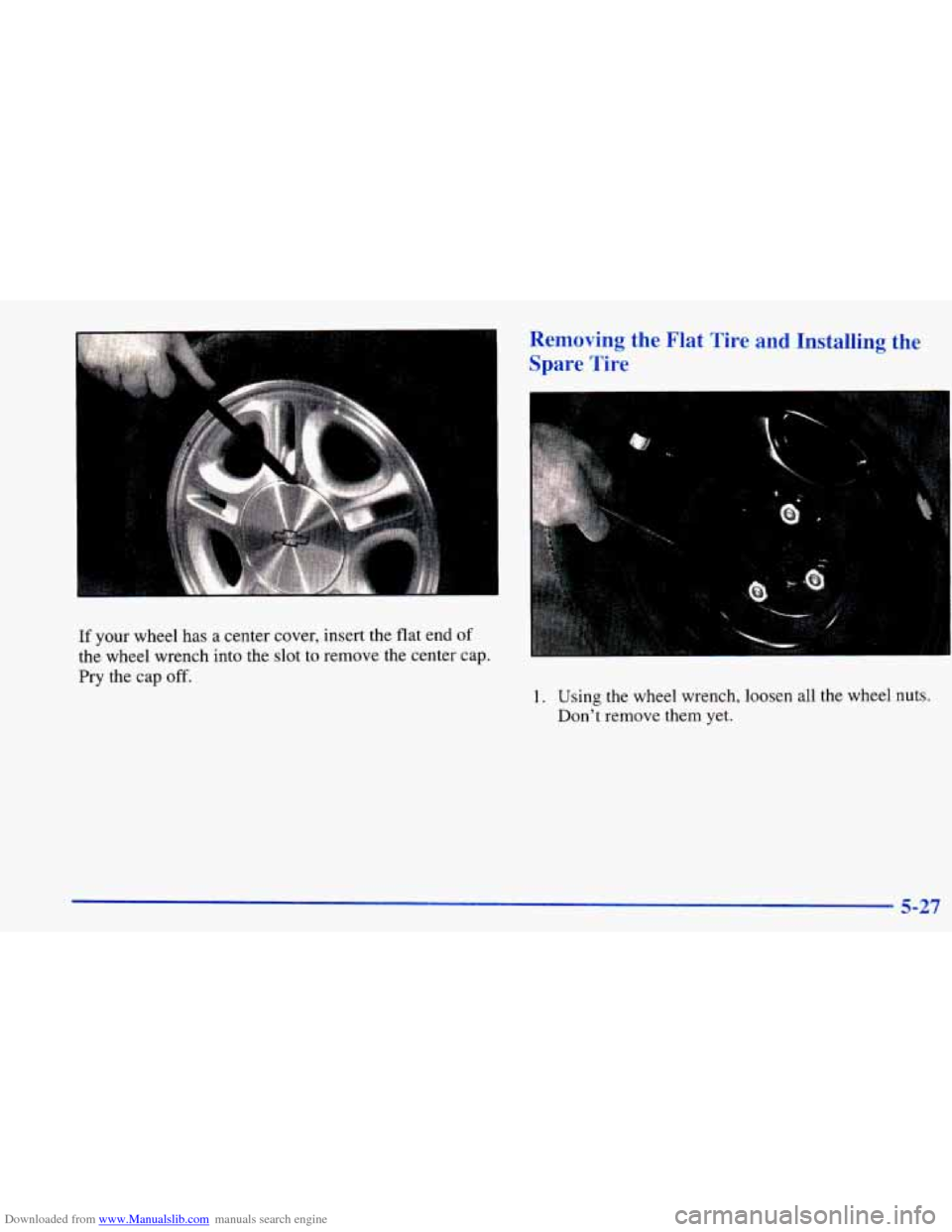
If your wheel has a center cover, insert the flat end of
the wheel wrench into the slot to remove the center cap.
Pry the cap off.
1. Using the wheel wrench, loosen all the wheel nuts.
Don’t remove them yet.
5-27
Page 219 of 364
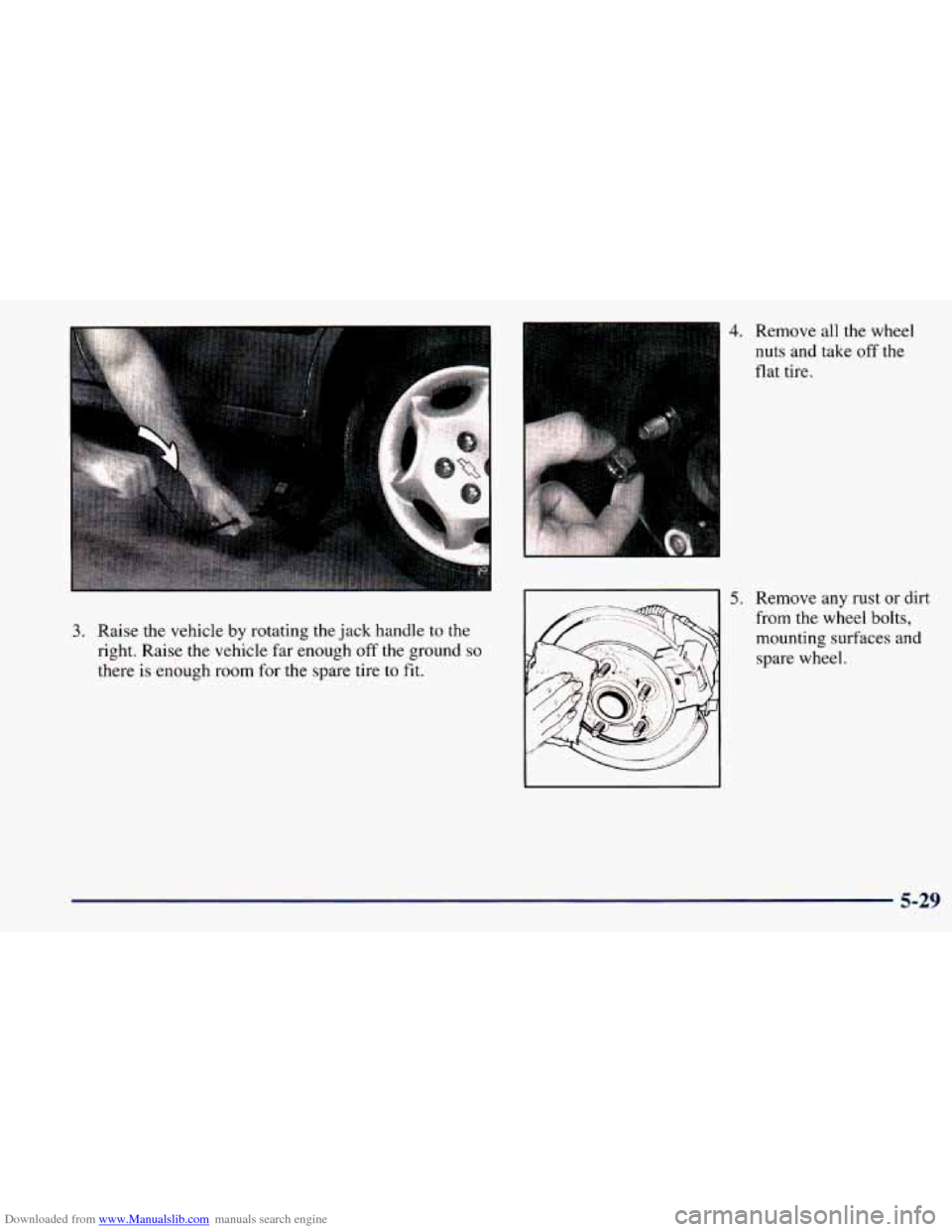
Downloaded from www.Manualslib.com manuals search engine 3. Raise the vehicle by rotating the jack handle to the
right. Raise
the vehicle far enough off the ground so
there is enough room for the spare tire to fit.
4. Remove all the wheel
nuts and take off the
flat tire.
5. Remove any rust or dirt
from the wheel bolts,
mounting surfaces and
spare wheel.
5-29
Page 222 of 364
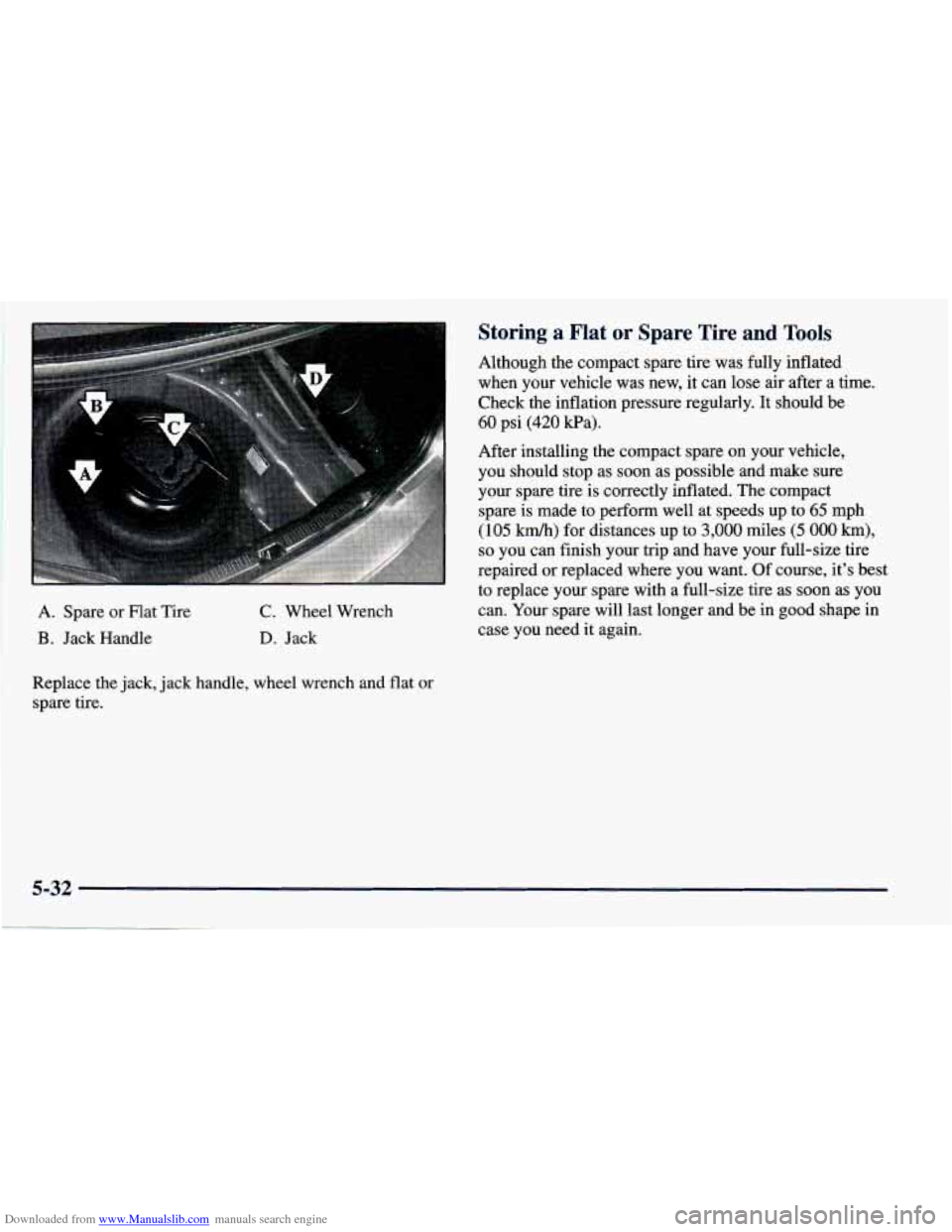
Downloaded from www.Manualslib.com manuals search engine A. Spare or Flat Tire
B. Jack Handle
C. Wheel Wrench
D. Jack
Replace the jack, jack handle, wheel wrench and flat or
spare tire.
Storing a Flat or Spare Tire and Tools
Although the compact spare tire was fully inflated
when your vehicle was new, it can lose air after a time.
Check the inflation pressure regularly. It should be 60 psi
(420 kPa).
After installing the compact spare on your vehicle, you should stop as soon as possible and make sure
your spare tire is correctly inflated. The compact spare is made to perform well at speeds up to 65 mph
(105
km/h) for distances up to 3,000 miles (5 000 km),
so you can finish your trip and have your full-size tire
repaired or replaced where you want. Of course, it’s best
to replace your spare with a full-size tire as soon
as you
can. Your spare will last longer and be in good shape in
case you need it again.
5-32
Page 223 of 364
Downloaded from www.Manualslib.com manuals search engine NOTICE:
Improperly tightened wheel nuts can lead to
brake pulsation and
rotor damage. To avoid
expensive brake repairs, evenly tighten the wheel
nuts in the proper sequence and to the proper
torque specification.
Don’t try to put a wheel cover on your compact spare
tire.
It won’t fit. Store the wheel cover in the trunk
until you have the flat tire repaired or replaced.
I NOTICE:
Wheel covers won’t fit on your compact spare.
If you try to put a wheel cover on your compact
spare, you could damage the cover or the spare. Storing
a jack, a tire
or other equipment in the
passenger compartment
of the vehicle could
cause injury. In a sudden stop
or collision, loose
equipment could strike someone. Store all these
in the proper place.
5-33
Page 224 of 364
Downloaded from www.Manualslib.com manuals search engine I NOTICE:
When the compact spare is installed, don’t take
your vehicle through an automatic car wash with
guide rails, The compact spare can get caught on
the rails. That can damage the tire and wheel,
and maybe other parts
of your vehicle.
Don’t use your compact spare on other vehicles.
And don’t
mix your compact spare tire or wheel with
other wheels or tires. They won’t fit. Keep your spare
tire and its wheel together.
NOTICE:
Tire chains won’t fit your compact spare. Using
them can damage your vehicle and can damage
the chains too. Don’t use tire chains on your
compact spare.
If You’re Stuck: In Sand, Mud,
Ice or Snow
What you don’t want to do when your vehicle is stuck
is to spin your wheels too fast. The method known
as
“rocking” can help you get out when you’re stuck, but
you must use caution.
If you let your tires spin at high speed, they can
explode, and you
or others could be injured. And,
the transaxle or other parts
of the vehicle can
overheat. That could cause an engine
compartment fire or other damage. When you’re
stuck, spin the wheels
as little as possible. Don’t
spin the wheels above
35 mph (55 km/h) as shown
on the speedometer.
5-34