1998 CHEVROLET MALIBU tow
[x] Cancel search: towPage 104 of 362
Downloaded from www.Manualslib.com manuals search engine If the ignition has been off for less than two minutes,
the lamps inside your vehicle will stay
on for about
15 seconds after your key is removed from the ignition
to provide an illuminated exit.
Mirror Reading Lamps (If Equipped)
Press the switch on the lower front portion of the mirror
to turn on the lamp. Press the other side of the switch to
turn the lamp
off.
Three-Position Dome Lamp
The switch on this lamp has three positions. The ON
position will turn on the light. The DOOR position will
turn on the light whenever a door is opened. The OFF
position will shut
off the lamp completely, even when a
door is opened.
Trunk Lamp
The trunk lamp comes on when you open your trunk.
Battery Saver
Your vehicle is equipped with a battery saver feat ;
designed to protect your vehicle’s battery. When any interior
lamp (trunk, reading, footwell or
glove box) is left on when the ignition is turned
off, the
battery saver system will automatically shut the lamp off
after
20 minutes. This will avoid draining the battery.
LO reactivate the interior lamps, either:
0 The ignition must be turned on,
0 The activated lamp switch must be turned off and
then on or
0 A door must be opened.
The battery saver feature will also be activated when
any door
of your vehicle is left open.
Mirrors
Inside Daymight Rearview Mirror
This mirror can be adjusted two ways. First, to adjust
the angle
of the mirror, move the mirror to a position
that allows you see to out the back window.
To adjust
the height of the mirror, adjust the arm that connects the
mirror to the windshield.
To reduce glare from lights behind you, move the lever
toward you to the night position.
Page 118 of 362
Downloaded from www.Manualslib.com manuals search engine If the light and chime come on while you are driving,
pull off the road and stop carefully. You may notice that
the pedal is harder to push.
Or, the pedal may go closer
to the floor.
It may take longer to stop. If the light is still
on, have the vehicle towed for service. (See “Towing
Your Vehicle” in the Index.)
Your brake system may not be working properly
if the brake system warning light
is on. Driving
with the brake system warning light on can lead
to an accident.
If the light is still on after you’ve
pulled
off the road and stopped carefully, have
the vehicle towed for service.
When the ignition is on, the brake system warning light
will also come on when you set your parking brake. The
light will stay on if your parking brake doesn’t release
fully. If it stays on after your parking brake is fully
released, it means you have a brake problem.
Anti-Lock Brake System Warning Light
With the anti-lock brake
system, this light will come
on when you turn your
ignition on
or start your
engine and it will stay
on for three seconds.
That’s normal.
If the light stays on, turn the ignition to OFF. Or, if the
light comes on and the chime sounds when you’re driving,
stop
as soon as possible and turn the ignition off. Then
start the engine again to reset the system. If the light still
stays on, or comes on again while you’re driving, your
vehicle needs service.
If the regular brake system warning
light isn’t
on, you still have brakes, but you don’t have
anti-lock brakes.
If the regular brake system warning light
is
also on, you don’t have anti-lock brakes and there’s a
problem with
your regular brakes. See “Brake System
Warning Light” earlier in this section.
The anti-lock brake system warning light should come
on briefly when you turn the ignition key
to ON. If the
light doesn’t come on then, have it fixed
so it will be
ready to warn you
if there is a problem.
Page 121 of 362
Downloaded from www.Manualslib.com manuals search engine This light should come on, as a check to show you it is
working, when the ignition is on and the engine is not
running. If the light doesn’t come on, have it repaired.
This light will also come on during a malfunction in one
of two ways:
0
0 Light Flashing -- A misfire condition has been
detected.
A misfire increases vehicle emissions and
may damage the emission control system
on your
vehicle. Dealer or qualified service center diagnosis
and service may be required.
Light On Steady -- An emission control system
malfunction has been detected on your vehicle.
Dealer or qualified service center diagnosis and service may be required.
If the Light Is Flashing
The following may prevent more serious damage to
your vehicle:
0 Reducing vehicle speed.
Avoiding hard accelerations.
0 Avoiding steep uphill grades.
0 If you are towing a trailer, reduce the amount of
cargo being hauled as soon as
it is possible. If
the light stops flashing and
remains on steady, see “If
the Light Is On Steady” following.
If the light continues to flash, when it is safe to do so,
stop the vehicle. Find a safe place to park your vehicle.
Turn the key
off, wait at least 10 seconds and restart the
engine. If the light remains on steady, see “If the Light
Is On Steady” following. If the light is still flashing,
follow the previous steps, and drive the vehicle to your
dealer or qualified service center for service.
If the Light Is On Steady
You may be able to correct the emission system
malfunction by considering the following:
Did you recently put fuel into your vehicle?
If
so, reinstall the fuel cap, making sure to fully install
the cap. The diagnostic system can determine if the fuel
cap has been left
off or improperly installed. A loose or
missing fuel cap will allow fuel to evaporate into the
atmosphere. A few driving trips with the cap properly
installed should turn the light off.
Did you just drive through a deep puddle of water?
If so, your electrical system may be wet. The condition
will usually be corrected when the electrical system
dries out.
A few driving trips should turn the light off.
Page 131 of 362
Downloaded from www.Manualslib.com manuals search engine For quick cool-down on very hot days, use vent with the
temperature knob
all the way in the blue area and the
NC and recirculation buttons pressed. If this setting is
used for long periods of time, the air in your vehicle
may become too dry.
For normal cooling on hot days, use vent with the
temperature knob
in the blue area and the A/C button
pushed
in. The system will bring in outside air and cool it.
Heating
On cold days, use FLOOR and the outside air button
with the temperature knob all the way in the red area.
The system will bring in outside air, heat it and send it to
the floor outlets.
Your vehicle has heat ducts that are directed toward
the rear seat. Keep the area under the front seats clear
of obstructions
so the heated air can reach the rear
seat passengers.
If your vehicle has an engine coolant heater, you can
use it to help your system provide warm air faster when
it’s cold outside (0°F (-18°C) or lower). An engine
coolant heater wms the coolant your engine and
heating system uses to provide heat. See “Engine
Coolant Heater” in the Index.
Defogging and Defrosting Windows
Your system has two settings for clearing the front and
side windows. For each setting, adjust the temperature
control as desired.
To defrost the front window quickly, rotate the
temperature control knob all the way in the red area.
Use defrost and adjust the fan to the highest speed.
To warm passengers while keeping the front window
clean, use defog.
Your vehicle is equipped with side window defogger
vents. The side window defogger vents are located on
the outside of the side instrument panel vents.
To defrost
the side windows, rotate the temperature control knob
all
the way in the red area. Use FLOOR and adjust the
fan to the highest speed.
To control fogging of the
windows, rotate the temperature control knob all the
way in the red area. Use DEFOG and adjust the fan to
the highest speed.
To defog the side windows while using air conditioning,
use BI-LEVEL and adjust the fan to the highest speed and press the
A/C button. For additional airflow to the
side windows, aim the side vents toward the windows
and close the center vents.
Recirculation will not work in defrost and defog. This is
done to prevent recirculation of humid inside air and
allow the system to work properly.
3-4
Page 152 of 362
Downloaded from www.Manualslib.com manuals search engine 0 Section 4 Your Driving and the Road
Here you’ll find information about driving on different kinds of roads and in varying weather conditions. We’ve also
included many other useful tips on driving.
4-2
4-3
4-6
4-6
4-9
4-11
4-12
4-13
4- 14
4- 16 Defensive
Driving
Drunken Driving
Control of a Vehicle
Braking Steering
Off-Road Recovery
Passing
Loss of Control
Driving at Night
Driving in Rain and on Wet Roads 4-
19
4-20
4-2 1
4-22 4-22
4-24
4-28
4-30
4-32 City Driving
Freeway Driving
Before Leaving on a Long
Trip
Highway Hypnosis
Hill and Mountain Roads
Winter Driving
Recreational Vehicle Towing Loading Your Vehicle
Towing a Trailer
Page 179 of 362
Downloaded from www.Manualslib.com manuals search engine Run your engine only as long as you must. This saves
fuel. When you
run the engine, make it go a little faster
than just idle. That
is, push the accelerator slightly. This
uses less fuel for the heat that you get and it keeps the
battery charged. You will need a well-charged battery to
restart the vehicle, and possibly for signaling later on
with your headlamps. Let the heater run for a while.
Then, shut the engine
off and close the window almost
all the way to preserve the heat. Start the engine again
and repeat this only when you feel really uncomfortable
from the cold. But do it as little as possible. Preserve the
fuel
as long as you can. To help keep warm, you can get
out of the vehicle and do some fairly vigorous exercises
every half hour or
so until help comes.
Recreational Vehicle Towing
You can tow your vehicle behind another vehicle for use
at your destination. Be sure to use the proper towing
equipment designed for recreational towing. Follow the
instructions for the towing equipment.
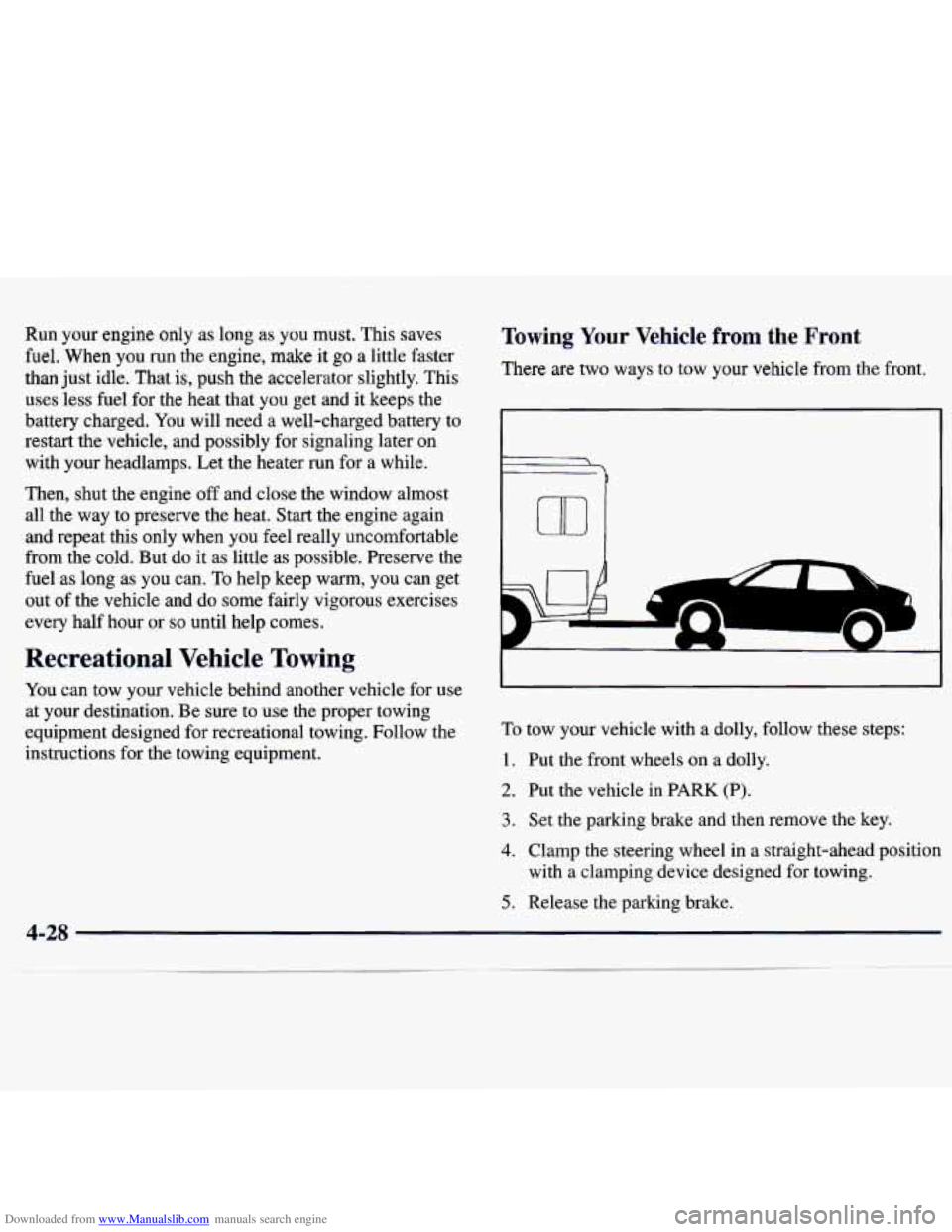
Towing Your Vehicle from the Front
There are two ways to tow your vehicle from the front,
To tow your vehicle with a dolly, follow these steps:
1. Put the front wheels on a dolly.
2. Put the vehicle in PARK (P).
3. Set the parking brake and then remove the key.
4. Clamp the steering wheel in a straight-ahead position
with
a clamping device designed for towing.
5. Release the parking brake.
Page 180 of 362
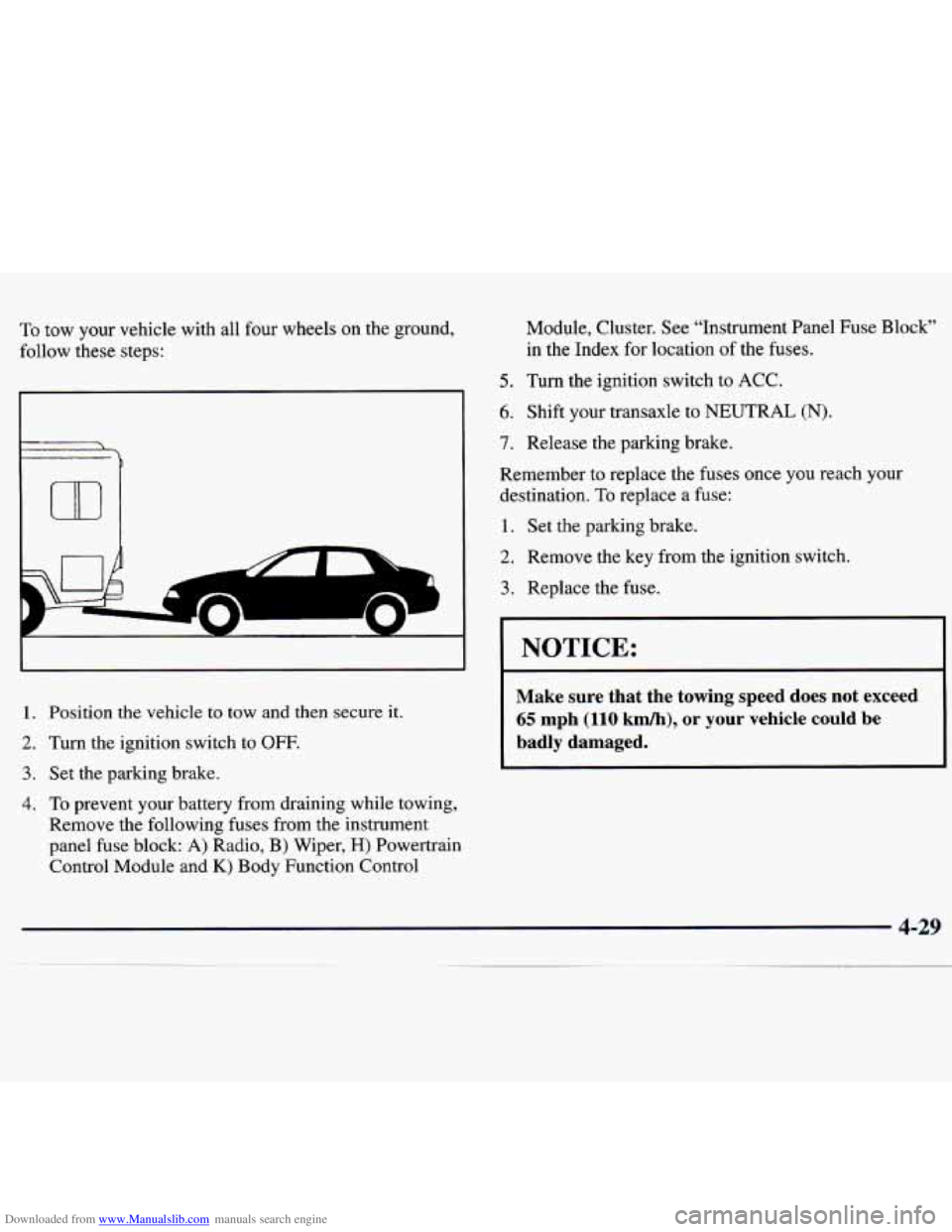
Downloaded from www.Manualslib.com manuals search engine To tow your vehicle with all four wheels on the ground,
follow these steps: Module,
Cluster. See “Instrument Panel Fuse Block”
in the Index for location of the fuses.
5. Turn the ignition switch to ACC.
6. Shift your transaxle to NEUTRAL (N).
7. Release the parking brake.
Remember to replace the fuses once you reach your
destination.
To replace a fuse:
1. Set the parking brake.
2. Remove the key from the ignition switch.
3. Replace the fuse.
I NOTICE:
1. Position the vehicle to tow and then secure it.
2. Turn the ignition switch to OFF.
3. Set the parking brake.
4. To prevent your battery from draining while towing,
Remove the following fuses from the instrument
panel fuse block: A) Radio,
B) Wiper, H) Powertrain
Control Module and
K) Body Function Control
Make sure that the towing speed does not exceed
65 mph (110 km/h), or your vehicle could be
badly damaged.
Page 181 of 362
Downloaded from www.Manualslib.com manuals search engine Towing Your Vehicle from the Rear
I NOTICE:
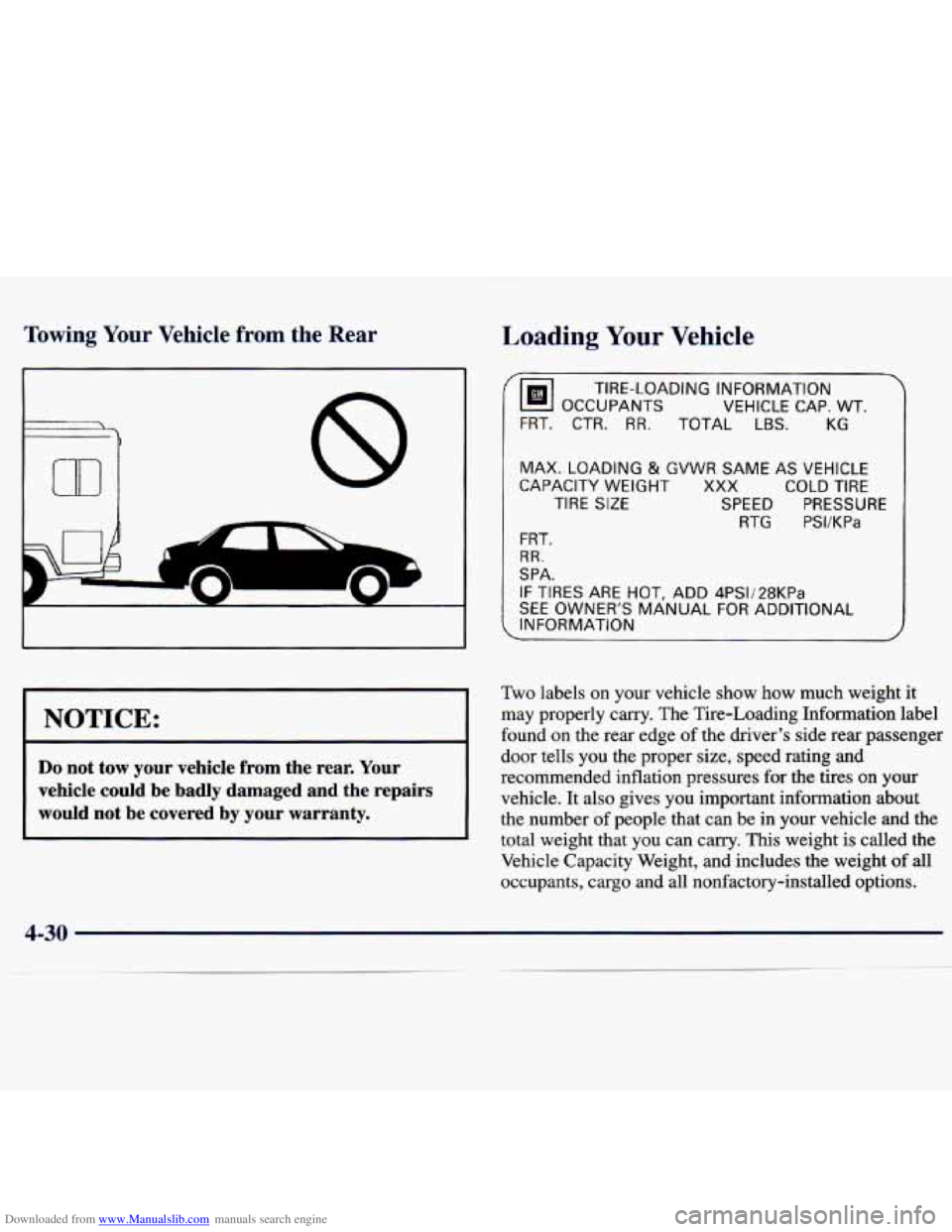
Do not tow your vehicle from the rear. Your
vehicle could be badly damaged and the repairs
would not be covered by your warranty.
Loading Your Vehicle
i"
TIRE-LOADING INFORMATION
OCCUPANTS
VEHICLE CAP. WT.
FRT, CTR. RR. TOTAL LBS. KG
MAX. LOADING & GVWR SAME AS VEHICLE
CAPACITY
WEIGHT XXX COLD TIRE
TIRE SIZE SPEED PRESSURE
RTG PSI/KPa
FRT.
RR.
SPA.
IF TIRES ARE HOT, ADD 4PSIi28KPa
SEE OWNER'S MANUAL FOR ADDITIONAL
, INFORMATION
Two labels on your vehicle show how much weight it
may properly carry. The Tire-Loading Information label
found on
the rear edge of the driver's side rear passenger
door tells you the proper size, speed rating and
recommended inflation pressures for the tires on your
vehicle. It also gives you important information about
the number
of people that can be in your vehicle and the
total weight that you can
carry. This weight is called the
Vehicle Capacity Weight, and includes the weight
of all
occupants, cargo and all nonfactory-installed options.
4-30