1998 CHEVROLET MALIBU fuel
[x] Cancel search: fuelPage 13 of 362
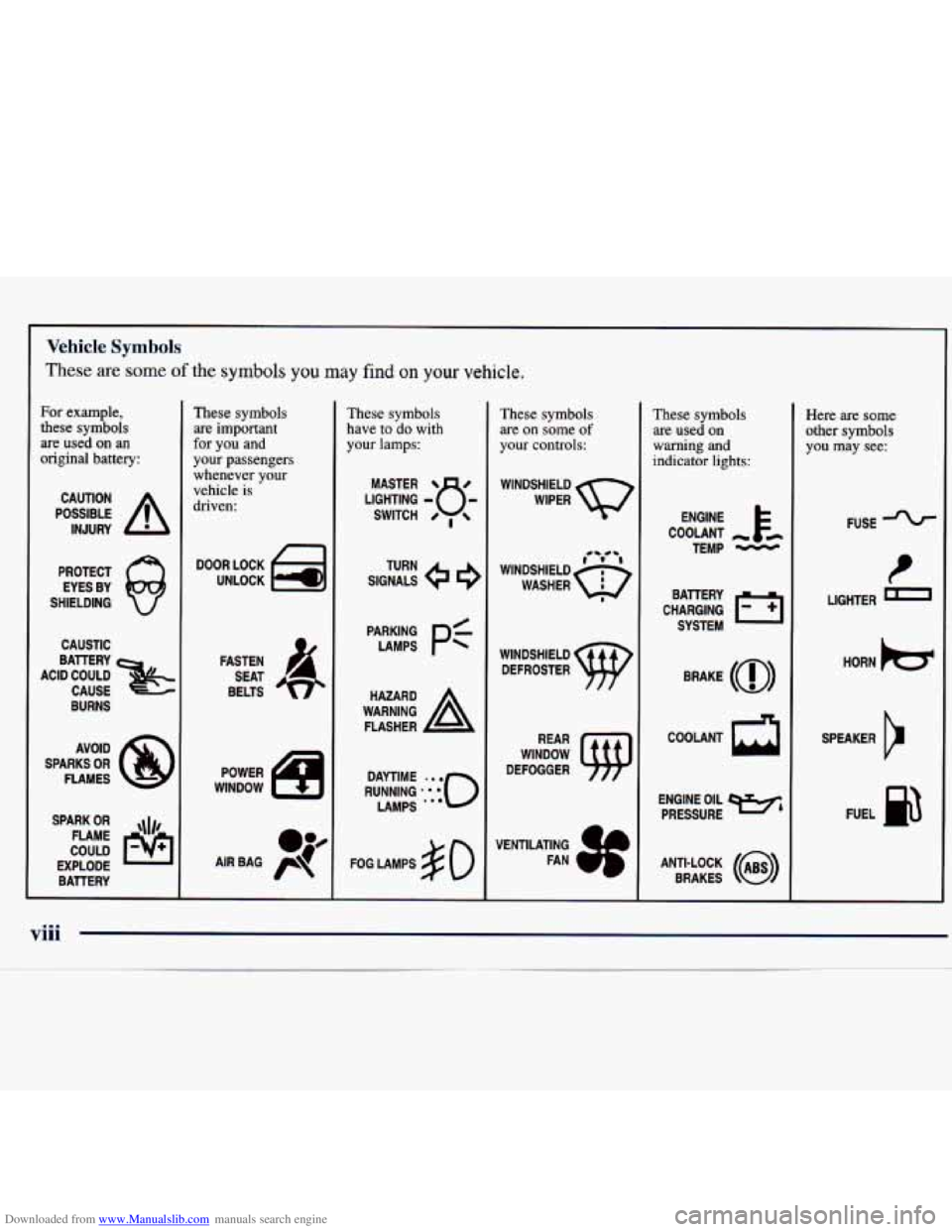
Downloaded from www.Manualslib.com manuals search engine For example,
these symbols
are used
on an
original battery:
POSSIBLE A
CAUTION
INJURY
PROTECT EYES BY
SHIELDING
CAUSTIC
BURNS AVOID
SPARKS
OR
FLAMES
SPARK
OR ,111,
COULD FLAME
EXPLODE BATTERY
These symbols are important
for you and
your passengers
whenever your vehicle is
driven:
n
FASTEN
SEAT
BELTS
These symbols have
to do with
your lamps:
SIGNALS e e
TURN
FOG LAMPS
$0
Vehicle Symbols
These are some of the symbols you may find on your vehicle.
-
These symbols
are
on some of
your controls:
WINDSHIELD
WIPER
WINDOW
DEFOGGER
These symbols are used on
warning and
indicator lights:
CHARGING 1-1
BATTERY
SYSTEM
BRAKE
(0)
R
ENGINE OIL e,
PRESSURE
ANTI-LOCK
(@)
BRAKES
Here are some
other symbols
you may see:
FUSE
LIGHTER
D
HORN )cr
SPEAKER
cr
FUEL p3
viii
Page 77 of 362
Downloaded from www.Manualslib.com manuals search engine Parking Lots Passlock@
If you park in a lot where someone will be watching
your vehicle, it’s best to lock it up and take your keys.
But what
if you have to leave your key?
0
0
0
0
0
0
If possible, park in a busy, well lit area.
Put your valuables in a storage area, like your
trunk or glove box. Be sure to close and lock
the
storage area.
Close all windows. Slide the remote trunk release lockout switch all the
way to the
OFF.
Lock the glove box.
Lock all the doors except the driver’s. Your
vehicle
is equipped with the Passlock
theft-deterrent system.
Passlock is a passive theft-deterrent system. The system
is armed once the key is removed from the ignition.
Passlock enables fuel if the ignition lock cylinder is
turned with
a valid key. If a correct key is not used, fuel
is disabled.
During normal operation, the THEFT SYSTEM light will go
off after the engine is started.
If the THEFT SYSTEM light flashes, wait until the light
stops flashing before starting the engine.
If the THEFT
SYSTEM light comes on while the engine
is running, a problem has been detected and the system
may need service. See your dealer for service.
In an emergency, call the Chevrolet Roadside Assistance
Center at 1-800-CHEV-USA
(1-800-243-8872). (In
Canada, call
1-800-268-6800.)
Page 82 of 362
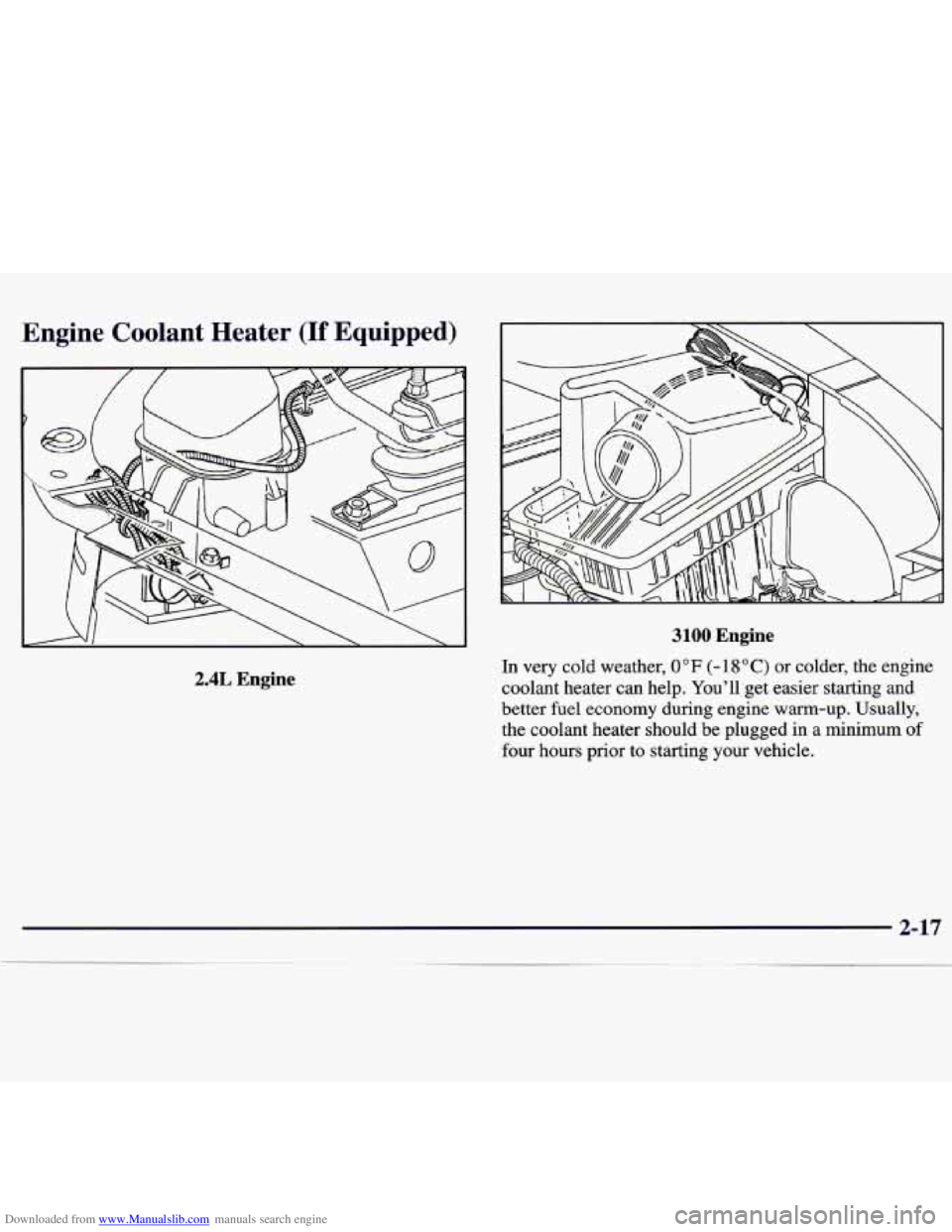
Downloaded from www.Manualslib.com manuals search engine Engine Coolant Heater (If Equipped)
2.4L Engine
3100 Engine
In very cold weather, 0 "F (- 18°C) or colder, the engine
coolant heater can help. You'll get easier starting and
better fuel economy during engine warm-up. Usually,
the coolant heater should be plugged in
a minimum of
four hours prior to starting your vehicle.
2-17
__
Page 86 of 362
Downloaded from www.Manualslib.com manuals search engine THIRD (3): This position is also used for normal
driving, however, it offers more power and lower fuel
economy than AUTOMATIC
OVERDRIVE (D). Here
are some times you might choose THIRD
(3) instead of
AUTOMATIC OVERDRIVE
(D):
0 When driving on hilly, winding roads.
When towing a trailer, so there is less shifting
When going down a steep hill.
SECOND
(2): This position gives you more power but
lower fuel economy.
You can use SECOND (2) on hills.
It can help control your speed as you
go down steep
mountain roads, but then you would also want to use
your brakes
off and on.
between gears.
NOTICE:
Don’t
drive in SECOND (2) for more than 25 miles
(41 km), or at speeds over 55 mph (88 km/h), or
you can damage your transaxle. Use AUTOMATIC
OVERDRIVE @) or THIRD (3) as much as
possible. Don’t shift into SECOND (2) unless you
are going slower than 65 mph (105 km/h) or you
can damage your engine. FIRST
(1): This
position gives you even more power
(but lower fuel economy) than
SECOND (2). You can
use it on very steep hills, or
in deep snow or mud.
If the selector lever is put in FIRST
(I), the transaxle
won’t shift into first gear until the vehicle is going
slowly enough.
I
NOTICE:
If your front wheels can’t rotate, don’t try to
drive. This might happen if you were stuck in
very deep sand or mud
or were up against a solid
object. You can damage your transaxle.
Also, if you stop when going uphill, don’t hold
your vehicle there with only the accelerator
pedal. This could overheat and damage the
transaxle. Use your brakes or shift into
PARK (P)
to hold your vehicle in position on a hill.
2-21
Page 102 of 362
Downloaded from www.Manualslib.com manuals search engine Daytime Running Lamps
Daytime Running Lamps (DRL) can make it easier for
others to see the front of your vehicle during the day.
DRL can be helpful in many different driving
conditions, but they can be especially helpful in the
short periods after dawn and before sunset.
Automatic Light Control (A I )
When it is dark enough outside, your Automatic Light
Control
(LC) will turn on your headlamps at the
normal brightness along with other lamps such as the
taillamps, sidemarker, park lamps and the instrument
panel lights. The radio lights will also be dim.
The
DJXL system will make your low-beam headlamps
come on at a reduced brightness when:
The ignition is on,
The headlamp switch is in the OFF position or you
have turned
on your parking lamps
The light sensor detects daytime light,
The parking brake is released and
The shift lever is not in PARK (P).
When the DRL system is on, the taillamps, sidemarker,
park lamps and instrument panel lights will not
be illuminated.
The DRL system will remain off any time your vehicle
is in PARK (P) or the parking brake is engaged.
As with any vehicle, you should turn on the regular
headlamp system when you need it. Your
vehicle is equipped with a light sensor on the top
of the instrument panel under the defroster grill,
so be
sure it is not covered which will cause the ALC system
to be on whenever the ignition is on.
The ALC system may also be on when driving through a
parking garage, heavy overcast weather,
a tunnel or
fueling your vehicle in a low light area. This is normal.
There is a delay in the transition between the daytime
and nighttime operation of the DRL and the
ALC
systems so that driving under bridges or bright overhead
street lights does not affect
the system. The DRL and
ALC systems will only be affected when the light sensor
sees a change in lighting lasting longer than this delay.
To idle your vehicle with the ALC system
off, set the
park brake while the ignition is
off. Then start the
vehicle. The ALC system will stay off until you release
the park brake.
As with any vehicle, you should turn on the regular
headlamp system when
you need it.
2-37
Page 112 of 362
Downloaded from www.Manualslib.com manuals search engine Your instrument panel is designed to let you know at a glance how your vehicle is running. You’ll know how fast
you’re going, how much fuel you’re using, and many other things you’ll need to drive \
safely and economically.
The main components
of your instrument panel are:
A. Instrument Panel Brightness Control
B. Fog Lamp Switch (If Equipped)
C. Turn SignaVMultifunction Lever
D. Cruise Control Switches (If Equipped)
E. Instrument Cluster
F. Windshield Wipermasher Lever
G. Ignition Switch
H. Hazard Switch
I. Fuse Panel
J. Climate Control System
K. Accessory Power Outlet
L. Ashtray
M. Lighter
N. Audio System
0. Horn
P. Park Pedal
Q. Tilt Wheel Lever
R. Hood Release Lever
S. Remote Trunk Release Switch
T. Instrument Panel Cupholder
Page 120 of 362

Downloaded from www.Manualslib.com manuals search engine Malfunction Indicator Lamp
(Check Engine Light)
CHECK
Your vehicle is equipped
with a computer which
monitors operation of the
fuel, ignition and emission
control systems.
This system
is called OBD I1 (On-Board
Diagnostics-Second Generation) and is intended to
assure that emissions
are at acceptable levels for the life
of the vehicle, helping to produce a cleaner
environment. The
CHECK ENGINE light comes on and
a chime will sound to indicate that there is a problem
and service is required, Malfunctions often will be
indicated by the system before any problem
is apparent.
This may prevent more serious damage to
your vehicle.
This system
is also designed to assist your service
technician in correctly diagnosing any malfunction.
NOTICE:
If you keep driving your vehicle with this light
on, after a while, your emission controls may not
work
as well, your fuel economy may not be as
good and your engine may not run as smoothly.
This could lead to costly repairs that may not be
covered by your warranty.
NOTICE:
Modifications made to the engine, transaxle,
exhaust or fuel system
of your vehicle or the
replacement of the original tires with other than
those
of the same Tire Performance Criteria
(TPC) can affect your vehicle’s emission
controls and may cause the light to come on.
Modifications to these systems could lead to
costly repairs not covered by your warranty.
This may also result in a failure to pass
a
required Emission InspectiodMaintenance test.
Page 121 of 362
Downloaded from www.Manualslib.com manuals search engine This light should come on, as a check to show you it is
working, when the ignition is on and the engine is not
running. If the light doesn’t come on, have it repaired.
This light will also come on during a malfunction in one
of two ways:
0
0 Light Flashing -- A misfire condition has been
detected.
A misfire increases vehicle emissions and
may damage the emission control system
on your
vehicle. Dealer or qualified service center diagnosis
and service may be required.
Light On Steady -- An emission control system
malfunction has been detected on your vehicle.
Dealer or qualified service center diagnosis and service may be required.
If the Light Is Flashing
The following may prevent more serious damage to
your vehicle:
0 Reducing vehicle speed.
Avoiding hard accelerations.
0 Avoiding steep uphill grades.
0 If you are towing a trailer, reduce the amount of
cargo being hauled as soon as
it is possible. If
the light stops flashing and
remains on steady, see “If
the Light Is On Steady” following.
If the light continues to flash, when it is safe to do so,
stop the vehicle. Find a safe place to park your vehicle.
Turn the key
off, wait at least 10 seconds and restart the
engine. If the light remains on steady, see “If the Light
Is On Steady” following. If the light is still flashing,
follow the previous steps, and drive the vehicle to your
dealer or qualified service center for service.
If the Light Is On Steady
You may be able to correct the emission system
malfunction by considering the following:
Did you recently put fuel into your vehicle?
If
so, reinstall the fuel cap, making sure to fully install
the cap. The diagnostic system can determine if the fuel
cap has been left
off or improperly installed. A loose or
missing fuel cap will allow fuel to evaporate into the
atmosphere. A few driving trips with the cap properly
installed should turn the light off.
Did you just drive through a deep puddle of water?
If so, your electrical system may be wet. The condition
will usually be corrected when the electrical system
dries out.
A few driving trips should turn the light off.