Page 171 of 362
Downloaded from www.Manualslib.com manuals search engine Freeway Driving
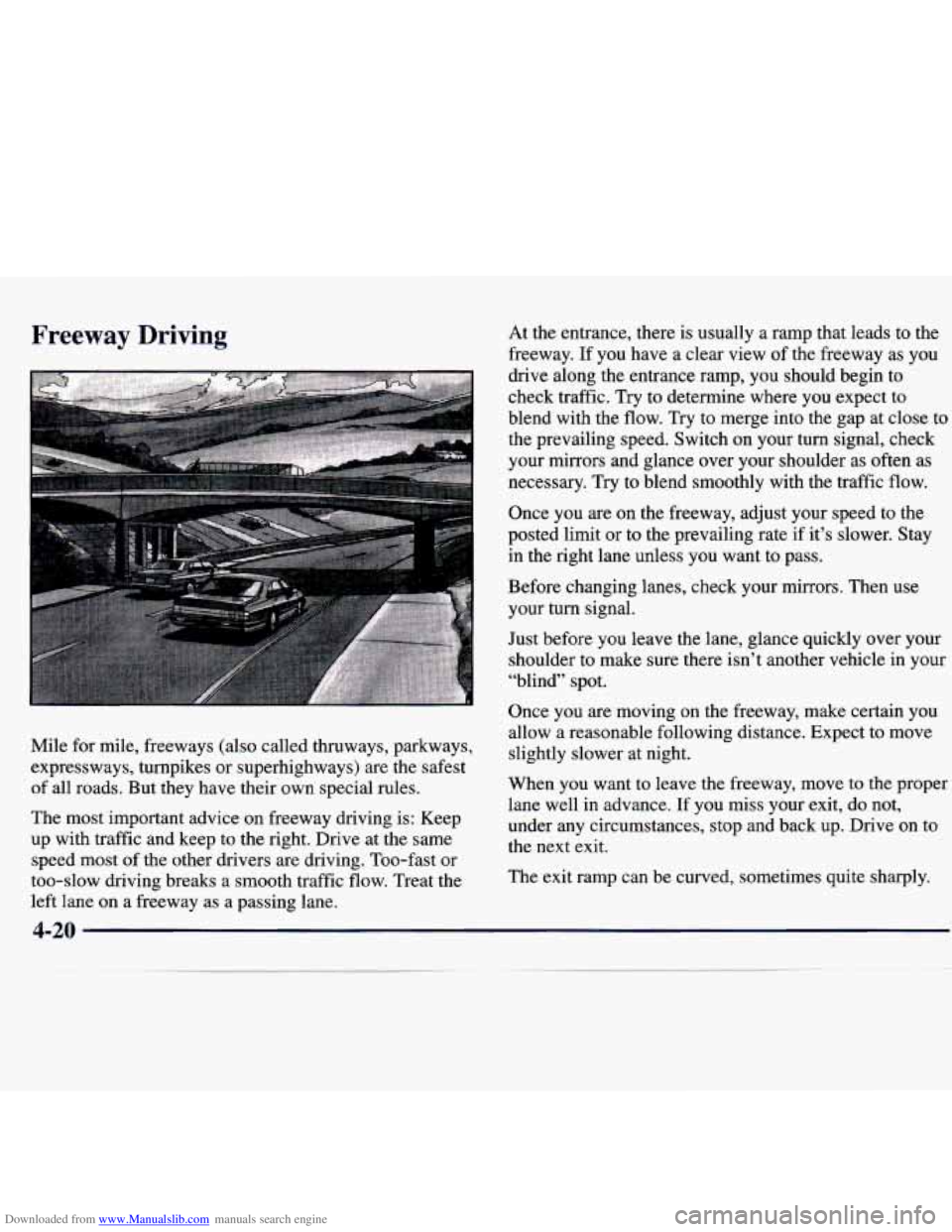
Mile for mile, freeways (also called thruways, parkways,
expressways, turnpikes or superhighways) are the safest
of all roads. But they have their own special rules.
The most important advice on freeway driving is: Keep
up with traffic and keep to the right. Drive at the same
speed most of the other drivers are driving. Too-fast or
too-slow driving breaks a smooth traffic flow. Treat the
left lane on a freeway
as a passing lane. At the entrance, there is usually
a ramp that leads to
the
freeway. If you have a clear view
of the freeway as you
drive along the entrance ramp, you should begin to
check traffic.
Try to determine where you expect to
blend with the flow. Try to merge into the gap at close to
the prevailing speed. Switch on your turn signal, check
your mirrors and glance over your shoulder as often as
necessary. Try to blend smoothly with the traffic flow.
Once you
are on the freeway, adjust your speed to the
posted limit or to the prevailing rate
if it’s slower. Stay
in the right lane unless you want to pass.
Before changing lanes, check your mirrors. Then use your turn signal.
Just before you leave the lane, glance quickly over your shoulder to make sure there isn’t another vehicle in your
“blind” spot.
Once you are moving on the freeway, make certain you
allow a reasonable following distance. Expect to move
slightly slower at night.
When you want to leave the freeway, move to the proper lane well in advance.
If you miss your exit, do not,
under any circumstances, stop and back up. Drive on to
the next exit.
The exit ramp can be curved, sometimes quite sharply.
. I”
Page 188 of 362
Downloaded from www.Manualslib.com manuals search engine Following Distance
Stay at least twice as far behind the vehicle ahead as you
would when driving your vehicle without a trailer. This
can help you avoid situations that require heavy braking
and sudden turns.
Passing
You’ll need more passing distance up ahead when
you’re towing a trailer. And, because you’re
a good deal
longer, you’ll need to go much farther beyond the
passed vehicle before you can return to your lane.
Backing Up
Hold the bottom of the steering wheel with one hand.
Then, to move the trailer to the left, just move that hand
to the left.
To move the trailer to the right, move your
hand to the right. Always back up slowly and,
if
possible, have someone guide you.
Making Turns
I NOTICE: I
Making very sharp turns while trailering could
cause the trailer to come in contact with the
vehicle. Your vehicle could be damaged. Avoid
making very sharp turns while trailering.
When you’re turning with a trailer, make wider turns
than normal.
Do this so your trailer won’t strike soft
shoulders, curbs, road signs, trees or other objects.
Avoid jerky or sudden maneuvers. Signal well
in advance.
Page 189 of 362
Downloaded from www.Manualslib.com manuals search engine Turn Signals When Towing a Trailer
When you tow a trailer, your vehicle may need
additional wiring. Check with your dealer. The green
arrows on
your instrument panel will flash whenever
you signal a turn or lane change. Properly hooked up,
the trailer lamps will also flash, telling other drivers
you’re about to turn, change lanes
or stop.
When towing a trailer, the green arrows on your
instrument panel will flash for turns even
if the bulbs on
the trailer are burned out. Thus, you may think drivers
behind you are seeing your signal when they are not. It’s
important to check occasionally to be sure the trailer
bulbs are still working.
Driving On Grades
NOTICE:
Do not tow on steep continuous grades exceeding
6 miles (9.6 km). Extended, higher than normal
engine and transaxle temperatures may result and damage your vehicle. Frequent stops are
very important
to allow the engine and transaxle
to
cool.
Reduce speed and shift to a lower gear before you start
down a long
or steep downgrade. If you don’t shift
down, you might have to
use your brakes so much that
they would get hot and no longer work well.
On a long uphill grade, shift down and reduce your
speed to around
45 mph (70 km/h) to reduce the
possibility
of engine and transaxle overheating.
Pay attention to the engine coolant gage.
If the indicator
is in the red area, turn
off the air conditioning to reduce
engine load (see “Engine Overheating” in the Index).
Page 193 of 362
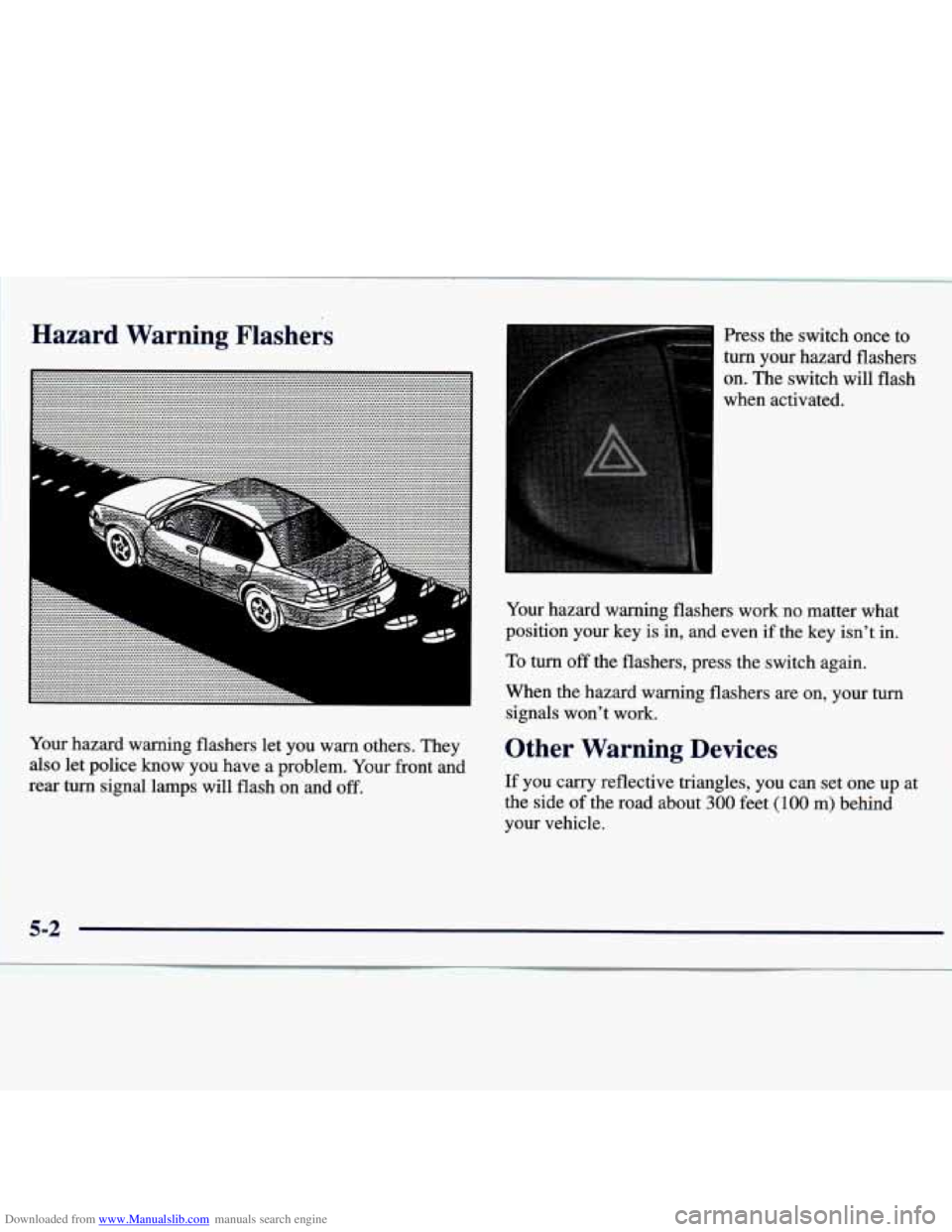
Downloaded from www.Manualslib.com manuals search engine Hazard Warning Flashers Press the switch once to
turn your hazard flashers
on. The switch will flash
when activated.
Your hazard warning flashers work no matter what
position your key is in, and even
if the key isn’t in.
Your hazard warning flashers let you warn others. They
also let police know you have a problem. Your front and
rear turn signal lamps will flash on and
off.
To turn off the flashers, press the switch again.
When the hazard warning flashers are on, your turn signals won’t work.
Other Warning Devices
If you carry reflective triangles, you can set one up at
the side
of the road about 300 feet (100 m) behind
your vehicle.
5-2
Page 256 of 362
Downloaded from www.Manualslib.com manuals search engine Bulb Replacement
This section describes bulb changing procedures for
some of your interior and exterior lamps. For bulb sizes,
see “Replacement Bulbs” in the Index. For any bulbs not
listed in this section, contact your Chevrolet dealer
service department.
Halogen Bulbs
A CAUTION
-- I
Halogen bulbs have pressurized gas inside and
can burst
if you drop or scratch the bulb. You or
others could be injured. Be sure to read and
follow the instructions on the bulb package.
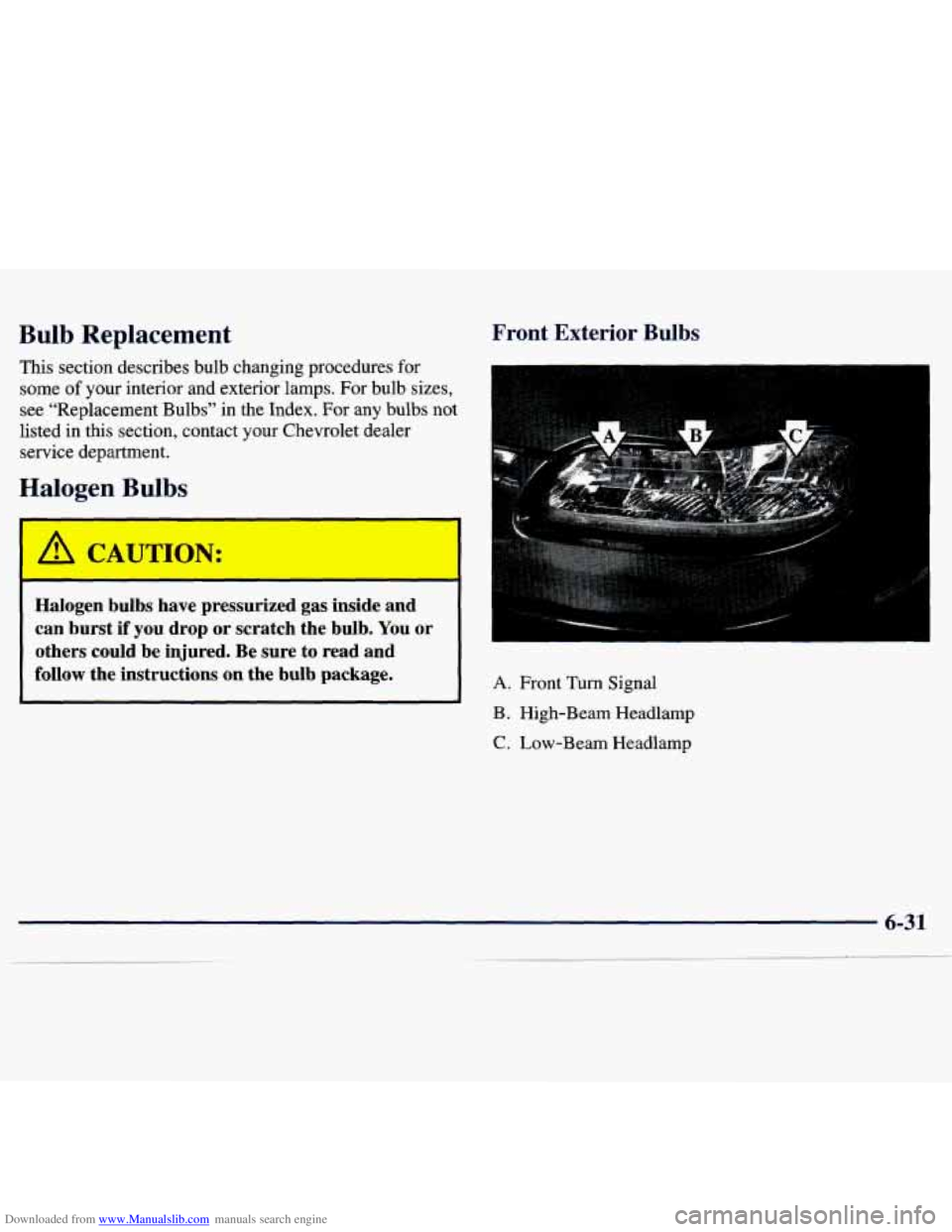
Front Exterior Bulbs
A. Front Turn Signal
B. High-Beam Headlamp
C. Low-Beam Headlamp
Page 257 of 362
Downloaded from www.Manualslib.com manuals search engine Headlamp and Front nrn Signal Lamp
Bulb Replacement
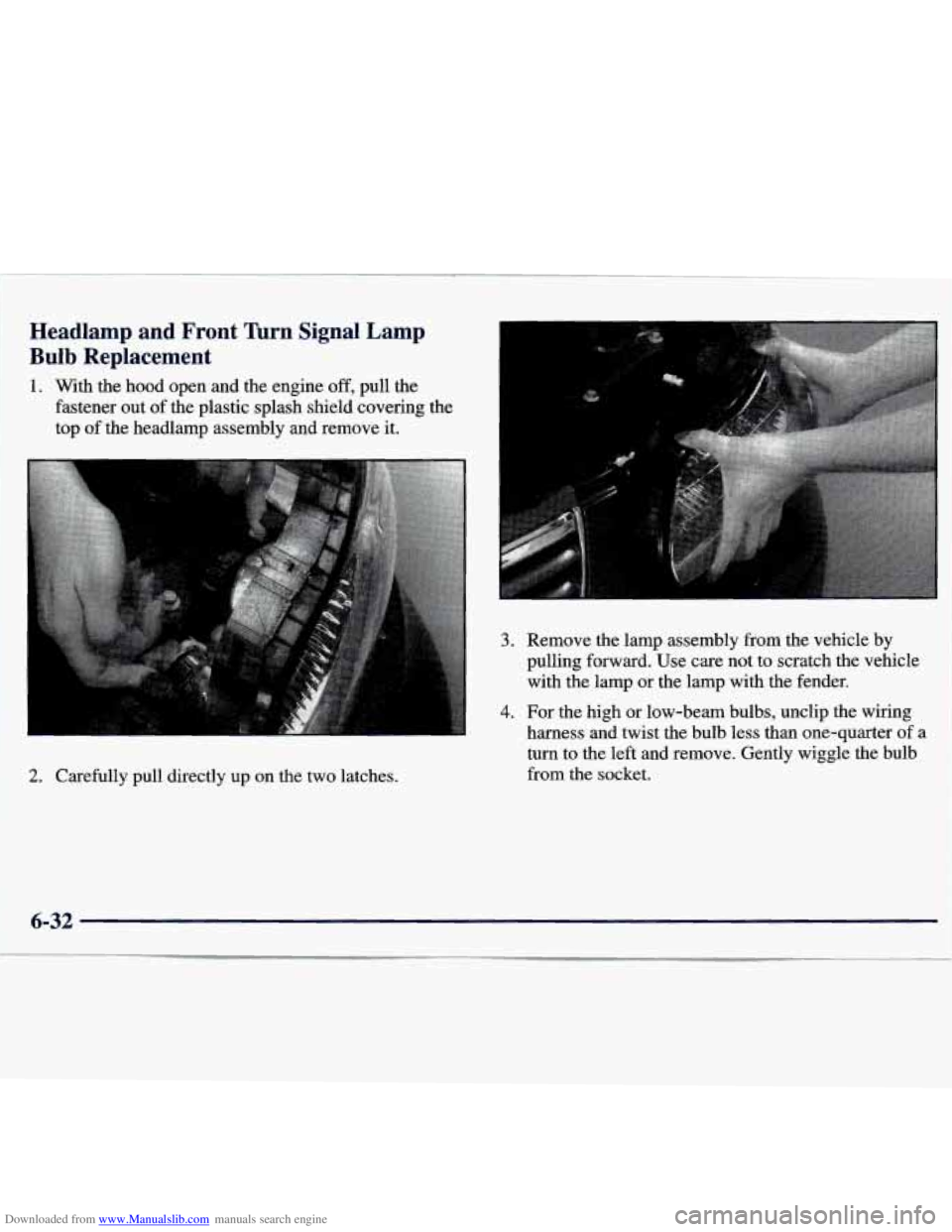
1. With the hood open and the engine off, pull the
fastener out of the plastic splash shield covering the
top of the headlamp assembly and remove it.
2. Carefully pull directly up on the two latches.
3. Remove the lamp assembly from the vehicle by
pulling forward. Use care not to scratch the vehicle
with the lamp or the lamp with the fender.
4. For the high or low-beam bulbs, unclip the wiring
harness
and twist the bulb less than one-quarter of a
turn to the left and remove. Gently wiggle the bulb
from the socket.
6-32
Page 258 of 362
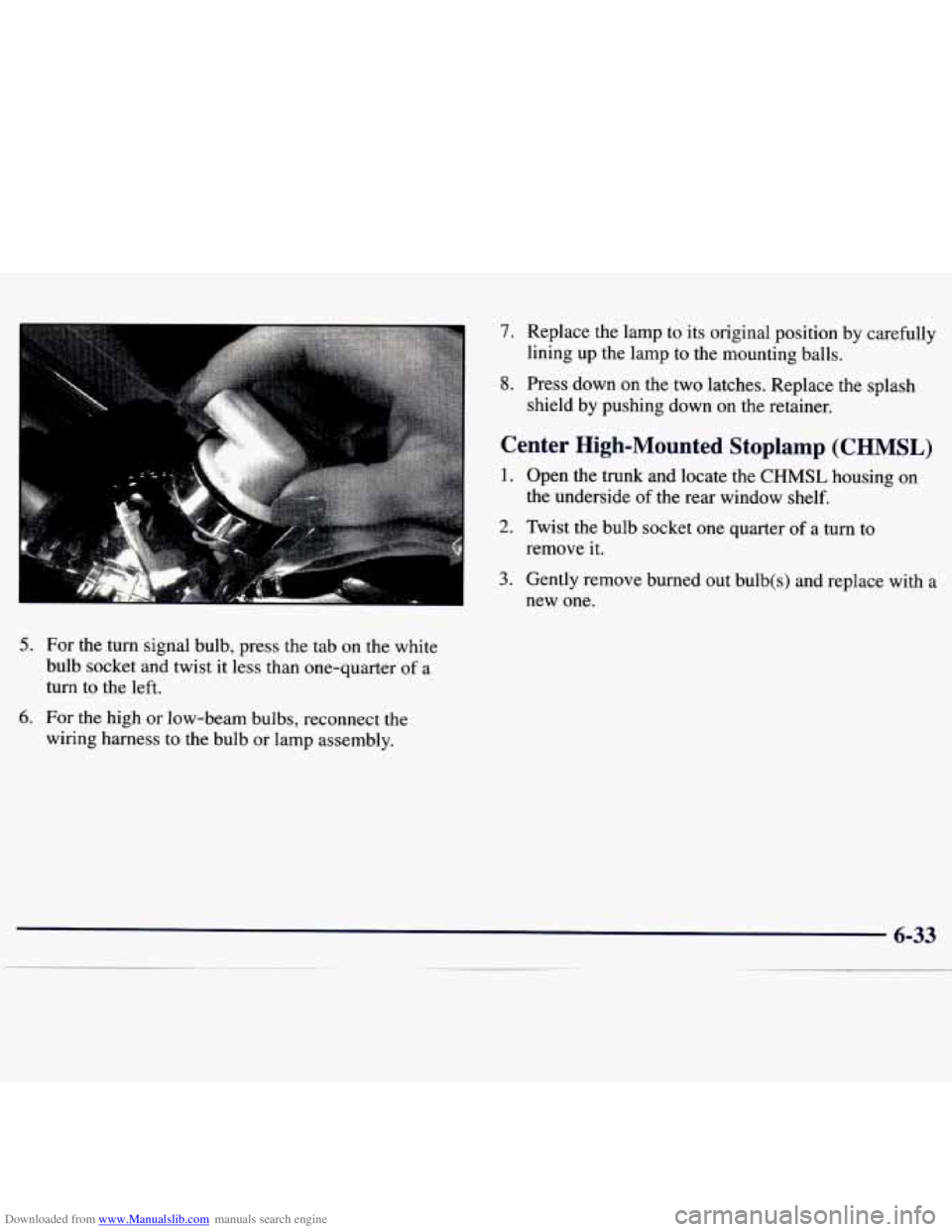
Downloaded from www.Manualslib.com manuals search engine 5. For the turn signal bulb, press the tab on the white
bulb socket and twist it less than one-quarter
of a
turn to the left.
6. For the high or low-beam bulbs, reconnect the
wiring harness to the bulb or lamp assembly.
7. Replace the lamp to its original position by carefully
lining up the lamp to the mounting balls.
8. Press down on the two latches. Replace the splash
shield by pushing down on the retainer.
Center High-Mounted Stoplamp (CHMSL)
1. Open the trunk and locate the CHMSL housing on
the underside of the rear window shelf.
2. Twist the bulb socket one quarter of a turn to
remove it.
3. Gently remove burned out bulb(s) and replace with a
new one.
Page 259 of 362
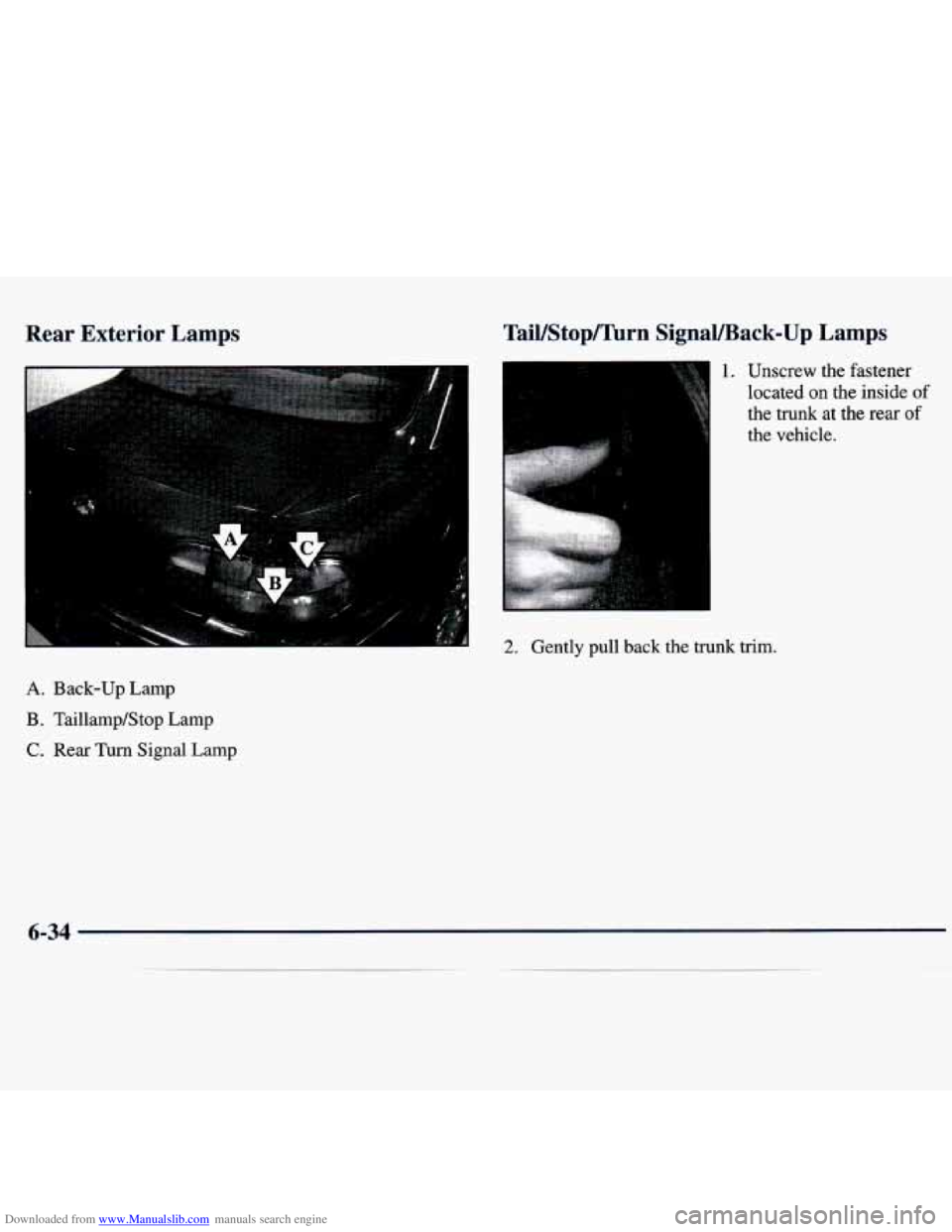
Downloaded from www.Manualslib.com manuals search engine Rear Exterior Lamps TaiYStopFIhrn SignaVBack-Up Lamps
1. Unscrew the fastener
located
on the inside of
the trunk at the rear
of
the vehicle.
2. Gently pull back the trunk trim.
A. Back-up Lamp
B . Taillamp/Stop Lamp
C. Rear Turn Signal Lamp
6-34