Page 14 of 362
Downloaded from www.Manualslib.com manuals search engine 0 Section 1 Seats and Seat Restraints
Here you’ll find information about the seats in your Chevrolet and how to use your safety belts properly. You can also
learn about some things you should not do with air bags and safety belts.
. -2
. -6
.-lo
.-11
.-11
.-19
. -20
. -20
. -27
Seats and Seat Controls
Safety Belts: They’re for Everyone
Here
Are Questions Many People Ask About
Safety Belts
-- and the Answers
How to Wear Safety Belts Properly
Driver Position
Safety Belt Use During Pregnancy
Right Front Passenger Position
Supplemental Restraint System
(SRS)
Rear Seat Passengers 1-30
1-32
1-34
1-37
1-49 1-52
1-52 1-52 Rear
Safety Belt Comfort Guides for Children
and Small Adults
Center Passenger Position
Children
Child Restraints
Larger Children Safety Belt Extender
Checking Your Restraint Systems
Replacing Restraint System Parts
After a Crash
1-1
Page 24 of 362
Downloaded from www.Manualslib.com manuals search engine e.’’ If I’m a good driver, and I never drive far from
A: You may be an excellent driver, but if you’re in an
home, why should I wear safety belts?
accident -- even one that isn’t your fault -- you and
your passengers can be hurt. Being
a good driver
doesn’t protect you from things beyond
your
control, such as bad drivers.
Most accidents occur within
25 miles (40 km) of
home. And the greatest number of serious injuries
and deaths occur at speeds of less than
40 mph
(65 km/h).
Safety belts are for everyone.
How to Wear Safety Belts Properly
Adults
This part is only for people of adult size.
Be aware that there
are special things to know about safety
belts and children. And there are different rules for smaller
children and babies.
If a child will be riding in your
vehicle, see the part of
this manual called “Children.”
Follow those rules for everyone’s protection.
First, you’ll want to know which restraint systems your
vehicle has.
We’ll start with the driver position.
Driver Position
This part describes the driver’s restraint system.
Lap-Shoulder Belt
The driver has a lap-shoulder belt. Here’s how to wear
it properly.
1. Close and lock the door.
2. Adjust the seat (to see how, see “Seats” in the Index)
so you can sit up straight.
Page 34 of 362
Downloaded from www.Manualslib.com manuals search engine ontinue
And, for unrestrained occupants, reduced-force
air bags may provide less protection in frontal
crashes than more forceful air bags have
provided in the past. Everyone in your vehicle should wear a safety belt properly
-- whether or
not there’s an air bag for that person.
Air bags inflate with great force, faster than the
blink of an eye.
If you’re too close to an inflating
air bag, it could seriously injure you. This is true
even with reduced-force frontal air bags. Safety
belts help keep you in position before and during
a crash. Always wear your safety belt, even with
reduced-force air bags. The driver should sit as
far back as possible while still maintaining
control of the vehicle.
A CAUTI-”:
I
-1 -
Children who are up against, or very close to, an
air bag when it inflates can be seriously injured
or killed. This is true even though your vehicle
has reduced-force frontal
air bags. Air bags plus
lap-shoulder belts offer the best protection for
adults and older children, but not for young
children and infants. Neither the vehicle’s safety
belt system nor its air bag system is designed for
them. Young children and infants need the
protection that a child restraint system can
provide. Always secure children properly in your
vehicle. To read how, see the part of this manual
called “Children” and see the caution labels on
the sunvisors and the right front passenger’s
safety belt.
1-21
Page 43 of 362
Downloaded from www.Manualslib.com manuals search engine To unlatch the belt, just push the button on the buckle.
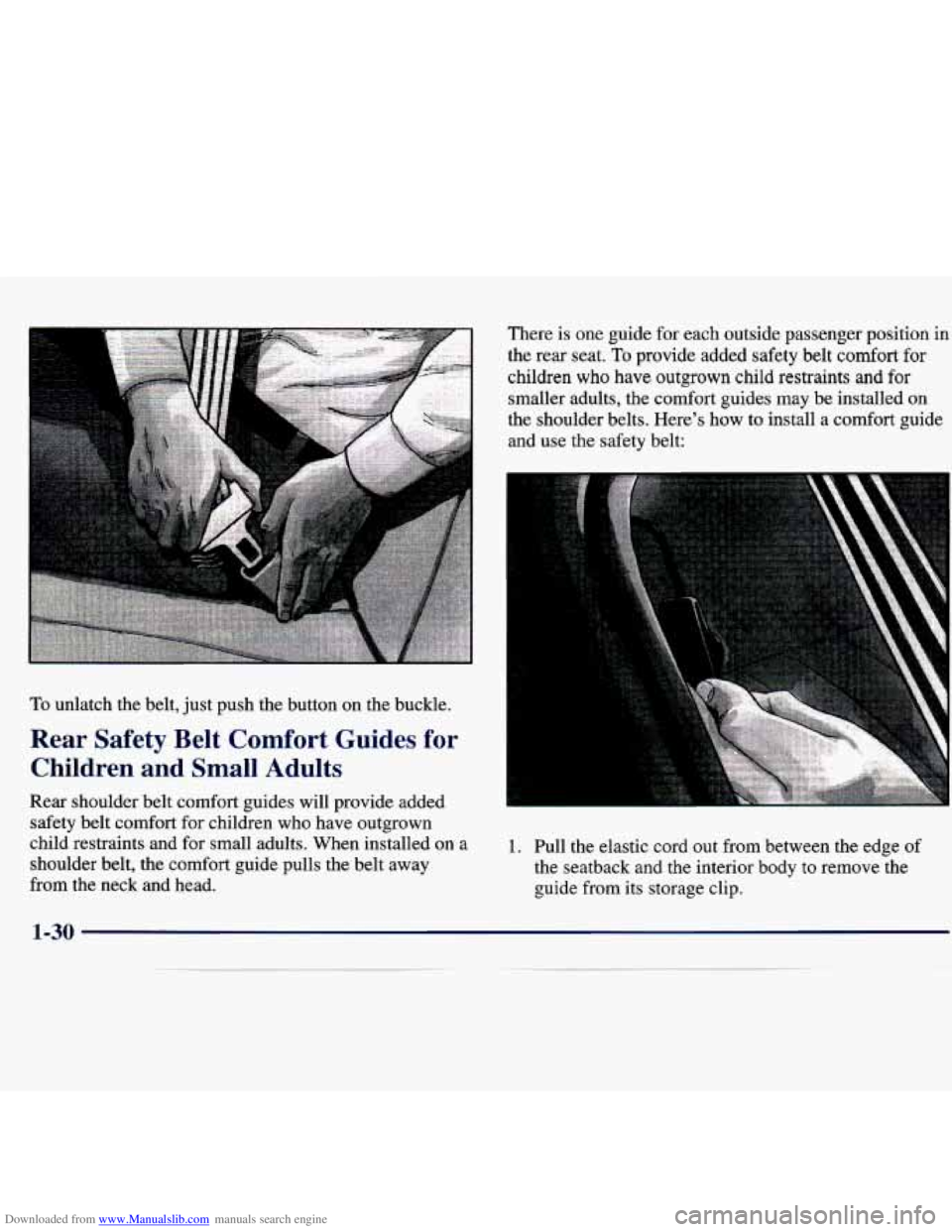
Rear Safety Belt Comfort Guides for
Children and Small Adults
Rear shoulder belt comfort guides will provide added
safety belt comfort for children who have outgrown
child restraints and for small adults. When installed on a
shoulder belt, the comfort guide pulls the belt away
from the neck and head. There
is one guide
for each outside passenger position in
the rear seat.
To provide added safety belt comfort for
children who have outgrown child restraints and for
smaller adults, the comfort guides
may be installed on
the shoulder belts. Here’s
how to install a comfort guide
and use the safety belt:
1. Pull the elastic cord out from between the edge of
the seatback and the interior body to remove the
guide from its storage clip.
Page 47 of 362
Downloaded from www.Manualslib.com manuals search engine Children Smaller Chil4ren md Babies
Everyone in a vehicle needs protection! That includes
infants and all children smaller than adult size. Neither
the distance traveled
nor the age and size of the traveler
changes the need, for everyone, to use safety restraints.
In fact, the law in every state in the United States and
in
every Canadian province says children up to some age
must be restrained
while in a vehicle.
/1 CAUTION:
1- -
Children who are up against, or very 4 se to, an
air bag when it inflates can be seriously injured
or killed. This is true even though your vehicle
has reduced-force frontal
air bags. Air bags plus
lap-shoulder belts
offer the best protection for
adults and older children, but not
for young
children and infants. Neither the vehicle’s safety
belt system nor its
air bag system is designed for
them. Young children and infants need the
protection that
a child restraint system can
provide. Always secure children properly in
your vehicle.
Page 48 of 362
Downloaded from www.Manualslib.com manuals search engine /I CAUTION:
Smaller children and babies should always be
restrained in a child or infant restraint. The
instructions for the restraint will say whether it is
the right type and size
for your child. A very
young child’s hip bones
are so small that a
regular belt might not
stay low on the hips, as it
should. Instead, the belt will likely be over the
child’s abdomen. In a crash, the belt would apply
force right on the child’s abdomen, which could
cause serious or fatal injuries.
So, be sure that
any child small enough for one is always properly
restrained in a child or infant restraint.
Infants need complete support, including support for the
head and neck. This is necessary because an infant’s
neck
is weak and its head weighs so much compared
with the rest of its body. In
a crash, an infant in a
rear-facing restraint settles into the restraint,
so the crash
forces can be distributed across the strongest part
of the
infant’s body, the back
and shoulders. A baby should be
secured in an appropriate infant restraint. This
is so
important that many hospitals today won’t release a
newborn infant to its parents unless there is an
infant restraint available for the baby’s first trip in a
motor vehicle.
1-35
Page 50 of 362
Downloaded from www.Manualslib.com manuals search engine Child Restraints
Every time infants and young children ride in
vehicles, they should have protection provided by
appropriate restraints.
What are the different types of add-on
child restraints?
A: Add-on child restraints are available in four basic
types. When selecting a child restraint, take into
consideration not only the child’s weight and size,
but also whether or not the restraint will be
compatible with the niotor vehicle in which it will
be used.
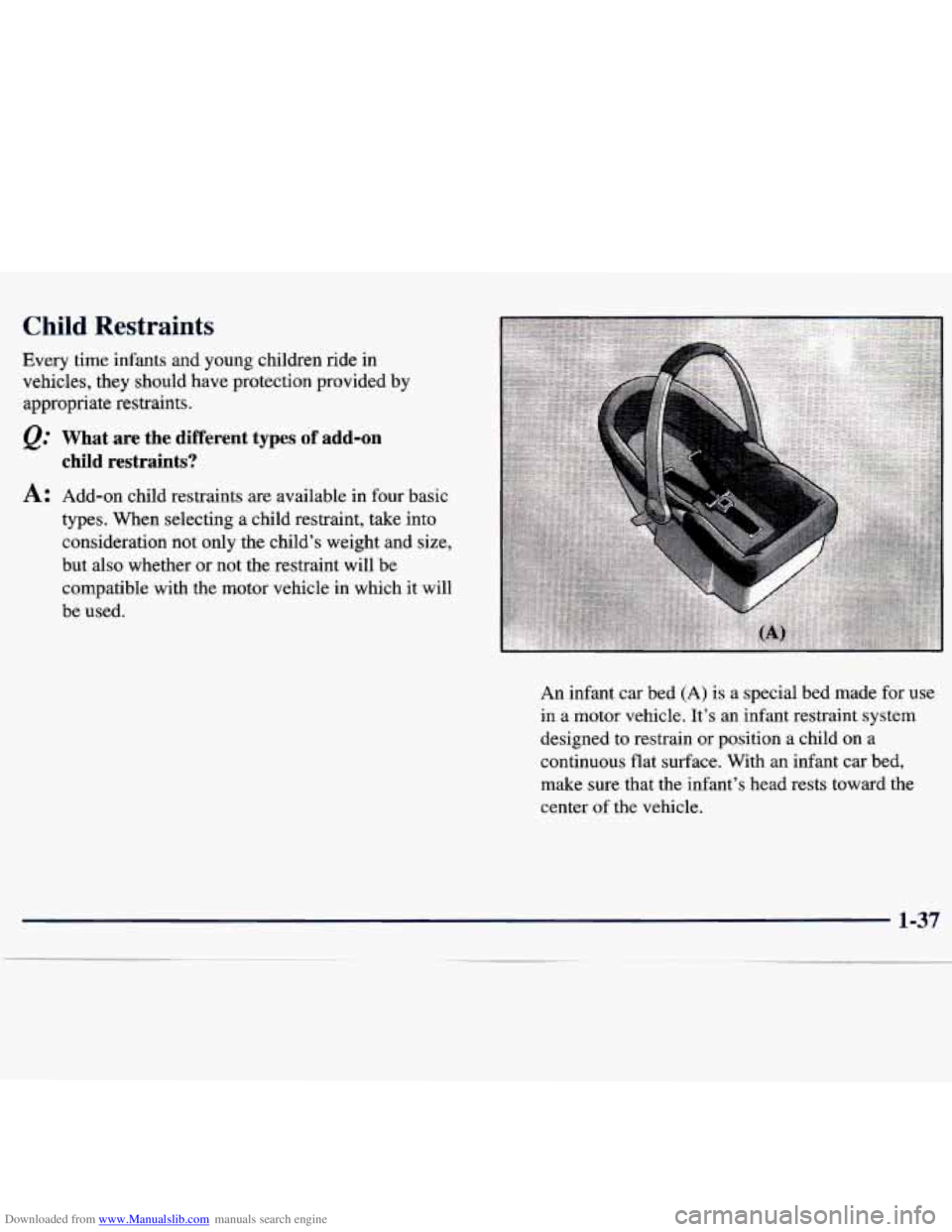
An infant car bed (A) is
a special bed made for use
in a motor vehicle. It’s an infant restraint system
designed to restrain or position a child on a
continuous flat surface. With an infant car bed, make sure that the infant’s head rests toward the
center of the vehicle.
1-37
Page 52 of 362
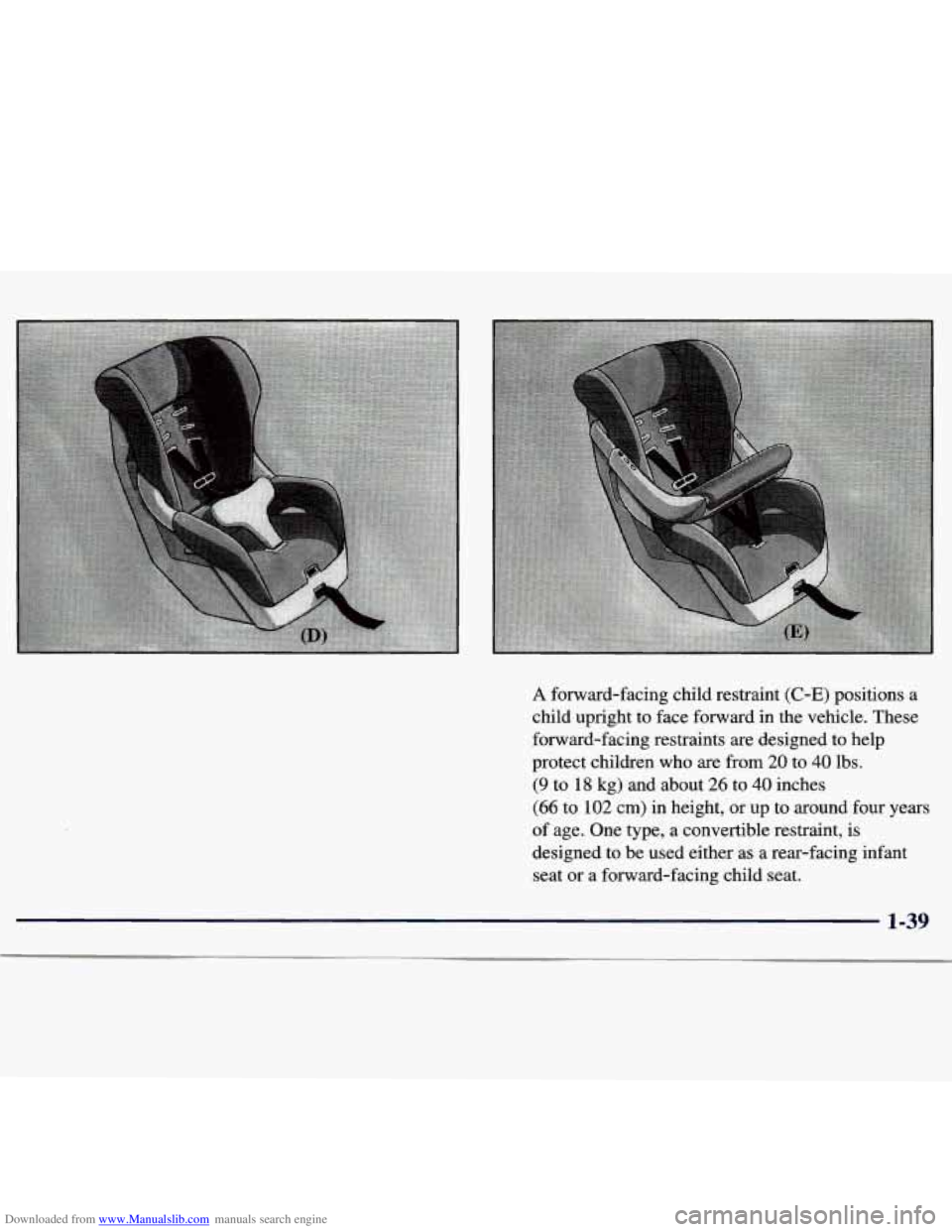
Downloaded from www.Manualslib.com manuals search engine A forward-facing child restraint (C-E) positions a
child upright to face forward in the vehicle. These
forward-facing restraints are designed to help
protect children who are from
20 to 40 lbs.
(9 to
18 kg) and about 26 to 40 inches
(66 to 102 cm) in height, or up to around four years
of age. One type, a convertible restraint, is
designed to be used either as a rear-facing infant
seat or a forward-facing child seat.
1-39